
SLIDE 1
C O L L E G I U M I N T E R N A T I O N A L
In Partnership with With the Support of
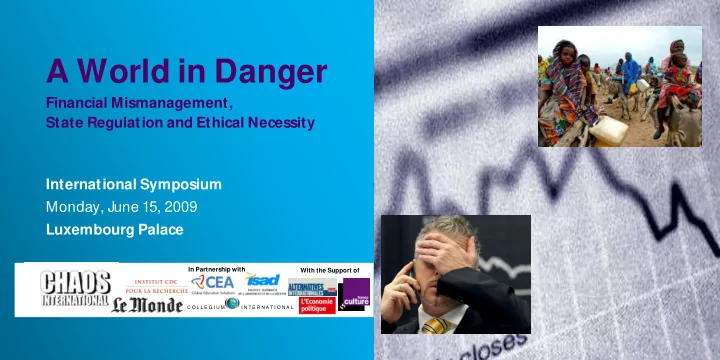
A World in Danger
Financial Mismanagement, State Regulation and Ethical Necessity International Symposium Monday, June 15, 2009 Luxembourg Palace
A World in Danger Financial Mismanagement, State Regulation and - - PowerPoint PPT Presentation
A World in Danger Financial Mismanagement, State Regulation and Ethical Necessity International Symposium Monday, June 15, 2009 Luxembourg Palace In Partnership with With the Support of I N T E R N A T I O N A L C O L L E G I U M Symposium
C O L L E G I U M I N T E R N A T I O N A L
In Partnership with With the Support of
Financial Mismanagement, State Regulation and Ethical Necessity International Symposium Monday, June 15, 2009 Luxembourg Palace
Simultaneous French-English Translation
9h15 Introduction
Professor of Political Science, University of Paris I, Panthéon-Sorbonne, Sciences Po Paris President of International Chaos
9h30 Round Table 1 10h45 The Empirical and Theoretical Framework 11h00 Round Table 2 12h30 Human Security in Peril 14h00 Round Table 3 15h15 The Political Constraints of Financial Interdependence 15h30 Round Table 4 –International Collegium 17h30 A Global Governance Based on Common Values ? 17h30 Conclusion & Closing Words Stéphane Hessel
Ambassador of France, Vice-President of International Collegium
Cicero
The financial earthquake that struck in 2008 created a credit crisis in world finance that has been both brutal and extreme, particularly given how much excessive borrowing has gone on these past years. These troubles struck first in the developed world, moved on to the developing world, before finally striking in the most impoverished states. Today, we all are confronted by a crisis of consi- derable magnitude and of unpredictable length. And it is a crisis that is truly global, both because all actors everywhere – both state and non-state – have been involved and because every aspect of human activity – economic, political, social, cultural, and environmental – has been affected. These factors require that we first reflect upon the
nisms now under threat so that we can build a meaningful framework of analysis.
9h30 Round Table 1 10h45 The Empirical and Theoretical Framework
Moderator Isabelle Laudier
Director of the CDC Research Institute
> André Cartapanis
Professor of Economics Institute of Political Studies of Aix-en-Provence
The Architects of the World Financial Crisis > Ronen Palan
Professor of International Political Economy, University of Birmingham
Functions and Opacity of Tax Havens > Philip G. Cerny
Professor of International Political Economy, Rutgers University of New Jersey
Crisis and Renewal: Saving Capitalism from the Capitalists > Michel Rainelli
Professor of Economics, University of Nice Sophia-Antipolis
Ethics: A Global Necessity
It was President Clinton who, during the November 1998 meeting of the G7, emphasized the supreme urgency
rings even more urgent. Indeed, over the last decade, globalization has hardly been synonymous with wide- spread shared growth or with a peaceful and unified world
reduce the stark inequalities of our world. As a result, countries and even entire regions were excluded from wealth redistribution policies or progres- sively marginalized, while others – like Brazil China and India –, experienced very strong growth. Similarly, even within developed economies, we are now witnessing levels
words of Robert Reich, “social secessionist” movements. What then is to become of existing social inequa- lities, of Nord-South and South-South cleavages at the very time world financial markets face a major crisis that threatens basic human security? Are the recent G20 declarations really up to the task of reconciling ethics and politics?
11h00 Round Table 2 12h30 Human Security in Peril
Moderator Antoine de Ravignan
Alternatives internationales
> Marc Abélès
Research Director, CNRS
Governance and the Stakes of Survival: The Emergence of World-Policy > Hélène Thomas
Professor of Political Science Institute of Political Science, Aix-en-Provence
From Financial Frenzy to Social Depression > Philippe Ryfman
Associate Professor of Political Science at the University of Paris I, Panthéon-Sorbonne, Member of Action Contre la Faim’s Board of Directors
Public Development Aid: Collapse or Rebound > Catherine Wihtol de Wenden
Research Director, CNRS
Towards an Intensification of Migrations Flows > Françoise Benhamou
Professor of Economics, University of Paris XIII
Crisis and Culture: Contrasted Effects
For several years now, the Bretton Woods institutions have shown themselves incapable of anticipating such financial crises, a sign of the fragility of a financial system founded upon wide-reaching deregulation. Hence, a great many experts today conclude that the structure of world financial governance should now be built. But this calls for a studied analysis of both America’s history of Exceptionalism and of the limitations of a model of post-war imperial governance that was designed to keep world finance under American control, if we are to believe Charles Kindleberger’s and Roberts Gilpin’s Theory of Hegemonic Stability. Currently, this model seems to have failed. Yet, when it comes to creating a model of world governance, opposing grand strategies quickly clash. Should states strive to develop stronger multilateral relations or should they, through the resolute abandonment of the very structure of their sovereignty, seek to build a supranational authority capable of imposing international financial regula- tion? The timely consensus put forward by the G20 delegates will not for long mask the political disagreements such a choice entails.
14h00 Table ronde 3 15h15 The Political Constraints of Financial Interdependence
Moderator Thierry Garcin
Associated Researcher at the University of Paris V and at the University Québec at Montréal, Producer in Radio France
> Scott Blair
Professor of History of International Relations, CEA Global Campus, University of New Haven
American Exceptionalism: Review and Prospects > Thomas Lindemann
Professor of Political Science, University of Artois, Sciences Po Paris
Opportunity for American Multilateralism > Ramon Torrent
Director of the WTO International Chair of Regional Integration, University of Barcelona
World Trade at the Crossroads of Protectionism and Multilateralism > Jean-Jacques Roche
Professor of Political Science, Director of the Institut Supérieur de l’Armement et de la Défense, University of Paris II
Confidence and Solidarity Between Cold Monsters
The recent crisis has given people the eye-opening experience of a laissez-faire system that in the end, gives a guarantee neither
fairness nor
social solidarity. Furthermore, the ongoing commercial insecurity and attendant bewilderment that has set in finds political leaders seemingly struck by theoretical paralysis as they grapple with this crisis. Indeed, the system itself contributes to just such uncertainty: the impossibility of anticipating the consequences of a myriad of individual and apparently erratic, atomized actions, in addition to the constant retreat of state authority and of her regulatory powers so much in evidence over these recent decades. With so much said today about the existence of the international community, it is a fitting moment to reexamine how we actually define the common values we so often evoke. Indeed, the suddenness of the crisis compels us to address the now urgent issue of our collective sustainable development, and this in a manner that faces both the logic and the systemic limitations of current global financial management. Without such realism, any talk of the shared heritage of global resources will be but empty rhetoric and will place our world in danger.
A public Appeal for the creation of an international political, ethical and scientific Collegium was made in New York in 2002 and its members were welcomed before the European Parliament in Brussels on April 2, 2003. The Collegium brings together political and intellectual leaders from the five continents. Confronted by the dangers threatening our planet, the Collegium group strives to generate new ideas and concrete actions in a context of sound ethics and political realism.
15h30 Table ronde 4 – Collegium International 17h30 A Global Governance Based on Common Values ?
Moderator Stéphane Hessel
Ambassador of France, Vice-President of the International Collegium
> Peter Sloterdijk
Philosopher, Rector of the Hochschule für Gestaltung, Karlsruhe
> René Passet
Emeritus Professor of Economics, University of Paris I, Panthéon-Sorbonne
> Ruth Dreifuss
Past President of the Swiss Confederation
> Michel Rocard
Past Prime Minister of the French Republic, President of the International Collegium In the presence of other members of the International Collegium
To participate in this Symposium
No later than 9 June 2009
Important Information Participants must sign-in at the Welcome desk
(Accueil) no later than 8:30 am.
Participants will be required to show a form of
identification in order to enter the Luxembourg Palace.
Location
Palais du Luxembourg – Salle Clemenceau 15 rue de Vaugirard – 75006 PARIS
Access
Metro > Lines 4 and 10, Odéon station RER > Line B, Luxembourg station Bus > Lines 58, 84, and 89, bus stop Sénat Car > 3 nearby parking garages (place Saint- Sulpice, rue de l'École de médecine and rue Soufflot)
Registration Form
Return by 9 June 2009 International Symposium, Monday, June 15, 2009
A World in Danger
Financial Mismanagement, State Regulation and Ethical Necessity
Salle Clemenceau – Palais du Luxembourg – 15 rue de Vaugirard - 75006 PARIS
Surname : …………………………………………………………………………………………… Given name : ……………………………………………………………………………………….. Profession : …………………………………………………………………………………………. Address : ……………………….………………………………………………........................... Postal Code : …………………………….City : ………….……………………………………….
E-mail address : …………………………………………………….………………………………
Will attend Will not intend and will be accompanied by ____ guest(s), please indicate full names and addresses
Chaos International 75 rue Leblanc 75015 PARIS Contacts
Simon Uzenat
General Secretary of International Chaos Phone +33.(0)6.17.71.88.71 E-mail colloque.1506@gmail.com Web Site www.chaos-international.org
Sacha Goldman
General Secretary of the International Collegium Phone +33.(0)6.22.11.93.49 E-mail info@collegium-international.org Web Site www.collegium-international.org Phone