A WORLD CLASS GREEN PORT CHALLENGE : ONSHORE POWER SUPPLY AND LNG - - PowerPoint PPT Presentation

a world class green port challenge
SMART_READER_LITE
LIVE PREVIEW

A WORLD CLASS GREEN PORT CHALLENGE : ONSHORE POWER SUPPLY AND LNG - - PowerPoint PPT Presentation

A WORLD CLASS GREEN PORT CHALLENGE : ONSHORE POWER SUPPLY AND LNG BUNKERING OPPORTUNITIES 2nd SMALL LNG SHIPPING AND DISTRIBUTION FORUM 2015 Bali, September 2015 FERIALDY NOERLAN Technical Director (Indonesia Port Corporation II) Energizing


slide-1
SLIDE 1

A WORLD CLASS GREEN PORT CHALLENGE :

ONSHORE POWER SUPPLY AND LNG BUNKERING OPPORTUNITIES

FERIALDY NOERLAN Technical Director

(Indonesia Port Corporation II)
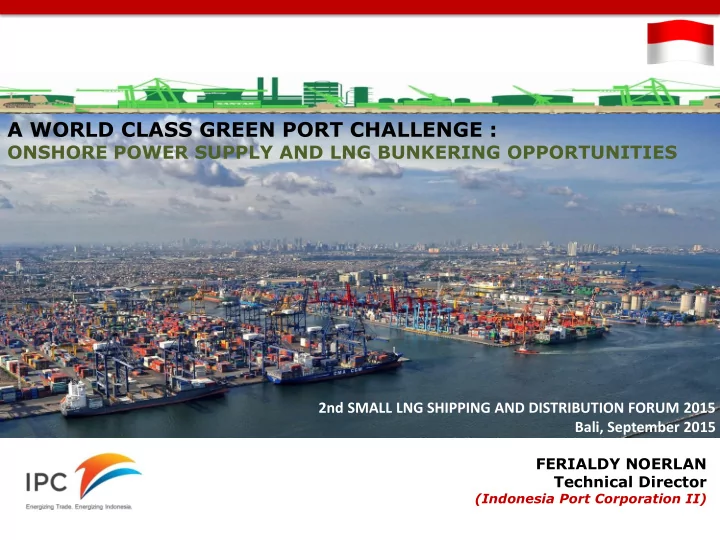
2nd SMALL LNG SHIPPING AND DISTRIBUTION FORUM 2015 Bali, September 2015

slide-2
SLIDE 2

Energizing Trade. Energizing Indonesia.

CONTENTS

1 | ENERGIZINGTRADE ENERGIZINGINDONESIA

  • 1. OVERVIEW OF INDONESIA PORT CORPORATION II
  • 2. GREEN PORT INITIATIVES
  • 3. ON SHORE POWER SUPPLY
  • 4. LNG BUNKERING OPPORTUNITIES
slide-3
SLIDE 3

OVERVIEW OF INDONESIA PORT CORPORATION II

slide-4
SLIDE 4

Energizing Trade. Energizing Indonesia.

  • PT. PELABUHAN INDONESIA II (PERSERO)/ IPC

PORT BRANCHES

2 | ENERGIZINGTRADE ENERGIZINGINDONESIA

slide-5
SLIDE 5

3 | ENERGIZINGTRADE ENERGIZINGINDONESIA

Core businesses: Cargo handling Supporting businesses and utilities Logistics and port services

Rukindo PT RSP PT EPI PT PMLI PT EDI PPI PT JAI PT ILCS JPPI

Dredging Vessel services throughout all IPC ports New port developer Logistics ICT Equipment maintenance Hospital management Energy supply within the port Education and training center E-business solutions nationwide

16 17 14 15 Terminal Petikemas Indonesia KSO TPK Koja PT JICT IKT IPC Terminal Petikemas PT Terminal Curah Indonesia

International container Domestic container Bulk cargo Car/heavy eqp. handling

PT MTI / IPC Logistics Pelabuhan Tg Priok

Focus on domestic container and break bulk Logistics

3 4 5 6 7 1 2 10 11 12 8 9 13

SUBSIDIARIES

slide-6
SLIDE 6

GREEN PORT INITIATIVES

slide-7
SLIDE 7

4 | ENERGIZINGTRADE ENERGIZINGINDONESIA

Environmental Awareness Wasted Management System Regular Air Quality Monitoring & Management Reducing Gas Carbon Emission Saving Energy EIA Document Implementation Global Networking

1 2 3 4 5 6 7

GREEN PORT CORPORATE INITIATIVES

slide-8
SLIDE 8

5 | ENERGIZINGTRADE ENERGIZINGINDONESIA

ENVIRONMENTAL AWARENESS IMPLEMENTATION  Regular briefing or meeting to update or remind information environmental aspects (include safety aspect) before working; Done  Provide simple sign or instruction regarding environmental

  • bedience (include safety aspect) in working area;

Done  Employee/worker training related to environmental knowledge (include safety aspect). Done

1 2

WASTED MANAGEMENT SYSTEM IMPLEMENTATION  Reception Facility (RF) for oily water from vessels that comprises temporary storage and oily water separator; Already established at 12 port branches, meanwhile only Tg Priok Port already had operating license  Waste Water Treatment Plant (WWTP) to manage domestic waste in terminal; 3 locations at Tanjung Priok Port, and Kalibaru Terminal still in design  Separation in solid waste storage between

  • rganic, in-organic, paper, and hazardous

waste. Implemented in all port branches

CONT’D

slide-9
SLIDE 9

6 | ENERGIZINGTRADE ENERGIZINGINDONESIA

REGULER AIR QUALITY MONITORING IMPLEMENTATION  Monitoring for air quality (TSP/Dust, CO, SO2, NO2); Environmental Monitoring Report is done twice a year at all port branches  Monitoring for noise level;  Implementation steps in noise handling.

3 4

REDUCING GAS CARBON EMISSION IMPLEMENTATION  Truck using LNG; Will be implemented at Kalibaru Terminal  Provide rules and regulations regarding LNG bunkering scenarios (ship-to-ship, shore-to-ship, and truck-to-ship); Soon to be implemented  Using the electric equipment; Electrification of 17 equipments in 3 port branches and using electric equipments at Kalibaru Terminal  Prepare lots of amount of green area (plantation) on port. Implemented in all port branches

CONT’D

slide-10
SLIDE 10

7 | ENERGIZINGTRADE ENERGIZINGINDONESIA

IMPLEMENTATION FOR RULES BASED ON EIA DOCUMENT IMPLEMENTATION

Regularly and obediently conduct mandatory activities which have been regulated in EIA document:  Environmental monitoring; Twice a year  Environmental management; Twice a year  Reporting both of aspects above to related institutions Twice a year

6 7

GLOBAL NETWORKING  Involving in port organization as an active member either national or international which concern in environmental aspects;  Keep a good relationship with other port operator or related institutions for local and international parties.

CONT’D

5

SAVING ENERGY IMPLEMENTATION  Light Emitting Diode (LED); For office lamp  Solar cell; For garden lights (pilot project)  Air Conditioning System with Exhaust Gas Soon to be implemented

slide-11
SLIDE 11

8 | ENERGIZINGTRADE ENERGIZINGINDONESIA

WASTE SOURCE FROM SHIP SEPARATOR TANK BARGE

. OLI WATER

BACK TO THE SEA

TANK TRUCK TANK TRUCK

RECEPTION FACILITIES IN TANJUNG PRIOK PORT

OPERATIONAL SUPPORT EQUIPMENTS :

Facility Unit Capacity Tug Boat 2 350 HP Barge 3 195, 285, 300 ton Oil Tank 1 25 ton Oil Skimmer 1 5 m3/hour Oil Boom 1 200 m

Total capacity barge and tank ± 805 ton/2days

  • Figure. Tank and Barge at Tanjung Priok Port
slide-12
SLIDE 12

9 | ENERGIZINGTRADE ENERGIZINGINDONESIA

EXISTING AT TANJUNG PRIOK PORT

Three existing locations of WWTP at Tanjung Priok Port : 1. IPC Head Office (capacity : 50 m3) 2.

  • PT. Pelabuhan Tanjung Priok Office (capacity : 50 m3)

3.

  • PT. Indonesia Kendaraan Terminal Office (capacity : 50 m3)
  • Fig. WWTP layout

1 2 3

KALIBARU TERMINAL FUTURE PLAN

WASTE WATER TREATMENT PLANT

slide-13
SLIDE 13

ONSHORE POWER SUPPLY

slide-14
SLIDE 14
  • 1. Create A

World Class Port and Green Port Issues, in

  • rder to fulfill

environment standards

With the number of ship visits were very high, the Port of Tanjung Priok management strives to create a world – class port that is free of pollution through the Green Port Program . Green Port Programme aims to reduce the level of pollution in the port generated by Diesel Engine for Power Generator on board. Based on research and surveys , it is known that the main cause of pollution in the harbor is a diesel engine (auxiliary engine ) for Power Generators . The ship is the largest emitter after ground vehicles ( cars ) . At the time of hotelling in the Port , the ship uses an auxiliary engine to generate electricity as source of lighting and power needs for day-to- day crew and used also as a source of energy for the loading and unloading of goods . Auxiliary engines generally use a fuel that is cheap with low quality to cover the operating costs of the ship.

BACKGROUND

In order to reduce exhaust emissions from auxiliary engines, the power source will be pursued provision of land ( Shore Side Electricity ) or so-called Alternative Marine Power Supply which is known as the Shore to Ship

10 | ENERGIZINGTRADE ENERGIZINGINDONESIA

slide-15
SLIDE 15

CONT’D

  • 2. Awareness
  • f the New

Regulations and Standards

WORLD REGULATIONS and STANDARDS

  • . 1997, IMO (International Maritime Organization) included ANNEX VI in the MARPOL (Marine

Pollution) convention: An effort to reduce the air pollution generated primarily from heavy duty marine diesel engines (Regulations for the Prevention of Air Pollution from Ships‐Annex VI). Since then, A substantial number of major maritime countries have ratified the regulations described by Annex VI.

  • . 2004, IMO included the MARPOL Convention (73/78) :

a limit on sulphur emissions generated by ships, creating a mandatory use of < 4.5% sulphur based fuel oil by 2010, and target mandatory use of < 0.5% sulphur based fuel oil by 2020

  • . 2005, EU - 2005/33/EC :

limit the amount of sulphur to 0.1% in all types of marine fuel used while at berth for vessel "hotelling" more than 2 hours in European ports, since 2010.

  • . 2006, EU Recommendation 2006/339/EG :

EU member countries to promote cold ironing electricity facilities, also urged for the development

  • f harmonized international standards, providing also guidance on costs and benefits on the field
  • f connecting ships to the power grid.
  • . 2011, IMO introducing chapter 4 of Annex VI:

A mandatory adoption of ENERGY EFFICIENCT DESIGN INDEX (EEDI) for new vessels and the SHIP ENERGY EGGICIENCY MANAGEMENT PLAN (SEEMP) both for new and prior built ships; in order to reduce the GhG emissions generated by shipping activities. These are expected to enter in force

  • n 1st January 2013.

11 | ENERGIZINGTRADE ENERGIZINGINDONESIA

slide-16
SLIDE 16

12 | ENERGIZINGTRADE ENERGIZINGINDONESIA

1) Marine vessels is the biggest air polluter in Port and Shipping Industry 2) Port is an industry that produce high air pollutant compared to other industries, such as refinery and power plant 3) High concentration of PM (Particulate Matters) air pollutant from Marine Vessel in Indonesia, especially in Java and Sumatera Island 4) A very rapid increment of CO2 concentration in earth atmosphere within the recent century

CONT’D

slide-17
SLIDE 17

13 | ENERGIZINGTRADE ENERGIZINGINDONESIA

CONCEPT OF SHORE SIDE CONNECTION

IPC’s Shore to Ship Technical Specification:

  • . Maximum Supplied Power = 6 MVA
  • . Voltage Supply = 6.6 kV
  • . Frequency = 50 / 60 Hz
  • . Vessel Type : Container

Vessel

“…Shore Side Connection / Cold Ironing is a process where shore side electrical power is provided to ocean going vessels, allowing them to shut down auxiliary diesel generators while they are docked…”

DEFINITION

SHORE SIDE CONNECTION

slide-18
SLIDE 18

14 | ENERGIZINGTRADE ENERGIZINGINDONESIA

SHORE SIDE CONNECTION ADVANTAGES AND DISADVANTAGES

ADVANTAGES

  • Port Infrastructure Readiness , if a new Shore

Side Connection regulation implemented

  • Shore Side Connection is not a sophisticated

technology, especially when only a single frequency provided, since no 50 – 60 Hz frequency converter investment necessary (note: only if all ships visiting the port use same electrical frequency – further research and investigation required)

  • Add a new business opportunity that will

benefit the port operator

  • Eliminating emissions and reducing air

pollutant in the port area (Reduced 99% of Nox, >50% of Sox, >50% PM)

  • Minimizing noise and vibrations
  • Improving working environment quality in

port

DISADVANTAGES

  • High investment cost and lengthy break

even point

  • Uncertain data about Shore Connection

usage rate in every port (highly dependent to Ship Owner willingness)

  • No

Shore Connection laws

  • r

regulations from local authorities, and Country Government

  • No standard rules or agreement about

Shore Connection Utilities among Ship

  • wners
  • Majority of vessels have only shore

connection facility when docking at shipyard, but not when hotelling or berthing at port.

  • No awareness from ship owners about

new environmental standards and emission reduction from ship exhaust

slide-19
SLIDE 19

15 | ENERGIZINGTRADE ENERGIZINGINDONESIA

SHORE SIDE CONNECTION CHALLENGES AND SUGGESTIONS

CHALLENGES

  • High

cost investment, especially for frequency converter

  • Old ship needs a room for installing shore

connection infrastructure inside it

  • The

shore connection infrastructure installation can only be done in shipyard (bad for shipping business, because they must rest the ship temporarily)

  • Shore Connection Utility at Ship must have

ATS (Automatic Transfer Switch) that functioned as the energy transfer from ship’s auxiliary engine to Shore power connection, or vice versa, without switching

  • ff ship electric power.

SUGGESTIONS

  • Needs a regulatory support from the

government

  • A

cooperation between government within regional area, for the standard implementation of shore connection

  • A Mutual agreement between port
  • perators

within regional area, for

  • peration of shore connection
  • Socialization

and awareness improvement from ship owners to the society about green port issues

slide-20
SLIDE 20

LNG BUNKERING OPPORTUNITIES

slide-21
SLIDE 21

16 | ENERGIZINGTRADE ENERGIZINGINDONESIA

  • 1. KALIBARU PRODUCT TERMINAL

DEVELOPMENT : 2012 – 2017 ESTIMATE PROJECT COST : US $ 2,3 Million LENGTH OF BERTH : 4000 M DEPTH : - 16 M LWS (Post Panamax) VESSEL CAPACITIES : 12.000 – 15.000 TEUs Container Terminal : 3 Terminal AREA : 132 Ha CAPACITY : 4,5 MILLION TEUs/Year Oil & Gas Terminal : 2 Terminal AREA : 48 Ha CAPACITY : 10,0 MILLION M³ /Year

PHASE 1

KALIBARU PRODUCT TERMINAL DEVELOPMENT PLAN

LNG BUNKERING OPPORTUNITIES IN IPC

slide-22
SLIDE 22

17 | ENERGIZINGTRADE ENERGIZINGINDONESIA

Forecasted Throughput of Liquid Bulk

  • 24 million tonnes per year by

the 10th operational year

  • 32 million tonnes per year by

the 20th operational year

Based on demand forecasting, it is proposed that Bojonegara Port is developed in three phases :

Phase and Year 2017 2024 2031 Liquid Bulk

1 x 200,000 DWT 1 x 200,000 DWT 1 x 200,000 DWT 2 x 20,000 DWT 1 x 50,000 DWT 1 x 50,000 DWT 2 x 20,000 DWT 3 x 20,000 DWT

  • 2. BOJONEGARA PORT-WEST JAVA

CONT’D

slide-23
SLIDE 23

18 | ENERGIZINGTRADE ENERGIZINGINDONESIA

  • 3. KIJING PORT-KALIMANTAN

CONT’D

Forecasted Throughput of Liquid Bulk at Kijing Port (000 tonnes)

  • Fig. Overall Layout for Port Liquid Bulk Operations

Table of Phasing Plan

slide-24
SLIDE 24

19 | ENERGIZINGTRADE ENERGIZINGINDONESIA

  • 4. TANJUNG CARAT PORT-SOUTH SUMATERA

CONT’D

Layout Plan of Liquid Terminal

Phase I development of Liquid Terminal is designed to handle 15 Million tonnes Full phase development of Liquid Terminal is designed to handle 30 Million tonnes

Parameters Phase I Phase II Berths 2 x 60,000 DWT 4 x 7,000 DWT 4 x 60,000 DWT 8 x 7,000 DWT Area (Ha) 9 16.2 Capacity 000 (tonnes) 15,000 30,000

slide-25
SLIDE 25