SLIDE 1
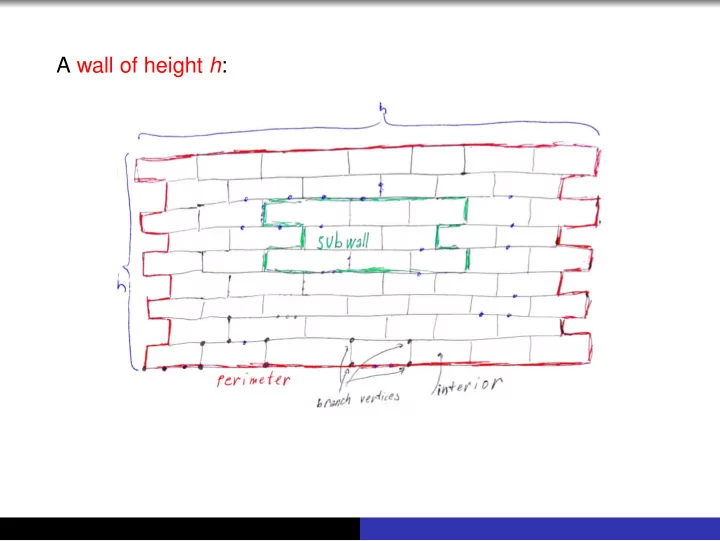
A wall of height h:
SLIDE 2
Theorem (A reformulation of the grid theorem) For every h, there exists t such that every graph of treewidth at least t contains a wall of height h as a subgraph. Proof. Grid minor ⇒ unsubdivided wall minor ⇒ wall subgraph.
SLIDE 3
A W-bridge of G is an edge of E(G) \ E(W) with both ends in W, or a component of G − V(W) together with the edges to W.
SLIDE 4
The compass C(W) of W: the perimeter K of W + the K-bridge containing the interior of W. A subwall W of a wall Z is dividing if K(W) ∩ Z = W. A cross over W: Disjoint paths P1, P2 ⊂ C(W) joining branch vertices of K s.t.
the ends of P1 are in different components of K − V(P2), and (P1 ∪ P2) ∩ Z ⊂ W.
SLIDE 5
Definition A wall W is flat if there is no cross over W. Compasses of flat walls are “almost planar”, see homework:
SLIDE 6 Theorem (The Flat Wall Theorem) For every h and m, there exists t such that for every graph G of treewidth at least t, either G contains Km as a minor, or there exists a set X of less than m
2
- vertices and a flat wall
- f height h in G − X.
SLIDE 7 Application: Testing the presence of a fixed graph H as a minor. For m = |V(H)|: A minor of H ⊆ Km in G, or small treewidth, or a large flat wall after removal of < m
2
Claim: In the flat wall, one can find a vertex v such that H G if and only if H G − v.
SLIDE 8
For u, v ∈ V(W), let d(u, v) = the minimum number of intersections of a closed curve from u to v with W. Observation Let T consist of separations (A, B) of order at most h/2 where A does not contain any row of W. Then T is a respectful tangle and d(u, v) = Θ(dT (u, v)).
SLIDE 9 A W-path intersects W exactly in its ends. Lemma (Jump Lemma) (∀m)(∃dm): m
2
- disjoint W-paths with ends in Y ⊂ V(W),
d(y1, y2) ≥ dm for all y1, y2 ∈ Y ⇒ Km G.
SLIDE 10
Lemma (Cross Lemma) (∀m)(∃d′
m): subwalls W1, . . . , Wm4 such that
d(Wi, Wj) ≥ d′
m
for i = j, disjoint crosses over all the subwalls ⇒ Km G.
SLIDE 11
For X ⊆ V(W), let W/X be obtained by removing rows and columns intersecting X. Observation The wall W/X has height at least h − 2|X|, dW/X(u, v) ≥ d(u, v) − 4|X|.
SLIDE 12
A vertex v is (l, s)-central over W if there exist paths P1, . . . , Pl with ends v and w1, . . . , wl ∈ V(W) s.t. Pi ∩ Pj = v and d(wi, wj) ≥ s for i = j, and Pi ∩ W ⊆ {v, wi}.
SLIDE 13 Lemma (Horn Lemma) For every m, there exist l and s such that if at least m
2
are (l, s)-central over W, then Km G.
SLIDE 14 Suppose v1, . . . , v(m
2) are (l, s)-central.
WLOG v1, . . . ∈ V(W): Consider W/{v1, . . .}. For a = 0, . . . , m
2
find a disjoint W-paths with ends s/2 apart and disjoint from va+1, . . .
Obtain Km G by the Jump Lemma.
SLIDE 15
Assume we have Q1, . . . , Qa−1, P1, . . . , Pl−(m
2) from centrality of va and disjoint from
{v1, . . .}. If 2a of P1, . . . , intersect some Qi:
SLIDE 16
Assume we have Q1, . . . , Qa−1, P1, . . . , Pl−(m
2) from centrality of va and disjoint from
{v1, . . .}. If 2a of P1, . . . are disjoint from Q1, . . . , Qa−1:
SLIDE 17
Lemma (Non-division Lemma) (∀m, l, s)(∃k, d′′
m): Non-dividing subwalls W1, . . . , Wk such that
d(Wi, Wj) ≥ d′′
m
for i = j ⇒ Km G or G contains an (l, s)-central vertex.
SLIDE 18
F = minimal subgraph of G − E(W) showing W1, . . . , Wk are non-dividing. F ′ a W-bridge of F: F ′ is a tree, |F ′ ∩ W| ≥ 2. Wi is solitary if only one W-bridge of F intersects Wi. If |F ′ ∩ W| ≥ 3: Each leaf in a different solitary subwall. Subdivision of a star.
SLIDE 19
F = minimal subgraph of G − E(W) showing W1, . . . , Wk are non-dividing. F ′ a W-bridge of F: F ′ is a tree, |F ′ ∩ W| ≥ 2. Wi is solitary if only one W-bridge of F intersects Wi. If |F ′ ∩ W| = 2: At least one end in a solitary subwall.
SLIDE 20
If ∆(F) ≥ l, then G contains an (l, s)-central vertex. Otherwise, F has a ≥ k/l2 disjoint bridges:
disjoint W-paths P1, . . . , Pa with ends si and ti d(si, sj) ≥ d′′
m for i = j.
SLIDE 21
Case 1: d(si, ti) ≤ d′′
m/100 for m4 values of i. Apply the Cross
Lemma to obtain Km G: We can assume d(si, ti) > 100dm for all i.
SLIDE 22 Case 2: There exists i0 such that d(ti, ti0) < 2dm for 3 m
3
Let X be vertices of W at distance less than 2dm from ti0. Apply the Jump Lemma in W/X. Observation ∆(W[X]) ≤ 3 ⇒ many vertices ti can be joined by disjoint paths in W[X].
SLIDE 23 Case 2: There exists i0 such that d(ti, ti0) < 2dm for 3 m
3
Let X be vertices of W at distance less than 2dm from ti0. Apply the Jump Lemma in W/X.
SLIDE 24 Case 3: At least
a 3(m
3) indices I such that d(ti, tj) ≥ 2dm for
distinct i, j ∈ I. Auxiliary graph H with V(H) = I, ij ∈ E(H) if d(si, tj) < dm
∆(H) ≤ 2, α(H) ≥ |H|/3. The Jump Lemma gives Km G.
SLIDE 25 Lemma (Non-division Lemma) (∀m, l, s)(∃k, d′′
m): Non-dividing subwalls W1, . . . , Wk such that
d(Wi, Wj) ≥ d′′
m
for i = j ⇒ Km G or G contains an (l, s)-central vertex. Iteration + Horn Lemma: Corollary (∀m)(∃k0, d′′
m): Subwalls W1, . . . , Wk such that
d(Wi, Wj) ≥ d′′
m
for i = j ⇒ Km G or X ⊆ V(G), |X| < m
2
- such that all but k0 of the subwalls
are dividing in (G − X) ∪ W.
SLIDE 26 Proof of the Flat Wall Theorem: large treewidth ⇒ large wall W many distant subwalls X ⊆ V(G), |X| < m
2
- and many distant dividing walls in
(G − X) ∪ W many distant dividing walls in G − X Cross Lemma: less than m4 of them are crossed.