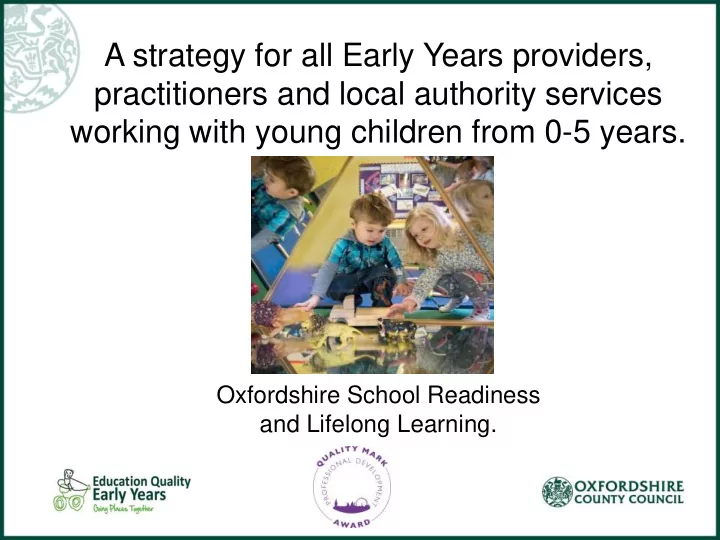
A strategy for all Early Years providers, practitioners and local - - PowerPoint PPT Presentation

a strategy for all early years providers practitioners
SMART_READER_LITE
LIVE PREVIEW

A strategy for all Early Years providers, practitioners and local - - PowerPoint PPT Presentation

A strategy for all Early Years providers, practitioners and local authority services working with young children from 0-5 years. Oxfordshire School Readiness and Lifelong Learning. What is School Readiness? School readiness is a measure of


slide-1
SLIDE 1

A strategy for all Early Years providers, practitioners and local authority services working with young children from 0-5 years.

Oxfordshire School Readiness and Lifelong Learning.

slide-2
SLIDE 2

What is School Readiness?

  • School readiness is a measure of how prepared a

child is to succeed in school cognitively, socially and

  • emotionally. Professional Association for Childcare

and Early Years (PACEY) describes this as having strong social skills, being able to cope emotionally with being separated from parents, being relatively independent in their own personal care and to have a curiosity about the world and a desire to learn.

slide-3
SLIDE 3

Definition of school readiness

Oxfordshire is using UNICEF’s description of the three elements of school readiness:

  • Children’s readiness for school.
  • Families and communities’ readiness for school.
  • Settings’ and schools’ readiness for children.

School Readiness - Unicef

slide-4
SLIDE 4

School Readiness

slide-5
SLIDE 5

Why do we need a strategy?

The National Association of Headteachers (NAHT) and the Family and Child Care Trust (FCCT) reported a growing concern that children do not have the necessary skills to be school ready. The report entitled “School Ready” believed that the issue of school readiness has worsened over the last five years.

slide-6
SLIDE 6
  • A number of different professional groups in

Oxfordshire, particularly primary headteachers stated that there is an increasing issue in Oxfordshire in relation to young children not being “ready” for school.

  • The task and finish group was formed to look at

good work already taking place in Oxfordshire but also identifying where the gaps in provision were; and how we might work together to address these gaps.

slide-7
SLIDE 7

GLD for Oxfordshire

slide-8
SLIDE 8

FSM gap increased in 2018

The FSM gap has increased from 20%pts to 23%pts this year. Nationally it has remained at 17%pts.

slide-9
SLIDE 9

Where are we now?

  • Participation in Public Health England’s (PHE) pilot of

Best start in life self-assessment with input from partners across 0-5 services. An action plan will have findings incorporated into the strategy.

  • Oxfordshire participated in a project led by PHE to

describe the current situation across the South East with regards to data and school readiness initiatives. Parents participated in focus groups (Chalgrove, Bloxham and Thame). Findings and national guidance is now published

  • School Readiness consultation now closed and multi-

agency strategy will be written.

slide-10
SLIDE 10

Where are we now?

.

  • Delivery of School Readiness conference in November

2018, multi-agency conference with Early Years colleagues working together to support practitioners in Oxfordshire – Evaluations were very positive.

  • Publication of Community around the setting document,

describing what all professionals working with 0-5 do. Appendix has links to Early help sources (launched at the conference)

  • Publication of Early Years - School Readiness

Partnership Agreement (Exemplar) (launched at the conference)

  • Development of school Readiness webpages for

practitioners and parents

  • Part of the APPG working group for a fit and healthy

childhood

slide-11
SLIDE 11

Tales Toolkit pilot- Promoting Language and communication

  • Winner of Teach First Innovation award 2015/16, Teach

First Community Choice Award, UnLtd Do it and Grow it award, Educate supported, Member of BESA and Fair Education Alliance

  • Published research in 2018 with Goldsmiths University of

London proving schools using Tales Toolkit significantly improved children’s communication and language, social skills, creativity and closed the gender gap in literacy. Report can be seen on the website www.talestoolkit.com

  • Currently working on a trial with Oxfordshire measuring

the impact of our resources with 13 schools and 3

  • childminders. Goldsmiths will evaluate
slide-12
SLIDE 12

Easy Peasy pilot – Improving the home learning environment

EasyPeasy parent app is the recipient of the Bett Early Years Content Awards 2019, the EDUCATE Evidence Applied EdWard, and is the subject of two published Randomised Control Trial studies led by the University of Oxford’s Department of Education, showing positive impact

  • n children’s outcomes and parenting behaviour.

15 schools, 2 nursery schools and 1 pre-school are part of this exciting pilot. Oxford university will evaluate.

slide-13
SLIDE 13

Improved partnership working has been identified

  • Improved partnership working between social care and

education

  • Consistent messages across organisations
  • Improved Early Help working and training between,

Health visitors, Attendance, Admissions, LCSS, Voluntary sector

  • Awareness of each others roles and signposting to help
  • Local and national information shared through different

avenues

slide-14
SLIDE 14

Developing a Strategy

  • A collaborative approach has been used in

developing Oxfordshire’s school readiness strategic plan.

  • Over 120 professionals from a wide range of early

years services are involved in shaping the priorities and actions detailed in this strategy by being part of the School Readiness and Lifelong learning consultation, this was conducted online and by 2 stakeholder meetings.

slide-15
SLIDE 15

Emerging themes/priorities from the consultation

  • Priority 1: Strong Home Learning Experience to support

children’s learning and development

  • Priority 2: Early Engagement
  • Priority 3: High Quality Provision
  • Priority 4: Information-sharing and high-quality

transitions through life outcomes

slide-16
SLIDE 16

The strategy will include:

  • How the priorities were identified
  • The current Early Years practitioners and provision in

Oxfordshire

  • The Local Authority work
  • Identified barriers
  • What Early Years practitioners/providers and the Local

Authority will do next?

slide-17
SLIDE 17

Next steps

  • Finalise the strategy by the end of July.
  • From September 2019 the School Readiness

strategy will be rolled out across Oxfordshire, under the strategic direction of the children’s trust.

  • Launch of the strategy at the Early Years conference

in November 2019.

slide-18
SLIDE 18

Early Years conference 2019

7th November 2019 9.15am- 4.00pm Exhibition and Registration from 8.30am The Kassam Stadium Grenoble Road, Oxford, OX4 4XP

slide-19
SLIDE 19

Conference speakers include:

  • Greg Bottrill - Author of Can I Go and Play Now?
  • Jen Lexmond - Founder of Easy Peasy
  • Kate Shelley - Founder of Tales Toolkit
  • Tamsin Grimmer - School Readiness and the

Characteristics of Effective Learning

  • Elizabeth Jarman - Creating Optimum Spaces for

Learning Workshop topics include: partnership working with parents, music and movement in the Early Years, speech and language, children’s dental care.

slide-20
SLIDE 20