a story telling robot: modelling and evaluation of human-like gaze - - PowerPoint PPT Presentation

a story telling robot
SMART_READER_LITE
LIVE PREVIEW

a story telling robot: modelling and evaluation of human-like gaze - - PowerPoint PPT Presentation

a story telling robot: modelling and evaluation of human-like gaze behaviour 1 motivations social functions of gaze behaviour gaze and task performance previous work on simulating gaze behaviour in agents and robots How are


slide-1
SLIDE 1

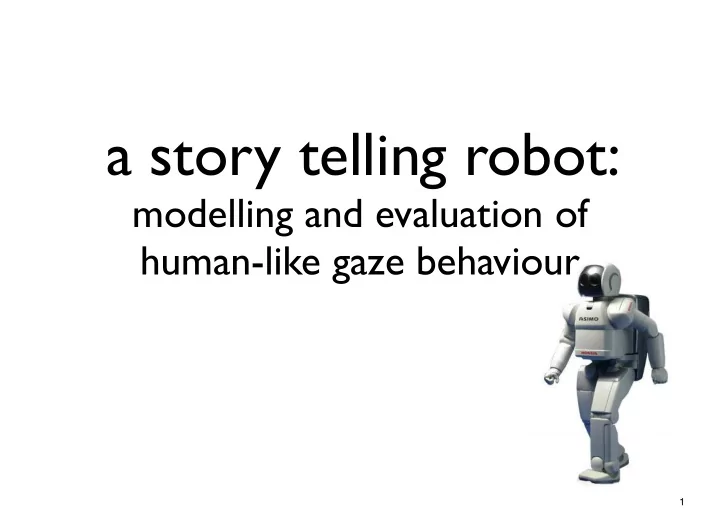
a story telling robot:

modelling and evaluation of human-like gaze behaviour

1
slide-2
SLIDE 2

motivations

  • social functions of gaze behaviour
  • gaze and task performance
  • previous work on simulating gaze behaviour

in agents and robots

  • How are human-human and human-robot

interactions related?

2

slide-3
SLIDE 3

social functions

  • communicating syntactic signals like verbal

utterances and emphasis

  • based on the structure and the content of

the utterance.

  • communicating interpersonal attitude or

affect between speaker and listener

  • indicating speakers attitude

3

slide-4
SLIDE 4

task performance

  • Students were shown to recall significantly

better the details of a story when the teacher made eye contact with them/when they received gaze.

4

slide-5
SLIDE 5

hypothesis

  • Participants who are looked at more will

perform better in the recall task.

  • Participant who are looked at more will

evaluate ASIMO more positively.

5

slide-6
SLIDE 6

the experiment

  • 20 subjects, 12 males, 8

females

  • 2 conditions, looked-at 20% of

the time, and looked-at 80% of the time

  • 2 further conditions, male and female!
  • 4 male and 3 female participants were

students of technical majors.

  • pre and post experimental questionnaires
  • recall task after listening to another story

6

slide-7
SLIDE 7

for each proposition do if proposition is theme then if beginning of turn or distribution(0.70) then attach a look-away from the listener end if else if proposition is rheme then if end of turn or distribution(0.73) then attach a look-toward the listener end if end if end for

method

  • based on Cassell et. al.’s

empirical gaze behaviour model:

7

slide-8
SLIDE 8

method

  • and analyzing gaze data from a professional story teller.

Listener 1 Listener 2 Fixed Random spot spot Frequency (%) 13 11 38 38 Length (%) 38 27 30 5 Min (ms) 477 484 242 360 Max (ms) 15,324 5,914 13,674 4,383 Mean (ms) 2,400 2,262 2,640 1,072

  • Approx. StDev (ms)

500 500 500 250 TABLE I LENGTH AND DISTRIBUTIONS OF GAZE AT EACH LOCATION.

8

slide-9
SLIDE 9

results

9

slide-10
SLIDE 10
  • ther results
  • Positive evaluations of ASIMO were highly

correlated with participant’s video gaming experience and not with their computer use.

10

slide-11
SLIDE 11

problems

  • due to physical design of the robot
  • limited gestures
  • not completely human like gaze
  • Some aspects of human story teller’s gaze

were not taken into account.

11