
SLIDE 1
A Review on the Research Status and Development Trend on Low Energy Beta-Emitter Measurement
Hara Kang a,b, Sang Bum Hong b, Changhyun Roh b, and Cheong Jae Hak a
aKyung-Hee University, Suwon, Gyeonggi-do, 17104 Republic of Korea bKorea Atomic Energy Research Institute, Yuseong-Gu, Deajoen, 34057 Republic of Korea *sbhong@kaeri.re.kr
- 1. Introduction
Globally, the characterization of residual radioactivity at the decommissioning site and nuclear wastes treatment is essential and significant interest. Thus, there have been developed a number of technologies on the fabrication
- f
detectors to measure various radioisotopes [1], [2]. Generally, in the case of beta ray emitting isotopes, it relies on Liquid Scintillation Counter (LSC), which is only available in the laboratory
- r indirect measurement like Scaling Factor [3], [4]. In
this study, we elucidated a review on the scientific research status and development trend to have better knowledge and understanding of the beta emitter measuring equipment. Herein, researches
- n
commercial and prototype detectors to measure low energy beta emitter are presented.
- 2. Methods and Results
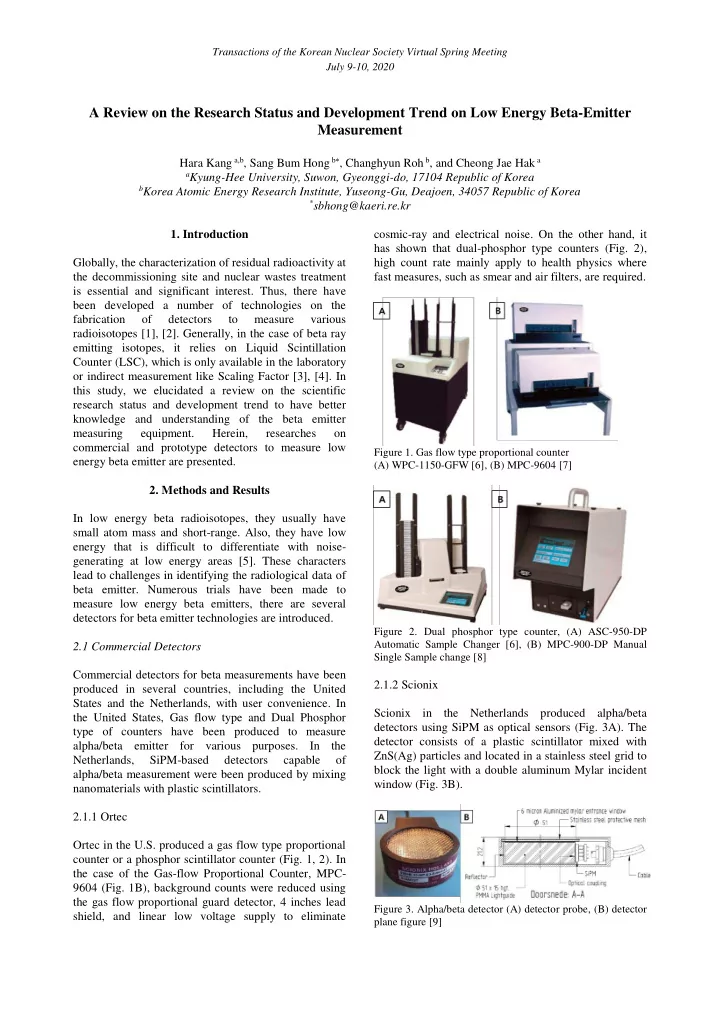
In low energy beta radioisotopes, they usually have small atom mass and short-range. Also, they have low energy that is difficult to differentiate with noise- generating at low energy areas [5]. These characters lead to challenges in identifying the radiological data of beta emitter. Numerous trials have been made to measure low energy beta emitters, there are several detectors for beta emitter technologies are introduced. 2.1 Commercial Detectors Commercial detectors for beta measurements have been produced in several countries, including the United States and the Netherlands, with user convenience. In the United States, Gas flow type and Dual Phosphor type of counters have been produced to measure alpha/beta emitter for various purposes. In the Netherlands, SiPM-based detectors capable
- f