A Review of Summer Workshop on Innovative Techniques for LVCSR - - PowerPoint PPT Presentation

a review of summer workshop on innovative techniques for
SMART_READER_LITE
LIVE PREVIEW

A Review of Summer Workshop on Innovative Techniques for LVCSR - - PowerPoint PPT Presentation

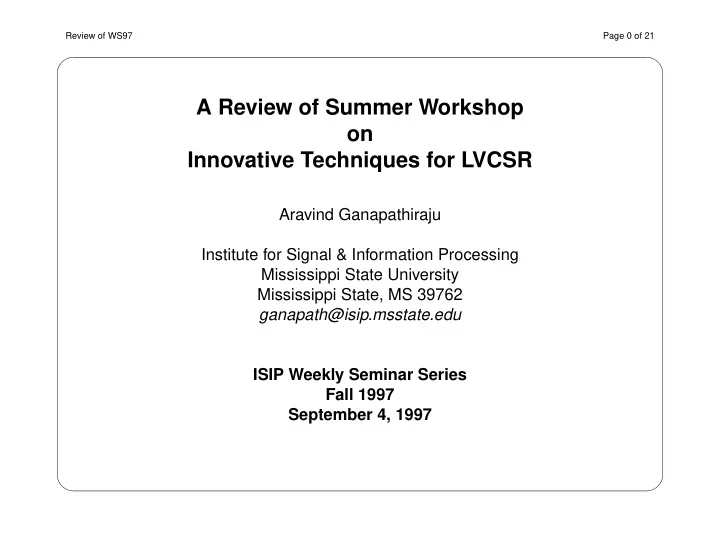
Review of WS97 Page 0 of 21 A Review of Summer Workshop on Innovative Techniques for LVCSR Aravind Ganapathiraju Institute for Signal & Information Processing Mississippi State University Mississippi State, MS 39762


slide-1
SLIDE 1

Review of WS97 Page 0 of 21

A Review of Summer Workshop

  • n

Innovative Techniques for LVCSR

Aravind Ganapathiraju Institute for Signal & Information Processing Mississippi State University Mississippi State, MS 39762 ganapath@isip.msstate.edu ISIP Weekly Seminar Series Fall 1997 September 4, 1997

slide-2
SLIDE 2

Review of WS97 Page 1 of 21

INTRODUCTION

❑ Areas of Research ❍ Acoustic processing ❍ Syllable-based speech recognition ❍ Pronunciation modeling ❍ Discourse language modeling ❑ Research at the previous workshops ❍ 1995 - Language Modeling workshop ❍ 1996 - LVCSR workshop — Speech data modeling (ANN, Multi-band, large context) — Automatic learning of word pronunciations — Hidden speaking mode

slide-3
SLIDE 3

Review of WS97 Page 2 of 21

ACOUSTIC MODELING

❑ Goal: Investigate methods that integrate information extracted from various time-scales into the acoustic models. ❑ Techniques experimented on: ❍ Linear discriminant analysis (LDA), Heteroscedastic discriminant analysis (HDA) ❍ filtering trajectories of acoustic features ❍ investigate different warping functions

slide-4
SLIDE 4

Review of WS97 Page 3 of 21

FEATURE TRANSFORMATIONS

❑ LDA - incorrectly assumes equal variances classes, simple Eigen analysis ❑ HDA - takes care of unequal variance in classes, requires non-linear

  • ptimization

❑ Methods ❍ collect class statistics (means and variances of monophones) ❍ find feature transformation (LDA or HDA) ❍ apply transformation to all data ❍ train recognizer with new features ❍ a modified EM algorithm used for training

slide-5
SLIDE 5

Review of WS97 Page 4 of 21

CONCLUSIONS

❑ LDA - worsened performance by 1% ❑ HDA - improved performance by 1%, need for a more intelligent training algorithm ❑ Filtering at different time scales helped on small set of studio quality data, but has not been tested on Switchboard ❑ “mel” warping seems to a reasonable warping function

slide-6
SLIDE 6

Review of WS97 Page 5 of 21

PRONUNCIATION MODELING

❑ Goal: Model pronunciation variation found in the SWITCHBOARD corpus to improve speech recognition performance ❑ Methods ❍ Use hand-labeled phonetic transcriptions as target of modeling ❍ Use dictionary pronunciation, lexical stress and other linguistic information as source of modeling ❍ Use statistical methods to learn the mapping from base forms to the surface forms ❍ Create pronunciation networks to be used as the recognizer’s dictionary

slide-7
SLIDE 7

Review of WS97 Page 6 of 21

MODEL ESTIMATION

❑ Decision Trees ❍ predict phone realizations based on questions concerning baseform context ❑ Multi-words ❍ predict phone realizations based on their frequency of occur- rence in pairings with their baseform context ❑ Unsupervised Learning ❍ bootstrap by clustering automatic phone recognition of high frequency words

slide-8
SLIDE 8

Review of WS97 Page 7 of 21

TRAINING and TEST ISSUES

❑ Pronunciation Model: ❍ cross-word or word-internal ❍ should it generalize to unseen contexts ❍ should it be word specific ❍ should training be on hand-labeled or automatically transcribed data ❑ Acoustic Model: ❍ training on a standard dictionary ❍ training on pronunciation realization model

slide-9
SLIDE 9

Review of WS97 Page 8 of 21

UNSOLVED/FUTURE WORK

❑ Tree based models ❍ effective acoustic retraining ❍ improved crossword modeling ❑ Multi-word models: ❍ Derive new multi-words from data ❍ Generalize to unseen contexts ❑ Dynamic pronunciation modeling - use of rate/duration information

slide-10
SLIDE 10

Review of WS97 Page 9 of 21

DISCOURSE LANGUAGE MODELING

❑ Goal: Better use of discourse knowledge to improve recognition accuracy ❑ Understanding spontaneous dialog ❍ need to know who said what to whom ❑ Better human-computer dialog ❍ agent needs to know whether you asked it a question or

  • rdered to do something

❑ First step towards speech understanding ❑ Can discourse knowledge help improve recognition performance

slide-11
SLIDE 11

Review of WS97 Page 10 of 21

WHY DISCOURSE KNOWLEDGE?

❑ Word “DO” has an error rate of 72% ❑ “DO” present in almost every yes-no-question ❑ If we detect a yes-no-question we could increase P(DO) ❑ yes-no-question easily detected by rising intonation

slide-12
SLIDE 12

Review of WS97 Page 11 of 21

UTTERANCE TYPE DETECTION

❑ Words and word grammar ❍ pick the most likely utterance type (UT) given the word string ❑ Discourse grammar ❍ pick the most likely UT given the surrounding utterance types ❑ Prosodic information ❍ pitch contour ❍ energy/SNR ❍ speaking rate

slide-13
SLIDE 13

Review of WS97 Page 12 of 21

UTTERANCE TYPE DETECTION

RAW ACOUSTIC FEATURES PROSODIC FEATURES DISCOURSE/DIALOG FEATURES HMM intonation classifier Decision Trees Maximum Entropy models P(U/F)

slide-14
SLIDE 14

Review of WS97 Page 13 of 21

WHAT DID WE LEARN?

❑ Successful utterance type detection ❑ First step towards automatic discourse understanding ❑ Prosodic information is useful for discourse processing ❑ Only marginal recognition win, why? ❍ with complete knowledge of utterance type gain of only 2% over baseline recognizer ❍ maximum win in question detection but database primarily statement oriented

slide-15
SLIDE 15

Review of WS97 Page 14 of 21

SYLLABLE-BASED SPEECH RECOGNITION

❑ All state-of-the-art LVCSR systems have been predominantly phone based ❑ Phone is not a very flexible unit for spontaneous speech ❑ Cannot exploit temporal dependencies when modeling unit’s of very short duration ❑ Syllable is a reasonable alternate ❍ Longer time window to better capture contextual effects ❍ can be viewed as a stochastic model on top of a collection of phones, thus inherently modeling more variations

slide-16
SLIDE 16

Review of WS97 Page 15 of 21

SYLLABLES OFFER MORE!

❑ Stability of a syllable as a recognition unit ❍ Insertion and deletion rate of syllable is as low as 1% as com- pared to 12% for phones ❍ Clearly syllable is much more stable ❑ Longer duration makes it easier to exploit temporal and spectral variations simultaneously (Parameter trajectories, Multi-path HMMs) ❑ Possibility of compact coverage

slide-17
SLIDE 17

Review of WS97 Page 16 of 21

WHAT DOES A SYLLABLE SYSTEM COMPARE WITH?

❑ Only context independent syllables were used ❍ context independent phone system is a reasonable lower bound for performance (62.3% WER) ❑ Comparing with cross-word context dependent phone system not correct since cross-word modeling for syllables not done ❑ A better upper bound is a word-internal context dependent phone system (49.8% WER)

slide-18
SLIDE 18

Review of WS97 Page 17 of 21

BASELINE SYLLABLE SYSTEM

❑ A syllabified lexicon used for syllable definitions ❑ 9023 syllable seeded for complete coverage of training data ❑ Syllable durations found from forced alignment ❑ Number of states in HMM proportional to syllable duration ❑ Due to under trained models, used only 800 syllables for testing ❑ Monophones used to fill up the test lexicon ❑ Performance - 55.1% WER

slide-19
SLIDE 19

Review of WS97 Page 18 of 21

HYBRID SYLLABLE SYSTEM

❑ Error analysis of baseline system: ❍ errors on words with mixed or all phone representation high ❑ Suggests mismatch at syllable phone junctions ❑ 800 syllables and monophones trained together ❑ Performance - 51.7% WER

slide-20
SLIDE 20

Review of WS97 Page 19 of 21

OTHER IMPORTANT EXPERIMENTS

❑ Finite duration modeling ❍ long tails for some of the syllable model duration histograms. ❍ high word deletion rate ❍ both these suggest need for durational constraints on models ❍ number of states in model proportional to expected stay ❍ performance - 49.9% WER ❑ Monosyllabic word modeling ❍ 75% of training word tokens are monosyllabic ❍ 200 monosyllabic words cover 71% ❍ monosyllabic words account for 70% of error ❍ created separate models for monosyllabic words ❍ performance - 49.3%, with finite duration 49.1

slide-21
SLIDE 21

Review of WS97 Page 20 of 21

MAJOR CONCLUSIONS

❑ Ofcourse, we proved that syllable models work as well as triphone models, if not better ❑ Lexical issues need to be addressed ❍ a quick post workshop experiment showed a gain of 1% by looking at one particular issue (ambisyllabics) ❑ We have not explicitly exploited temporal characteristics of syllables ❍ parameter trajectories and multi-path HMMs need to be tested ❑ Context dependent syllable modeling and state tying ❍ will involve decision tree clustering

slide-22
SLIDE 22

Review of WS97 Page 21 of 21

WORKSHOP CONCLUSIONS

❑ Not much gain in terms of reduction in word error rate ❑ Pronunciation modeling has been repeatedly shown to be useful ❑ Generalized discriminant analysis shows promise ❑ Discourse level information is not explicitly beneficial in improving recognition accuracy ❑ Decision trees are used successfully in all aspects of speech recog- nition ❑ Overall it is sad that there was no breakthrough ❑ Isn’t that good for us? More things to solve and more time to get there to the top! WHY WAIT? LETS DO IT FOLKS!!!!