A Presentation Authoring Tool for Media Devices Distributed - - PDF document

a presentation authoring tool for media devices
SMART_READER_LITE
LIVE PREVIEW

A Presentation Authoring Tool for Media Devices Distributed - - PDF document

A Presentation Authoring Tool for Media Devices Distributed Environments Hangjin Zhang 1 , Qiong Liu 2 , Surapong Lertsithichai 2 , Chunyuan Liao 3 , Don Kimber 2 1 Department of Computer Science, Univ. of California, Santa Barbara,


slide-1
SLIDE 1

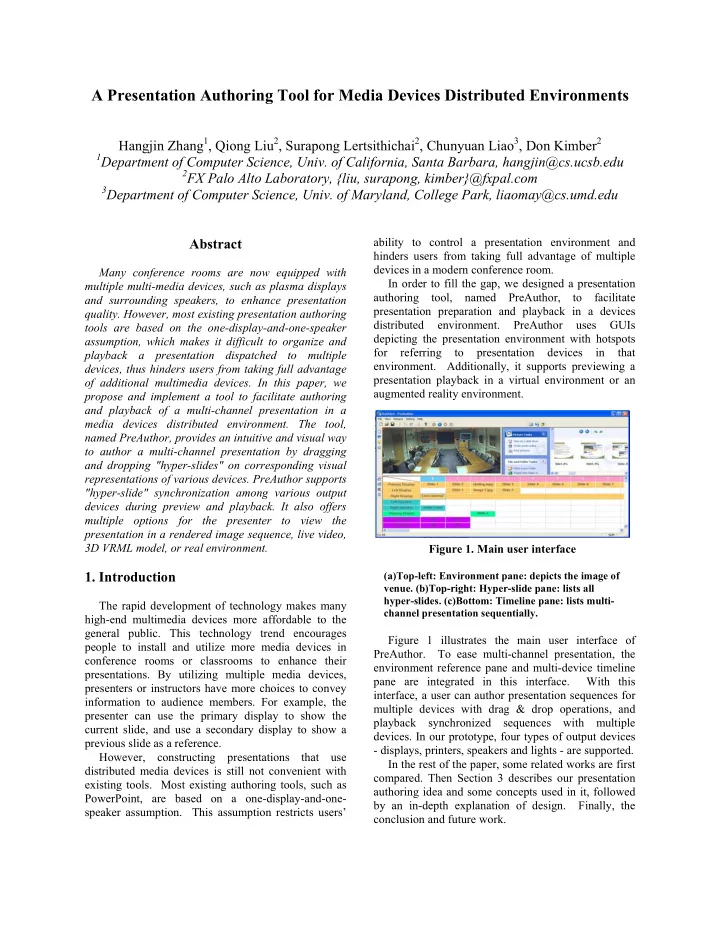
Figure 1. Main user interface

(a)Top-left: Environment pane: depicts the image of

  • venue. (b)Top-right: Hyper-slide pane: lists all

hyper-slides. (c)Bottom: Timeline pane: lists multi- channel presentation sequentially.

A Presentation Authoring Tool for Media Devices Distributed Environments

Hangjin Zhang1, Qiong Liu2, Surapong Lertsithichai2, Chunyuan Liao3, Don Kimber2

1Department of Computer Science, Univ. of California, Santa Barbara, hangjin@cs.ucsb.edu 2FX Palo Alto Laboratory, {liu, surapong, kimber}@fxpal.com 3Department of Computer Science, Univ. of Maryland, College Park, liaomay@cs.umd.edu

Abstract

Many conference rooms are now equipped with multiple multi-media devices, such as plasma displays and surrounding speakers, to enhance presentation

  • quality. However, most existing presentation authoring

tools are based on the one-display-and-one-speaker assumption, which makes it difficult to organize and playback a presentation dispatched to multiple devices, thus hinders users from taking full advantage

  • f additional multimedia devices. In this paper, we

propose and implement a tool to facilitate authoring and playback of a multi-channel presentation in a media devices distributed environment. The tool, named PreAuthor, provides an intuitive and visual way to author a multi-channel presentation by dragging and dropping "hyper-slides" on corresponding visual representations of various devices. PreAuthor supports "hyper-slide" synchronization among various output devices during preview and playback. It also offers multiple options for the presenter to view the presentation in a rendered image sequence, live video, 3D VRML model, or real environment.

  • 1. Introduction

The rapid development of technology makes many high-end multimedia devices more affordable to the general public. This technology trend encourages people to install and utilize more media devices in conference rooms or classrooms to enhance their

  • presentations. By utilizing multiple media devices,

presenters or instructors have more choices to convey information to audience members. For example, the presenter can use the primary display to show the current slide, and use a secondary display to show a previous slide as a reference. However, constructing presentations that use distributed media devices is still not convenient with existing tools. Most existing authoring tools, such as PowerPoint, are based on a one-display-and-one- speaker assumption. This assumption restricts users’ ability to control a presentation environment and hinders users from taking full advantage of multiple devices in a modern conference room. In order to fill the gap, we designed a presentation authoring tool, named PreAuthor, to facilitate presentation preparation and playback in a devices distributed environment. PreAuthor uses GUIs depicting the presentation environment with hotspots for referring to presentation devices in that

  • environment. Additionally, it supports previewing a

presentation playback in a virtual environment or an augmented reality environment. Figure 1 illustrates the main user interface of

  • PreAuthor. To ease multi-channel presentation, the

environment reference pane and multi-device timeline pane are integrated in this interface. With this interface, a user can author presentation sequences for multiple devices with drag & drop operations, and playback synchronized sequences with multiple

  • devices. In our prototype, four types of output devices
  • displays, printers, speakers and lights - are supported.

In the rest of the paper, some related works are first

  • compared. Then Section 3 describes our presentation

authoring idea and some concepts used in it, followed by an in-depth explanation of design. Finally, the conclusion and future work.

slide-2
SLIDE 2
  • 2. Related Work

There are many commercial products for presentation authoring, such as PowerPoint, Freelance, and OpenOffice are available. They can organize presentations with a sequence of slides, and support text editing, figure drawing, audio/video and animation for each slide. But these tools are designed based on the one-display-and-one-speaker assumption, and do not support multi-display presentation. Some multi-display designs are found in [4, 5]. In [4] multiple displays are modeled as a single continuous surface by mapping the edge of each display to the nearest edge of the adjacent display. This model is not very suitable for presentations, because people prefer a slide to be shown on a single display surface. ModSlideShow [5] considers multiple displays as sliding chalkboard array in old lecture

  • halls. It manipulates presentation slides among

multiple displays by mapping presenter’s gestures to proper display manipulation commands. With this tool, the presenter needs to remember the whole presentation sequence well to move slides around

  • efficiently. It is not very easy for presenters to author

presentations offline without a model of the presentation environment. Moreover, ModSlideShow is limited to slideshow, and cannot manipulate other devices, such as multiple loudspeakers and lights in the environment. In some videoconferencing or remote collaboration systems, such as Presenter [3], LiveMeeting [2], the presenter is able to deliver presentation slides to many remote audience members, uses either multicast or unicast protocols. However, all audiences receive same slides on their viewers. While in our model, the podium PreAuthor distributes independent hyper-slides (same or different) to a variety of local or remote devices. PreAuthor is an extension to the work described in [1]. These two systems share the same Remote Control Agent architecture. In [1] the authors focused

  • n interactions with multiple devices during playback.

PreAuthor, however, emphasizes the integrated authoring interface. Additionally, PreAuthor provides more flexible preview and playback modes.

  • 3. Multi-channel Presentation Components

Unlike traditional presentation tools that only manage one slide sequence, PreAuthor has to manage multiple output sequences corresponding to various

  • utput devices. In this sense, PreAuthor handles a

multi-channel presentation: creating a presentation sequence for each device and synchronizing all sequences during playback. Since many single-display media-editing tools [3, 5] have been developed by various companies, PreAuthor does not aim at single-display media editing; instead, it is designed to organize pre-edited slides, audio files, images, and movies for multiple distributed devices. It is an upper-level tool that manages results of a single- channel media editor for multi-channel applications. Before getting into design details, it is helpful to introduce some concepts used by PreAuthor. Hyper-Slides (Input Sources): As the name suggests, a hyper-slide is an extension to a regular

  • slide. It is a basic presentation unit that can be a

regular PowerPoint slide, an image, a video clip, an audio segment, a streaming video (audio) from a live camera (microphone), or even a light control command (on/off/dim). In a word, a hyper-slide is an input source or an object that can be “rendered” by a device. Hotspots (Output Devices): The term “hotspot” has different meanings under various situations. In this paper, a hotspot is defined as a visual representation of an output device, such as a display, a speaker, a printer, or a light. The hotspot is useful for users to refer to various devices distributed in the environment. Timeline: The timeline reflects the hyper-slides’ time relations in a presentation. It is divided into columns, called states in this paper. Each state has a unique index. Playback synchronization is achieved by all devices playing hyper-slides in the same state. Playlist: An association of <state index t, hotspot h, hyper-slides s> means that at state t, the device h plays the hyper-slide s. A playlist for a multi-channel presentation is a sorted list of associations with the key

  • f state index. The authoring process of PreAuthor

“glues” hyper-slides together and associate them with proper output devices to form a playlist, which can be played by the playback process.

  • 4. The Design of PreAuthor

As shown in figure 1, the main window contains three panes. The environment pane shows an image representation of the presentation environment. It is crucial that all output devices are visible in this snapshot because it provides a user with visual means to define hotspots over it. The hyper-slides pane is used to view and drag hyper-slides. The timeline pane is a table. When the user defines a new hotspot, a new row is added to the table accordingly. The number of columns can be increased on demand. A non-blank cell in the table stands for a 3-element association: the row determines the device, the column determines the state

slide-3
SLIDE 3

index, and the content in the cell determines the hyper- slide.

4.1. Presentation Authoring

Since every controllable device is mapped to a hotspot, the user can drag and drop a hyper-slide to a hotspot representing an output device after device- hotspot mapping. A corresponding <state index, hotspot, hyper-slides> association then appears in the timeline table. Authoring a multi-channel presentation is essentially to fill out the timeline table. An individual hyper-slide representation must be generated for every PowerPoint slide for drag-and- drop operations. PreAuthor does this by generating a sequence of “.jpg” thumbnail images for various PowerPoint slides. As such, each slide is mapped to a .jpg image, and vice versa. Most hyper-slides are natural file-system files, but some input sources like live video cameras and microphones are not. In order to maintain the consistent semantics of the drag-and-drop mechanism, we purposely introduce iconic files to represent those hyper-slides. In this way, users can consider a camera as a regular file, and show a live video feeding from the camera to a display, by dragging the iconic file representing a camera to a display hotspot.

4.2. Presentation Preview

Preview functionality provides presenters helpful feedbacks for revising the presentation. It works either

  • ffline (disconnected to the real venue) or online

(connected to the venue). As a compelling feature, PreAuthor provides several preview options: rendered image sequence mode, VRML mode, and live video mode. In the rendered image sequence mode (see Figure 2), pictures of hyper-slides (if applicable) are rendered in regions of related hotspots, indicating such an image would be shown with that device. The VRML mode provides a 3D model preview to a user. In this mode, the environmental image is replaced by a 3D model. Figure 3 shows an example

  • f a VRML preview. A VRML preview enables the

user to change the viewpoint to observe the presentation effect (see the pop-up menu in Figure 3). A user may also perform zoom-in/zoom-out in the window to check details or overview of the authored result. In the live video mode, the environment pane plays a live video captured by a camera mounted in the conference room. The presenter is able to see the

  • nsite effect in real time. This feature also enables the

PreAuthor to be a teleconference tool. With this tool, a presenter can give a presentation to remote audience with the capability of viewing the live video of a remote conference room.

4.3. Presentation Playback

Figure 4 illustrates the playback model. PreAuthor runs on a podium computer and remote control agents run on all computers to which devices are connected. When the presenter presses a Page-Down key, unlike a single-channel presentation tool that only advances a slide on one display, PreAuthor checks all <state, Figure 2. Static picture preview

Static Pictures

Figure 3. VRML preview

Environment picture is replaced by a 3D model. Popup menu shows the VRML controls.

Figure 4. Playback model

Podium PreAuthor sends commands to multiple Remote Control Agents.

slide-4
SLIDE 4

hotspot, hyper-slide> associations with the same state index, and sends a corresponding “play” command to all involved remote control agents. The remote control agents, in turn, control the attached devices. Presenters can simply control multiple devices with a key stroke or mouse click.

4.4. System Architecture

Figure 5 shows the overall system architecture. Two ovals in this figure represent the PreAuthor and Remote Control Agent respectively. In the PreAuthor

  • val,

the hotspot management, hyper-slide management and the timeline management components are used to generate the playlist. The preview and playback components read the playlist, extract associations from the list, and send action commands to remote control agents if needed. A Remote Control Agent runs on every computer to which one or more devices are connected. The Agent listens on a pre-defined port. Upon receiving action commands sent by the PreAuthor, the agent launches an external application to generate outputs for corresponding devices. Taking PowerPoint slides as an example, in order to show a full screen slide on a display, a Remote Control Agent has to use MS automation technology to automate MS PowerPoint XP.

  • 5. Conclusions and Future Work

This paper presents the design and implementation

  • f a presentation authoring tool – PreAuthor. It

provides a simple and intuitive interface to author a multi-channel presentation. It also supports device synchronization during presentation preview and

  • playback. With this tool, a presenter can conveniently

use devices distributed in a presentation environment. Because of the live video feedback functionality, PreAuthor is also suitable for teleconferencing. The system still has some limitations. Because the basic presentation unit is a hyper-slide (i.e. a PowerPoint slide or a multimedia file), we do not have chances to manipulate more fine-grained items within a hyper-slide. As such we cannot use animation in the

  • presentation. By developing more complete interfaces

with MS Office Automation, this limitation can be

  • vercome.

We also want to introduce more functionality to the

  • tool. From time to time, the synchronization between

multiple channels needs to be broken. For example, when the presenter jumps back to a previous slide in answering a question, he may want to change only the slide shown in the primary display, leaving contents in

  • ther devices unchanged temporarily.

Finally we wanted to develop interfaces between PreAuthor and other tools to facilitate audience taking notes during a multi-channel presentation.

  • 6. Acknowledgement

The authors would like to thank our colleagues and the anonymous reviewers for their suggestions and constructive comments about this paper. The research work was fully supported by FX Palo Alto Laboratory (FXPAL). Hangjin Zhang and Chunyuan Liao worked

  • n this project during summer internship at FXPAL.
  • 7. References
  • 1. C. Liao, Q. Liu, D. Kimber, P. Chiu, J. Foote, L. Wilcox.

Shared Interactive Video for Teleconferencing. Proc. of ACM MM’03, p.p. 546-554.

  • 2. Livemeeting: http://main.placeware.com/index.cfm.
  • 3. R. Anderson, J. Beavers, T. VanDeGrift, F. Videon.

Videoconferencing and Presentation Support for Synchronous Distance Learning. 33rd ASEE/IEEE Frontiers in Education Conference.

  • 4. B. Johanson, G. Hutchins, T. Winograd, M. Stone.

PointRight: Experience with flexible input redirection in interactive workspaces. Proc. of UIST ’02, ACM Press, p.p. 227-234.

  • 5. P. Chiu, Q. Liu, J. Boreczky, J. Foote, T. Fuse, D.

Kimber, S. Lertsithichai, C. Liao. Manipulating and Annotating Slides in a Multi-Display Environment.

  • Proc. of INTERACT ’03, p.p. 583-590.

Figure 5. System architecture