~~@}a~~~ JUl ~ 1992 SAULT COLLEGE LIBRARY SAULT ST. MARIE ,_ - - PDF document

a
SMART_READER_LITE
LIVE PREVIEW

~~@}a~~~ JUl ~ 1992 SAULT COLLEGE LIBRARY SAULT ST. MARIE ,_ - - PDF document

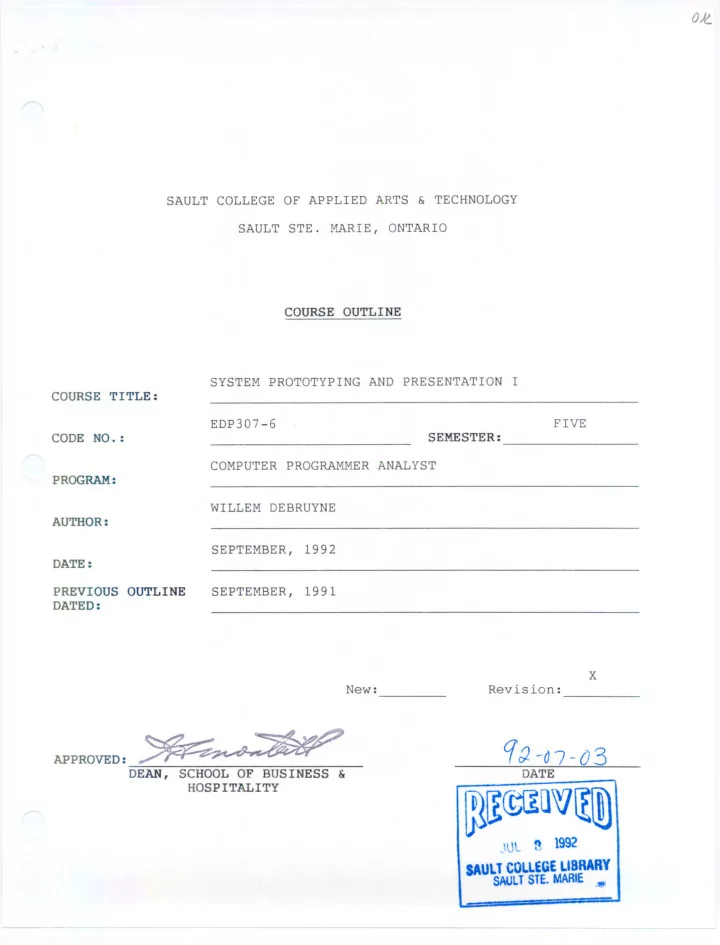
O)l SAULT COLLEGE OF APPLIED ARTS & TECHNOLOGY SAULT STE. MARIE, ONTARIO COURSE OUTLINE SYSTEM PROTOTYPING AND PRESENTATION I COURSE TITLE: FIVE EDP307-6 CODE NO.: SEMESTER: COMPUTER PROGRAMMER ANALYST PROGRAM: WILLEM


slide-1
SLIDE 1

O)l

SAULT COLLEGE OF APPLIED ARTS & TECHNOLOGY SAULT

  • STE. MARIE,

ONTARIO COURSE OUTLINE SYSTEM PROTOTYPING AND PRESENTATION I

COURSE TITLE: EDP307-6

FIVE

CODE NO.: SEMESTER:

COMPUTER PROGRAMMER ANALYST

PROGRAM:

WILLEM DEBRUYNE

AUTHOR:

SEPTEMBER, 1992

DATE:

PREVIOUS OUTLINE DATED: SEPTEMBER, 1991

x

New:

Revision:

SCHOOL OF BUSINESS & HOSPITALITY

l' () -0 7 - 0 3

DATE

~~@}a~~~

JUl ~ 1992 SAULT COLLEGE LIBRARY SAULT ST£. MARIE,_

slide-2
SLIDE 2
  • 2

SYSTEM PROTOTYPING & PRESENTATION I

ED307-6

COURSE NAME COURSE CODE CURRICULUM OVERVIEW:

Prerequisite:

Introduction to Systems Analysis and Design Data Base I Introduction to Fourth Generation Language

Textbook:

Working with Excelerator, Version 1.9, Allen Schmidt COURSE ROLE WITHIN THE PROGRAM: It has been stated that two

  • f

the most severe problems facing Information Systems today is the increasing backlog

  • f service

request and the decline in user confidence. The reasons for these problems stem from the traditional methodologies

  • f developing

systems which are not meeting these needs. The students have studied in detail the traditional development life cycle

  • f

business information systems. They are, therefore, prepared to study this new methodology

  • f proto-

typing and its apparent advantages

  • f

pleasing users, reducing development costs, decreasing communication problems, and so on. The industry is swinging towards prototyping and using tools such as Fourth Generation Languages which prepares the student to meet these new challenges. The student will use the CASE tool Excelerator to assist them in planning, analysis, design, documentation, and construction

  • f

a computer based information system in accordance to

  • ne
  • r

more software development methodologies.

slide-3
SLIDE 3
  • 3

EDP307-6 SYSTEM PROTOTYPING & PRESENTATION I

MODULE 1: MODULE 2: MODULE 3:

Review Systems Analysis and Design role of the systems analyst the system development life cycle systems development methodologies how to anlayze an information system process modelling project dictionary feasibility and cost-benefit analysis fact-finding techniques Prototyping (notes and EDP108 textbook) define prototyping compare prototyping to T.L.C.M. advantages vs disadvantages use prototyping to design and develop a computer based system

(establish project)

Case

(Presentation Topics)

Sign

  • ut booklets,

view video tape Software Requirements Analysis and Spec's

  • software engineering 1.2.1
  • analysis and specification 1.3, 1.3.1, 1.3.2., 1.3.3.

F.A.S.T. 1.4, 1.4.1 Software Requirements Analysis 1.5, 1.5.1, 1.5.2, 1.5.3 Prototyping Options 1.6 Commonly Used Analysis Tech. 1.7, 1.7.1, 1.7.2 Structured Analysis 1.8, 1.8.1, 1.8.2, 1.8.3, 1.8.4 1.9, 1.9.1, 1.9.2, 1.9.3, 1.9.4, 1.9.5, 1.9.6, 1.9.7, 1.9.8, 1.9.9, 1.9.12 Data Modelling 1.10, 1.11, 1.11.1 Analysis and Design Tools 1.12.1, 1.12.2, 1.12.3, 1.12.4

slide-4
SLIDE 4
  • 4 -

EDP307

SYSTEM PROTOTYPING & PRESENT. I

MODULE 4:

Software Design: Impact

  • n the Methodology

2.3, 2.3.1, 2.3.2, 2.4, 2.4.1 2.4.2, 2.4.3, 2.4.4, 2.4.5, 2.4.6, 2.4.7, 2.4.8, 2.4.9 Software Design 2.5, 2.5.1, 2.5.2, 2.5.3, 2.6, 2.6.1, 2.6.2 Procedural Design 2.7, 2.7.1, 2,7,2, 2,7,3, 2,8, 2,8,1, 2,8,2, 2,8,3, 2,8,4 Case: Technical Issues: Integration Issues 3.4.1, 3.4.2, 3.4.4, 3.4.5, 3.4.7, 3.4.8 Defining the Technology 3.6, 3.6.1

  • 3.6.9

Object-oriented programming 3.6.10, 3.6.12, 3.6.13, 3.6.15

Excelerator:

getting started with Excelerator graphics printing saving backups data flow diagrams exploding the D.F.D. drawing techniques structured charts presentation graphs data dictionary data modelling continue in EDP326

slide-5
SLIDE 5

SYSTEM PROTOTYPING & PRESENT. I STUDENT EVALUATION:

EDP307 a) Tests (3 @ 20) 60% Presentation 10% Paper (prototyping) 10% Execelerator Assignment (2 @ 10) 20% 100% b) Grading: A+ 90 A 80 B 70 C 55 R 100% 89% 79% 69% 54%

NOTE: Students are expected to attend classes regularly, participate in class~di5CUssiQn~ conduct themselves and tre9t thei~ peers and inst~uctors Late assignments are subject to a zero grade unless the student has prior permission from the instructor to hand the assignment in at a later date.