A Novel Passive Adhesion Principle and Application for an Inspired - - PowerPoint PPT Presentation

a novel passive adhesion principle and application for an
SMART_READER_LITE
LIVE PREVIEW

A Novel Passive Adhesion Principle and Application for an Inspired - - PowerPoint PPT Presentation

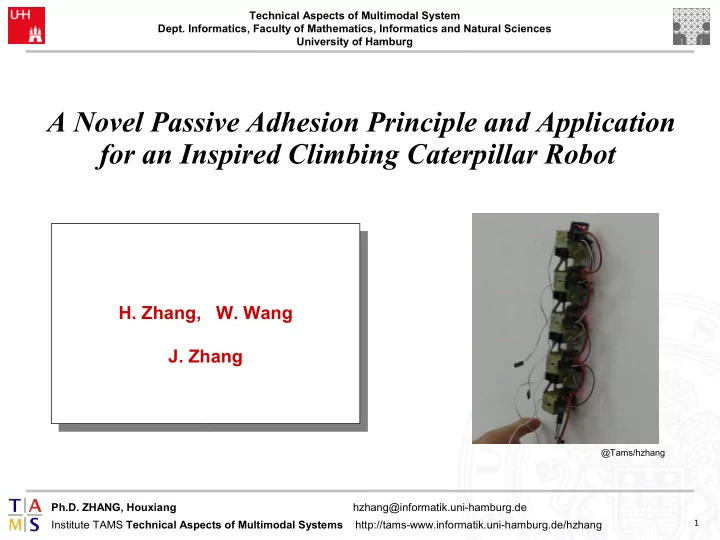
Technical Aspects of Multimodal System Dept. Informatics, Faculty of Mathematics, Informatics and Natural Sciences University of Hamburg A Novel Passive Adhesion Principle and Application for an Inspired Climbing Caterpillar Robot H. Zhang,


slide-1
SLIDE 1

Ph.D. ZHANG, Houxiang hzhang@informatik.uni-hamburg.de Institute TAMS Technical Aspects of Multimodal Systems http://tams-www.informatik.uni-hamburg.de/hzhang

1

Technical Aspects of Multimodal System

  • Dept. Informatics, Faculty of Mathematics, Informatics and Natural Sciences

University of Hamburg

A Novel Passive Adhesion Principle and Application for an Inspired Climbing Caterpillar Robot

  • H. Zhang, W. Wang
  • J. Zhang

@Tams/hzhang

slide-2
SLIDE 2

Ph.D. ZHANG, Houxiang hzhang@informatik.uni-hamburg.de Institute TAMS Technical Aspects of Multimodal Systems http://tams-www.informatik.uni-hamburg.de/hzhang

2

Technical Aspects of Multimodal System

  • Dept. Informatics, Faculty of Mathematics, Informatics and Natural Sciences

University of Hamburg

Outline

  • Review of climbing robots
  • Attachment Methods for Climbing Robots
  • New Passive Adhesion Principle
  • On-site Test on a Climbing Caterpillar Robot
  • Conclusions
slide-3
SLIDE 3

Ph.D. ZHANG, Houxiang hzhang@informatik.uni-hamburg.de Institute TAMS Technical Aspects of Multimodal Systems http://tams-www.informatik.uni-hamburg.de/hzhang

3

Technical Aspects of Multimodal System

  • Dept. Informatics, Faculty of Mathematics, Informatics and Natural Sciences

University of Hamburg

  • A special robot
  • A kind of mobile robot
  • Works and moves vertically on targets

What is a climbing robot

slide-4
SLIDE 4

Ph.D. ZHANG, Houxiang hzhang@informatik.uni-hamburg.de Institute TAMS Technical Aspects of Multimodal Systems http://tams-www.informatik.uni-hamburg.de/hzhang

4

Technical Aspects of Multimodal System

  • Dept. Informatics, Faculty of Mathematics, Informatics and Natural Sciences

University of Hamburg

Climbing robot technology

  • The last decade has seen an increasing interest in developing and

employing climbing mobile robots for

Industrial inspection;

Conducting surveillance;

Urban search and rescue;

Building maintenance;

Inspired research.

  • Two important issues for climbing robots

Attachment principles for climbing robots

Kinematics of climbing prototypes

slide-5
SLIDE 5

Ph.D. ZHANG, Houxiang hzhang@informatik.uni-hamburg.de Institute TAMS Technical Aspects of Multimodal Systems http://tams-www.informatik.uni-hamburg.de/hzhang

5

Technical Aspects of Multimodal System

  • Dept. Informatics, Faculty of Mathematics, Informatics and Natural Sciences

University of Hamburg

  • According to the attachment principles

Electromagnetic force Electromagnetic force

Molecular force Molecular force

Mechanical force Mechanical force

Vacuum Vacuum

Climbing robots classification

According to kinematics

  • Sliding frame robot;

Sliding frame robot;

  • Legged robot ;

Legged robot ;

  • Wheeled robot and chain-

Wheeled robot and chain- tracks tracks

slide-6
SLIDE 6

Ph.D. ZHANG, Houxiang hzhang@informatik.uni-hamburg.de Institute TAMS Technical Aspects of Multimodal Systems http://tams-www.informatik.uni-hamburg.de/hzhang

6

Technical Aspects of Multimodal System

  • Dept. Informatics, Faculty of Mathematics, Informatics and Natural Sciences

University of Hamburg

  • Electromagnetic force is not suitable

for general climbing robots because it

  • nly works on ferromagnetic surfaces.
  • Even if the adhesion is reliable and

easy to control, actuating the electromagnet still requires a big and heavy power supply. =>impossible to apply on light-weight climbing robots except in some special cases

Electromagnetic force

Other examples

slide-7
SLIDE 7

Ph.D. ZHANG, Houxiang hzhang@informatik.uni-hamburg.de Institute TAMS Technical Aspects of Multimodal Systems http://tams-www.informatik.uni-hamburg.de/hzhang

7

Technical Aspects of Multimodal System

  • Dept. Informatics, Faculty of Mathematics, Informatics and Natural Sciences

University of Hamburg

  • With the development of

nanotechnology, molecular force has become a promising reliable attachment principle for climbing from the technical point of view.

  • However, the benefits of this novel

adhesive principle are offset by high manufacturing costs and difficulties. Based on the current level of technology, real industrial application is still some way off.

Molecular force

slide-8
SLIDE 8

Ph.D. ZHANG, Houxiang hzhang@informatik.uni-hamburg.de Institute TAMS Technical Aspects of Multimodal Systems http://tams-www.informatik.uni-hamburg.de/hzhang

8

Technical Aspects of Multimodal System

  • Dept. Informatics, Faculty of Mathematics, Informatics and Natural Sciences

University of Hamburg

  • Grippers are relatively prevalent.

Usually climbing robots based on this attachment method work in a specialized environment such as metal- based buildings.

  • A propeller is another way to provide

the mechanical attachment force. It is very light, but the level of noise generated is too high.

Mechanical force

slide-9
SLIDE 9

Ph.D. ZHANG, Houxiang hzhang@informatik.uni-hamburg.de Institute TAMS Technical Aspects of Multimodal Systems http://tams-www.informatik.uni-hamburg.de/hzhang

9

Technical Aspects of Multimodal System

  • Dept. Informatics, Faculty of Mathematics, Informatics and Natural Sciences

University of Hamburg

  • Actuated by electrical motors in its

negative pressure chamber, the climbing robot can move on the wall flexibly and continuously.

  • The vacuum in the suckers is usually

established by vacuum ejectors or vacuum pumps.

Vacuum

slide-10
SLIDE 10

Ph.D. ZHANG, Houxiang hzhang@informatik.uni-hamburg.de Institute TAMS Technical Aspects of Multimodal Systems http://tams-www.informatik.uni-hamburg.de/hzhang

10

Technical Aspects of Multimodal System

  • Dept. Informatics, Faculty of Mathematics, Informatics and Natural Sciences

University of Hamburg

New Passive Adhesion Principle

  • Low Frequency Vibrating Adhesion
  • Simulation and Rational Testing
slide-11
SLIDE 11

Ph.D. ZHANG, Houxiang hzhang@informatik.uni-hamburg.de Institute TAMS Technical Aspects of Multimodal Systems http://tams-www.informatik.uni-hamburg.de/hzhang

11

Technical Aspects of Multimodal System

  • Dept. Informatics, Faculty of Mathematics, Informatics and Natural Sciences

University of Hamburg

Low-frequency vibrating passive suckers

  • Keep the merits and eliminate the

shortcomings of normal active vacuum suckers

  • Make it possible to avoid the usual

heavy vacuum ejectors and realize an simple adsorption

  • Improve the inspired technological

level and flexibility of the locomotion capability

  • In principle
slide-12
SLIDE 12

Ph.D. ZHANG, Houxiang hzhang@informatik.uni-hamburg.de Institute TAMS Technical Aspects of Multimodal Systems http://tams-www.informatik.uni-hamburg.de/hzhang

12

Technical Aspects of Multimodal System

  • Dept. Informatics, Faculty of Mathematics, Informatics and Natural Sciences

University of Hamburg

Simulation and Rational Testing

  • For idea gas, the following equations represent the passive suckers’ attachment
  • principle. In Fig. a, the passive sucker is at the initial state, where P0, V0, M0, T0 are

the inside pressure, volume, mass of air, and temperature respectively; H is the initial height of passive sucker; r is the radius of the suckers; ρ is the density of the idea air; F is the force for squeezing and lifting.

2 2 2 2

1 ( ) 3 (1 ) 1 3 P r H x PV x P P V H r H π π − = = = −

3 0(

) H x P P H x − = +

slide-13
SLIDE 13

Ph.D. ZHANG, Houxiang hzhang@informatik.uni-hamburg.de Institute TAMS Technical Aspects of Multimodal Systems http://tams-www.informatik.uni-hamburg.de/hzhang

13

Technical Aspects of Multimodal System

  • Dept. Informatics, Faculty of Mathematics, Informatics and Natural Sciences

University of Hamburg

Simulation and Rational Testing

  • A DC motor is used as an oscillator to realize the pushing and lifting

movement automatically

slide-14
SLIDE 14

Ph.D. ZHANG, Houxiang hzhang@informatik.uni-hamburg.de Institute TAMS Technical Aspects of Multimodal Systems http://tams-www.informatik.uni-hamburg.de/hzhang

14

Technical Aspects of Multimodal System

  • Dept. Informatics, Faculty of Mathematics, Informatics and Natural Sciences

University of Hamburg

On-site Test on a Climbing Caterpillar Robot

slide-15
SLIDE 15

Ph.D. ZHANG, Houxiang hzhang@informatik.uni-hamburg.de Institute TAMS Technical Aspects of Multimodal Systems http://tams-www.informatik.uni-hamburg.de/hzhang

15

Technical Aspects of Multimodal System

  • Dept. Informatics, Faculty of Mathematics, Informatics and Natural Sciences

University of Hamburg

Conclusions

  • This paper introduced a new passive attachment method In order to

find an efficient and effective attachment principle which can be adopted by a smart climbing caterpillar.

  • This novel passive sucker make it possible to complete our cooperated

climbing caterpillar idea which meets all requirements of functionality, safety, flexibility, extensibility and easy handling while being completely automatic and able to learn by the robot itself.

  • Still a lot of future work
slide-16
SLIDE 16

Ph.D. ZHANG, Houxiang hzhang@informatik.uni-hamburg.de Institute TAMS Technical Aspects of Multimodal Systems http://tams-www.informatik.uni-hamburg.de/hzhang

16

Technical Aspects of Multimodal System

  • Dept. Informatics, Faculty of Mathematics, Informatics and Natural Sciences

University of Hamburg

Thanks for your attention! Any questions? Any questions?