Reducing Extraneous Processing Modality Principle Jan L. Plass, ECT - - PDF document

reducing extraneous processing modality principle jan l
SMART_READER_LITE
LIVE PREVIEW

Reducing Extraneous Processing Modality Principle Jan L. Plass, ECT - - PDF document

3/29/10 Reducing Extraneous Processing Modality Principle Jan L. Plass, ECT Coherence Principle Contiguity Principle Signaling Principle Club Marian Maid Marian Extraneous Processing (60 min.) Working in groups of


slide-1
SLIDE 1

3/29/10 1

Jan L. Plass, ECT

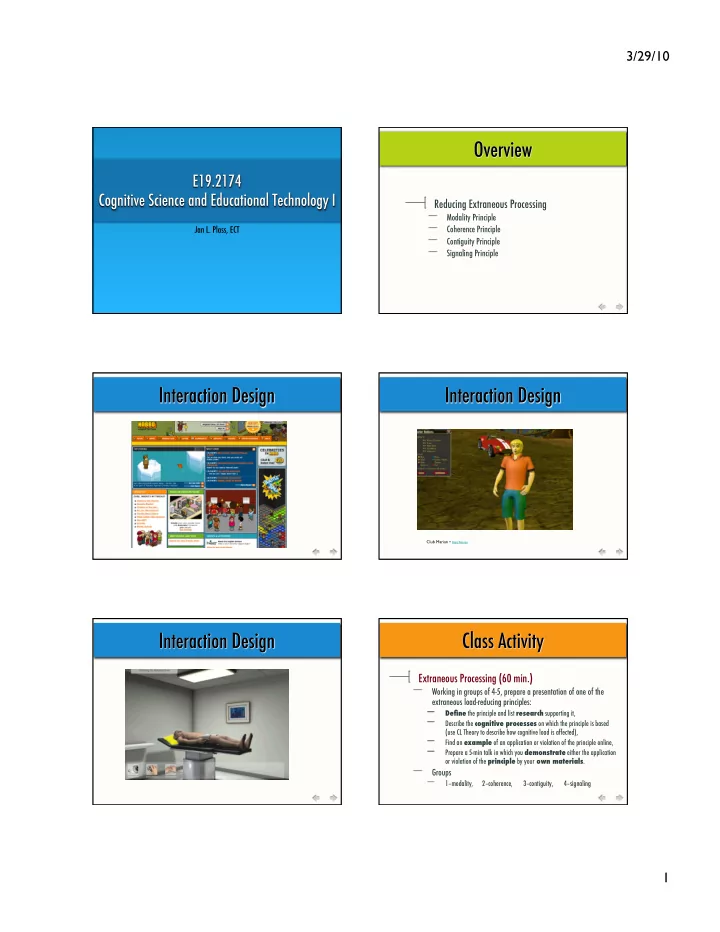
Reducing Extraneous Processing

Modality Principle Coherence Principle Contiguity Principle Signaling Principle

Club Marian • Maid Marian

Extraneous Processing (60 min.)

Working in groups of 4-5, prepare a presentation of one of the extraneous load-reducing principles:

Define the principle and list research supporting it, Describe the cognitive processes on which the principle is based (use CL Theory to describe how cognitive load is affected), Find an example of an application or violation of the principle online, Prepare a 5-min talk in which you demonstrate either the application

  • r violation of the principle by your own materials.

Groups

1–modality, 2–coherence, 3–contiguity, 4–signaling

slide-2
SLIDE 2

3/29/10 2

Modality Principle Modality Principle

Definition

For animations, narration is more effective than on-screen text IF it is essential for understanding Rationale: off-load information from visual to auditory channel

Research Support

Mayer & Moreno, 1998; Moreno & Mayer, 1999, Moreno, Mayer, Spires, & Lester, 2001; Brünken, Steinbacher, Plass, & Leutner, 2002; Brünken, Plass, & Leutner, 2004 (review: Low & Sweller, 2005)

Example

WISE-MD Modules for Surgery Education (NYU)– http://wise-md.med.nyu.edu/

Modality Principle WISE-MD Modules for Surgery Education (NYU)– http://wise-md.med.nyu.edu/ Coherence Principle Coherence Principle

Definition

Exclude rather than include extraneous material in a multimedia presentation

Research Support

Mayer et al., 1996; Harp & Mayer, 1997, 1998; Moreno & Mayer, 2000, Mayer et al., 2001 (Review: Mayer, 2005)

Example

BBC Science and Nature: Human Body & Mind–http://www.bbc.co.uk/science/humanbody/body/

Coherence Principle BBC Science and Nature–http://www.bbc.co.uk/science/humanbody/body/

slide-3
SLIDE 3

3/29/10 3

Contiguity Principle Contiguity Principle (spatial, temporal)

Definition

corresponding information should be presented near one another in time (temporal) and space (spatial contiguity)

Research Support

Mayer, 1989; Sweller et al., 1990; Chandler & Sweller, 1991; Mayer at al., 1995; Tindall-Ford et al., 1997; Moreno & Mayer, 1999 (Review: Mayer, 2005)

Example

Virtual Knee Surgery Site– http://edheads.org/activities/knee/

Contiguity Principle Virtual Knee Surgery Site– http://edheads.org/activities/knee/ Signaling Principle Signaling Principle

Definition

Add cues to highlight the organization of the essential material

Research Support

Harp & Mayer, 1998; Mautone & Mayer, 2001; de Koning, Tabbers, Rikers, & Paas, 2007; Lowe, 2003 (Review: Mayer, 2005)

Example

3D Brain Anatomy (PBS)– http://www.pbs.org/wnet/brain/3d/ Heart - http://www.nhlbi.nih.gov/health/dci/Diseases/hhw/hhw_pumping.html

Signaling Principle Heart - http://www.nhlbi.nih.gov/health/dci/Diseases/hhw/hhw_pumping.html

slide-4
SLIDE 4

3/29/10 4

Signaling Principle 3D Brain Anatomy (PBS)– http://www.pbs.org/wnet/brain/3d/ Reducing extraneous processing in your project

Working in your project groups, discuss how you can apply extraneous load-reducing principles to your project:

Find an example of an application or violation of the principle in your materials, Discuss and document how you addressed this issue and reduced extraneous processing through your design