A High Resolution Vertical Gradient Approach for Delineation of - - PowerPoint PPT Presentation

a high resolution vertical gradient approach
SMART_READER_LITE
LIVE PREVIEW

A High Resolution Vertical Gradient Approach for Delineation of - - PowerPoint PPT Presentation

A High Resolution Vertical Gradient Approach for Delineation of Hydrogeologic Units at a Contaminated Sedimentary Rock Field Site Jessica Meyer 2013 - Solinst Symposium High Resolution, Depth-Discrete Groundwater Monitoring - Benefits &


slide-1
SLIDE 1

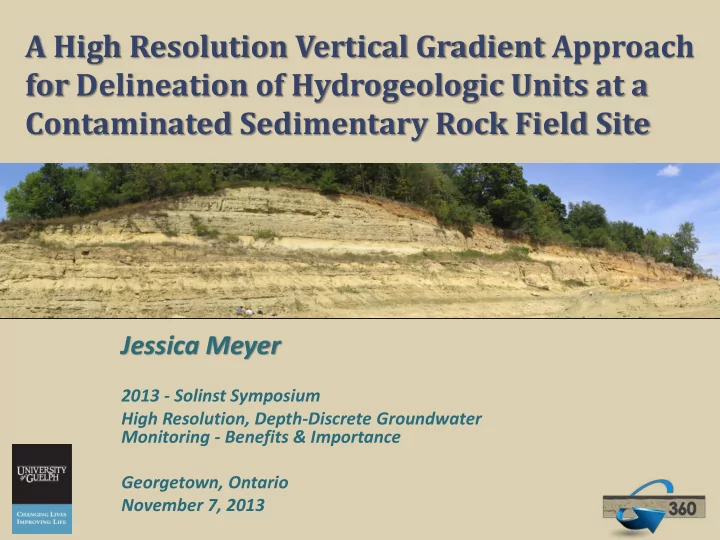
A High Resolution Vertical Gradient Approach for Delineation of Hydrogeologic Units at a Contaminated Sedimentary Rock Field Site

Jessica Meyer

2013 - Solinst Symposium High Resolution, Depth-Discrete Groundwater Monitoring - Benefits & Importance Georgetown, Ontario November 7, 2013

slide-2
SLIDE 2

DNAPL Fractured Rock Site in Southern Wisconsin

Contamination in a fractured sandstone

  • Multicomponent DNAPL source zone
  • Dissolved phase plume ~ 3 km long
slide-3
SLIDE 3

Mixed Organic Contaminants Plume in Fractured Sandstone

  • 154 monitoring

locations

  • 20 multilevel

systems

  • Total of 558

monitoring points

  • Flow generally

toward east to southeast

DNAPL Source Area ~ 72,000 L DNAPL Plume ~ 2.8 km long in 2003 Flow

slide-4
SLIDE 4

Pleistocene Unconsolidated Sediments Cambrian/Ordovician Sedimentary Bedrock

Regional Aquifer

Regional Aquitard Local Aquifer Most laterally extensive dissolved phase plume DNAPL

slide-5
SLIDE 5

Objectives

  • High resolution hydraulic basis for delineation
  • f hydrogeologic units
  • High resolution characterization of the mass

distribution

slide-6
SLIDE 6

Hydrogeologic Units (HGUs) Represent partitions of the groundwater flow domain with contrasting hydraulic conductivities

slide-7
SLIDE 7

Why are HGUs Important Used as a framework for ALL conceptual and numerical models of groundwater flow and contaminant transport

slide-8
SLIDE 8

All Groundwater Studies Require Delineation of HGUs

  • Position
  • Thickness
  • Lateral Extent/geometry
slide-9
SLIDE 9

Hypothesis

Head Depth

High resolution head profiles identify the position / thickness

  • f Kv contrasts that can be used to delineate HGUs

Inflection K = 100 K = 100 K = 100 K = 1 K = 1 Meyer PhD, 2013

slide-10
SLIDE 10

Discrete Fracture Network (DFN) Approach to Site Characterization

Parker et al., 2012, AQUA mundi Drill Corehole Core

Physical / Chemical Properties

Contaminant Analysis

Geology / Fractures

Corehole Hydraulic Tests Geophysics/ Hydrophysics Multilevel Systems

slide-11
SLIDE 11

Multilevel System (MLS)

Generic Multilevel System

Definition: A single device assembled

  • n surface and then

installed in a borehole or a multi-screened casing to divide the hole into many separated intervals for data acquisition from many depth-discrete segments of the hole

Monitoring Interval Sealed Interval

slide-12
SLIDE 12

High Resolution MLS Design Objectives

  • Avoid blending HGUs

– Position monitoring zones and seals based on complimentary data sets – Use short monitoring zones – Seal un-monitored sections of the borehole

  • Maximize the number of monitoring zones
slide-13
SLIDE 13

High Resolution Design

Packer Monitoring Interval

Multilevel System monitors 129.5 m of bedrock 46 monitoring zones 3.6 zones per 10 m 32% sealed

slide-14
SLIDE 14

Schematic Head Profile

Monitoring Interval Packer Seal

Sharp change in head (inflection) No to minimal change in head

Meyer PhD, 2013

slide-15
SLIDE 15

Schematic Vertical Gradient Profile

Upward Gradient Downward Gradient Unresolvable Vertical gradients Meyer PhD, 2013

slide-16
SLIDE 16

Head Profiles are Geometric

Thin sections of large vertical gradient (inflections)

– Relatively low Kv

Thick sections of unresolvable vertical gradient

– Relatively high Kv

Meyer et al. 2008, Meyer PhD 2013

slide-17
SLIDE 17

Head Profiles are Repeatable

Dec 2003 Jun 2009 Aug 2011

Meyer et al. 2008, Meyer PhD 2013

slide-18
SLIDE 18

Comparison to Lithostratigraphy

Relatively low Kv Relatively high Kv

Lithostratigraphy is not predictive of the position/thickness of Kv contrasts

Meyer et al. 2008, Meyer PhD 2013

slide-19
SLIDE 19

Research Questions

  • Do the vertical gradients correlate

between locations

  • What is the geologic basis for the shape
  • f the head/vertical gradient profiles?
slide-20
SLIDE 20

DNAPL Source Area ~ 72,000 L DNAPL Plume ~ 2.8 km long in 2003 Flow

slide-21
SLIDE 21

High Resolution MLS Transect

slide-22
SLIDE 22

Key Points

  • Vertical gradients occur at similar stratigraphic

positions across the site (they correlate!)

  • Indicate laterally extensive contrasts in K
  • K contrasts are not coincident with

lithostratigraphy

slide-23
SLIDE 23

New Basis for Numerical Models

Vertical Gradient Based Bedrock HGUs

No HGU4

slide-24
SLIDE 24

How Much Resolution is Enough?

Lower resolution profiles

  • do not accurately

identify the position and thickness of K contrasts

  • do not identify thin but

important contrasts in K

  • provide inaccurate

(blended) heads and gradients ?

slide-25
SLIDE 25

Acknowledgements

The research presented is a portion of Jessica Meyer’s PhD dissertation.

  • Dr. Beth Parker: Supervisor
  • Dr. John Cherry: Collaborator and committee member
  • Dr. Emmanuelle Arnaud: Collaborator and committee member

Funding and In Kind Support

  • Dr. Beth Parker’s NSERC IRC and the University Consortium for

Field Focused Groundwater Contamination Research Westbay – Schlumberger Canada Ltd., Solinst, FLUTe, Stone Environmental, Golder

slide-26
SLIDE 26

References

Austin, D.C. 2005. Hydrogeologic controls on contaminant distribution within a multi-component DNAPL zone in a sedimentary rock aquifer in south central Wisconsin. Master's thesis, University of Waterloo. Lima, G., B.L. Parker, and J.R. Meyer. 2012. Dechlorinating microorganisms in a sedimentary rock matrix contaminated with a mixture of VOCs. Environmental Science & Technology 46, no.11: 5756-5763. Meyer, J.R., B.L. Parker, and J.A. Cherry. 2008. Detailed hydraulic head profiles as essential data for defining hydrogeologic units in layered fractured sedimentary rock. Environmental Geology 56, no.1: 27-44. Meyer, J.R. 2013. A high resolution vertical gradient approach to hydrogeologic unit delineation in fractured sedimentary rocks. PhD

  • dissertation. University of Guelph.

Parker, B.L., J.A. Cherry, and S.W. Chapman. 2012. Discrete fracture network approach for studying contamination in fractured rock. AQUA mundi 3, no.2: 101-116.