A Global and local perspective Michelle Weinberger, Avenir Health - - PowerPoint PPT Presentation

a global and local perspective
SMART_READER_LITE
LIVE PREVIEW

A Global and local perspective Michelle Weinberger, Avenir Health - - PowerPoint PPT Presentation

UN EGM on Strengthening the Demographic Evidence Base For The Post-2015 Development Agenda, New York, 5-6 October 2015 1 A Global and local perspective Michelle Weinberger, Avenir Health Session 4. Demographic evidence from administrative data


slide-1
SLIDE 1

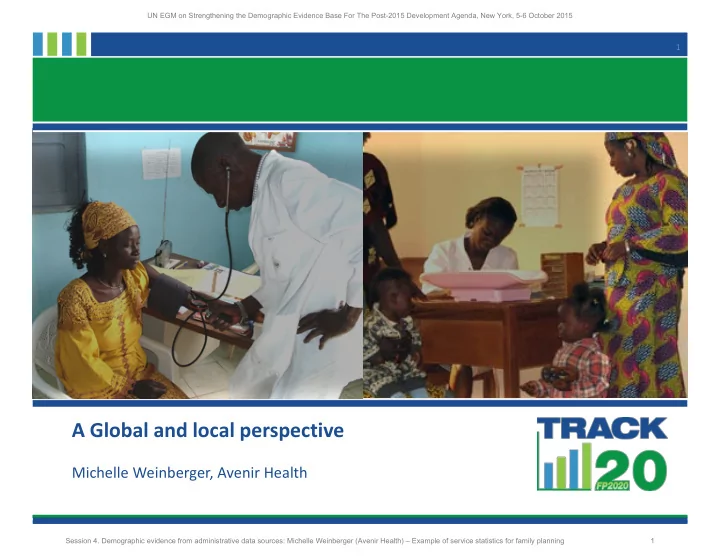
A Global and local perspective

Michelle Weinberger, Avenir Health

1

UN EGM on Strengthening the Demographic Evidence Base For The Post-2015 Development Agenda, New York, 5-6 October 2015 Session 4. Demographic evidence from administrative data sources: Michelle Weinberger (Avenir Health) – Example of service statistics for family planning 1

slide-2
SLIDE 2

2

UN EGM on Strengthening the Demographic Evidence Base For The Post-2015 Development Agenda, New York, 5-6 October 2015 Session 4. Demographic evidence from administrative data sources: Michelle Weinberger (Avenir Health) – Example of service statistics for family planning 2

slide-3
SLIDE 3

 Data routinely recorded in connection with family planning (FP) service delivery  Reported from facility  district  national  Collect information such as:

(Example forms from Kenya MOH)

What are FP service statistics?

3

UN EGM on Strengthening the Demographic Evidence Base For The Post-2015 Development Agenda, New York, 5-6 October 2015 Session 4. Demographic evidence from administrative data sources: Michelle Weinberger (Avenir Health) – Example of service statistics for family planning 3

slide-4
SLIDE 4

 Service statistics were primary source of data for tracking FP program performance prior to 1970 or so.  Due to limitations (upcoming slides) shift to reliance on survey data to track key FP indicators:

  • World Fertility Surveys (WFS) in the early 1970s,
  • Contraceptive Prevalence Surveys (CPS) in the early 1980s,
  • Demographic and Health Surveys (DHS) and the Multiple Indicator Cluster

Surveys (MICS) later

  • PMA2020

 Because of this survey reliance, FP service statistics systems receive relatively little attention and tend not to be relied on or invested in

From service statistics to surveys

4

UN EGM on Strengthening the Demographic Evidence Base For The Post-2015 Development Agenda, New York, 5-6 October 2015 Session 4. Demographic evidence from administrative data sources: Michelle Weinberger (Avenir Health) – Example of service statistics for family planning 4

slide-5
SLIDE 5

Weaknesses:

  • Prone to errors (mistakes, under-

reporting, duplicate reporting, ‘padding’ numbers)

  • Can’t measure some things- e.g.

current use (mCPR)

  • Often include vague concepts

(‘new acceptors’)

  • Don’t always capture private sector

Strengths:

  • Collected at service delivery

level, no additional cost

  • Collected from each individual
  • High geographic detail
  • Available often– usually

monthly

Weighing out the use of service statistics

5

UN EGM on Strengthening the Demographic Evidence Base For The Post-2015 Development Agenda, New York, 5-6 October 2015 Session 4. Demographic evidence from administrative data sources: Michelle Weinberger (Avenir Health) – Example of service statistics for family planning 5

slide-6
SLIDE 6

6

UN EGM on Strengthening the Demographic Evidence Base For The Post-2015 Development Agenda, New York, 5-6 October 2015 Session 4. Demographic evidence from administrative data sources: Michelle Weinberger (Avenir Health) – Example of service statistics for family planning 6

slide-7
SLIDE 7

 Track20 seeking to address weaknesses and find new ways to improve and use service statistics  Why we think this is worthwhile:

1.

Service statistics are the most cost-effective means of providing tracking data on an annual basis

2.

Even if the data are flawed, they may still be useful if the flaws/biases are understood and can be compensated for through modelling

3.

Advances in information technology provides an opportunity to minimize measurement error

Back to service statistics?

7

UN EGM on Strengthening the Demographic Evidence Base For The Post-2015 Development Agenda, New York, 5-6 October 2015 Session 4. Demographic evidence from administrative data sources: Michelle Weinberger (Avenir Health) – Example of service statistics for family planning 7

slide-8
SLIDE 8

 Rapid Assessments in country  Analysis is public sector data  Innovative modelling to develop improved annual estimates (mCPR)

Revitalizing the use of FP service statistics

8

UN EGM on Strengthening the Demographic Evidence Base For The Post-2015 Development Agenda, New York, 5-6 October 2015 Session 4. Demographic evidence from administrative data sources: Michelle Weinberger (Avenir Health) – Example of service statistics for family planning 8

slide-9
SLIDE 9

 Conducted in: Cote d’Ivoire, Ethiopia, India, Indonesia, Kenya, Malawi, Rwanda, Senegal – more in the works.  In-depth reports (around 50 pages) on the current systems for FP data collection, including recommendations for action steps

Rapid Assessments

“Reporting rates are high for public and private clinics (95% or so), but only 80- 90% among private midwives and around 70% for private physicians registered with the National Population and Family Planning Board (BKKBN) to receive government contraceptive commodities.”

–Findings, Indonesia Rapid Assessment

9

UN EGM on Strengthening the Demographic Evidence Base For The Post-2015 Development Agenda, New York, 5-6 October 2015 Session 4. Demographic evidence from administrative data sources: Michelle Weinberger (Avenir Health) – Example of service statistics for family planning 9

slide-10
SLIDE 10

 Track20 conducting analysis of public sector data collected from focus countries– including FP visits, and FP commodities provided

Looking at: smoothness of trends, overall levels, and method mix

Analysis of public sector data

0.00 5.00 10.00 15.00 20.00 25.00 30.00 35.00 40.00 45.00 2012 2013 2014

Zambia: converting service stats to prevalence

Condom Injectable Implant Pills IUD Male sterilization Female sterilization 0.00 5.00 10.00 15.00 20.00 25.00 2010 2011 2012 2013 2014

Burkina Faso: converting service stats to prevalence

Condom Injectable Implant Pills IUD

10

UN EGM on Strengthening the Demographic Evidence Base For The Post-2015 Development Agenda, New York, 5-6 October 2015 Session 4. Demographic evidence from administrative data sources: Michelle Weinberger (Avenir Health) – Example of service statistics for family planning 10
slide-11
SLIDE 11

Analysis of public sector data

0.00 5.00 10.00 15.00 20.00 25.00 30.00 35.00 2007 2008 2009 2010 2011 2012 2013 2014

Uganda: converting service stats to prevalence

Condom Injectable Pills IUD EC 0.00 5.00 10.00 15.00 20.00 25.00 2010 2011 2012 2013 2014

Nepal: converting service stats to prevalence

Condom Injectable Implant Pills IUD EC

11

UN EGM on Strengthening the Demographic Evidence Base For The Post-2015 Development Agenda, New York, 5-6 October 2015 Session 4. Demographic evidence from administrative data sources: Michelle Weinberger (Avenir Health) – Example of service statistics for family planning 11

slide-12
SLIDE 12

 Cannot convert directly from service statistics to mCPR:

  • Under or over-reporting at facility level
  • Coverage of reporting (e.g. not all facilities report)
  • Does not capture discontinuation and non-use of methods provided
  • Does not capture continuation (for IUDs and Implants)

 But, if understand bias, and if bias is more or less constant over time, can adjust for this bias to inform estimates of mCPR

Using service statistics in modelling

12

UN EGM on Strengthening the Demographic Evidence Base For The Post-2015 Development Agenda, New York, 5-6 October 2015 Session 4. Demographic evidence from administrative data sources: Michelle Weinberger (Avenir Health) – Example of service statistics for family planning 12

slide-13
SLIDE 13

Bangladesh example– good fit

10 20 30 40 50 60 1975 1980 1985 1990 1995 2000 2005 2010

Modern CPR

Surveys SS Adjusted

13

UN EGM on Strengthening the Demographic Evidence Base For The Post-2015 Development Agenda, New York, 5-6 October 2015 Session 4. Demographic evidence from administrative data sources: Michelle Weinberger (Avenir Health) – Example of service statistics for family planning 13

slide-14
SLIDE 14

Ethiopia example– less good fit

10 20 30 40 50 60 1990 1995 2000 2005 2010

Modern CPR

Surveys SS Adjusted

14

UN EGM on Strengthening the Demographic Evidence Base For The Post-2015 Development Agenda, New York, 5-6 October 2015 Session 4. Demographic evidence from administrative data sources: Michelle Weinberger (Avenir Health) – Example of service statistics for family planning 14

slide-15
SLIDE 15

 The Family Planning Estimation Tool is a Bayesian, hierarchical statistical model that fits logistic growth curves to historical data  Adapted from UNPD projection model, now allows inclusion of service statistics to inform trends since the last survey

Adding service statistics to FPET

FPET modelled mCPR (married) for Côte d'Ivoire, with and without service statistics

2015 mCPR = 15.2% 2015 mCPR = 16%

15

UN EGM on Strengthening the Demographic Evidence Base For The Post-2015 Development Agenda, New York, 5-6 October 2015 Session 4. Demographic evidence from administrative data sources: Michelle Weinberger (Avenir Health) – Example of service statistics for family planning 15

slide-16
SLIDE 16

 Consistent levels of reporting over time (so changes in volume of service statistics do not represent more facilities reporting, rather than an increase in service delivered)  At least 3 years of consistent data, with at least one year overlapping with a survey, so that the model can celebrate the two trends  At least one year of service statistics reported after the most recent survey- if a survey is the most recent data point, the survey will be used to inform the mCPR trend

Deciding if service statistics can be used

16

UN EGM on Strengthening the Demographic Evidence Base For The Post-2015 Development Agenda, New York, 5-6 October 2015 Session 4. Demographic evidence from administrative data sources: Michelle Weinberger (Avenir Health) – Example of service statistics for family planning 16

slide-17
SLIDE 17

 Promising findings that service statistics can be useful for monitoring at a global and country level  New technologies = potential improvements to data quality (DHIS2)  New modelling techniques = improvements to data usability  Pulling from public and private sector data sources gives a comprehensive picture of family planning in a country  But, many challenges still exist in terms of data quality and usability

Emerging successes

17

UN EGM on Strengthening the Demographic Evidence Base For The Post-2015 Development Agenda, New York, 5-6 October 2015 Session 4. Demographic evidence from administrative data sources: Michelle Weinberger (Avenir Health) – Example of service statistics for family planning 17

slide-18
SLIDE 18

Questions??

18

UN EGM on Strengthening the Demographic Evidence Base For The Post-2015 Development Agenda, New York, 5-6 October 2015 Session 4. Demographic evidence from administrative data sources: Michelle Weinberger (Avenir Health) – Example of service statistics for family planning 18