A Few Experiments in 2D Information 5 June 2018 Background - - PowerPoint PPT Presentation

a few experiments in 2d information
SMART_READER_LITE
LIVE PREVIEW

A Few Experiments in 2D Information 5 June 2018 Background - - PowerPoint PPT Presentation

A Few Experiments in 2D Information 5 June 2018 Background Interests: Probability Theory/Mathematical Physics Modern Probability Theory: Random Matrices, Percolation, Universality results An Interesting Example: Self-Avoiding


slide-1
SLIDE 1

A Few Experiments in 2D Information

5 June 2018
slide-2
SLIDE 2

Background

  • Interests: Probability Theory/Mathematical Physics
  • Modern Probability Theory: Random Matrices, Percolation, Universality results…
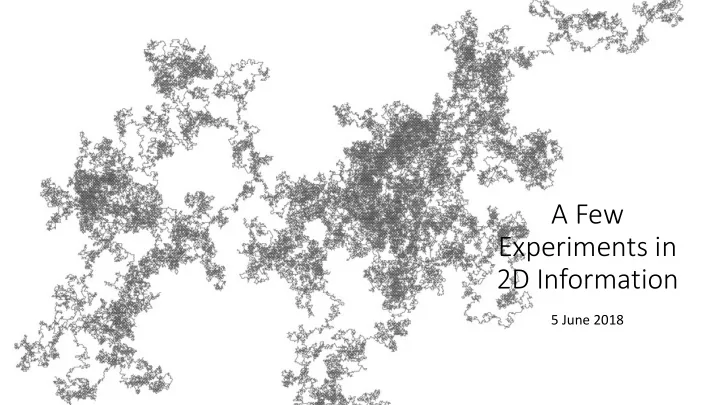
  • An Interesting Example: Self-Avoiding Walks (SAW) and the Connective Constant

!"≈ $"%&'(

  • Honeycomb lattice: $ =

2 + 2 (Duminil-Copin/Smirnov, 2011)

  • , = 43/32 (conjectured) is universal: only depends on dimension
slide-3
SLIDE 3

Background

  • Past project idea: SAWs as an approximation to information theory in 2 dimensions
  • Self avoiding assumption is necessary to avoid unnatural correlations
  • Gather information measures well understood in the 1D setting along paths in a grid
  • Possible suggestion: Delve deeper into study of SAWs using tools of IT
slide-4
SLIDE 4

Motivation and Challenges

  • Generalize measures of information such as Excess Entropy or Entropy Rate
  • Classical IT : Discrete Time Stochastic Processes

!" !#,%

  • For topological reasons 2D case is more interesting
  • Applications to image processing
  • No clear generalization: Use well known 1D techniques
  • Theoretical Difficulties: No canonical way to scan a lattice
  • Computational Difficulties:

&%≈ (%)*+,

  • We are making sampling assumptions about the weight of each path
slide-5
SLIDE 5

Literature

Lempel, Ziv (1986)

  • Assymptotic compressibility: Analogue of

Entropy Rate

  • Does not capture geometrical/causal

structure

  • Peano-Hilbert curve construction

Crutchfield, Feldman (2002)

  • Generalizations of Excess Entropy
  • Works well in the setting of the Ising Model
  • !" can distinguish periodic states that are

structurally distinct; e.g. checkerboard and left diagonal pattern

slide-6
SLIDE 6

Methods: Measures

  • Block entropy:

! " = $

%&∈(&

ℙ(+,) log ℙ(+,)

  • Entropy rate:

lim

3→5

6(3) 3

  • Excess entropy :

7 = 8 9←; 9→ = lim

3→5 8(9<, … 93?@; 93, … 9A3?@)

slide-7
SLIDE 7

Methods: Grid

Checkerboard: No randomness in next step White Noise: Next step is 1

  • r -1 with probability 1/2
slide-8
SLIDE 8

Methods: Generating Paths

  • State emitting HMM: We identify the symbols 1/2/3/4 with directions (resp.) U/R/D/L
  • No theoretical reason to use this; just a convenient way to generate SAWs.
  • We can control potentially interesting aspects like length of walks or drift.
  • MATLAB built-in tool: hmmgenerate
slide-9
SLIDE 9

Experiements: Spectrum of Information

200 Walks generated by the same HMM on a 3x3 checkerboard vs random configuration: With a periodic structure fewer values are attained and the random configuration appears as a “smoothed” version of the checkerboard spectrum.

slide-10
SLIDE 10

Experiments: Sliding Window

  • Idea: 2D Analogue of entropies of length !

substrings in written text.

  • Method: For each grid site consider reassign

its value by the average of an "×" square (Mollification/Heat Eq.)

  • Intuition: More disordered configurations

should have persistently higher entropies at different resolutions.

slide-11
SLIDE 11

Remarks

  • Lack of generality in the definitions might mean that, in practice, structural information has to be

measured on a case by case basis

  • Information measures of structural complexity might not be enough; incorporate notions of

difficulties of learning and synchronizing to patterns

slide-12
SLIDE 12

Acknowledgments and References

Code and suggestions: Jordan Snyder [1] Lempel, Abraham, and Jacob Ziv. "Compression of two dimensional data." Information Theory, IEEE Trans actions on 32.1 (1986): 2.8 [2] Feldman, David P. and James P. Crutchfield. "Structural information in two dimensional patterns: Entropy convergence and excess entropy." Physical Review E 67.5 (2003): 051104 [3] J. P. Crutchfield and D. P. Feldman, "Regularities Unseen, Randomness Observed: Levels of Entropy Convergence", CHAOS 13:1 (2003) 25-54.