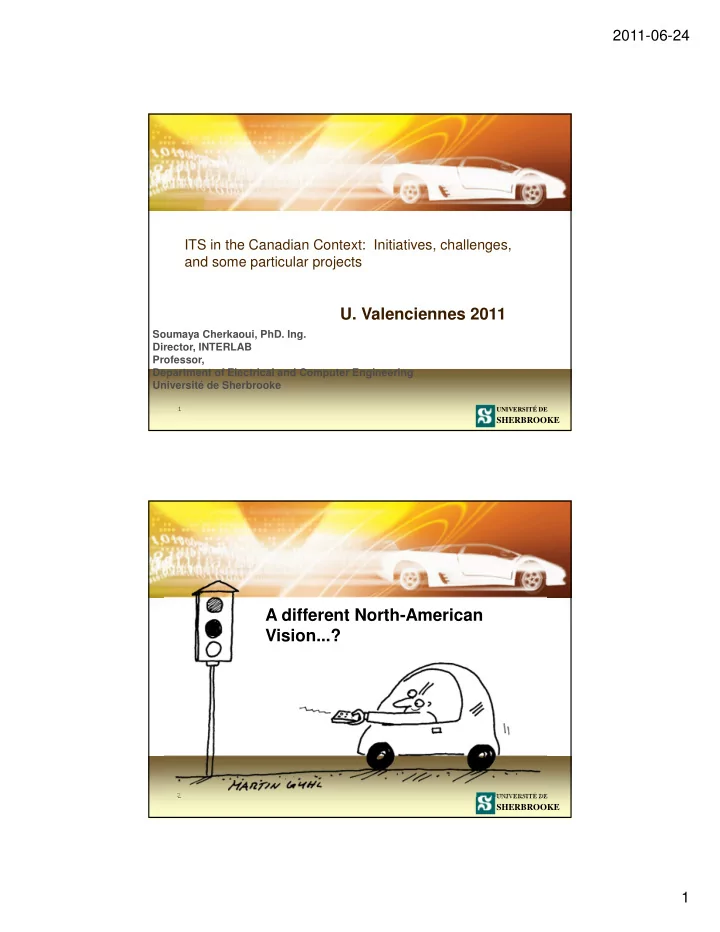
A different North-American Vision...? UNIVERSIT DE SHERBROOKE 1 - - PDF document

a different north american vision
SMART_READER_LITE
LIVE PREVIEW

A different North-American Vision...? UNIVERSIT DE SHERBROOKE 1 - - PDF document

2011-06-24 ITS in the Canadian Context: Initiatives, challenges, and some particular projects U. Valenciennes 2011 Soumaya Cherkaoui, PhD. Ing. Director, INTERLAB Professor, Department of Electrical and Computer Engineering Universit de


slide-1
SLIDE 1

2011-06-24 1

UNIVERSITÉ DE

SHERBROOKE

  • U. Valenciennes 2011

Soumaya Cherkaoui, PhD. Ing. Director, INTERLAB Professor, Department of Electrical and Computer Engineering Université de Sherbrooke

ITS in the Canadian Context: Initiatives, challenges, and some particular projects

UNIVERSITÉ DE

SHERBROOKE

  • A different North-American

Vision...?

slide-2
SLIDE 2

2011-06-24 2

UNIVERSITÉ DE

SHERBROOKE

  • Outline

North American Efforts

  • IntelliDrive in USA
  • Canadian Context
  • AUTO21
  • Transport Canada and

ITS Canada

  • Conclusion

UNIVERSITÉ DE

SHERBROOKE

  • R&D in North America
  • USA: the leader
  • Mexico: R&D almost inexistent in ITS
  • Canada: joint participation with the USA, alignment and programs

complimentarily

NAFTA: CANADA-MEXICO-USA

  • Trilateral meetings on transportation (border passing, freight and

merchandise, security etc.)

Research on Intelligent Vehicles and Infrastructure

slide-3
SLIDE 3

2011-06-24 3

UNIVERSITÉ DE

SHERBROOKE

  • ITS in USA
  • ITS America/US DOT: IntelliDrive (VII before)
  • Michigan: test bed, pilot project and

demonstrations: + 25 vehicles, 57 intersections and highway sections. MIT, Carnegie-Mellon, UMTRI, Rutgers,

  • ORNL: Commercial Motor Vehicle Roadside

Corridor Project –100 km test track for wireless applications and other

  • California
  • U. Berkeley: PATH: first working prototype with

red lights + 40 units deployed over intersections and segments.

  • U. Stanford: CarLab:
  • DARPA Grand Challenge and DARPA Urban

Challenge

  • Greenville SC (CU-iCAR),

UNIVERSITÉ DE

SHERBROOKE

  • R&D on Wireless V2V and V2I Systems
  • FCC in USA allocated 75 MHz at 5.9 GHz for DSRC (licensed)

targeting V2V&V2I applications (active safety).

  • Standards

– IEEE 802.11p (DSRC) working group – WAVE (Wireless Access in Vehicular Environments)

  • There are many multi-million $$ for test bed implementations in USA

and Canada to demonstrate the feasibility of V2V&V2I in active safety for light vehicles based on DSRC.

  • It has been demonstrated, at small scale, in North America that DSRC

technology works in a reliable manner for V2I (vehicle to infrastructure) communications EX. Project CICAS

slide-4
SLIDE 4

2011-06-24 4

UNIVERSITÉ DE

SHERBROOKE

  • Before: VII - “Vehicle-Infrastructure Integration”

– American program aimed at enhancing public safety based exclusively

  • n licensed technology (FCC 75 MHz en 1999) DSRC (5.9GHz

Dedicated Short-Range Communication) – Expanding DSRC applications to enhance mobility (ex. Tolling)

  • Now (IntelliDrive): VIC - Vehicle-Infrastructure Cooperation
  • Vehicle-Infrastructure Coordination
  • Vehicle-Infrastructure Collaboration

– Collaborative, holistic et agnostic to rely information on road environments by using ALL AVAILABLE wireless technologies licensed and/or non-licensed.

VII versus VIC

UNIVERSITÉ DE

SHERBROOKE

  • Original Objectives of VII
  • USA 1999: Big Bang Approach !

– Nationwide deployment of a dedicated communication infrastructure (DSRC) on the road – “Hot Spots” network (~250,000) – Equip Urban and Inter-State highways -- 150,000 km – Equip Main rural roads-- 220,000 km – Euqip 454 biggest urban zones (population > 50,000)

  • Serve ~ 70% total US population
  • Add 15 millions new vehicles equipped with DSRC at 5.9 GHz

every year

  • Develop a nationwide VII architecture and a set of standards
slide-5
SLIDE 5

2011-06-24 5

UNIVERSITÉ DE

SHERBROOKE

  • Expected Original Deployment on US

National Road Network

UNIVERSITÉ DE

SHERBROOKE

  • VII Consortium
  • Initially: an industrial consortium targeted at developing

pre-competitive technology for road safety

  • Nine automobile manufacturers
slide-6
SLIDE 6

2011-06-24 6

UNIVERSITÉ DE

SHERBROOKE

  • Mainly targeted at active Safety V2V

Applications

  • Approaching Emergency Vehicle

Warning

  • Blind Spot Warning
  • Adaptive Cruise Control
  • Cooperative Collision Warning
  • Cooperative Forward Collision

Warning

  • Cooperative Vehicle-Highway

Automation System

  • Emergency Electronic Brake

Lights

  • Highway Merge Assistant
  • Highway/Rail Collision Warning
  • Lane Change Warning
  • Post-Crash Warning
  • Pre-Crash Sensing
  • Vehicle-Based Road Condition

Warning

  • Vehicle-to-Vehicle Road Feature

Notification

  • Visibility Enhancer
  • Wrong Way Driver Warning

UNIVERSITÉ DE

SHERBROOKE

  • Michigan Developmental Test

Environment (DTE)

  • Built at Novi, MI
  • Test bed for VII

– 57 sites with RSE (Road-Side Equipment) – 13 highways; 44 Arteries – + de 100 km2 coverage

  • 200 km of roads
  • Highways: ~80 km
  • Arteries: ~100 km
slide-7
SLIDE 7

2011-06-24 7

UNIVERSITÉ DE

SHERBROOKE

  • Michigan DTE – Private Applications

Next exit services, traveler information Navigation, rerouting Parking School zone Tolling Speed limit, icy bridge, curve ahead Signal timing, EBL

UNIVERSITÉ DE

SHERBROOKE

  • Traveler Information

and Corridor Management Load Balancing Applications All Applications except Signal Timing Optimization Application Signal Timing Optimization Application Ramp Metering Application Weather Information and Corridor Management Planning Assistance Applications use the entire DTE area

Michigan DTE – Public Applications

slide-8
SLIDE 8

2011-06-24 8

UNIVERSITÉ DE

SHERBROOKE

  • California VII Test bed

Vehicles: various manufacturers Infrastructure:

  • 40 RSE installed

Potentiel trafic: 400,000 vehicles:

  • US-101: 215,000
  • SR-82 (El Camino Real): 50,000
  • US-280: 135,000

UNIVERSITÉ DE

SHERBROOKE

  • Information for travelers (no. 511)
  • Collision avoidance at intersections “Intersection

Collision Avoidance (CICAS Project)

  • Electronic payment and tolling
  • Alarms – speeding at curves
  • Private sector applications: vehicle tele diagnostics

California VII Test bed

Applications:

slide-9
SLIDE 9

2011-06-24 9

UNIVERSITÉ DE

SHERBROOKE

  • IntelliDriveSM – VII : Showcase in 2008

UNIVERSITÉ DE

SHERBROOKE

  • What is IntelliDriveSM ?
  • IntelliDriveSM is a set of technologies and applications

which use wireless communication to offer . . .

CONNECTIVITY

  • To, from and between vehicles;
  • Between vehicles and road infrastructure;
  • Between vehicles, road infrastructure, and portable

devices.

slide-10
SLIDE 10

2011-06-24 10

UNIVERSITÉ DE

SHERBROOKE

  • DSRC only

Technology options OEM production units only Aftermarket and retrofit considered All vehicle types Light vehicle focus Focus towards deployment Prototyping/proof of concept Broader stakeholder engagement Limited stakeholders (OEM) Greater program transparency Limited visibility by “outsiders” International harmonization US focus Strong, collective USDOT support, coordination, and leadership Loosely coupled programs

Differences between VII and IntelliDrive

IntelliDrive VII

UNIVERSITÉ DE

SHERBROOKE

  • Similarities between VII and IntelliDrive

Connectivity V2V and V2I National level interoperability

Open standards for communications and data

5.9 GHz DSRC for active safety (& real-time mobility) Safety, mobility, environmental, productivity, convenience applications Applications must not compromise on safety or security Must protect privacy Continued close collaboration among IntelliDrive Coalition

USDOT, AASHTO / local agencies and vehicle manufacturers

slide-11
SLIDE 11

2011-06-24 11

UNIVERSITÉ DE

SHERBROOKE

  • IntelliDriveSM :Plan
  • 5 year Plan for 2009-2014
  • Comprises multiple applications for

– Safety – Mobility – Environment

  • Committed partnership with public and private

sectors

  • Intellidrive becomes real for public in 2014

UNIVERSITÉ DE

SHERBROOKE

  • http://www.intellidriveusa.org/

IntelliDriveSM : More info

slide-12
SLIDE 12

2011-06-24 12

UNIVERSITÉ DE

SHERBROOKE

  • Canada: a particular context
  • Canada population is about 32 millions
  • Canada has about 900000 kms of roads, (22 times

world circumference)

  • Among which 100000 kms of important national

and regional roads

  • Big spaces with little density
  • Big climate variations

UNIVERSITÉ DE

SHERBROOKE

  • Canada: geography

Canadian Automobile Industry

slide-13
SLIDE 13

2011-06-24 13

UNIVERSITÉ DE

SHERBROOKE

  • Part of daily life…
  • Il fait froid…beaucoup de neige … et longtemps!

UNIVERSITÉ DE

SHERBROOKE

  • Not only vehicles on the road
slide-14
SLIDE 14

2011-06-24 14

UNIVERSITÉ DE

SHERBROOKE

  • Dangerous face-to-faces

UNIVERSITÉ DE

SHERBROOKE

  • Big spaces…

…and roads punished by the climate

slide-15
SLIDE 15

2011-06-24 15

UNIVERSITÉ DE

SHERBROOKE

  • Canadian Organizations Involved in R&D
  • n intelligents Vehicles

VISION 2010 Network of Centres of Expertise (CoE) in ITS Canadian Network of Centres of Excellence on the Automobile : www.auto21.ca Pan-Canadian association of organizations and companies working in ITS. Mainly focuses on the deployment of ITS within infrastructure, public and multi-modal transportation. Not much R&D. Annual Conference ITS Canada.

UNIVERSITÉ DE

SHERBROOKE

  • Canada – 7e biggest producer of automobiles worldwide

(10 assembly plants et 5 manufacturing plants).

  • More than 800 of automobile component suppliers, (APMA

association)

  • More than 400,000 Canadians work directly or indirectly in

the automobile sector - 1 /10 in Canada, 1/8 in Ontario.

  • Generates 10% of Canadian manufacturing GNP

Canada: automobile sector

slide-16
SLIDE 16

2011-06-24 16

UNIVERSITÉ DE

SHERBROOKE

  • AUTO21 : description
  • A multi-university network of researchers from a wide range of

disciplines working on a suite of applied research projects in collaboration with the automotive industry. AUTO21 is governed by an industry-led board of directors consisting of senior executives. Six themes of research, each led by an expert theme coordinator. Each theme contains several research projects, each of which is led by

a project leader who coordinates the work of a research team. Project teams consist of several researchers and their graduate students and many work with international collaborators. 4 years Projects are funded by a grant from AUTO21 + cash and in-kind support from industry and the companies that fund the research steer the project.

UNIVERSITÉ DE

SHERBROOKE

  • Membre universities
  • Carleton University

Centre for Addiction & Mental Health Concordia University

  • Dalhousie University

Ecole Polytechnique de Montreal George Brown College

  • HEC Montreal

Hospital for Sick Children IWK Health Centre

  • Lakehead University

Université de Montreal

Université de Sherbrooke

  • Université du Quebec à

Trois-Rivières Université Laval McGill University

  • McMaster University

Queen’s University Ryerson University

  • Royal Military College

Simon Fraser University Trent University

  • University of Alberta

University of British Columbia University of Calgary

  • University of Guelph

University of Manitoba University of New Brunswick

  • University of Ottawa

University of Regina University of Ontario Institute of Tech.

  • University of Saskatchewan

University of Toronto University of Northern British Columbia

  • University of Victoria

University of Waterloo University of Western Ontario

  • University of Windsor

University of Victoria

slide-17
SLIDE 17

2011-06-24 17

UNIVERSITÉ DE

SHERBROOKE

  • Industrial partners (sample)

UNIVERSITÉ DE

SHERBROOKE

  • AUTO21: few numbers

2001 2010 % Change AUTO21 federal $ $5.778 M $5.9 M 0.39% Industry $ $3.03 M $5.8 M +82% Nb researchers 193 312 +62% Nb Projects 28 54 +93% Nb Industry partners 80 220 +175% Nb University institutions 27 43 +59% Nb Grad Students 163 505 +210%

slide-18
SLIDE 18

2011-06-24 18

UNIVERSITÉ DE

SHERBROOKE

  • AUTO21: Research focus

UNIVERSITÉ DE

SHERBROOKE

  • Internet
  • bstacle

Roadside Sensor Network DSRC- Access Point DSRC- Access Point

Roadside Sensor Network

AUTO21: Intelligent systems and sensors

  • Enhance security , efficiency
  • Enhance comfort
  • Make cars more “intelligent”:

communicative, cooperative, aware of their environment

  • HMI within vehicles
  • ...

Objectives:

slide-19
SLIDE 19

2011-06-24 19

UNIVERSITÉ DE

SHERBROOKE

  • List of projects completed in 2010-2011
  • F201-FII

Integrated Vehicle Navigation and Communication Systems Development (Elizabeth Cannon, U Calgary)

  • F202-FVC

Vehicle Communications and Applications (S. Cherkaoui U Sherbrooke, B Chaib-draa U Laval)

  • F203-FCO

Cephalo-Ocular Behaviour & Visual Search Patterns of Drivers (Denis Laurendeau, U Laval)

  • F204-FIN

Smart Technologies for Improved Acoustic Environment of Autos (Alain Berry, U Sherbrooke)

  • F205-FPM

Electrical Power Management and Safety Systems (Shahriar Mirabbasi, UBC)

  • F206-FCD

Dynamic Collaborative Driving (Amir Khajepour, Waterloo)

  • F301-FSN

Wireless MEMS-Based Sensor Nodes For Intelligent Automotive Safety, Comfort, And Performance Systems (Rafaat Mansour, U Waterloo)

  • FC302-FSC Distributed Intelligent Sensing and Control (DISC) for Automotive Factory

Automation (Jonathan Wu, U Windsor)

AUTO21: intelligent systems and sensors

UNIVERSITÉ DE

SHERBROOKE

  • F401-FWS Wireless Sensor Networks for Communicative and Adaptive Cars (Soumaya

Cherkaoui U Sherbrooke Shahrokh Valaee, U of T)

  • F402-FIA A MEMS-Based Intelligent Active Safety System for Vehicles (Sazzadur

Chowdhury Uni. of Windsor)

  • F403-FSE Self Sustained Active Smart Engine Mount Isolators for Future Vehicles (Farid

Golnaraghi, Simon Fraser Uni.)

  • F404-FPS Pollution and Particle Sensors for Environment-Aware Vehicles (Wai-Tung Ng, U
  • f T)
  • FE405-FGE Development of Automotive Glass Exciter technologies for Subwoofer

Applications (Colin Novak, Uni. of Windsor))

List of projects 2011

AUTO21: intelligent systems and sensors
slide-20
SLIDE 20

2011-06-24 20

UNIVERSITÉ DE

SHERBROOKE

  • Objectives:

– Advanced knowledge in (HMI) in car – Optimize ergonomics and security through new embedded HMI – Evaluate technologies – Recommend new regulations and standards for ITS embedded systems. – Evaluate drivers performance

Canadian Automotive Research Simulators

CARS: « Canadian Automotive Research Simulators »

UNIVERSITÉ DE

SHERBROOKE

  • Canadian Automotive Research

Simulators

slide-21
SLIDE 21

2011-06-24 21

UNIVERSITÉ DE

SHERBROOKE

  • University of Calgary Driving

Simulator University of Guelph, DRIVE Lab.

Canadian Automotive Research Simulators

UNIVERSITÉ DE

SHERBROOKE

  • Transport Canada: a particular issue-

border crossing with USA

  • 5000 km of border
  • Congestion means business delays
  • “Border Working Group”, ITS and Customs working group

at both to sides to lower crossing delays of people and merchandise

  • The Border Information Flow Architecture (BIFA)

exchange of data across borders, including vehicle inspection.

slide-22
SLIDE 22

2011-06-24 22

UNIVERSITÉ DE

SHERBROOKE

  • Transport Canada: what is going on now
  • Created CVIS (Cooperative Vehicle

Infrastructure Systems - CVIS) (Not the European

Project)

  • Established a Network of Centres of Expertise

and Test beds across the nation

UNIVERSITÉ DE

SHERBROOKE

  • Transport Canada – Expertise Centers

1) University of Toronto: ITS test bed for traffic management in urban areas 2) University of British Columbia + University of Waterloo: (SAVECOM) Security of freight et merchandise transportation through intelligent commercial corridors 3) Université de Sherbrooke : Mobile road and weather information systems – mRWIS, and management of road data 5) University of Waterloo: Research to support intelligent border- crossing of vehicles and merchandise 4) University of New Brunswick: ITS in rural & low density areas

slide-23
SLIDE 23

2011-06-24 23

UNIVERSITÉ DE

SHERBROOKE

  • Transport Canada: mRWIS in Sherbrooke

Vehicle Infrastructure Coperation applied to Mobile Road Weather Information Systems (mRWIS) Objective: Real-time on the road information for users, better winter road maintenance

  • Develop tools, using sensors, and communication, to obtain real-time information

about road surface temperature, ice detection, anti-freezing materials concentration

  • n road surface, and winter maintenance vehicles activity
  • Tools Integration with road infrastructure and use of vehicle sensors and

communication capabilities to collect data

UNIVERSITÉ DE

SHERBROOKE

  • Transport Canada: CESTI in Sherbrooke

Display panel Private Vehicle Control and decision center Mobile decision and execution unit Sensor Network

slide-24
SLIDE 24

2011-06-24 24

UNIVERSITÉ DE

SHERBROOKE

  • Other relevant Canadian Ongoing

initiatives

NVF: Networked Vehicle Foundation

Ongoing initiative between CATA (Canadian Advanced Technology Alliance) and NRC (National Rechearch Centre) Goal : Establish a north-american instrumented corridor with leading edge technologies for test purppses between Detroit and Quebec (ABOUT 1500KM) Michigan testbed is no longer fit for current R&D. The Networked Highway Test-Bed

UNIVERSITÉ DE

SHERBROOKE

  • Other relevant Canadian Ongoing initiatives

2009-2014: Automotive Partnership Canada (145 M$ for R&D for 3 yrs) : Projects R&D lead by universities on axis defined by industrials.

  • > CTA- Centre des technologies avancées Bombardier Recreational Products-

UdeS (12M$). Hybrid Roadsters California Canada Strategic Innovation Partnership (CCSIP) : ITS work group to initiate R&D collaborative efforts. Canadian partners: AUTO21, Transport Canada, U de Sherbrooke, UofT California partners: PATH (Berkeley), CarLab (Stanford), Caltrans

  • >3 bilateral committee workshops during 2010.

ANR-NSERC: French and Canadian research to collaboration on different issues, including those related to ITS

  • > ACooPerCom: Cooperative Perception and Communication in vehicular

technologies (Ude S, UofT, IFSTTAR, IEF, CIVITEC), 1M$

slide-25
SLIDE 25

2011-06-24 25

UNIVERSITÉ DE

SHERBROOKE

slide-26
SLIDE 26

Vehicle Communications And Applications

Soumaya Cherkaoui*, Brahim Chaib-draaT, Shahrokh Valaee #, Ramiro Liscano&

*Université de Sherbrooke, TLaval Univesity, #Univesity of Toronto, & University of Ontario

Globis Data, Bell Canada, CRIM, ITS Centre Toronto, Intelwaves Technologies, Mark IV

*

slide-27
SLIDE 27

Information Routing Schemes

Target: Routing useful and timely information to the right vehicles

  • n the road without disturbing
  • thers.

Safety messages Transport management Distance delay function. Vehicles are identified according to their relative position on the road (Km X of Road Y).

F202 – Vehicle Communication and Applications

slide-28
SLIDE 28

F202 – Vehicle Communication and Applications

Infotainment: Authentication Authorization- Accounting

On-demand services. PKI model with government trusted authorities and Private trusted authorities Verification of credentials Verification of credit Issuing of certificates Privacy (Vehicle tracking) Incentives for multi-hop collaboration

slide-29
SLIDE 29

Validation through simulation and testing

miniature test bed: vehicles with attenuated communication capabilities (dual wireless cards for V2V/V2I and WiFI) that are monitored from an on-board computer

F202 – Vehicle Communication and Applications

Simulation Testbed

First Implementation of 802.11p draft on NS2 open to community

slide-30
SLIDE 30

Positive Orthogonal Codes (pseudo-

  • rthogonal codes)

F202 – Vehicle Communication and Applications

Multihop Communications Medium Access Control

Virtual relaying

Clustering in Vehicular Networks

Affinity Propagation Message exchange

slide-31
SLIDE 31

Cooperative Adaptive Cruise Control (CACC) System

  • CACC system similar to Adaptive Cruise Control systems, with additional

cooperative decision-making via inter-vehicles communication. The Coordination Layer : Takes into account intentions about high-level driving actions (ie.~lane change) from other vehicles. Coordinates with other vehicles to select future actions in a secure manner. The Action Layer : Takes into account low-level control information (ie. acceleration of front vehicles) to select control actions (throttle, brakes or steering). Takes an accurate driving decision that could help achieve the coordination task assigned by the Coordination Layer. Inter-vehicle communication used to : Share driving intentions for cooperation purposes,

F202 – Vehicle Communication and Applications

slide-32
SLIDE 32

Cooperative Adaptive Cruise Control (CACC) System

F202 – Vehicle Communication and Applications

CACC using reinforcement learning via a Neural Network

slide-33
SLIDE 33

Outputs and outcomes

F202 – Vehicle Communication and Applications

  • This project has resulted in a total of :

Technology transfer to industry partners (KTT Award) during 2010 Training of a total of 17 graduate students (Ph.D and Msc.) and 3

undergraduate students

Publication of 37papers during the project.

slide-34
SLIDE 34

Wireless Sensor Networks for Communicative and Adaptive Cars

Soumaya Cherkaoui*, Shahrokh ValaeeT , Denis Gingras* and Brahim Chaib-draa#

*Université de Sherbrooke, T Univesity of Toronto, # Laval Univesity

  • OPAL-RT
  • OPAL-RT

OpalRT, Purelink, Alizem, Nexus Communications, Defense Research and Development Canada (DRDC) , The Intelligent Transportation Systems Centre (ITS) of Toronto ,

slide-35
SLIDE 35

Wireless Sensor Networks for Communicative and Adaptive Cars

The project has three main components: sensing, communication, and processing. Addresses the fundamental issues crucial for developing solutions that use sensory information with new communication techniques to address issues in the areas

  • f:
  • Vehicular data sensing, sampling, categorization, compression, storing, and retrieval;
  • Short range and long range vehicular communications to complement previous

AUTO21 research

  • Real-time software engineering to conceive efficient sensorial data processing
slide-36
SLIDE 36

F 401– Wireless Sensor Networks for Communicative and Adaptive Cars

Opportunistic Network Coded MAC in Vehicular Networks

  • Goal: Enhance message delivery rate

CognitiveCar

  • Localization

Radar enabled localization

  • Sensing

Compressive sensing

Wireless Sensor Networks for Communicative and Adaptive Cars

slide-37
SLIDE 37

Reader RFID-3 Reader RFID-4 Reader RFID-2 Reader RFID-1 Pr2-T1 Pr3- T1 Pr2- T1 CBL localization based on RSS Pos- T1 Pr4- T1

Pedestrian Localization

22% better

CBL 8% better

Trilateration

Relative SS

  • For one

tentative of localization

  • Confidence

level more 90% CBL

  • U. Sherbrooke (S. Cherkaoui)

CBL 20% better

slide-38
SLIDE 38

Identifying Meaningful Places via Machine Learning

  • Collecting GPS Data via Smartphones (from Cars circulating around and inside cities)
  • Analyzing GPS data using time series
  • Identifying meaningful (and problematic) places using time series and supervised

machine learning

  • Designing recommendation systems for a better flow control
  • Validating the approach on real cars.