INC Briefing Department of Public Works Budget and Management - - PowerPoint PPT Presentation

inc briefing
SMART_READER_LITE
LIVE PREVIEW

INC Briefing Department of Public Works Budget and Management - - PowerPoint PPT Presentation

INC Briefing Department of Public Works Budget and Management Office 1 Todays Presentation Wastewater rate proposal Citywide drainage needs Platte to Park Hill: Stormwater Systems program 2 Why is a Rate Increase Needed 3


slide-1
SLIDE 1

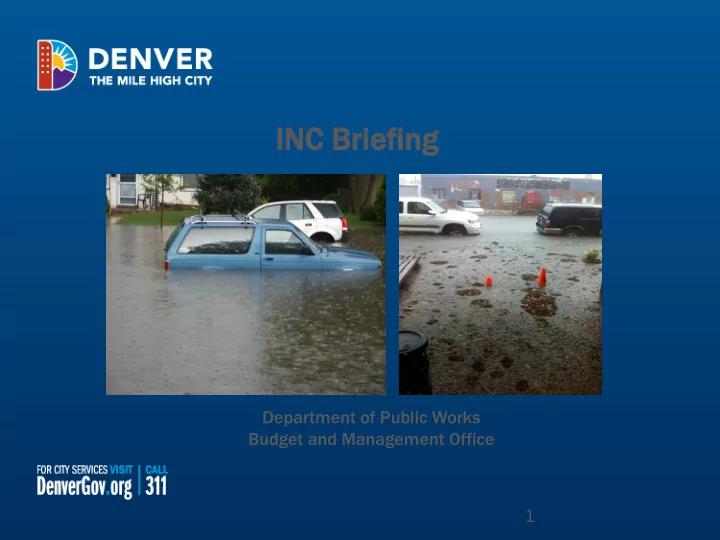
INC Briefing

Department of Public Works Budget and Management Office 1
slide-2
SLIDE 2

Today’s Presentation

– Wastewater rate proposal – Citywide drainage needs – Platte to Park Hill: Stormwater Systems

program

2

slide-3
SLIDE 3

Why is a Rate Increase Needed

3

slide-4
SLIDE 4

Storm & Sanitary Combined Recommended Rate Structures

4

Year

  • Avg. Annual

Combined Single Family Bill (1) Total Increase in Annual Bill 2016 $341.85 $21.56 2017 $365.15 $23.30 2018 $387.90 $22.75 2019 $411 $23.10 2020 $436 $25 Total increase over five-year period is approximately $116 per single family residential home or an average increase of $23 per year.

(1) Assumes 5/8-inch meter, 5,000 gallons of flow, and 7,500 sq. ft. lot with 2,750 sq.

  • ft. impervious area.
slide-5
SLIDE 5

Sewer & Storm Combined Single Family Residential Annual Bill Comparison (2)

5

(1)

Annual charge does not include Storm Utility charges

(2)

5/8-inch meter; 5,000 gallons usage; Lot size 7,500 sq. ft.; Impervious Area 2,750 sq. ft.

slide-6
SLIDE 6

What will the rate increase fund?

  • Six-Year Storm Drainage Capital

Improvement Plan

– $177M, or approximately $30M per year, for storm

drainage capital improvements, addressing

  • Neighborhood Needs – localized storm drainage

improvements citywide ($53M)

  • Focus Basins – Major critical storm drainage

system capital projects to reduce flood risk to life and property ($78M)

6

slide-7
SLIDE 7

7

Citywide Improvements Planned

slide-8
SLIDE 8

Citywide list of planned projects

8

  • 1. Citywide Concrete Repair Annual Program
  • 2. General Storm Drainage Capital Improvement Annual

Program

  • 3. Storm Project Annual Development
  • 4. Storm Drainage Annual Master Plan Implementation
  • 5. Storm Drainage Master Plan Update
  • 6. 33rd Street Outfall
  • 7. Glenbrook Detention Basin
  • 8. E Yale Avenue Storm, Phase I
  • 9. E 16th Avenue Street System, Phase I
  • 10. 27th Street Interceptor, Phase I
  • 11. Lakewood Gulch-Sheridan Phase II, Construction
  • 12. Jackson Street System
  • 13. E 16th Avenue System, Phase II
  • 14. Marion Street System, Phase I
  • 15. Oneida & Tennessee to Cherry Creek, Phase I
  • 16. Park Hill System, Phases VI & 38th Avenue – Dahlia to

Holly

  • 17. UDFCD Study: Sloan’s Lake MDP and FHAD Update

(2016)

  • 18. UDFCD Study: Goldsmith Gulch MDP and FHAD

Update (2017) 19 UDFCD Study: Irondale Gulch OSP Update (2018)

  • 20. UDFCD Study: Sand Creek (downstream of Colfax)

MDP & FHAD (2018)

  • 21. UDFCD Study: Lakewood Gulch MDP and

FHAD (2019)

  • 22. UDFCD CIP: Cherry Creek Stabilization – Holly

to Iliff

  • 23. UDFCD CIP: Bowles Ditch Separation
  • 24. UDFCD CIP: Marston Lake North Drainageway

MDP Implementation (Reaches 7, 8, and 9)

  • 25. Sanderson Gulch, Reach 1
  • 26. USACE River South Study
  • 27. USACE South Platte River Implementation
  • 28. USACE Gulch Improvements (Weir and

Harvard Gulches)

  • 29. Regional Water Quality Project Development
  • 30. Regional Water Quality Construction projects
  • 31. Public Restrooms
  • 32. Annual Critical Sanitary Sewer Lining Program
  • 33. Annual Critical Sanitary Sewer Replacement

Program

  • 34. Annual Sanitary Improvements
  • 35. Annual Sanitary Project Development
  • 36. Sanitary Master Plan Updates
  • 37. E Cherry Creek Sanitary Upsizing
  • 38. 49th Avenue, Phase II
  • 39. York Street Sanitary Improvements
slide-9
SLIDE 9

Priority Basins

9

slide-10
SLIDE 10

Flood Modeling

10

slide-11
SLIDE 11

Platte to Park Hill Projects

11

slide-12
SLIDE 12

Platte to Park Hill Projects

12

Areas of Reduced Flooding

slide-13
SLIDE 13

Platte to Park Hill Funding Sources

  • The budget for Platte to Park Hill is a

range of $267-$298M depending on the use of contingencies.

  • Sources

– $206M Wastewater debt issuance – $63M CDOT funds – $29M Urban Drainage and non-rate

Wastewater & Environmental Service funds

  • The project represents a little over $5 of

the $23 yearly storm and sanitary rate

13

slide-14
SLIDE 14

Denver Post Endorsement

14

slide-15
SLIDE 15

Statements/Response

15 Statement: the Annual Storm Drainage Service Charge will be increased after Jan. 1, 2021 in perpetuity, without a vote by City Council Response: Per City Ordinance, increases to the annual storm and sanitary service charge above and beyond Consumer Price Index (CPI) requires a City Council approval.

slide-16
SLIDE 16

Statements/Response

16 Statement: the P2PH project did not exist in Denver’s 2014 Storm Drainage Master Plan and proceeding with this project will delay other fixes identified in the plan. Response: The master plan is a high level planning tool, not a design

  • document. Justification for P2Ps enlarged backbone drainage

systems is based upon engineering analysis (defines the problem) and the corresponding system size that would be needed to address the potential flood risk (defines the solution). The statement that “proceeding with this project will delay other fixes identified in the plan” is false. The city continually assesses needs based upon a variety of technical and social criteria to create a citywide storm capital program that balances addressing both large projects with small projects, neighborhood needs with priority basin needs, and water quality.

slide-17
SLIDE 17

Statements/Response

17 Statement: The P2PH project, in contrast to the City's representations and photos, will provide little to no flood benefit to the majority of Denver residents who are paying for it, including neighborhoods located within the Montclair and Park Hill basins. Response: The statement is false. P2P is the start to a necessary backbone drainage system for Montclair and a continuation of the backbone system for Park Hill that began in the early 2000’s. For Montclair specifically, P2P will have significant immediate benefit to hundreds of properties north of 39th Avenue. The city recognizes that P2P is not the full solution for Montclair, and even with CPGC detention, more improvements south of the 39th Ave channel will still be needed to fully protect the residents in Cole, Clayton, Skyland & Whittier, however P2P is a big first step in creating a reliable system.

slide-18
SLIDE 18

Statements/Response

18 Statement: According to the January, 2015 MATT Letter of Recommendation, P2PH provides storm drainage primarily for new development: the I-70 expansion, the North Denver Cornerstone Collaborative and the RTD North Metro Rail Line…. Response: The MATT letter says much more:

The recommended technical solution of a combined drainage system would provide benefits for I- 70, the local community, NWC, RTD’s EAGLE and North Metro Lines and the Montclair/Park Hill

  • watersheds. Below are some of the potential benefits:
  • A more robust drainage system for I-70, utilizing two drainage systems in the Montclair Basin

potentially providing a higher factor of safety

  • Additional 100-year storm protection for the area located between the two drainage systems

(40th Avenue/Smith Road to I-70)

  • Enhanced water quality improvements (open channel, green streets, detention/ water quality

ponds)

  • Provide drainage amenity to promote ecological enhancement and economic development
  • Potential recreational amenities for the community
  • Improved mobility/connectivity (vehicular, bicycle, pedestrian)
  • Provides a usable outfall connection for future upstream flood control improvements in both the

Montclair and Park Hill watersheds

  • Increased drainage protection (100 year) for the North Metro Corridor, EAGLE and NWC.
  • Potential cost savings to the North Metro Corridor and NWC depending on timing of the

Combined Drainage Solution

  • Ability to create a multi-agency partnership which provides a common solution that benefits all,

inclusive of the public

slide-19
SLIDE 19

19

Questions?

slide-20
SLIDE 20

20

slide-21
SLIDE 21

More About Globeville

  • Globeville is NOT currently in a FEMA

flood plain

  • The Platte to Park Hill project will NOT put

Globeville back in the flood plain

– The Globeville Landing Outfall, which is a part

  • f P2P, is located on the opposite (east) side
  • f the river as the Globeville neighborhood

– The potential river overtopping along Ringsby

Court occurs upstream of where the P2P project enters the river.

21

slide-22
SLIDE 22

What About Globeville?

When it comes to Globeville, we fully understand that there’s also a need in this neighborhood to address some flooding issues. This rate increase proposal includes:

– $6M in funding to begin implementation of the Army

Corps and UDFCD study of the South Platte River in this area to address overtopping issues along Ringsby Court. This will match an estimated $12M in federal funding.

– $5M per year for citywide “General Storm” projects.

Globeville project needs will be considered each year as part of the annual budget process.

» Projects such as Platte Farm Open Space and 43rd

and Sherman

22

slide-23
SLIDE 23

Rate distribution for Cash CIP Programs

  • Rates attributable to the pay-as-you-go

projects for storm and sanitary:

– Storm

  • Cash funded CIP – Average of 6.3% over 5 years
  • Debt program – Average of 4.3% over 5 years

– Sanitary

  • Cash funded CIP - Average of 2.2% over 5 years
  • Annual O&M - Average of 2.2% over 5 years

23

slide-24
SLIDE 24

Metro Wastewater Charges

  • The Metro Wastewater Reclamation

District treats Denver’s sanitary system, along with dozens of other area cities.

  • We have forecasted the rate they charge

for treatment will increase 8% annually or $17M over the five year forecast.

  • This is a CCD estimate based on historical

experience.

  • Increases would erode the capital program

and decreases would allow for more

24

slide-25
SLIDE 25

Consumer Price Index

– The use of CPI was approved by City Council

in 2011 in order to keep up with basic costs.

– Automatic CPI increases have been noted as

a credit positive by the rating agencies because they are seen as providing revenue certainty.

– Eliminating CPI increases may put the fund’s

credit rating at risk of being downgraded.

25

slide-26
SLIDE 26

Wastewater Reporting

– Wastewater intends to submit a report each

year to Council on the state of the fund and can also present each year as part of the budget process. We will include the review of the CIP projects planned for the following year.

– Council also has the ability to request that

agencies present on their progress as part of the committee process.

26

slide-27
SLIDE 27

Wastewater Fund vs General Fund

  • The General Fund is reimbursed by the

Wastewater fund for activities that support the Wastewater fund activities and has been since 2004.

  • These activities include alley

improvements, snow removal, street sweeping, and curb and gutter.

  • Percentage breakdowns (GF/WW)

– Curb and gutter: 50/50 – Sweeping – 50/50

27

slide-28
SLIDE 28

Platte to Park Hill project

Since providing costs estimates last year in the IGA with CDOT, we’ve:

  • Expanded P2P to provide flood protection

to neighborhood areas south of the channel with detention at City Park Golf Course.

  • Accounted for labor, materials, and real

estate cost escalations

  • Added additional contingency

28

slide-29
SLIDE 29

Storm Drainage System Recommended Rate Structure

29 Storm Drainage Estimated Rate Structure (Annual Billing) $115M revenue bond – Platte to Park Hill (2016) $121M revenue bond - $91M Platte to Park Hill; $30M Storm (2018)

Year Total Avg. Residential Annual Bill Total Rate Change % (Rate w/o CPI) Residential Rate Change $ (YoY) Monthly rate*

2015 $93.48 2.7% $7.89 2016 $103.77 11% (8%) $10.28 $8.64 2017 $115.19 11% (8%) $11.42 $9.59 2018 $127.86 11% (8%) $12.67 $10.65 2019 $140.64 10% (7%) $12.78 $11.72 2020 $154.71 10% (7%) $14.07 $12.89

  • The total impact to residential rate payer is approximately $61 over five years or average of

$12.24 per year.

  • Meets $177M storm capital improvement project needs of system ($30M/year).
  • In order to maintain $30M/year program, a projected rate increase of approximately 9% will

be needed in 2021-2023.

slide-30
SLIDE 30

Proposed Sanitary Sewer Rate Plan

30

Sanitary Sewer Estimated Rate Structure (Monthly Billing )

Year Total Avg. Residential Annual Bill Total Avg. Monthly Bill Total Rate Change % (Rate w/o CPI) Annual Rate Change $ Monthly Rate Change $

2015 $226.80 $18.90 2.7% $6.00 $0.50 2016 $238.08 $19.84 5% (2%) $11.28 $0.94 2017 $249.96 $20.83 5% (2%) $11.88 $0.99 2018 $260.04 $21.67 4% (1%) $10.08 $0.84 2019 $270.36 $22.53 4% (1%) $10.32 $0.86 2020 $281.28 $23.44 4% (1%) $10.92 $0.91

  • Meets capital project needs of sanitary sewer system.
  • Annual program of $8M ($5.3M annual sanitary capital

maintenance, $3M in discretionary sanitary projects).

  • Maintains sufficient cash reserves and debt service

requirements.

  • Long-term financial sustainability of sanitary sewer utility service.