A correspondence between logical translations and ( x y ) y - - PowerPoint PPT Presentation

a correspondence between logical translations and
SMART_READER_LITE
LIVE PREVIEW

A correspondence between logical translations and ( x y ) y - - PowerPoint PPT Presentation

Classical logic CPC is axiomatized the the following axioms x ( y x ) ( x ( y z )) (( x y ) ( x z )) ( x y ) x A correspondence between logical translations and ( x y ) y semantic transformations


slide-1
SLIDE 1

A correspondence between logical translations and semantic transformations

Tommaso Moraschini

Institute of Computer Science of the Czech Academy of Sciences

December 1, 2017

1 / 14

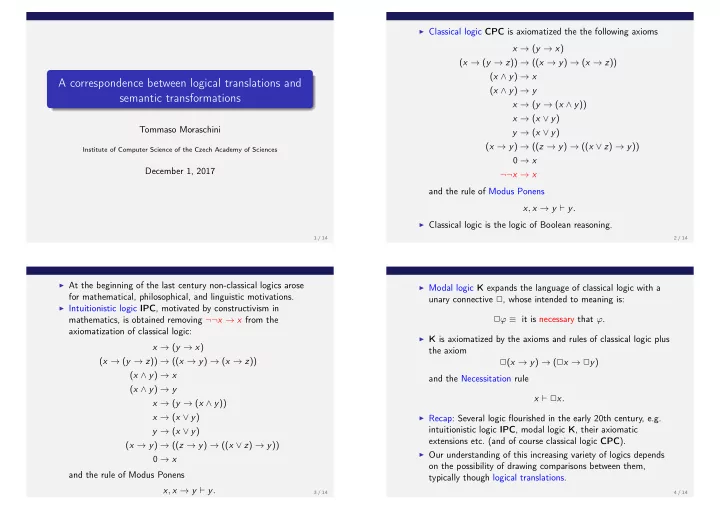
◮ Classical logic CPC is axiomatized the the following axioms

x → (y → x) (x → (y → z)) → ((x → y) → (x → z)) (x ∧ y) → x (x ∧ y) → y x → (y → (x ∧ y)) x → (x ∨ y) y → (x ∨ y) (x → y) → ((z → y) → ((x ∨ z) → y)) 0 → x ¬¬x → x and the rule of Modus Ponens x, x → y ⊢ y.

◮ Classical logic is the logic of Boolean reasoning.

2 / 14

◮ At the beginning of the last century non-classical logics arose

for mathematical, philosophical, and linguistic motivations.

◮ Intuitionistic logic IPC, motivated by constructivism in

mathematics, is obtained removing ¬¬x → x from the axiomatization of classical logic: x → (y → x) (x → (y → z)) → ((x → y) → (x → z)) (x ∧ y) → x (x ∧ y) → y x → (y → (x ∧ y)) x → (x ∨ y) y → (x ∨ y) (x → y) → ((z → y) → ((x ∨ z) → y)) 0 → x and the rule of Modus Ponens x, x → y ⊢ y.

3 / 14

◮ Modal logic K expands the language of classical logic with a

unary connective ✷, whose intended to meaning is: ✷ϕ ≡ it is necessary that ϕ.

◮ K is axiomatized by the axioms and rules of classical logic plus

the axiom ✷(x → y) → (✷x → ✷y) and the Necessitation rule x ⊢ ✷x.

◮ Recap: Several logic flourished in the early 20th century, e.g.

intuitionistic logic IPC, modal logic K, their axiomatic extensions etc. (and of course classical logic CPC).

◮ Our understanding of this increasing variety of logics depends

  • n the possibility of drawing comparisons between them,

typically though logical translations.

4 / 14

slide-2
SLIDE 2

Kolmogorov’s translation of CPC into IPC.

◮ In 1925 Kolmogorov defined a double-negation translation of

the formulas ϕ of CPC into formulas ϕK of IPC as follows: xK := ¬¬x for variables x 0K := 0 (α ∧ β)K := ¬¬(αK ∧ βK) (α ∨ β)K := ¬¬(αK ∨ βK) (α → β)K := ¬¬(αK → βK) (¬α)K := ¬(αK) where in IPC we define ¬ϕ := ϕ → 0.

◮ Kolmogorov’s translation is logically faithful in the sense that

for every set of formulas Γ ∪ {ϕ}, Γ ⊢IPC ϕ ⇐ ⇒ Γ K ⊢CPC ϕK.

5 / 14

Gödel’s translation of IPC into S4.

◮ One of the most important axiomatic extension of the modal

logic K is the system S4 obtained adding the axioms ✷x → x ≡ if ϕ is necessary, then it hlolds ✷x → ✷✷x ≡ if ϕ is necessary, then it is necessarily so.

◮ In 1933 Gödel defined a translation of IPC into S4 as follows:

xG := ¬✷x for variables x 0G := 0 (α ∧ β)G := αG ∧ βG (α ∨ β)G := αG ∨ βG (α → β)G := ✷(αG → βG).

◮ Gödel’s translation is logically faithful:

Γ ⊢IPC ϕ ⇐ ⇒ Γ G ⊢S4 ϕG.

6 / 14

Semantic dual of Kolmogorov’s translation

◮ The algebraic semantics of CPC are Boolean algebras, i.e.

algebras A = A, ∧, ∨, ¬, 0, 1 such that A, ∧, ∨, 0, 1 is a bounded distributive lattice such that a ∨ ¬a = 1 and a ∧ ¬a = 0, for all a ∈ A.

◮ The algebraic semantic of IPC are Heyting algebras, i.e.

algebras A = A, ∧, ∨, →, 0, 1 such that A, ∧, ∨, 0, 1 is a bounded (distributive) lattice and a ∧ b ≤ c ⇐ ⇒ a ≤ b → c, for all a, b, c ∈ A.

◮ Kolmogorov’s translation of IPC into CPC has a semantic

dual, i.e. the transformation Reg: HA → BA A → Reg(A) := Reg(A), ∧, ⊔, ¬, 0, 1 where Reg(A) = {a ∈ A : ¬¬a = 1} and a ⊔ b := ¬¬(a ∨ b).

7 / 14

Semantic dual of Gödel’s translation

◮ The algebraic semantics of S4 are interior algebras, i.e.

algebras A = A, ∧, ¬, ∨, ✷, 0, 1 such that A, ∧, ∨, ¬, 0, 1 is a Boolean algebra and ✷ is an interior operator such that ✷(a ∧ b) = ✷a ∧ ✷b and ✷1 = 1, for all a, b ∈ A.

◮ Gödel’s translation of IPC into S4 has a semantic dual, i.e.

the transformation Op: IA → HA A → Op(A) := Op(A), ∧, ∨, ⊸, 0, 1 where Op(A) = {a ∈ A : ✷a = a} and a ⊸ b := ✷(a → b).

◮ Recap: Kolmogorov and Gödel’s logic translations correspond

to semantics transformations in the reverse direction: (·)K : CPC → IPC and Reg: HA → BA (·)G : IPC → S4 and Op: IA → HA.

8 / 14

slide-3
SLIDE 3

Adjoint Functors

◮ The semantic transformations, dualizing Kolmogorov and

Gödel’s translations, are special instances of the following:

Definition

A pair of functors F : X ← → Y: G is an adjunction if there is a pair

  • f natural transformation η: 1X → GF and ǫ: FG → 1Y such that

1G(B) = G(ǫB) ◦ ηG(B) and 1F(A) = ǫF(A) ◦ F(ηA). for every A ∈ X and B ∈ Y.

◮ In this case F is left adjoint to G and G right adjoint to F. ◮ Under the identification right adjoints = semantic

transformations, proving the equivalence logical translations ≡ semantic transformations amounts to find a syntactic description of right adjoints.

9 / 14

Matrix powers with infinite exponents

◮ Let X be a class of similar algebras and κ > 0 be a cardinal. ◮ Consider the language L κ X whose n-ary operations are the

κ-sequences ti : i < κ where each ti is a term of X in variables x1, . . . , xn.

Definition

Given A ∈ X, let A[κ] be the L κ

X-algebra with universe Aκ s.t.

ti : i < κA[κ]( a1, . . . , an) = tA

i (

a1/ x1, . . . , an/ xn) : i < κ. The κ-th matrix power of X is the class X[κ] := I{A[κ] : A ∈ X}.

◮ This construction extends to a functor [κ]: X → X[κ].

10 / 14

Compatible Equations

Definition

Let X be a class of algebras of language LX and L ⊆ LX. A set

  • f equations θ in one variable is compatible with L in X if for every

n-ary operation ϕ ∈ L we have that: θ(x1) ∪ · · · ∪ θ(xn) X θ(ϕ(x1, . . . , xn)).

◮ For every A ∈ X, we let A(θ, L ) be the algebra of type L

with universe A(θ, L ) = {a ∈ A : A θ(a)} equipped with the restriction of the operations in L .

◮ We obtain a functor

θL : X → I{A(θ, L ) : A ∈ X}.

11 / 14

Logical description of right adjoints

◮ It turns out that, among quasi-varieties,

right adjoints admit a syntactic/logical description.

◮ More precisely, we have the following:

Theorem

Let X and Y be quasi-varieties.

  • 1. For every non-trivial right adjoint

G : Y → X there is a (generalized) quasi-variety K and functors [κ]: Y → K and θL : K → X such that G is naturally isomorphic to θL ◦ [κ].

  • 2. Every functor of the form θL ◦ [κ]: Y → X is a right adjoint.

12 / 14

slide-4
SLIDE 4

◮ This syntactic description of right adjoints (inspired by work of

McKenzie and others) allows to establish a precise correspondence right adjoints ≡ logical translations where the precise meaning of logical translations come from the syntactic canonical form θL ◦ [κ] of right adjoints.

◮ This new notion of logical translation embraces most known

examples, e.g. Kolmogorov and Gödel’s ones. Recap:

◮ One can state a precise correspondence between semantic

transformations (understood as right adjoints) and translations between logics (understood as equational consequences).

◮ This yields an algebraic canonical form for right adjoints. ◮ Some computational results follows, e.g. the problem of

determining whether two finite algebras are related by an adjunction is decidable.

13 / 14

Finally...

...thank you for coming!

14 / 14