A COMPARISON OF IMPLICIT AND EXPLICIT FINITE ELEMENT METHODS FOR THE - - PDF document

a comparison of implicit and explicit finite element
SMART_READER_LITE
LIVE PREVIEW

A COMPARISON OF IMPLICIT AND EXPLICIT FINITE ELEMENT METHODS FOR THE - - PDF document

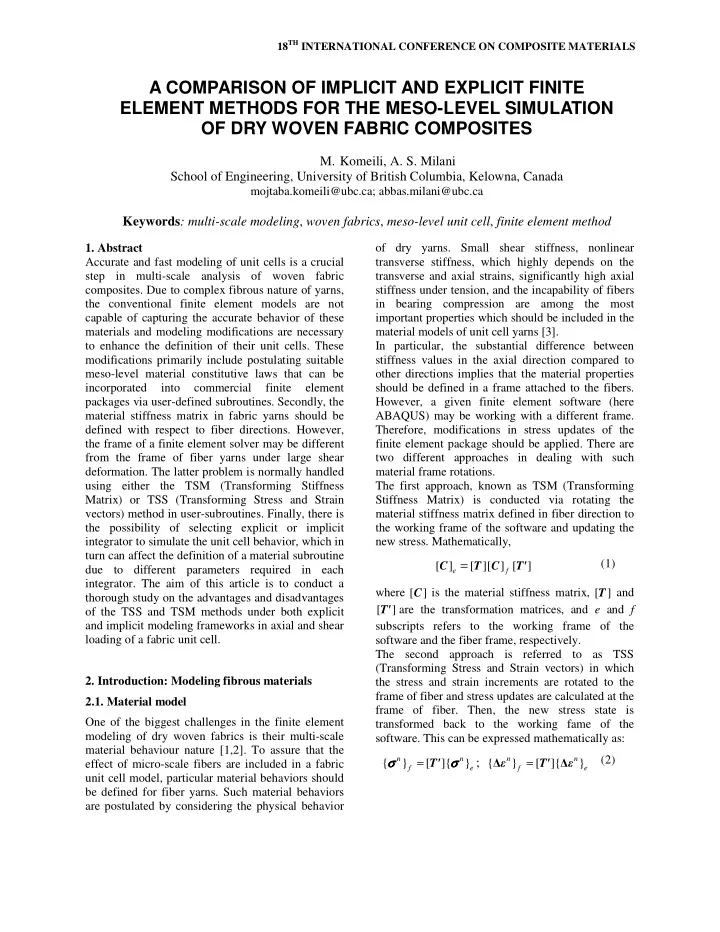
18 TH INTERNATIONAL CONFERENCE ON COMPOSITE MATERIALS A COMPARISON OF IMPLICIT AND EXPLICIT FINITE ELEMENT METHODS FOR THE MESO-LEVEL SIMULATION OF DRY WOVEN FABRIC COMPOSITES M. Komeili, A. S. Milani School of Engineering, University of British


slide-1
SLIDE 1

18TH INTERNATIONAL CONFERENCE ON COMPOSITE MATERIALS

  • 1. Abstract

Accurate and fast modeling of unit cells is a crucial step in multi-scale analysis of woven fabric

  • composites. Due to complex fibrous nature of yarns,

the conventional finite element models are not capable of capturing the accurate behavior of these materials and modeling modifications are necessary to enhance the definition of their unit cells. These modifications primarily include postulating suitable meso-level material constitutive laws that can be incorporated into commercial finite element packages via user-defined subroutines. Secondly, the material stiffness matrix in fabric yarns should be defined with respect to fiber directions. However, the frame of a finite element solver may be different from the frame of fiber yarns under large shear

  • deformation. The latter problem is normally handled

using either the TSM (Transforming Stiffness Matrix) or TSS (Transforming Stress and Strain vectors) method in user-subroutines. Finally, there is the possibility of selecting explicit or implicit integrator to simulate the unit cell behavior, which in turn can affect the definition of a material subroutine due to different parameters required in each

  • integrator. The aim of this article is to conduct a

thorough study on the advantages and disadvantages

  • f the TSS and TSM methods under both explicit

and implicit modeling frameworks in axial and shear loading of a fabric unit cell.

  • 2. Introduction: Modeling fibrous materials

2.1. Material model One of the biggest challenges in the finite element modeling of dry woven fabrics is their multi-scale material behaviour nature [1,2]. To assure that the effect of micro-scale fibers are included in a fabric unit cell model, particular material behaviors should be defined for fiber yarns. Such material behaviors are postulated by considering the physical behavior

  • f dry yarns. Small shear stiffness, nonlinear

transverse stiffness, which highly depends on the transverse and axial strains, significantly high axial stiffness under tension, and the incapability of fibers in bearing compression are among the most important properties which should be included in the material models of unit cell yarns [3]. In particular, the substantial difference between stiffness values in the axial direction compared to

  • ther directions implies that the material properties

should be defined in a frame attached to the fibers. However, a given finite element software (here ABAQUS) may be working with a different frame. Therefore, modifications in stress updates of the finite element package should be applied. There are two different approaches in dealing with such material frame rotations. The first approach, known as TSM (Transforming Stiffness Matrix) is conducted via rotating the material stiffness matrix defined in fiber direction to the working frame of the software and updating the new stress. Mathematically, [ ] [ ][ ] [ ]

e f

=

C T C T' (1) where [ ] C is the material stiffness matrix, [ ] T and [ ] T' are the transformation matrices, and e and f subscripts refers to the working frame of the software and the fiber frame, respectively. The second approach is referred to as TSS (Transforming Stress and Strain vectors) in which the stress and strain increments are rotated to the frame of fiber and stress updates are calculated at the frame of fiber. Then, the new stress state is transformed back to the working fame of the

  • software. This can be expressed mathematically as:

{ } [ ]{ } { } [ ]{ }

;

n n n n f e f e

= =

  • T'
  • T'
  • σ

σ σ σ σ σ σ σ (2)

A COMPARISON OF IMPLICIT AND EXPLICIT FINITE ELEMENT METHODS FOR THE MESO-LEVEL SIMULATION OF DRY WOVEN FABRIC COMPOSITES

  • M. Komeili, A. S. Milani

School of Engineering, University of British Columbia, Kelowna, Canada

mojtaba.komeili@ubc.ca; abbas.milani@ubc.ca

Keywords: multi-scale modeling, woven fabrics, meso-level unit cell, finite element method

slide-2
SLIDE 2

1 1/2

{ } { } [ ] { }

n n n f f f f + +

= +

  • C
  • σ

σ σ σ σ σ σ σ (3)

1 1

{ } [ ]{ }

n n e f + +

= T

σ σ σ σ σ σ σ σ (4) where { } σ σ σ σ and { }

  • are the stress and strain

increments and the superscript refers to the step

  • number. The current fiber direction can be tracked

using the deformation gradient tensor and the initial direction of fiber [2,3]. Apart from choosing a stress update method and applying transformations for stress calculations, the integrator of finite element solver can play an important role in defining a correct unit cell model. It can also affect the accuracy of simulation results and the run time. In this paper, two different integrators (implicit/explicit) and two aforementioned approaches for handling the specific material behavior of yarns are studied under the axial tension and pure shear deformation modes of a plain weave. Comparison of the methods in terms of their convergence and computational cost is presented. 2.2. A simple geometry example case First, to show the difference between using the default material models (stress update) available in built-in modules of Abaqus and the modifications proposed using the TSM or TSS algorithms, a simple case study is illustrated in this section. The geometry is made of a simple 20×20×20 mm unit

  • cube. The assigned material properties contain a

fictitious stiffness, which is relatively high in the axial direction-z compared to other non-zero stiffness components (namely, 50 GPa for the axial component and 5 MPa for the shear and lateral components). The direction of the main axial stiffness and the assigned loading condition on the cube are illustrated in Figure 1. A lateral displacement of 4 units (mm) is applied on the top

  • surface. This induces a stretch ratio of 1=1.0392 in

the main axial direction (along the cube height) which corresponds to an axial stress of 1=1.923

  • GPa. Nearly zero stress components are obtained in

the other directions. It should be noted that the strains are calculated using the logarithmic strain which is the default strain measure used by the software.

The main axial stiffness direction

uy = 4 (mm) ux = 4 (mm) x y z

  • Fig. 1. The schematic of a cube element and applied

loading mode

Results of this finite element model on a single element with the above mentioned stress update models (TSM or TSS) along with two different integrators (implicit or explicit) are compared in Table 1. The table also shows the percentage of error compared to the analytical solution. Results confirm the superior advantage of TSM and TSS compared to the default method by the software.

Table 1. Obtained axial stresses (1) using different combinations of integrator/material models and their error percentages compared to the analytical solution of the problem shown in Fig. 1

Method Explicit Implicit

1 (GPa) Error 1 (GPa) Error

Default 0.994 48.3% 1.013 47.3% TSM 1.983 3.1% 1.961 2.0% TSS 1.983 3.1% 1.961 2.0%

  • 3. Modeling woven fabrics

3.1. Geometry To study the computational effectiveness of each stress update method (TSM or TSS) along with different integrators, a plain woven fabric is selected for the analysis (Figure 2-a). The first step of the analysis is defining a representative element (also known as the unit cell) which can describe the

  • verall behaviour of the fabric [1, 3]. The unit cell

should be as small as possible to reduce the modeling and computation costs, yet it should not be too small not to reflect the actual behaviour of the

  • fabric. There are different types of unit cells

suggested for balanced woven fabrics, based on the applied loading mode and different assumptions on the behaviour of a given fabric [3]. Figure 2-b shows

slide-3
SLIDE 3

3 A COMPARISON OF IMPLICIT AND EXPLICIT FINITE ELEMENT METHODS FOR THE MESO-LEVEL SIMULATION OF DRY WOVEN FABRIC COMPOSITES

the selected unit cell in this study. It consists of four half-yarns and its efficiency under pure axial and shear modes has been proven previously [4]. The geometry of yarns are generated by four sinusoidal curves [4] which are defined using three geometrical parameters including the yarn spacing (S=5.13 mm), the yarn width (w=4.22 mm) and the yarn height (h=0.5 mm). These geometrical factors are selected for a typical weave as described in the study [3].

  • Fig. 2. (a) A balanced plain woven fabric [2]; (b) the

selected unit cell

3.2. Finite element model of the unit cell After generating the geometry of the unit cell using a CAD software (e.g., CATIA), it was imported into the selected finite element software (Abaqus) to simulate basic deformation modes. In order to make the unit cell behave as a segment of a bigger structure (fabric) under homogenous loading, periodic boundary conditions are applied on the boundaries of the unit cell [1, 3]. A glass yarn material behaviour similar to [2] is used in the numerical model via user-defined material subroutines (UMAT for Abaqus/implicit and VUMAT for Abaqus/explicit). Both integrators can carry out the TSM or TSS algorithm. The values of strain, the strain increment and the stress, along with the deformation state (i.e., the deformation gradient and the stretch tensor) in each increment are provided for each subroutine as input and the new stress state is calculated and reported back to the Abaqus solver for the next increment. Because of a low magnitude of shear and transverse stiffness, the model can be prone to singular (hourglass) deformation modes. Therefore, a suitable hourglass control mechanism is also applied. Three different basic loading modes including the uni-axial and bi-axial tension and pure shear are applied on the unit cell and convergence, stability and computational cost of simulations are compared to find the superior stress update method (TSM or TSS) and the integrator (implicit or explicit). The final goal of our current research is the modeling of fabrics under different combined loading modes and manufacturing processes with a computationally efficient and reliable finite element model. In this work, only basic deformation modes are focused on.

  • 4. Numerical results

The axial and shear tests are simulated in a displacement control mode. In the axial test, a predefined displacement is applied on one edge of the unit cell while the opposite edge is fixed. In the shear test, one corner is fixed and the displacement is applied to the opposite corner to simulate a picture frame experimental setup. More details of the deformation in each test and the required boundary conditions are given in, e.g., [3]. 4.1. Divergence and stability 4.1.1 Axial mode For both uni-axial and bi-axial tension tests, a displacement of 0.1 mm is applied to the moving side of the unit cell. This corresponds to an axial strain of = 19.5×10⁻³. The convergence range reported in the following is the percentage of completed analysis with respect to this maximum strain magnitude. The implicit axial loading under two modes (uni- axial and biaxial) is simulated for different shear stiffness (G) and hourglass stiffness (HG) values. An ideal condition is attained when the shear stiffness vanishes and the hourglass stiffness is close to the average shear stiffness (i.e., when the shear stiffness is in the same order of the axial stiffness). However, too small values of the above parameters makes the numerical model unstable and too large values can result in an overestimation of reaction forces. Therefore, a basic sensitivity analysis was conducted to understand the effect of these two parameters on the convergence of the methods. Select results are given in Table 2. It can be concluded that a shear modulus of 5-10 MPa along with an hourglass stiffness of 30 GPa could result in a reasonable convergence range. However, to check if the applied values of G and HG have any undesirable effect on

slide-4
SLIDE 4

the predicted response, the reaction force for different runs were also compared in Figure 3.

Table 2. The convergence range for axial runs using the implicit integrator and the TSM/TSS stress update methods with different G and HG values Run No. G (MPa) HG (GPa) Convergence range uni-axial bi-axial TSM TSS TSM TSS 1 1 30 0% 0% 85% 85% 2 5 10 51% 51% 50% 49% 3 5 30 83% 82% 70% 70% 4 10 10 62% 62% 51% 52% 5 10 30 87% 87% 88% 88%

100 200 300 400 500 600 20 40 60 80 100 R e a c t i

  • n

f

  • r

c e ( N / u n i t c e l l ) Analysis completion percentage

bi-axial

G = 5; HG = 30 G = 5; HG = 10 G = 10; HG = 30 G = 10; HG = 10 50 100 150 200 250 300 350 400 450 500 20 40 60 80 100 R e a c t i

  • n

f

  • r

c e ( N / u n i t c e l l ) Analysis completion percentage

uni-axial

G = 5; HG = 30 G = 5; HG = 10 G = 10; HG = 30 G = 10; HG = 10

  • Fig. 3. The effect of shear modulus and hourglass

stiffness values on the predicted reaction forces of the unit cell in axial loadings (implicit integrator)

It should be mentioned that the results of the TSM and TSS stress updates using the implicit integrator was almost identical. Thus, the results in Figure 3 represent the model predictions for both methods. As it can be seen from Figure 3, in the axial modes there is no noticeable difference between the selected values of shear modulus and hourglass

  • stiffness. Accordingly, a small shear modulus (G = 5

GPa) and a relatively high hourglass stiffness (HG = 30 GPa) were selected for the subsequent analyses. Similar runs were conducted on the axial tension simulations using the explicit integrator. This time the sensitivity analysis was conducted on the shear modulus (G) and the analysis time period (T). The scale factor for time steps in the explicit analysis can be selected as another factor in the sensitivity

  • analysis. However, it drastically increases the run
  • time. Therefore, all the explicit runs reported here

employ an increment time scale of unity. It has also been verified that changing the displacement and viscosity scaling factors, which are the parameters in controlling the hourglass behavior in Abaqus/explicit, does not affect the convergence considerably and therefore the default combined hourglass method of Abaqus/explicit can be reliably applied. The first important point noticed under several simulations of the axial tension using the explicit integrator was that, the explicit integrator may show unpredictable behavior but generally has better convergence and stability under higher G (Table 3). The percentage of convergence values in Table 3 again correspond to the same magnitude of strain as before ( = 19.5×10⁻³).

Table 3. The convergence range for the axial runs using the explicit integrators and the TSM/TSS stress update methods using different G and T value Run No. G (MPa) T (s) Convergence range uni-axial bi-axial TSM TSS TSM TSS 1 5 1 2% 2% 2% 2% 2 20 0.1 8% 1% 8% 1% 3 20 1 13% 14% 18% 18% 4 20 10 1% 1% 1% 14% 5 50 0.1 59% 59% 38% 38% 6 50 1 18% 14% 28% 28% 7 50 10 4% 2% 25% 26% 8 100 0.1 72% 7% 56% 6% 9 100 1 18% 16% 45% 45% 10 100 10 58% 3% 42% 42%

It can be seen from Table 3 that, in general, using lower time periods along with a high shear modulus increases the chance of convergence with the explicit integrator. However, after checking the results of simulations, some dynamic effects

slide-5
SLIDE 5

5 A COMPARISON OF IMPLICIT AND EXPLICIT FINITE ELEMENT METHODS FOR THE MESO-LEVEL SIMULATION OF DRY WOVEN FABRIC COMPOSITES

(including non-homogenous stress/ displacement distribution, descending macro-level stiffness, etc.) and instability state were noticed for very low time period values. As a result, a time period of T=1 (s) along with a shear modulus of G=50 or 100 MPa seemed to be a reasonable parameter set for having both a convergent simulation and reliable results in the axial modes using the explicit integrator. Figure 4 shows the predicted reaction force versus the percentage of analysis completion for G=50 and 100 MPa using the TSM and TSS methods with T=1 (s). Although the results of TSM and TSS are generally close to each other, the effect of shear modulus is clearly distinguished, especially under the uni-axial mode.

5 10 15 20 25 30 5 10 15 R e a c t i

  • n

f

  • r

c e ( N / u n i t c e l l ) Analysis completion percentage

uni-axial

G = 50 (TSM) G = 100 (TSM) G = 50 (TSS) G = 100 (TSS) 50 100 150 200 250 10 20 30 40 R e a c t i

  • n

f

  • r

c e ( N / u n i t c e l l ) Analysis completion percentage

bi-axial

G = 50 (TSM) G = 100 (TSM) G = 50 (TSS) G = 100 (TSS)

  • Fig. 4. The effect of shear modulus and the stress update

method on the predicted reaction forces of the unit cell under axial loadings (explicit integrator)

4.1.2 Shear mode Similar runs were conducted under the shear loading

  • mode. The moving corner has a displacement of

1.54 mm along the diagonal direction, which corresponds to a shear angle of ~45° [3]. Results of several shear runs (using different values

  • f shear modulus and time period) showed that for

the explicit integrator, more unstable results are

  • btained compared to the axial loading modes. In

fact, although the convergence range for some of the shear runs were satisfactory, the trend of the reaction force and stress distribution was not realistic, and even similarities between results of the runs did not

  • exist. On the other hand, the implicit integrator was

unstable at the initiation of simulations but had a stable progress afterwards. Therefore, a relatively higher shear stiffness (G=15 MPa) was selected for the first increment only. After this increment, for each simulation case the shear modulus was replaced by its actual values in Table 2. The interesting fact was that the results of reaction forces predicted by the TSM and TSS methods were again almost identical and had a full convergence over the prescribed displacement range. This could prove more reliability of the implicit integrator in the current study. Figure 5 illustrates the effect of the shear and hourglass stiffness values on the reaction force results in shear mode (implicit integrator). As can be seen, the effect of the shear modulus is generally noticeable whereas the hourglass stiffness only shows an effect at very high shear angles. This indicates that the selected hourglass stiffness values have no adverse effect on the overestimation of reaction forces in low and medium range and might

  • nly induce some overestimation close to the fabric

locking angle.

0.5 1 1.5 2 2.5 3 3.5 4 4.5 5 20 40 60 80 100 120 R e a c t i

  • n

f

  • r

c e ( N / u n i t c e l l ) Analysis completion percentage G = 1; HG = 30 G = 5; HG = 10 G = 5; HG = 30 G = 10; HG = 10 G = 10; HG = 30

  • Fig. 5. The effect of shear modulus and hourglass

stiffness on the predicted reaction force of the unit cell under shear loading (implicit integrator)

slide-6
SLIDE 6

4.2. Computational cost Besides the convergence range and accuracy of the selected models, the computational cost can be an important criterion to choose the optimum analysis technique. In order to compare the computational cost of different methodologies used in Sections 4.1.1 and 4.1.2, the run time of each integrator and the stress update method was recorded. For the implicit integrator, run no. 3 form Table 2 (G=5 MPa; HG=30 GPa) and for the explicit integrator run no. 9 from Table 3 (G=100 MPa and T=1 s) were selected. The reason for selecting these runs was that from the previous results they showed a reasonable convergence range and reliability in predicting the corresponding reaction forces. Nevertheless, their convergence ranges have been different and the total run time might not be a fair comparison measure. Thus, a new normalized run time is defined as the ratio of the computation time to the percentage completion of the analysis. Based on the results in Figure 6, a lower computational cost for the implicit integrator has been found. Moreover, generally speaking, there is no noticeable difference between the TSM and TSS methods for either integrator.

2 4 6 8 10 12 14 16 TSM, Implicit TSS, Implicit TSM, Explicit TSS, Explicit N

  • r

m l i z e d r u n t i m e Selected method (stress update, integrator) uni-axial bi-axial shear

  • Fig. 6. The normalized run-time for each simulation using

different stress update method and integrator

  • 5. Conclusions

A comparative study is conducted

  • n

the effectiveness of different finite element integrators and the modified stress update algorithms that are

  • ften used for the modeling of dry woven fabric unit

cells under axial tension and shear loading modes. The convergence behavior of the models and their run time (computational cost) are compared using different analysis parameters. Results indicated that although the implicit models are harder to handle in terms of generating the analysis and writing subroutines, the reliability of results and the convergence of runs are significantly superior to the explicit models. The implicit integrator also shows less sensitivity to the analysis parameters such as the hourglass stiffness. Furthermore, it allows assigning smaller quasi-zero model values (e.g., for the yarn shear modulus) which in turn would make a fabric model more realistic. Finally, in terms of the computational cost, it needs less run time compared to the explicit method. Between the TSM and TSS approaches, they showed a similar convergence behavior and computational cost in this study. In general, using an implicit integrator along with a user-defined material subroutine, which would use either the TSM or TSS approach for the stress updates, seems to be the best analysis approach for the meso-level finite element modeling of fabric unit

  • cells. It can lead to the most efficient model in view
  • f the accuracy, run time, and convergence criteria.

Acknowledgments The authors would like to acknowledge financial support from the Natural Sciences and Engineering Research Council (NSERC) of Canada. References

[1] P. Badel, E. Vidalsalle, and P. Boisse, “Computational determination of in-plane shear mechanical behaviour

  • f

textile composite reinforcements”. Computational Materials Science,

  • Vol. 40, No. 4, pp 439-448, 2007.

[2] P. Badel, E. Vidalsalle, and P. Boisse, “Large deformation analysis of fibrous materials using rate constitutive equations”. Computers & Structures,

  • Vol. 86, No. 11-12, pp 1164-1175, 2008.

[3] M. Komeili and A. S. Milani “Meso-level analysis of uncertainties in woven fabrics”. VDM Verlag Dr. Müller, 2010. [4] J. Chen, D. S. Lussier, J. Cao, and X. Peng, “Materials characterization methods and material models for stamping of plain woven composites”. International Journal of Forming Processes, Vol. 4, pp 269–284, 2001.