HYPERBOLIC EXPLICIT-PARABOLIC LINEARLY IMPLICIT FINITE DIFFERENCE - - PowerPoint PPT Presentation

hyperbolic explicit parabolic linearly implicit finite
SMART_READER_LITE
LIVE PREVIEW

HYPERBOLIC EXPLICIT-PARABOLIC LINEARLY IMPLICIT FINITE DIFFERENCE - - PowerPoint PPT Presentation

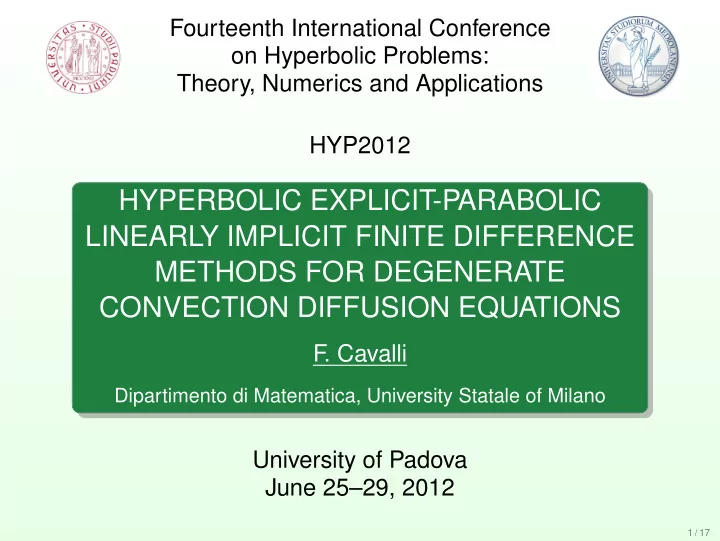
Fourteenth International Conference on Hyperbolic Problems: Theory, Numerics and Applications HYP2012 HYPERBOLIC EXPLICIT-PARABOLIC LINEARLY IMPLICIT FINITE DIFFERENCE METHODS FOR DEGENERATE CONVECTION DIFFUSION EQUATIONS F . Cavalli


slide-1
SLIDE 1

Fourteenth International Conference

  • n Hyperbolic Problems:

Theory, Numerics and Applications HYP2012

HYPERBOLIC EXPLICIT-PARABOLIC LINEARLY IMPLICIT FINITE DIFFERENCE METHODS FOR DEGENERATE CONVECTION DIFFUSION EQUATIONS

F . Cavalli

Dipartimento di Matematica, University Statale of Milano

University of Padova June 25–29, 2012

1 / 17

slide-2
SLIDE 2

Hyperbolic explicit-Parabolic linearly implicit methods Outline ∂tu + ∂xf(u) = ∂xxp(u), (x, t) ∈ [a, b] × [0, T] + boundary conditions and initial datum p(u) non linear, Lipschitz continuous, possibly degenerate (p′(u) = 0) Nonlinear convection-diffusion equation Explicit time integration: ◮ Very accurate, high order schemes, non linear reconstructions ◮ Computationally expensive: ∆t ≤ ch2 Implicit time integration: ◮ Parabolic equation is unconditionally stable ◮ Require non linear iterative solvers, converge for “small” ∆t Numerical approaches for the parabolic term

2 / 17

slide-3
SLIDE 3

Hyperbolic explicit-Parabolic linearly implicit methods Outline ∂tu + ∂xf(u) = ∂xxp(u), (x, t) ∈ [a, b] × [0, T] + boundary conditions and initial datum p(u) non linear, Lipschitz continuous, possibly degenerate (p′(u) = 0) Nonlinear convection-diffusion equation Explicit time integration: ◮ Very accurate, high order schemes, non linear reconstructions ◮ Computationally expensive: ∆t ≤ ch2 Implicit time integration: ◮ Parabolic equation is unconditionally stable ◮ Require non linear iterative solvers, converge for “small” ∆t Numerical approaches for the parabolic term

2 / 17

slide-4
SLIDE 4

Hyperbolic explicit-Parabolic linearly implicit methods Outline ∂tu + ∂xf(u) = ∂xxp(u), (x, t) ∈ [a, b] × [0, T] + boundary conditions and initial datum p(u) non linear, Lipschitz continuous, possibly degenerate (p′(u) = 0) Nonlinear convection-diffusion equation Explicit time integration: ◮ Very accurate, high order schemes, non linear reconstructions ◮ Computationally expensive: ∆t ≤ ch2 Implicit time integration: ◮ Parabolic equation is unconditionally stable ◮ Require non linear iterative solvers, converge for “small” ∆t Numerical approaches for the parabolic term

2 / 17

slide-5
SLIDE 5

Hyperbolic explicit-Parabolic linearly implicit methods Outline ∂tu + ∂xf(u) = ∂xxp(u), (x, t) ∈ [a, b] × [0, T] + boundary conditions and initial datum p(u) non linear, Lipschitz continuous, possibly degenerate (p′(u) = 0) Nonlinear convection-diffusion equation Explicit time integration: ◮ Very accurate, high order schemes, non linear reconstructions ◮ Computationally expensive: ∆t ≤ ch2 Implicit time integration: ◮ Parabolic equation is unconditionally stable ◮ Require non linear iterative solvers, converge for “small” ∆t Numerical approaches for the parabolic term

2 / 17

slide-6
SLIDE 6

Parabolic non linear equation

Semi discrete scheme

◮ Avoid parabolic stability constraints, only ∆t ≤ ch ◮ Avoid to solve non linear implicit problems ◮ Develop high order schemes for smooth solutions ◮ Be accurate where solution is non smooth

Goals Non linear Chernoff formula based schemes 1      qn = p(un)/ξ qn+1 = qn + ∆t∂xxξqn+1 un+1 = un + qn+1 − qn Stability is proved under condition ξ ≥ Lp Poor accuracy, first order scheme Linear implicit

1Berger, A.; Brezis, H. Rogers, J. A numerical method for solving the problem

ut − ∆f(u) = 0 RAIRO numerical analysis, 1979, 13, 297-312

3 / 17

slide-7
SLIDE 7

Parabolic non linear equation

Semi discrete scheme

◮ Avoid parabolic stability constraints, only ∆t ≤ ch ◮ Avoid to solve non linear implicit problems ◮ Develop high order schemes for smooth solutions ◮ Be accurate where solution is non smooth

Goals Non linear Chernoff formula based schemes 1      qn = p(un)/ξ qn+1 = qn + ∆t∂xxξqn+1 un+1 = un + qn+1 − qn Stability is proved under condition ξ ≥ Lp Poor accuracy, first order scheme Linear implicit

1Berger, A.; Brezis, H. Rogers, J. A numerical method for solving the problem

ut − ∆f(u) = 0 RAIRO numerical analysis, 1979, 13, 297-312

3 / 17

slide-8
SLIDE 8

Parabolic non linear equation

Semi discrete scheme

◮ Avoid parabolic stability constraints, only ∆t ≤ ch ◮ Avoid to solve non linear implicit problems ◮ Develop high order schemes for smooth solutions ◮ Be accurate where solution is non smooth

Goals Non linear Chernoff formula based schemes 1      qn = p(un)/ξ qn+1 = qn + ∆t∂xxξqn+1 un+1 = un + qn+1 − qn Stability is proved under condition ξ ≥ Lp Poor accuracy, first order scheme Linear implicit

1Berger, A.; Brezis, H. Rogers, J. A numerical method for solving the problem

ut − ∆f(u) = 0 RAIRO numerical analysis, 1979, 13, 297-312

3 / 17

slide-9
SLIDE 9

Parabolic non linear equation

Semi discrete scheme

◮ Avoid parabolic stability constraints, only ∆t ≤ ch ◮ Avoid to solve non linear implicit problems ◮ Develop high order schemes for smooth solutions ◮ Be accurate where solution is non smooth

Goals Non linear Chernoff formula based schemes 1      qn = p(un)/ξ qn+1 = qn + ∆t∂xxξqn+1 un+1 = un + qn+1 − qn Stability is proved under condition ξ ≥ Lp Poor accuracy, first order scheme Linear implicit

1Berger, A.; Brezis, H. Rogers, J. A numerical method for solving the problem

ut − ∆f(u) = 0 RAIRO numerical analysis, 1979, 13, 297-312

3 / 17

slide-10
SLIDE 10

Parabolic non linear equation

Semi discrete scheme

◮ Avoid parabolic stability constraints, only ∆t ≤ ch ◮ Avoid to solve non linear implicit problems ◮ Develop high order schemes for smooth solutions ◮ Be accurate where solution is non smooth

Goals Non linear Chernoff formula based schemes 1      qn = p(un)/ξ qn+1 = qn + ∆t∂xxξqn+1 un+1 = un + qn+1 − qn Stability is proved under condition ξ ≥ Lp Poor accuracy, first order scheme Linear implicit

1Berger, A.; Brezis, H. Rogers, J. A numerical method for solving the problem

ut − ∆f(u) = 0 RAIRO numerical analysis, 1979, 13, 297-312

3 / 17

slide-11
SLIDE 11

Parabolic non linear equation

Semi discrete scheme

◮ Avoid parabolic stability constraints, only ∆t ≤ ch ◮ Avoid to solve non linear implicit problems ◮ Develop high order schemes for smooth solutions ◮ Be accurate where solution is non smooth

Goals Non linear Chernoff formula based schemes 1      qn = p(un)/ξ qn+1 = qn + ∆t∂xxξqn+1 un+1 = un + qn+1 − qn Stability is proved under condition ξ ≥ Lp Poor accuracy, first order scheme Linear implicit

1Berger, A.; Brezis, H. Rogers, J. A numerical method for solving the problem

ut − ∆f(u) = 0 RAIRO numerical analysis, 1979, 13, 297-312

3 / 17

slide-12
SLIDE 12

Parabolic non linear equation

Semi discrete scheme

◮ Avoid parabolic stability constraints, only ∆t ≤ ch ◮ Avoid to solve non linear implicit problems ◮ Develop high order schemes for smooth solutions ◮ Be accurate where solution is non smooth

Goals Non linear Chernoff formula based schemes 1      qn = p(un)/ξ qn+1 = qn + ∆t∂xxξqn+1 un+1 = un + qn+1 − qn Stability is proved under condition ξ ≥ Lp Poor accuracy, first order scheme Linear implicit

1Berger, A.; Brezis, H. Rogers, J. A numerical method for solving the problem

ut − ∆f(u) = 0 RAIRO numerical analysis, 1979, 13, 297-312

3 / 17

slide-13
SLIDE 13

Non linearity

Brezis scheme Example p(u) = u3

very inaccurate near degeneracy inaccurate

Solution: more local1 2 3 form of ξ, in particular near degeneracy

1J¨

ager, W.; Kaˆ cur J., Solution of porous medium type systems by linear approximation schemes, Numer. Math. (1991) 60: 407–427

2Pop, I.S.; Yong, W. A., A numerical approach to degenerate parabolic equations

  • Numer. Math. (2002) 92: 357–381

3Slodiˆ

cka, M., Approximation of a nonlinear degenerate parabolic equation via a linear relaxation scheme, Numerical Methods for Partial Differential Equations (2005) Vol 21 Issue 2 191–212

4 / 17

slide-14
SLIDE 14

Non linearity

Brezis scheme Example p(u) = u3

very inaccurate near degeneracy inaccurate

Solution: more local1 2 3 form of ξ, in particular near degeneracy

1J¨

ager, W.; Kaˆ cur J., Solution of porous medium type systems by linear approximation schemes, Numer. Math. (1991) 60: 407–427

2Pop, I.S.; Yong, W. A., A numerical approach to degenerate parabolic equations

  • Numer. Math. (2002) 92: 357–381

3Slodiˆ

cka, M., Approximation of a nonlinear degenerate parabolic equation via a linear relaxation scheme, Numerical Methods for Partial Differential Equations (2005) Vol 21 Issue 2 191–212

4 / 17

slide-15
SLIDE 15

Accuracy

Locally corrected scheme ξ = p′(un) : in general we do not have a stable scheme Correction: we consider ξ(un

h) = min (p′(un h) + α(un h), Lp)

with α(un

h) ≥ 0, for example

α ξ

5 / 17

slide-16
SLIDE 16

Convection Diffusion problem

First order modified Explicit convection Linear implicit diffusion        qn = p(un) ξ(un) qn+1 + ∆t∂xf(un) = qn + ∆t∂xx(ξ(un)qn+1) un+1 = un + qn+1 − qn

◮ Linearly implicit: no iterative methods for non linear problems ◮ Accurate, generalizable to higher order IMEX schemes1

IMEX(1,1,1) scheme

1Ascher U.; Ruuth S.; Spiteri R., Implicit-explicit Runge-Kutta methods for

time-dependent partial differential equations, Applied Numerical Mathematics (1997) Vol 25 Issue 2–3 151–167

6 / 17

slide-17
SLIDE 17

Convection Diffusion problem

First order modified Explicit convection Linear implicit diffusion        qn = p(un) ξ(un) qn+1 + ∆t∂xf(un) = qn + ∆t∂xx(ξ(un)qn+1) un+1 = un + qn+1 − qn

◮ Linearly implicit: no iterative methods for non linear problems ◮ Accurate, generalizable to higher order IMEX schemes1

IMEX(1,1,1) scheme

1Ascher U.; Ruuth S.; Spiteri R., Implicit-explicit Runge-Kutta methods for

time-dependent partial differential equations, Applied Numerical Mathematics (1997) Vol 25 Issue 2–3 151–167

6 / 17

slide-18
SLIDE 18

Convection Diffusion problem

First order modified Explicit convection Linear implicit diffusion        qn = p(un) ξ(un) qn+1 + ∆t∂xf(un) = qn + ∆t∂xx(ξ(un)qn+1) un+1 = un + qn+1 − qn

◮ Linearly implicit: no iterative methods for non linear problems ◮ Accurate, generalizable to higher order IMEX schemes1

IMEX(1,1,1) scheme

1Ascher U.; Ruuth S.; Spiteri R., Implicit-explicit Runge-Kutta methods for

time-dependent partial differential equations, Applied Numerical Mathematics (1997) Vol 25 Issue 2–3 151–167

6 / 17

slide-19
SLIDE 19

Space discretization

         qn

i = p(un i )

ξ(un

i )

qn+1

i

+ ∆t(Dhun

h)i = qn i + ∆t(Lhξ(un h)qn+1 h

)i un+1

i

= un

i + qn+1 i

− qn

i

Fully discrete Lh : discrete operator approximating ∂xx Dh : discrete operator approximating ∂xf, for example (Dhuh)i ≈ (∂x(f(u)))i ≈ ˆ Fi+1/2(uh) − ˆ Fi−1/2(uh) h where ˆ F is a numerical flux, we can use non linear reconstructions (ENO scheme) Finite difference operators

7 / 17

slide-20
SLIDE 20

Space discretization

         qn

i = p(un i )

ξ(un

i )

qn+1

i

+ ∆t(Dhun

h)i = qn i + ∆t(Lhξ(un h)qn+1 h

)i un+1

i

= un

i + qn+1 i

− qn

i

Fully discrete Lh : discrete operator approximating ∂xx Dh : discrete operator approximating ∂xf, for example (Dhuh)i ≈ (∂x(f(u)))i ≈ ˆ Fi+1/2(uh) − ˆ Fi−1/2(uh) h where ˆ F is a numerical flux, we can use non linear reconstructions (ENO scheme) Finite difference operators

7 / 17

slide-21
SLIDE 21

Analysis of first order scheme

We have the following results for convex p(u)

◮ The method is consistent with the problem ◮ Each system involved is non-singular for α ≥ 0

Consistency

◮ we can find α = C for which the scheme is stable if the

hyperbolic problem is stable (parabolic problem is unconditionally stable in maximum norm, i.e. if un∞ ≤ M then un+1∞ ≤ M).

◮ If the analytical solution is sufficiently smooth on [a, b] × [tn, tn+1]

then C = c∆t;

◮ C is bounded from above uniformly for ∆t, h → 0

Stability

8 / 17

slide-22
SLIDE 22

Analysis of first order scheme

We have the following results for convex p(u)

◮ The method is consistent with the problem ◮ Each system involved is non-singular for α ≥ 0

Consistency

◮ we can find α = C for which the scheme is stable if the

hyperbolic problem is stable (parabolic problem is unconditionally stable in maximum norm, i.e. if un∞ ≤ M then un+1∞ ≤ M).

◮ If the analytical solution is sufficiently smooth on [a, b] × [tn, tn+1]

then C = c∆t;

◮ C is bounded from above uniformly for ∆t, h → 0

Stability

8 / 17

slide-23
SLIDE 23

Analysis of first order scheme

We have the following results for convex p(u)

◮ The method is consistent with the problem ◮ Each system involved is non-singular for α ≥ 0

Consistency

◮ we can find α = C for which the scheme is stable if the

hyperbolic problem is stable (parabolic problem is unconditionally stable in maximum norm, i.e. if un∞ ≤ M then un+1∞ ≤ M).

◮ If the analytical solution is sufficiently smooth on [a, b] × [tn, tn+1]

then C = c∆t;

◮ C is bounded from above uniformly for ∆t, h → 0

Stability

8 / 17

slide-24
SLIDE 24

Analysis of first order scheme

We have the following results for convex p(u)

◮ The method is consistent with the problem ◮ Each system involved is non-singular for α ≥ 0

Consistency

◮ we can find α = C for which the scheme is stable if the

hyperbolic problem is stable (parabolic problem is unconditionally stable in maximum norm, i.e. if un∞ ≤ M then un+1∞ ≤ M).

◮ If the analytical solution is sufficiently smooth on [a, b] × [tn, tn+1]

then C = c∆t;

◮ C is bounded from above uniformly for ∆t, h → 0

Stability

8 / 17

slide-25
SLIDE 25

High Order accuracy

IMEX scheme

s stage implicit s + 1 stage explicit · · · c1 ˜ a2,1 · · · . . . . . . . . . ... . . . cs−1 ˜ as,1 ˜ as,2 · · · ˜ b1 ˜ b2 · · · ˜ bs c1 a1,1 · · · c2 a2,1 a2,2 · · · . . . . . . . . . ... . . . cs as,1 a2,s · · · as,s b1 b2 · · · bs IMEX(s,s + 1,p) scheme                                qn

h = p(un h)

ξ(un

h) ,

q(0)

h

= qn

h,

u(0)

h

= un

h

For i=1,. . . ,s q(i)

h = qn h + ∆t i

  • k=1

ai,jLh(ξ(un

h)q(j) h ) − ∆t i−1

  • j=0

˜ ai+1,j+1Dh(u(j)

h )

u(i)

h = un h + q(i) h − qn h

qn+1

h

= qn

h + ∆t s

  • biLh(ξ(un

h)q(i) h ) − ∆t s

˜ bi+1Dh(u(i)

h )

High order scheme

9 / 17

slide-26
SLIDE 26

High Order accuracy

IMEX scheme

s stage implicit s + 1 stage explicit c ˜ A ˜ b c A b IMEX(s,s + 1,p) scheme                                  qn

h = p(un h)

ξ(un

h) ,

q(0)

h

= qn

h,

u(0)

h

= un

h

For i=1,. . . ,s q(i)

h = qn h + ∆t i

  • k=1

ai,jLh(ξ(un

h)q(j) h ) − ∆t i−1

  • j=0

˜ ai+1,j+1Dh(u(j)

h )

u(i)

h = un h + q(i) h − qn h

qn+1

h

= qn

h + ∆t s

  • i=1

biLh(ξ(un

h)q(i) h ) − ∆t s

  • i=0

˜ bi+1Dh(u(i)

h )

un+1

h

= un

h + qn+1 h

− qn

h

High order scheme

9 / 17

slide-27
SLIDE 27

Analysis of high order schemes

If we use an IMEX method of order r ≥ 2, if the solution is sufficiently smooth, then the consistency error of the scheme is 2 provided that α(un

h) = O(∆t).

Stability in the general case has yet to be proved However, for both regular and non regular solutions the estimates given in the first order case seem reliable for higher order cases: for smooth solutions we can find C = O(∆t) and obtain a “stable” and second order accurate scheme. Accuracy

10 / 17

slide-28
SLIDE 28

Numerical tests

Convergence        ∂tu + ∂x(u2) = ∂xxu3 (x, t) ∈ [−3/2, 3/2] × [0, 0.01] u(x, 0) = cos2(π 2x)χ[−1,1] x ∈ [−3/2, 3/2] u(±1, t) = 0 t ∈ [0, 0.01]; u(x, 0.01) ∈ C2(−3/2, 3/2) Burger + Porous media IMEX(1,1,1) IMEX(2,3,2) IMEX(3,4,3) N E1 r E1 r E1 r 10 1.86e-01 1.86e-01 1.86e-01 30 2.25e-02 1.92 8.25e-03 2.84 6.14e-03 3.11 90 6.98e-03 1.07 6.61e-04 2.30 2.72e-04 2.84 270 2.04e-03 1.12 5.89e-05 2.20 1.15e-05 2.88 810 6.80e-04 1.00 5.90e-06 2.09 1.16e-06 2.09 2430 2.27e-04 0.99 6.32e-07 2.03 1.34e-07 1.96 Error and rates

11 / 17

slide-29
SLIDE 29

Numerical tests

Convergence        ∂tu + ∂x(u2) = ∂xxu3 (x, t) ∈ [−3/2, 3/2] × [0, 0.01] u(x, 0) = cos2(π 2x)χ[−1,1] x ∈ [−3/2, 3/2] u(±1, t) = 0 t ∈ [0, 0.01]; u(x, 0.01) ∈ C2(−3/2, 3/2) Burger + Porous media IMEX(1,1,1) IMEX(2,3,2) IMEX(3,4,3) N E1 r E1 r E1 r 10 1.86e-01 1.86e-01 1.86e-01 30 2.25e-02 1.92 8.25e-03 2.84 6.14e-03 3.11 90 6.98e-03 1.07 6.61e-04 2.30 2.72e-04 2.84 270 2.04e-03 1.12 5.89e-05 2.20 1.15e-05 2.88 810 6.80e-04 1.00 5.90e-06 2.09 1.16e-06 2.09 2430 2.27e-04 0.99 6.32e-07 2.03 1.34e-07 1.96 Error and rates

11 / 17

slide-30
SLIDE 30

Numerical tests

Initial datum: step function u(x, 0) = 5χ[−1/2,1/2] IMEX(3,4,3) + third order spatial accuracy, N = 200 Comparison : “Exact solution”, numerical solution with non constant ξ, numerical solution with constant ξ

12 / 17

slide-31
SLIDE 31

Numerical tests

Initial datum: step function u(x, 0) = 5χ[−1/2,1/2] IMEX(3,4,3) + third order spatial accuracy, N = 200 Comparison : “Exact solution”, numerical solution with non constant ξ, numerical solution with constant ξ

12 / 17

slide-32
SLIDE 32

Numerical tests

Accuracy Approximation: IMEX(2,3,2) + 2nd order spatial operators, N = 100 Comparison : “Exact solution”(-) and Numerical solution with Chernoff modified scheme (-o), Numerical solution of non linear scheme+Newton (-o)

13 / 17

slide-33
SLIDE 33

Numerical tests

Accuracy Approximation: IMEX(2,3,2) + 2nd order spatial operators, N = 100 Comparison : “Exact solution”(-) and Numerical solution with Chernoff modified scheme (-o), Numerical solution of non linear scheme+Newton (-o)

13 / 17

slide-34
SLIDE 34

Numerical tests

Accuracy Approximation: IMEX(2,3,2) + 2nd order spatial operators, N = 100 Comparison : “Exact solution”(-) and Numerical solution with Chernoff modified scheme (-o), Numerical solution of non linear scheme+Newton (-o)

13 / 17

slide-35
SLIDE 35

Numerical tests

Linear vs. non linear

Smooth solution Non-smooth solution

Corrected Chernoff scheme (-) and Non-linear scheme (- -), IMEX(1,1,1), IMEX(2,3,2), IMEX(3,4,3)

14 / 17

slide-36
SLIDE 36

Numerical tests

Non convex diffusion Non convex convection f(u) = u2 u2 + (1 − u)2 Non convex diffusion p(u) = 10−2(2u2 − 4 3u3) Initial datum u(x, 0) = χ[1/2,3/4] Problem

15 / 17

slide-37
SLIDE 37

Numerical tests

Non convex diffusion Non convex convection f(u) = u2 u2 + (1 − u)2 Non convex diffusion p(u) = 10−2(2u2 − 4 3u3) Initial datum u(x, 0) = χ[1/2,3/4] Problem

15 / 17

slide-38
SLIDE 38

Numerical tests

Non convex diffusion Non convex convection f(u) = u2 u2 + (1 − u)2 Non convex diffusion p(u) = 10−2(2u2 − 4 3u3) Initial datum u(x, 0) = χ[1/2,3/4] Problem

15 / 17

slide-39
SLIDE 39

Numerical tests

Non convex diffusion Non convex convection f(u) = u2 u2 + (1 − u)2 Non convex diffusion p(u) = 10−2(2u2 − 4 3u3) Initial datum u(x, 0) = χ[1/2,3/4] Problem

15 / 17

slide-40
SLIDE 40

Numerical tests

Non convex diffusion Non convex convection f(u) = u2 u2 + (1 − u)2 Non convex diffusion p(u) = 10−2(2u2 − 4 3u3) Initial datum u(x, 0) = χ[1/2,3/4] Problem

15 / 17

slide-41
SLIDE 41

Numerical tests

Non convex diffusion Non convex convection f(u) = u2 u2 + (1 − u)2 Non convex diffusion p(u) = 10−2(2u2 − 4 3u3) Initial datum u(x, 0) = χ[1/2,3/4] Problem

15 / 17

slide-42
SLIDE 42

Numerical tests

Non convex diffusion Non convex convection f(u) = u2 u2 + (1 − u)2 Non convex diffusion p(u) = 10−2(2u2 − 4 3u3) Initial datum u(x, 0) = χ[1/2,3/4] Problem

15 / 17

slide-43
SLIDE 43

Numerical tests

Non convex diffusion Non convex convection f(u) = u2 u2 + (1 − u)2 Non convex diffusion p(u) = 10−2(2u2 − 4 3u3) Initial datum u(x, 0) = χ[1/2,3/4] Problem

15 / 17

slide-44
SLIDE 44

Conclusions and perspectives

◮ Developed high order schemes ◮ Linearly implicit ◮ Second order Chernoff correction ◮ Hyperbolic stability constraint ◮ Estimate of correction term α

Conclusions

◮ Study high order schemes ◮ Extend the analysis to the non convex case and refine the

estimate for α

◮ Study the strongly degenerate case ◮ Improve the choice of the time integration method ◮ Study mesh and method adaptivity ◮ Consider system of PDEs

Perspectives

16 / 17

slide-45
SLIDE 45

Conclusions and perspectives

◮ Developed high order schemes ◮ Linearly implicit ◮ Second order Chernoff correction ◮ Hyperbolic stability constraint ◮ Estimate of correction term α

Conclusions

◮ Study high order schemes ◮ Extend the analysis to the non convex case and refine the

estimate for α

◮ Study the strongly degenerate case ◮ Improve the choice of the time integration method ◮ Study mesh and method adaptivity ◮ Consider system of PDEs

Perspectives

16 / 17

slide-46
SLIDE 46

Conclusions and perspectives

◮ Developed high order schemes ◮ Linearly implicit ◮ Second order Chernoff correction ◮ Hyperbolic stability constraint ◮ Estimate of correction term α

Conclusions

◮ Study high order schemes ◮ Extend the analysis to the non convex case and refine the

estimate for α

◮ Study the strongly degenerate case ◮ Improve the choice of the time integration method ◮ Study mesh and method adaptivity ◮ Consider system of PDEs

Perspectives

16 / 17

slide-47
SLIDE 47

Conclusions and perspectives

◮ Developed high order schemes ◮ Linearly implicit ◮ Second order Chernoff correction ◮ Hyperbolic stability constraint ◮ Estimate of correction term α

Conclusions

◮ Study high order schemes ◮ Extend the analysis to the non convex case and refine the

estimate for α

◮ Study the strongly degenerate case ◮ Improve the choice of the time integration method ◮ Study mesh and method adaptivity ◮ Consider system of PDEs

Perspectives

16 / 17

slide-48
SLIDE 48

Conclusions and perspectives

◮ Developed high order schemes ◮ Linearly implicit ◮ Second order Chernoff correction ◮ Hyperbolic stability constraint ◮ Estimate of correction term α

Conclusions

◮ Study high order schemes ◮ Extend the analysis to the non convex case and refine the

estimate for α

◮ Study the strongly degenerate case ◮ Improve the choice of the time integration method ◮ Study mesh and method adaptivity ◮ Consider system of PDEs

Perspectives

16 / 17

slide-49
SLIDE 49

Conclusions and perspectives

◮ Developed high order schemes ◮ Linearly implicit ◮ Second order Chernoff correction ◮ Hyperbolic stability constraint ◮ Estimate of correction term α

Conclusions

◮ Study high order schemes ◮ Extend the analysis to the non convex case and refine the

estimate for α

◮ Study the strongly degenerate case ◮ Improve the choice of the time integration method ◮ Study mesh and method adaptivity ◮ Consider system of PDEs

Perspectives

16 / 17

slide-50
SLIDE 50

Conclusions and perspectives

◮ Developed high order schemes ◮ Linearly implicit ◮ Second order Chernoff correction ◮ Hyperbolic stability constraint ◮ Estimate of correction term α

Conclusions

◮ Study high order schemes ◮ Extend the analysis to the non convex case and refine the

estimate for α

◮ Study the strongly degenerate case ◮ Improve the choice of the time integration method ◮ Study mesh and method adaptivity ◮ Consider system of PDEs

Perspectives

16 / 17

slide-51
SLIDE 51

Thank you!

17 / 17