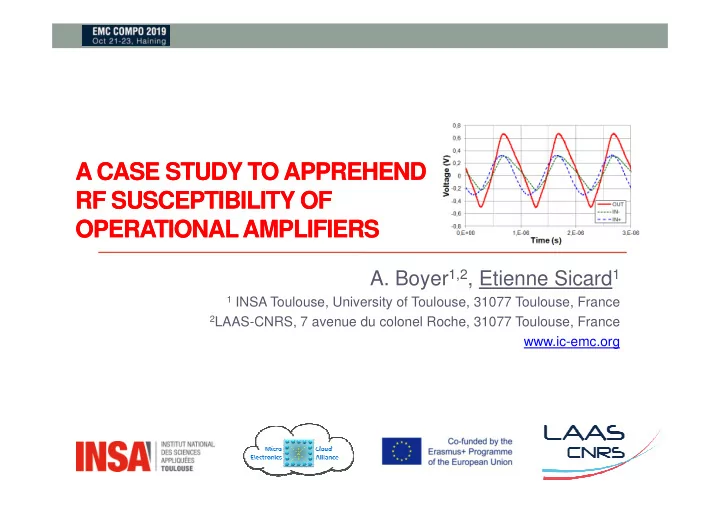
A CASE STUDY TO APPREHEND A CASE STUDY TO APPREHEND RF - - PowerPoint PPT Presentation

a case study to apprehend a case study to apprehend rf
SMART_READER_LITE
LIVE PREVIEW

A CASE STUDY TO APPREHEND A CASE STUDY TO APPREHEND RF - - PowerPoint PPT Presentation

A CASE STUDY TO APPREHEND A CASE STUDY TO APPREHEND RF SUSCEPTIBILITY OF RF SUSCEPTIBILITY OF OPERATIONAL AMPLIFIERS OPERATIONAL AMPLIFIERS A. Boyer 1,2 , Etienne Sicard 1 1 INSA Toulouse, University of Toulouse, 31077 Toulouse, France 2


slide-1
SLIDE 1

A CASE STUDY TO APPREHEND A CASE STUDY TO APPREHEND RF SUSCEPTIBILITY OF RF SUSCEPTIBILITY OF OPERATIONAL AMPLIFIERS OPERATIONAL AMPLIFIERS

  • A. Boyer1,2, Etienne Sicard1

1 INSA Toulouse, University of Toulouse, 31077 Toulouse, France 2LAAS-CNRS, 7 avenue du colonel Roche, 31077 Toulouse, France

www.ic-emc.org

slide-2
SLIDE 2

Outlines

  • Purpose
  • Experimental results
  • Failure analysis
  • Modeling op-amp susceptibility

2

  • Validation of the model
  • Conclusion
slide-3
SLIDE 3

Purpose

Analog amplifiers very common in signal conditioning Very sensitive to out-of-band electromagnetic

disturbance, specifically differential inputs

3

EMI-induced

  • ffset

+

ADC

Radiated EM disturbance

V+

RFI

V-

Conversion error

Nominal voltage Example: effect of AM 500 MHz radiated disturbance on op-amp output Sensor

_

ADC

V-

RFI

slide-4
SLIDE 4

Purpose

Many researches on modeling of the failure mechanisms

and op-amp design improvement

Issue still misunderstood by most electronic designers No simple models available to validate their design

4

Dedicated training to clarify this problem (observation by measurement, modeling, evaluation of design guidelines) measurement, modeling, evaluation of design guidelines) Based on low-cost demo board and SPICE simulation

  • J. G. Tront, J. J. Whalen, C. E. Larson, J. M. Roe, "Computer-Aided Analysis of RFI Effects

in Operational Amplifiers", IEEE Trans. on EMC, 21, (4), Nov. 1979

  • D. Golzio, S. Graffi, G. Masetti, "New Circuit Modeling of Operational Amplifiers", IEEE Int.

Symp on EMC, USA, 1989

  • F. Fiori, "A New Nonlinear Model of EMI-Induced Distortion Phenomena in Feedback CMOS

Operational Amplifiers", IEEE Trans on EMC, 44, (4), Nov. 2002

  • J. M. Redouté, M. Steyaert, EMC of Analog Integrated Circuits, Springer, 2010

slide-5
SLIDE 5

Purpose

Contents of the training:

Illustration on a real case-study Presentation of conducted

immunity test-bench

Analysis of the failure mechanisms EMI-hardened vs. non-hardened

  • p-amp

5

  • p-amp

Building of susceptibility models of

  • p-amp

Simulation of DPI tests on op-amp Evaluation of design guidelines for

improved immunity

www.ic-emc.org

slide-6
SLIDE 6

Presentation of the experiments

  • Two comparable amplifiers from www.ti.com

6

slide-7
SLIDE 7

Presentation of the experiments

TI’s universal op amp

evaluation board 551012875

Comparison of conducted

immunity on V+ and Vout

7 LMV651

EMI Hardened

Characteristics LMV651 LMV861 Power supply +/- 2.5 V +/- 2.5 V Static gain 93 dB 110 dB GBW product 12 MHz 30 MHz Slew rate +/- (not specified by datasheet) 3.6 / -2.2 V/µs 21.2 / -24.2 V/µs Max. input

  • ffset

voltage 1.5 mV 1 mV CMRR 100 dB 93 dB PSRR 95 dB 93 dB EMIRR Not defined 70 - 110 dB (400- 2400 MHz)

  • ut
  • ffset

pp

V V EMIRR

_

∆ =

Applied disturbance amplitude Induced

  • utput offset

LMV861

slide-8
SLIDE 8

Presentation of the experiments

DPI test bench at INSA Very close to IEC 62132-4 Direct Power

Injection tests from 1 MHz to 1 GHz

Forward power = 25 dBm (0,3W)

8

slide-9
SLIDE 9

Experimental results

Op-amp mounted on non-inverting amplifier

configuration (gain x2)

Injection on non-inverting input V+ and Vout. Failure criterion: +/-100 mV output offset

9 DC voltage DPI on Vout

HF active probe

+ _

500 Ω 500 Ω

Oscilloscope

(EMI-induced

  • ffset meas.)

50 Ω 20 MHz DPI on V+ 1 nF 1 µH

Oscilloscope

(VDM and VCM meas.)

DPI on Vout

slide-10
SLIDE 10

Experimental results

Susceptibility level and EMIRR measurements on IN+

and Vout

EMI-hardened version is the most robust, except between

25 and 60 MHz.

Different types of failures appear depending on frequency

10

slide-11
SLIDE 11

Failure analysis

Low-frequency DPI failure: slew-rate asymmetry

11

LMV651 LMV861 SR+ > SR- (3.6 / -2.2 V/µs) SR+ < SR- (21.2 / -24.2 V/µs) Positive offset Negative offset

slide-12
SLIDE 12

Failure analysis

For both op-amps, three failure

mechanisms are observed:

1.

Up to some tens of MHz : positive

  • ffset, quasi-linear increase with EM

disturbance amplitude (slew rate asymmetry)

12 Compensation of failure mode 1 by failure mode 2 2.

Above some tens of MHz : negative

  • ffset, rapid increase with EM

disturbance amplitude (weak distortion)

3.

High frequency and large disturbance level : saturation of the output (asymmetrical cut-off)

Evolution of EMI-induced offset vs. disturbance amplitude and frequency

slide-13
SLIDE 13

Failure analysis

High-frequency DPI failure: weak distortion brought by

input differential pair

13

Non linear behavior of MOS transistor leads to rectification of induced RF current Generation of drain current offsets (ID1 and ID2) Induced drain current imbalance ∆ID:

( )

2 2 2 1 2 1

2

sg sg

  • x

P D D D

v v L W C I I I − = − = ∆ µ

X CX CT Ibias VDD CGS CGS

Vsg1 Vsg2

Drain current imbalance if:

  • Diff. mode voltage VDM ≠ 0
  • Common-mode voltage VCM ≠ 0

( ) ( )

CM CM CM DM T sg in

  • ff

H H V V V V V arg cos 2 1

_

+ − − = φ

Theoretical EMI-induced input-related voltage

  • ffset:

( )

( )

g C C C j C C j V V H

X T gs X T CM sg CM

2 2 + + + + = = ω ω

With: and Φ is the phase between VDM and VCM

1 1 D D

I i +

2 2 D D

I i +

M1 M2 G1 G2

VCM VCM +VDM/2

  • VDM/2

High-pass behavior

slide-14
SLIDE 14

Modeling op-amp susceptibility

No susceptibility models provided by manufacturers (even the

slew rate asymmetry is not given)

Failure mechanisms are based on complex mechanisms, whose

accurate modeling requires unknown information for end-users

14

Propose a simplified equivalent electrical SPICE- based model built from measurement results (no extra measurement and rapid modeling process) Susceptibility simulation made with IC-EMC freeware

slide-15
SLIDE 15

Modeling op-amp susceptibility

Proposed equivalent model for slew rate asymmetry

and weak distortion effects:

15

ZOUT Voff_Weak

IS VD IM

+

IM

  • 1. Slew rate asymmetry

( ) ( ) [ ]

D M D M S

V K I V K I Max I . tanh ; . tanh

− − + +

=

Calculated from measurements

ZDiff IN+ IN- +

VD

IS RS CS

VS

OUT VOUT =VS ZOUT Voff_Weak Vss

  • 2. Weak distortion

( )

CM DM CM weak

  • ff

V V H Average V × × =

_

Equivalent filter fitted from measurements

slide-16
SLIDE 16

Modeling op-amp susceptibility

IC-EMC, a tool for simulating

emission & susceptibility of integrated circuits

A schematic editor An interface to WinSpice A post-processor to compare

simulated with measured spectrum

16

Spectrum Immunity Key tools Smith

Freeware, online www.ic-emc.org 250 pp documentation, 15 case

studies

16 October 19

Spectrum analysis Impedance simulation Near-field simulation Immunity simulation IBIS interface Smith Chart

slide-17
SLIDE 17

Modeling op-amp susceptibility

Op-Amp macro model described using SPICE “E” elements (any

formula)

DPI simulation in IC-EMC using RF disturbance & coupler Iterative simulations with varying frequencies (10 per decade)

17 RF disturbance Macro-model of the OpAmp Offset detection (Vout)

Edm ndm 0 VALUE = V(inP_f)-V(inM_f)} Ecm ncm 0 VALUE = (V(inP_f)+V(inM_f))/2 E1 n11 0 VALUE = 964e-6*TANH(9.18*V(1,inM_f)) E2 n22 0 0.002 VALUE = 1099e-6*TANH(8.06*V(1,inM_f))

slide-18
SLIDE 18

Validation of the models

Comparison between measurements and simulations of

LMV651 and LMV861 DPI level and EMIRR (non-inverter configuration).

Injection on non-inverting input

18

Quite good agreement between 10 and 500 MHz. Loss of accuracy around 10 MHz: limitation of slew rate model Loss of accuracy above 500 MHz: lack of models of coupling

between pins

slide-19
SLIDE 19

Validation of the models

DPI test in another configuration: voltage follower and

additional external low-pass filter on non-inverting input pin (LMV651)

19

Good agreement up to 400 MHz Above 400 MHz: limitation of the model

slide-20
SLIDE 20

Training scenario & feedback

  • 2-hours measurement :
  • Discovery of injection test

bench

  • Single-frequency DPI injection

to highlight failure modes

  • Comparison between standard

20

& EMI-hardened OpAmps

  • 2-hours simulation;
  • Simulation of DPI test bench
  • n a resistive load
  • Simulation of DPI test bench
  • n a OpAmp model
  • Positive feedback from

attendees (90% satisfied/100 students)

slide-21
SLIDE 21

21

Conclusion

A practical training dedicated to the susceptibility of op-amps

to electromagnetic disturbances:

Illustration of typical failure mechanisms Building a simple equivalent electrical model Test different EMI reduction techniques (EMI-robust op-amp, filtering)

The simple op-amp equivalent model provides acceptable

prediction results for op-amp end-users to anticipate EMI issues up to 500 MHz.

slide-22
SLIDE 22

THANK YOU FOR YOUR ATTENTION

22

alexandre.boyer@insa-toulouse.fr www.ic-emc.org