A B C D E F G L M Date Time Time Room/Location Type of - - PowerPoint PPT Presentation

a b c d e f g l m date time time room location type of
SMART_READER_LITE
LIVE PREVIEW

A B C D E F G L M Date Time Time Room/Location Type of - - PowerPoint PPT Presentation

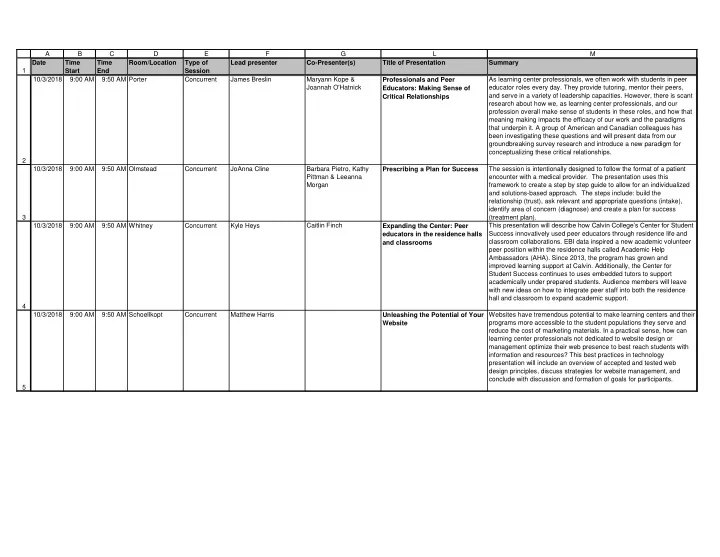
A B C D E F G L M Date Time Time Room/Location Type of Lead presenter Co-Presenter(s) Title of Presentation Summary 1 Start End Session 10/3/2018 9:00 AM 9:50 AM Porter Concurrent James Breslin Maryann Kope &


slide-1
SLIDE 1

1 2 3 4 5 A B C D E F G L M Date Time Start Time End Room/Location Type of Session Lead presenter Co-Presenter(s) Title of Presentation Summary 10/3/2018 9:00 AM 9:50 AM Porter Concurrent James Breslin Maryann Kope & Joannah O'Hatnick Professionals and Peer Educators: Making Sense of Critical Relationships As learning center professionals, we often work with students in peer educator roles every day. They provide tutoring, mentor their peers, and serve in a variety of leadership capacities. However, there is scant research about how we, as learning center professionals, and our profession overall make sense of students in these roles, and how that meaning making impacts the efficacy of our work and the paradigms that underpin it. A group of American and Canadian colleagues has been investigating these questions and will present data from our groundbreaking survey research and introduce a new paradigm for conceptualizing these critical relationships. 10/3/2018 9:00 AM 9:50 AM Olmstead Concurrent JoAnna Cline Barbara Pietro, Kathy Pittman & Leeanna Morgan Prescribing a Plan for Success The session is intentionally designed to follow the format of a patient encounter with a medical provider. The presentation uses this framework to create a step by step guide to allow for an individualized and solutions-based approach. The steps include: build the relationship (trust), ask relevant and appropriate questions (intake), identify area of concern (diagnose) and create a plan for success (treatment plan). 10/3/2018 9:00 AM 9:50 AM Whitney Concurrent Kyle Heys Caitlin Finch Expanding the Center: Peer educators in the residence halls and classrooms This presentation will describe how Calvin College’s Center for Student Success innovatively used peer educators through residence life and classroom collaborations. EBI data inspired a new academic volunteer peer position within the residence halls called Academic Help Ambassadors (AHA). Since 2013, the program has grown and improved learning support at Calvin. Additionally, the Center for Student Success continues to uses embedded tutors to support academically under prepared students. Audience members will leave with new ideas on how to integrate peer staff into both the residence hall and classroom to expand academic support. 10/3/2018 9:00 AM 9:50 AM Schoellkopt Concurrent Matthew Harris Unleashing the Potential of Your Website Websites have tremendous potential to make learning centers and their programs more accessible to the student populations they serve and reduce the cost of marketing materials. In a practical sense, how can learning center professionals not dedicated to website design or management optimize their web presence to best reach students with information and resources? This best practices in technology presentation will include an overview of accepted and tested web design principles, discuss strategies for website management, and conclude with discussion and formation of goals for participants.

slide-2
SLIDE 2

1 A B C D E F G L M Date Time Start Time End Room/Location Type of Session Lead presenter Co-Presenter(s) Title of Presentation Summary 6 7 8 9 10 10/3/2018 9:00 AM 9:50 AM DeVeaux Concurrent Katherine LeRoy Mindful or Mind Full? The Role

  • f Mindfulness on Student

Success and What That Means for Our Learning Centers The American College Health Association found in a 2015 study that more than 85 percent of students said they “felt overwhelmed” by the demands of college. And a third of all student said stress had a negative effect on their overall academic performance. Mindfulness practice has been shown to help students manage this kind of stress as well improve focus and concentration. For this reason, coupled with the fact that our students’ academic success is inextricably linked to their emotional well-being, promoting simple mindfulness strategies with our students can go a long way in helping them achieve balance not only along their academic journey but throughout their life. In this workshop, I will outline some of this research and share the multifaceted approach

  • ur Academic Resource Center has taken in helping our students

incorporate mindfulness as a way to improve concentration and focus as well as reduce stress and anxiety. 10/3/2018 9:00 AM 9:50 AM Cascades I Concurrent Susan Smith Roads ฀ “Making Employee Performance Appraisals SMART: Specific, Manageable, Achievable, Relevant and Timely” This session will focus on SMART employee performance appraisals for Learning Center professional staff and student peer tutors. Discussion will range from providing feedback on work performance and accomplishments to recognizing opportunities for professional

  • development. Additionally, the importance of an employee having a

clear position description and understanding of performance criteria such as concern for safety, customer service, problem solving, quality

  • f work and productivity, and teamwork will be highlighted. Finally,

participants will examine possible appraisal pitfalls including: focusing

  • n an isolated incident, the “halo” effect, length of service bias, and

personality conflicts. 10/3/2018 9:00 AM 9:50 AM Governors Concurrent Mercedes Torrez Layered Leadership Model: Creating Opportunities for Skill Development in Tutors At Texas A&M-San Antonio the Academic Learning Center piloted a Layered Leadership model in the 2017-2018 academic year. The program was designed to not only aid center staff in managing daily

  • perations, but also created leadership opportunities for tutors. This

presentation will offer an overview of the layered leadership model, including a discussion of the successes and shortcomings of the program, as well as suggestions for implementation. 10/3/2018 9:00 AM 9:50 AM Cascades II Concurrent Jen Welch Graduate-Level Peer Tutoring: Unique Benefits, Unique Considerations Graduate-level students and tutors are a unique group, given their career-mindedness, intense programs, non-traditional age demographic, and complex lives outside school. This session will realistically assess common challenges while also exploring the special benefits a graduate-level tutoring program can provide. 10/3/2018 9:00 AM 9:50 AM Red Jacket Concurrent, Live Streaming Elisha Teague Diversifying Your Academic Support Services to Meet the Needs of Distant/Online Learners In the past decade, many universities have seen a significant increase in their online/distant learner population. This change is causing Learning Centers to reevaluate their academic support offerings to ensure they are meeting the needs of all students. This session will explore Franklin University’s journey to diversify our academic support services to meet the needs of our distant learners. With just a few tweaks, we were able to use our own tutors to provide robust online academic services (tutoring, online writing review, targeted outreach, and online workshop & SLA programs) Come learn how you may be able to replicate this at your institution!

slide-3
SLIDE 3

1 A B C D E F G L M Date Time Start Time End Room/Location Type of Session Lead presenter Co-Presenter(s) Title of Presentation Summary 11 12 13 14 15 16 10/3/2018 9:00 AM 9:50 AM Tesa Digital Poster Glenna Heckler-Todt Evolution of an Early Alert System at a 4-year Institution Participants at this session will learn about how a 4-year institution developed its early alert system and the interventions done as a result

  • f an early alert. The presenter will discuss how the early alert system

grew from a homegrown system to part of a larger student retention platform as well as how academic advising at the institution grew as

  • well. The discussion will include the challenges with implementing an

early alert system, facilitating a cultural change of early interventions among faculty, and doing outreach with poor performing students. Participants will come away with tips and have time for questions. 10/3/2018 9:00 AM 9:50 AM Taylor Digital Poster Andrew Dentzau Special Populations - College Students with Bipolar Disorder The onset of bipolar disorder is a stressful and life-changing event. Students with bipolar disorder face unique challenges navigating the

  • nset of these symptoms and maintaining academic excellence.

10/3/2018 10:00 AM 10:50 AM Porter Concurrent James Breslin Kristen Wallitsch & Drew Thiemann The More Your Know: Using Predictive Analytics for Good in Student Success Whether from campus administrators or board members, we all hear the questions: why do they struggle? Why do they leave? What do we know about those who do not persist? Predictive analytics, sometimes called big data, offer a promise of answering these incredibly complex questions, but tools have been expensive, time consuming, and fail to incite action. This session tells the tale of a campus that has moved past those issues, implementing a low-cost, high-impact predictive

  • model. Join us to learn how we built a model collaboratively, navigated

ethical issues, and created an action-oriented approach embraced on

  • ur campus.

10/3/2018 10:00 AM 10:50 AM Olmstead Concurrent Amanda Shah Development of a Learning Skills Inventory to Guide Identification and Intervention This session will review the benefit of using assessment to personalize academic support intervention for students. In the Academic Success Center at Kent State University, a learning skills inventory was the basis for personalization of academic coaching for undergraduate

  • students. This session will detail the development of a learning skills

inventory, including purpose and implementation, item development, item and factor analysis, associated program results, and tool

  • refinement. Future plans for the inventory, including predictive

analytics, will be previewed. 10/3/2018 10:00 AM 10:50 AM Cataract Concurrent Jade Smith Carol Adams & Dede deLaughter Sell yourself! Designing a data strategy to get what you want. While Learning Center professionals understand that the services they provide to students are often integral to their academic success, many have a difficult time providing the statistical assessment of what they do to support resource allocation and promote buy-in among students and internal constituents. This presentation will be conducted in the style of a workshop to guide participants through the steps necessary to create a data strategy that aligns with their individual institutional goals as well as their current benchmarking tools. 10/3/2018 10:00 AM 10:50 AM Red Jacket Concurrent, Live Streaming Bonnie Ostrand Rethinking Diversity Tutor Training: Addressing Blind Spots and Biases in Tutoring This training will explore the webinar content I developed for tutors on

  • diversity. The content was inspired by two texts, Blind Spots: Hidden

Biases of Good People (Banaji, M.R. & Greenwald, A.G., 2013) and Whistling Vivaldi: How Stereotypes Affect us and What we can do (Steele, 2010). The tutor training is titled “Understanding Hidden Blind Spots and Biases: Strategies for Tutoring”. The training presents interactive tutor exercises to demonstrate unconscious bias, along with practical tutor scenarios which further explore how bias can present

  • itself. The presentation closes with strategies for counteracting bias.

Guided discussion will accompany the content overview.

slide-4
SLIDE 4

1 A B C D E F G L M Date Time Start Time End Room/Location Type of Session Lead presenter Co-Presenter(s) Title of Presentation Summary 17 18 19 20 21 22 10/3/2018 10:00 AM 10:50 AM Taylor Digital Poster Dave Ehren Becky Graham, Stephanie Alden & Jake Mohan How Do You Interact with Students Outside Your Center? The goal is to help students, but what if they never cross the threshold? We asked the students who didn't come in how we could still help them. This meant we had to find them. 10/3/2018 10:00 AM 10:50 AM Tubman Digital Poster Armando Garza Roberto Rivera Using Interdepartmental Collaboration for Procedural Improvement Time is essential for every Learning Center/Tutoring Lab. At the UTRGV Learning Center we used to spend lots of time every semester looking up and manually entering information from paper records regarding College Reading and Learning Association (CRLA) training. Now, with access to our institutions Learning Management System, Blackboard, we have been finding ways to save time, as well as streamline data collection. We will cover how this initial problem helped create a working relationship with the Center for Online Learning & Teaching Technology (COLTT) and how we are looking to the future to make things easier for our student employees, students and ourselves. 10/3/2018 10:00 AM 10:50 AM Tesla Digital Poster Nathan Hamlin

Tutor Training at the WSU MLC A discussion on how tutor training can address common tutoring dilemmas, at a Math Learning Center in a 2 hour training meeting involving group work and other forms of participation by the tutors.

10/3/2018 11:00 AM 11:20 AM Cascades I Mini-Engagemen Heather Anderson-Bibler Using Collaboration to Unleash the Power of Under-Represented Students' Learning Students will learn and practice 3 collaborative learning strategies, how they can be used to impact under-represented students' learning, and how their peers are already using similar strategies in their institutions. Participants will take home 3 ready-to-use strategies they can implement immediately with minimal adjustment needed. These strategies can be used in trainings, SI Sessions, tutoring sessions, courses, meetings, and many more settings. They can increase student learning for all, but can be especially useful for marginalized populations. 10/3/2018 11:00 AM 11:20 AM Cascades II Mini-Engagemen Katie Bjorkman Janet Bowers Queue Systems: Increasing Efficiency and Equity in Drop-In Tutoring This session will describe the use of an electronic “queue” system in a drop-in mathematics tutoring center. Implementation of this system has allowed for greater efficiency in deploying tutors to help students with

  • questions. It has also increased equity by creating a centralized system

to manage requests for tutor assistance in the order they are received. Additionally, the data collected in the queue system may be of use for evaluation and research. The perspectives on the queue system’s influence on drop-in tutoring practices of the center’s director, tutors in the center, and a researcher studying the center will be shared. 10/3/2018 11:00 AM 11:20 AM Schoellkopt Mini-Engagemen Kaitlyn Crosue Creating Student Leaders West Chester University (WCU) employees over 100 tutors in the Learning Assistance and Resource Center (LARC). With only three members as part of the professional staff, they allow students the

  • pportunity to take leadership positions at the LARC. Tutors who has

completed Level III training through the College Reading and Learning Association may apply for the position of Peer Tutor Coordinator (PTC). The PTCs are the direct supervisors to a group of tutors and have numerous responsibilities. People who attend this session will gain the knowledge and may be able to implement ideas learned into their own learner center.

slide-5
SLIDE 5

1 A B C D E F G L M Date Time Start Time End Room/Location Type of Session Lead presenter Co-Presenter(s) Title of Presentation Summary 23 24 25 26 27 10/3/2018 11:00 AM 11:20 AM Porter Mini-Engagemen Michele Doney Conquering the Chaos: How I Learned to Stop Worrying and Love Blackboard Audience members will take a tour of our center's Tutor Training Blackboard Organization and learn how we used Blackboard not only to bring the asynchronous portions of our training program online, but also how we use the Grade Center to enable collaboration among supervisory staff to track dozens of tutors completing multiple requirements at three different levels of training. 10/3/2018 11:00 AM 11:20 AM Olmstead Mini-Engagemen Olivia Fitch Irshad Prasla, Marcus Spann & Linda Brown Implementation of Online Academic Coaching Tools We operate under the assumption academic coaching is universally beneficial to all students. Our obstacle is finding an effective strategy to deliver that information. Tasked with providing academic coaching to

  • ver one thousand students, in thirteen different programs, covering

bachelors, masters, and doctoral education, our academic success center (with only 2 full time employees), has developed strategies to

  • ptimize our presence. In this workshop, we will teach you the effective

strategies to organize your resource delivery aimed at reaching the most students. We conclude with an interactive demonstration on how to use google documents to share interactive and protected documents with your students. 10/3/2018 11:00 AM 11:20 AM Governors Mini-Engagemen Michael Giannetto How to Structure an Online Summer Bridge Program This mini-engagement session will provide the scaffolding for coordinating and supervising an online summer bridge program where most of the students and student employees are not local. This would include staffing structure, online systems, communication channels, documentation management, assessment, outreach to both student and employees, training and partnerships. In 2018, we currently have 2 staff members, 7 graduate students and 61 math coaches all working to help over 800 incoming students increase their math placement. Participants will gain scalable techniques that could enable their programs to grow. 10/3/2018 11:00 AM 11:20 AM Hennepin Mini-Engagemen Trisha Lamers Recall vs. Recognition - Prepare to be Surprised! In this session, participants will learn, through a hands-on activity, the difference between the concepts of recall and recognition. Participants will explore the importance of this distinction and be amazed at how the human mind works. The goal is that each person who comes to this session will leave with ideas on how to increase student awareness on how to study effectively. 10/3/2018 11:00 AM 11:20 AM Whitney Mini-Engagemen Anne Raines Kristen Karpinski Power to the Leaders: Keeping Your Head above Water with a Train-the-Peer-Trainer Model Illustrating the power of student employees to serve as versatile resources within our centers, this session will review a model created to effectively train 150 SI leaders. An organizational structure incorporating teams, mentors and weekly meetings empowers mentors to train fellow leaders while developing mentor leadership skills to a deeper level. Scaffolding delivery of materials for on-going, semester- long training and professional development using a train-the-trainer model allows just-in-time delivery of content, removes training fatigue, and simplifies training logistics.

slide-6
SLIDE 6

1 A B C D E F G L M Date Time Start Time End Room/Location Type of Session Lead presenter Co-Presenter(s) Title of Presentation Summary 28 29 30 31 32 10/3/2018 11:00 AM 11:20 AM Cataract Mini-Engagemen Diane Stoelting Virginia Pasceri Map to Success: How to Support Students During their First Semester Niagara University’s Divisional Support Program (DSP) is a program designed for conditionally admitted freshmen to develop their academic strengths and support their transition to college life. During their first semester they meet weekly with a member of the Office of Academic Support staff to monitor their academic progress and discuss various study strategies, as well as campus resources. The presentation will consist of a summary of the program and then a “show and tell” of handouts and resources. The goal is to provide the audience with a strong foundation to set up (or enhance) a similar program. 10/3/2018 11:00 AM 11:20 AM DeVeaux Mini-Engagemen Chelsey Vincent Using Ongoing Training to Create a Positive Environment for SI Leaders to Thrive Our SI Leaders bring great value to our colleges and universities through their work with students. SI Leaders have many demands in both their personal and professional lives. As SI Supervisors, we have the opportunity to create a positive environment to encourage SI Leaders in both their personal and professional lives. The International Center for Supplemental Instruction requires certified SI programs to provide Ongoing Training Meetings for SI Leaders. This session provides SI Supervisors with a curriculum to use Ongoing Training Meetings as a way develop a positive environment that empowers SI Leaders. 10/3/2018 1:30 PM 2:20 PM Cascades II Concurrent Ashley Babcock Ramon Daines The Power of Collaboration: Empowering Students Through Learning Center Partnerships When learning center professionals are not engaged with faculty members, it limits the ability to promote student achievement. This presentation offers insights on bridging classroom experiences and learning center coaching sessions based on a pilot program to increase faculty-coach-student communication. Presenters will discuss the process of implementing the pilot program, including gaining buy-in from stakeholders and empowering students to become active facilitators of their learning. This interactive session will include artifacts from the pilot to start the conversation about how participants can leverage learning center partnerships at their institutions. 10/3/2018 1:30 PM 2:20 PM Porter Concurrent James Breslin Maryann Kope & Joannah O'Hatnick Students as Colleagues: Operationalizing a New Paradigm for Peer Educators As learning center professionals, we often have the opportunity to work with students in peer educator roles. They provide direct services, administrative support, and sometimes engage in marketing, assessment, or even supervision. While much of our practice relies on peer educators, we have little theory or research that explores how we conceptualize students in these roles and how the way we make sense

  • f these relationships impacts our work. This session explores a

powerful new paradigm for our relationships with peer educators and invites participants to develop specific ideas for implementing this new framework in their programs. 10/3/2018 1:30 PM 2:20 PM Cascades I Concurrent Melissa Brocato Using Data-based Evidence to Demonstrate the Value of Learning Centers The current emphasis on student retention gives learning centers a unique opportunity to demonstrate their value to a range of

  • stakeholders. The Center for Academic Success at LSU has been on a

decade-long journey to find data and research that links its services to student persistence. As a result, the CAS has increased funding, advanced its profile with administration, and faculty and is viewed as a leader in student success and persistence. This session will demonstrate how learning centers are poised with new data and information to show their impact on students and the university as a whole.

slide-7
SLIDE 7

1 A B C D E F G L M Date Time Start Time End Room/Location Type of Session Lead presenter Co-Presenter(s) Title of Presentation Summary 33 34 35 36 10/3/2018 1:30 PM 2:20 PM Schoellkopt Concurrent Amy Caton Laurissa Noack & Alex Mitchell From Culture Clash to Cohesive Commons Community Learning Common centers and programs are often idealized common spaces campuses look to for student success, retention, and

  • engagement. By untethering our thinking about program boundaries,

identities, and alliances and radically reforming, we can generate interest, passion, and opportunities across campus. The force of redistributing identity, authority, and alliances for student workers reshaped thinking about student success, high impact practices, and active learning at the highest levels. This session explores best practices utilized by Texas A&M University at Galveston to create The Learning Commons peer community. Participants will develop considerations that they can take back to their own campus. 10/3/2018 1:30 PM 2:20 PM Governors Concurrent Justine Chasmar Benjamin Smith Hunter Boylan Research Award: Tutoring QR or tutoring for QR courses? Time to change the narrative We will overview background, demonstrate portions of the module with attendees, and share materials for use at attendee’s institutions. We will pilot training activities in the allotted time and distribute materials in- person and electronically, including pre- and post-assessment, activities, research literature, and handouts. We will share pilot results

  • f the tutor training module. The interactive portion of the session will

serve as further validity testing, and we will use suggestions to continue adapting our module(s). A brainstorming mini-session about how to best use this or a similar module in their tutor training and further training that should be developed in the Q-center field. 10/3/2018 1:30 PM 2:20 PM Whitney Concurrent Jane Lerner Ashley Pease Creating Community to Support Student Success: A Multidimensional Training Approach for Supplemental Instruction and Peer Tutoring Fostering connections with our students is often the cornerstone of the work we do, playing an important role in creating community within our

  • institutions. Through the use of a multidimensional training approach,

we can be intentional in our efforts to foster a community culture within

  • ur peer academic support programs. Supervisors can help SI leaders

and peer tutors develop the skills necessary to ensure that students connect with each other, their faculty, and the students they support. Whether you are a learning center director or a supervisor of a specific program, we will outline the critical components needed to build an effective and inclusive training program. 10/3/2018 1:30 PM 2:20 PM DeVeaux Concurrent Ana Torres-Ayala Unleashing the Power of the Scholarship of Learning Centers Articles and conference presentations by learning center (LC) professionals are of value to higher education; however, they often go unrecognized as scholarly work. In this session, we will explore how Boyer’s Model of Scholarship is relevant to LCs. The results of an analysis of recent TLAR articles and NCLCA conference presentations will be presented to help audience members recognize Boyer’s four scholarship categories: discovery, integration, application, and teaching [and learning]. This will enable LC professionals to view and advocate for their work as a scholarly pursuit, as well as to identify other

  • pportunities to present their LC work.
slide-8
SLIDE 8

1 A B C D E F G L M Date Time Start Time End Room/Location Type of Session Lead presenter Co-Presenter(s) Title of Presentation Summary 37 38 39 40 41 10/3/2018 1:30 PM 2:20 PM Red Jacket Concurrent, Live Streaming Saundra McGuire Eric Kaldor, Skye Mendes & Sajida Shaikh When Learning and Teaching Collide, Student Learning Soars! Institutions typically have a learning center that is focused on helping students and a teaching center focused on helping faculty improve their

  • teaching. However, these two units are often housed in different

administrative units and rarely work together to offer programming. When learning center and teaching center professionals work together to help faculty develop approaches for teaching learning strategies to students, faculty can serve as a direct resource for struggling students instead of just sending them to that mysterious black box called the learning center. This session will present the impact of collaborations between learning and teaching centers. 10/3/2018 1:30 PM 2:20 PM Cataract Roundtable Lauren Brown A comprehensive retention initiative: Success Connect According to the U.S. News & World Report (2016), as many as 1 in 3 first-year students won’t make it back for their sophomore year. Therefore, universities are under pressure to develop intentional retention initiatives. This roundtable discussion will allow attendees to learn about the University of South Carolina Student Success Center’s comprehensive retention initiative: Success Connect. From there, attendees will partake in an interactive discussion to identify key components, existing resources, stakeholders, as well as needs and challenges, in order to develop an action plan for creating or restructuring early alert programs for their respective campuses. 10/3/2018 2:30 PM 3:20 PM Cascades I Concurrent Geoff Bailey David Reedy Powerful Currents: LC professionals and Servant Leadership Theory Learning center professionals deal with complex situations, politics, and personalities every day. Understanding how to navigate these interactions requires not only tact and diplomacy but also self- awareness and a willingness to forego power struggles that are disruptive and limit mutually beneficial collaborations. This session will allow participants: an opportunity to reflect on their leadership style; learn about servant leadership theory and its applicability to learning center contexts; and develop a strategic approach for incorporating servant leadership tenets into supervision, professional development, and daily projects that require collaboration with key partners. 10/3/2018 2:30 PM 3:20 PM DeVeaux Concurrent Hilary Bateman Preempting Probation Washington College recently implemented a formal ‘Pre-Warning’ program as a part of our Academic Recovery program. Some of the pieces of this program are present in early alert systems or programs at many other institutions. This presentation will discuss why the Pre- Warning program was added to the already robust academic recovery program, the success it has shown already in one academic year, as well as the opposition that has been presented to the program. 10/3/2018 2:30 PM 3:20 PM Porter Concurrent James Breslin Work Smarter! Implementing Tech Tools for Learning Center Leaders Feel like the email will never end? Completely covered your desk in post-its? Spend time digging through binders, notebooks, or file folders? It doesn’t have to be this way! Learning center leadership is incredibly demanding and requires you to wear so many hats. Implementing some simple, low/no-cost apps can make it all more manageable but taking the time to explore and experiment is just one more item on your task list. Come to this session to learn how one learning center leader has streamlined this kind of work and make plans to take your productivity to the next level!

slide-9
SLIDE 9

1 A B C D E F G L M Date Time Start Time End Room/Location Type of Session Lead presenter Co-Presenter(s) Title of Presentation Summary 42 43 44 45 10/3/2018 2:30 PM 3:20 PM Schoellkopt Concurrent Susan Chiappone A Guide for Working with Students with Disabilities Staff and faculty search for ideas to help reach students who have

  • disabilities. The presenter will help to eliminate some of the fears and

provide a toolbox filled with useful information to help with students who may or may not disclose their diagnosis. This presentation will offer suggestions on communicating with students who may be diagnosed with a learning disability or an intellectual disability. Tips for engaging the student and reducing the frustration of instructors will be provided. 10/3/2018 2:30 PM 3:20 PM Governors Concurrent Alan Craig Elaine Richardson & Jacqueline Harris Unleash the Power of an Advisory Board for Your Learning Center! NCLCA considers the use of advisory boards for learning centers a best practice and an important criterion for Learning Centers of Excellence certification. The presentation will include results of an

  • nline survey (n = 230, administered in 2017) on use of advisory boards

for learning centers. Results indicated 27 centers (11.7%) had active advisory boards. Presenters will discuss current status, mission, staffing, and operation of advisory boards in learning centers. Based

  • n survey results, reasons why centers do not have an active board will

be discussed. Session participants will take away practical information

  • n starting and operating an advisory board.

10/3/2018 2:30 PM 3:20 PM Cataract Concurrent Sharon Green Michael Durfee & Martha Krupa Re-designing a Summer Bridge Program to Increase Student Engagement For many years, Niagara University’s four-week Summer Bridge Program for opportunity students consisted of noncredit skills courses. But students couldn’t apply these skills to a “real" course until the fall. In 2016, we placed a three-credit history course, “USA in the Contemporary World,” at the center of the program. Students now immediately apply reading, writing, and study skills to a course in which they have a stake, while experiencing the demands of a college course. The course’s focus on race, class, gender, sexuality, and place-based inequality is highly engaging. Students who pass the course begin college with three credits. 10/3/2018 2:30 PM 3:20 PM Cascades II Concurrent Lauren Hensley I can, and it matters: The expectancy-value approach to motivation Helping students develop their study strategies is at the core of our work as learning support professionals. Learning is incomplete without motivation, however, and there is often a divide between learning about study skills and putting this knowledge into action. One framework that is particularly helpful for understanding and bridging this divide is expectancy-value theory. In this session, you will learn about expectancy-value theory and explore the importance of students’ beliefs about both themselves and the academic tasks in front of them. You will also learn practical ways to help students build these beliefs and take action.

slide-10
SLIDE 10

1 A B C D E F G L M Date Time Start Time End Room/Location Type of Session Lead presenter Co-Presenter(s) Title of Presentation Summary 46 47 48 49 50 10/3/2018 2:30 PM 3:20 PM Whitney Concurrent Theresa Mooney Adding Appreciative Inquiry to Already Varied Tutor Training This session will illustrate the range of tools that provide initial, on-the- job, and refresher training for Austin Community College’s Learning Lab tutors, with emphasis on Appreciative Inquiry, a newer tool we've added to the mix. This session will include a mini-workshop with Appreciative Inquiry; attendees will be encouraged to participate in this AI exercise. ACC’s Learning Lab professionals include peer tutors, professional tutors, instructional associates, and tutoring specialists. Although our blend of tutors may be atypical of most centers, discussing our training tools and conducting the AI exercise may prompt attendees to incorporate some of our shared ideas. Training tools to be discussed include start-of-semester orientation materials,

  • nline modules (Tutor Lingo and in-house), information from our 2017

Tutor Conference (tutors helping tutors; faculty collaborating with tutors), and three professional development workshops the college requires of all employees. 10/3/2018 2:30 PM 3:20 PM Event Center CR Concurrent Andrea Vahl A Deep-Dive into Facebook Groups: Collaboration, Connection, Creation Conference attendees will learn: Specific tactics for ideas covered during the keynote, intermediate strategies to engage social media following, and answers to other questions during the sessions Q&A portion 10/3/2018 2:30 PM 3:20 PM Red Jacket Concurrent, Live Streaming Joel McGee Developing an All Hands on Deck Approach to Helping Students on Probation Students on Academic Probation or Warning are one of the highest risk populations on our campuses. This presentation will discuss our multi- faceted approach to helping these students get back on track at Texas A&M. Probation students are invited to a Fresh Start orientation at the beginning of each semester and are given an overview of our services. Students have several options to complete a certificate program including semester long classes, 3-week workshops, academic coaching, or a hybrid model. We also monitor student progress and provide reports to Deans, academic advisors, or others who refer them to our office. 10/3/2018 10:00 AM 10:50 AM Cascades II Concurrent Jennifer Bebergal Ning Christopher The Power of a Year-Long “Summer” Bridge Program in Enhancing Student Success FAU Jump Start began as a summer cohort-based program for 200 first- year students. Within one year it replaced the existing summer bridge program and by 2018 has evolved into a year-long program for 1400 students with embedded peer coaching and specific Jump Start

  • courses. In this session, learning center administrators/professionals

will understand the value of coordinating a long-term bridge program for incoming students as it relates to student success and persistence. While the scope of this program may not fit all institutions, benefits of incorporating the elements of Jump Start and how they can be used (in whole or individually) to develop or enhance existing bridge or probationary programs at other schools along with program data will be discussed. 10/3/2018 10:00 AM 10:50 AM Cascades I Concurrent Santos Cortez Russ Hodges LSCHE, A Web Portal for Learning Support Professionals The renovated design of the LSCHE web portal more readily bridges the divide between learning support practitioners (e.g. learning lab directors and staff, peer-educators, researchers, classroom instructors) and rich and robust collections of resources. These assets include historical documents, instructional and tutor aides, seminal scholarship, and other documents and websites underscoring the importance of learning center leadership and management, professional development, and best practices, among many other topics that will be presented to the audience.

slide-11
SLIDE 11

1 A B C D E F G L M Date Time Start Time End Room/Location Type of Session Lead presenter Co-Presenter(s) Title of Presentation Summary 51 52 53 54 55 10/3/2018 10:00 AM 10:50 AM Governors Concurrent Jacqueline Harris Martin Golson, Jennifer Haley, Juan Jimenez & Kristie Keuntjes NCLCA Learning Center Leadership Certification (LCLC) NCLCA’s LCLC offers a nationally recognized set of standards, fostering future growth and development for learning center professionals by focusing on evolving levels of practice, training, self- reflection, service and evaluation. This session outlines the four levels

  • f certification and includes LCLC reviewers in a panel discussion.

Attendees will have an opportunity to ask reviewers questions and gain insights from their experiences. 10/3/2018 10:00 AM 10:50 AM DeVeaux Concurrent Sari Katzen Utilizing Co-Teaching in Peer Instructor Education to Increase Student Engagement The Learning Centers at Rutgers-New Brunswick offers a pedagogy course (Peer Instructor Education) for student peer leaders and applies different co-teaching model approaches (team-teaching, floating co- instructor, and instructor observations) to a flipped classroom and active learning environment. The use of co-teaching in this course has benefitted both students and instructors, leading to increased levels of engagement as well as additional classroom support from a curricular

  • standpoint. Evaluations completed by students in either co-taught

pedagogy sections or sections taught by one instructor, as well as the benefits and challenges resulting from our co-teaching findings, will be further discussed. 10/3/2018 10:00 AM 10:50 AM Schoellkopt Concurrent Jack Truschel Integrating Academic Coaching into the Learning Center: Learning theories put into practice Academic coaching is an interactive process focused on student

  • success. The student along with the academic coach, can examine the

students learning style, habits of working, current goals and any difficulties or barriers to success. Exploring student strengths and challenges can help them to reach their full academic potential. This presentation will focus on developing a Coaching based program within the learning center. 10/3/2018 10:00 AM 10:50 AM Whitney Concurrent Kathryn Zepeda John De La Rosa & Johanna Dvorak My Class is at 8? In the morning? Time is no one’s friend, especially the student trying to schedule their

  • classes. Students typically do not look at the whole picture when

scheduling their classes. Quite often they fail to take into consideration their daily lives. Approximately 80% of the student populations are first generation in their family to attend our university, Texas A&M San

  • Antonio. Typically these students are so excited just to be coming to a

university they forget to take into account travel time, work schedule, and family obligations. In a collaborative manner, Academic Advisers and Student Success Coaches teach time management skills to the student through the use of various tools, where the student can physically see how their day is planned. 10/4/2018 9:00 AM 9:50 AM Taylor Concurrent Santos Cortez How Effective is Military Veteran Peer Tutoring in Learning Assistance Centers? We believe that student veterans (SV) in Developmental Education (DE) can benefit academically and holistically from peer tutor pairing with other student veterans in post-secondary learning assistance

  • centers. Many student veterans that enter post-secondary institutions

are highly motivated and have developed a mission first mentality that they apply towards certificate and degree attainment; yet student veterans under perform academically nationally in comparison to traditional students. Results from this study may help underscore the importance of this tutoring resource in learning assistance centers.

slide-12
SLIDE 12

1 A B C D E F G L M Date Time Start Time End Room/Location Type of Session Lead presenter Co-Presenter(s) Title of Presentation Summary 56 57 58 59 10/4/2018 9:00 AM 9:50 AM Governors Concurrent Carol Dochen Beyond the Bachelor’s: Learning Center Services for Graduate Students Learning center services typically target undergraduate students, but many graduate students need academic assistance beyond writing

  • support. Students are earning college credit hours in high school,

graduating from college earlier, and entering graduate school at younger ages, often without essential learning strategies and self- regulation skills. This session will cover learning center services for graduate students—content tutoring, learning and study strategies presentations, and programs designed for general and specific graduate student populations (i.e., physical therapy, social work, veterans, prelaw). Partnerships with the Graduate College and other departments to offer programs for prospective and current graduate students will also be included. 10/4/2018 9:00 AM 9:50 AM Cascades I Concurrent Johanna Dvorak Online Tutoring Research: Results of the NCLCA Brenda Pfaehler Professional Development Grant The focus of presentation is to share current research in online tutoring and academic support services to find out how college learning centers are currently offering these services, and to analyze progress and challenges of current tutoring/online academic support initiatives. Research was conducted to determine current use of online tutoring/academic support services by college learning centers. An

  • nline survey administered to learning center directors. Questions

focused on the scope of service, the type of technology used, formats for online academic support, external or internal options, training, marketing, and evaluation of services. 10/4/2018 9:00 AM 9:50 AM Whitney Concurrent Mary Fischer Creating Meaningful Assessment: Measuring Learning in Academic Coaching Academic coaches are well-situated to assist students with developing an understanding of how to think about their learning, and ultimately, how to learn. Yet, many academic coaches struggle to conduct meaningful assessment of student learning in academic coaching

  • sessions. The presenter will discuss her decision to anchor her

academic coaching practice with strong student learning outcomes, and share her process for conducting meaningful qualitative and quantitative assessment of student learning. Participants will have an

  • pportunity to reflect on their own academic coaching program goals,

and to consider an assessment plan that meets the needs of their unique learning center. 10/4/2018 9:00 AM 9:50 AM DeVeaux Concurrent Taylor Fortney Giving Tutors the Tools to Engage Students with Disabilities This presentation will explore the TECHniques Center’s strong approach to supporting and challenging students with learning disabilities, AD/HD, and Autism Spectrum Disorders. I will first begin

  • utlining the universal design strategies that we employ on a daily

basis, and how we train our tutors to be comfortable in these strategies. Then, I will break down specific strategies that can be used to accommodate each specific diagnosis, and how they can be applied in a one-on-one tutoring environment. Lastly, I will show how academic coaches can engage students with learning disabilities and better support their success.

slide-13
SLIDE 13

1 A B C D E F G L M Date Time Start Time End Room/Location Type of Session Lead presenter Co-Presenter(s) Title of Presentation Summary 60 61 62 63 64 10/4/2018 9:00 AM 9:50 AM Olmstead Concurrent Charles Haas The Smell of Popcorn: How to Conduct an Effective Marketing Campaign Go beyond the basic white flyer pinned to a campus bulletin board. Learn how to design eye-catching marketing materials and craft an effective marketing campaign that will build excitement around the school and bring students (and faculty and staff) to your center. You will walk out of this session with the knowledge and ability to immediately implement over a dozen simple, inexpensive (or free!) ways to make your learning center the most popular place on campus. 10/4/2018 9:00 AM 9:50 AM Tubman Concurrent Ashley Hurst Clara Easterling Merging Centers: How Writing Center Scholarship Avails Content Tutor Training With budget cuts on the rise, more and more universities are merging academic support programs into centralized learning commons structures, but how do these seemingly collaborative mergers affect staff dynamics and most of all—staff training? For years writing centers have lead the scholarship trends in tutor training, providing an invaluable spring board for developing content tutoring, which seems to be under-represented in the tutor-training conversation. This presentation will follow Midwestern State University’s learning center transition as we export the writing center structure to interrogate the pre-existing content tutoring program. The presentation will highlight questions, challenges, and successes we are encountering during this pedagogical transfer. 10/4/2018 9:00 AM 9:50 AM Porter Concurrent Saundra McGuire Elzbieta Cook How Metacognitive Learning Strategies Saved the Day in General Chemistry Presenting a 50-minute session on metacognitive learning strategies has been shown to result in a significant increase in scores on the next

  • exam. The presentation, provided after students received the results of

their first exam, included such strategies as doing homework without using examples as models, conducting mock teaching sessions to ensure mastery of information, and using the study cycle (preview material-attend class-review class content-implement focused study sessions), and monitoring one’s learning every step of the way. This presentation will discuss what focus groups uncovered about what strategies the successful students implemented and the psychological impact on their learning journey. 10/4/2018 9:00 AM 9:50 AM Cascades II Concurrent Henry Rand Deanna Starr & Trevor Arnold We Need to Talk: Founding a Center for Speaking and Presentation This interactive session will explore the development of the Center for Speaking and Presentation at Villanova University. Specifically, we will discuss the preliminary planning and communication necessary to open a new campus-wide tutoring center, along with the strategies and partnerships needed to ensure a new tutoring service will thrive on

  • campus. An analysis of our usage data over first three semesters of
  • peration will be shared in order to evaluate the effectiveness of these
  • strategies. We invite attendees to reflect on their experiences in

planning and implementing a tutoring center on their campus. 10/4/2018 9:00 AM 9:50 AM Tesla Concurrent Susan Rinaldi The Power of the Learning Center – Using the Cycle of Inquiry to Spur Institutional Innovation The Learning Centers has a unique system-wide vantage point for the university through the students that we serve and in how we assess and report our findings. Using the cycle of inquiry, this presentation will demonstrate how our learning center staff collects and analyzes data, proposes solutions or innovations, re-assesses, and fine tunes the solution for scale.

slide-14
SLIDE 14

1 A B C D E F G L M Date Time Start Time End Room/Location Type of Session Lead presenter Co-Presenter(s) Title of Presentation Summary 65 66 67 68 69 70 10/4/2018 9:00 AM 9:50 AM Red Jacket Concurrent Laura Sanders Diana Garland CAS Standards for Learning Assistance Programs: Your Guide to Self-Assessment Based on their involvement with the Council for Advancement of Standards in Higher Education (CAS) and the self-assessment process, the presenters will review the recently updated Learning Assistance Program Standards (2017) and the process used for self-

  • assessment. Information will also be provided to the participants on

resources available to assist with the self-assessment process. 10/4/2018 9:00 AM 9:50 AM Cataract Concurrent Liz Scarbrough Gail Powers-Schaub, Jenny Haley, Katie Boswell & Rashawn Green Using SMART Planning to Harness the Power of Your Learning Center The 2017 NCLCA Institute challenged participants to select and plan a project for their Learning Centers. From developing measurable student learning outcomes, to devising an assessment strategy, to pursuing certification, participants had the opportunity to network with colleagues across the spectrum of experience from Learning Centers far and wide, while tapping the expertise of seasoned mentors in designing and tweaking their action plans. Join a panel presentation of NCLCA Institute attendees and mentors from the 2017 summer Institute as they share their experiences and results. Participants are encouraged to come with their own plan ideas and questions. 10/4/2018 9:00 AM 9:50 AM Schoellkopt Roundtable Jane Neuburger Jen Ferguson Constructing Items for the New NADE Guides on Tutoring Programs Participants will be actively involved in conceptualizing and writing both essential and recommended items for the new edition of the NADE Self- Evaluation Guides, Tutoring Services chapter. 10/4/2018 10:00 AM 10:30 AM Schoellkopt Mini-Engagemen Valerie Balester Anna Transue & Marissa Gossett Making Face: Creating an Inclusive Marketing Campaign We'll share our marketing plan and help participants create their own, taking into account their goals, data, and resources. While we can require probationary students to visit us, focus on that alone can give us the reputation of being remedial. It's harder to attract a broad range

  • f students who can benefit from our services. We focus on creating an

ethos (face) that is welcoming and that clarifies our offerings and

  • audiences. Since our plan is a work-in-progress, we'll show them a bit

about our past and our future efforts. 10/4/2018 10:00 AM 10:30 AM Porter Mini-Engagemen Rachel Cordy There are MORE Session Activities for That! Four activities will be demonstrated that are ideal for peer-facilitated study sessions in a variety of content areas. The presenter will give an

  • verview and directions for each activity and attendees will be

encouraged to participate. The presenter will engage the audience in a large group discussion about how these activities can be implemented

  • r adapted to work for their respective programs. Some activities may

also work as training exercises for staff. The goal of the session is to have fun and give practitioners new activity ideas to share with the staff who facilitate their academic support services! 10/4/2018 10:00 AM 10:30 AM DeVeaux Mini-Engagemen Charles Haas Marketing Your Center: Moving Beyond the Flyer Whether you’re a novice tutoring professional or a veteran learning center administrator, this session will provide you with at least 10 free

  • r inexpensive ways to market your learning center and attract
  • students. All marketing strategies can be quickly and easily

implemented.

slide-15
SLIDE 15

1 A B C D E F G L M Date Time Start Time End Room/Location Type of Session Lead presenter Co-Presenter(s) Title of Presentation Summary 71 72 73 74 75 10/4/2018 10:00 AM 10:30 AM Cascades II Mini-Engagemen Holly Hunt Todd Rakes Using Graphic Organizers as Powerful Tools for Learning Course Material This interactive workshop will highlight how the integration of graphic

  • rganizers can supplement the basic foundations of reading and note

review to enhance retention of course material. The session will focus

  • n reviewing common graphic organizers (e.g., concept map, matrix,

etc.), matching graphic organizers with courses, and implementing graphic organizers into a study routine. Participants will also explore how graphic organizers could be used with a diverse student population and incorporated into learning centers and tutoring/study sessions. Copies of graphic organizers will be provided along with a review of an

  • nline model to make graphic organizers available for student use.

10/4/2018 10:00 AM 10:30 AM Olmstead Mini-Engagemen Anne Raines Envisioned Tutoring: Accommodating Writers with Visual Impairments When tutors encounter writers with visual impairment, they instinctively recognize pedagogy must be adapted. However, uncertain of appropriate adaptations, they often make few adjustments to avoid inappropriate action or base interactions in contexts of uninformed cultural narratives. To bridge the gaps inherent in the writing process and tutorials for these students, directors must determine what training will equip tutors to facilitate access to texts and engagement in a recursive revisional process. In order to increase awareness and share best practices, a brief review of training materials and tutor resources will be included in the session. 10/4/2018 10:00 AM 10:30 AM Governors Mini-Engagemen Sarah Sanders Unleashing the Power of Cooperation Student success and increasing retention rates are concerns of all

  • universities. Cooperation between university departments is an integral

part of student success and increasing retention rates. The presenter will discuss how the Center for Academic Student Achievement engages with other departments on campus to promote student success and increase retention rates. This interactive presentation will involve group discussions as well as a question and answer session to provide the tools necessary to begin engagement within departments at the participant’s university. 10/4/2018 10:00 AM 10:30 AM Cataract Mini-Engagemen Dawn Shedd Tutors in the Classroom - Increasing Student Success and Center Usage The presentation will outline an embedded tutoring program utilized in the SSC at Central Campus for the past year. The program is a hybrid

  • f Supplemental Instruction and tutoring in the center. It allows for

faculty to customize the structure based on their needs and the needs

  • f their students. For the presentation portion, I will explain how the

system works at our campus, provide data and faculty feedback that show how embedded tutoring has positively impacted the campus, and dispense handouts relevant to the program. 10/4/2018 10:40 AM 11:30 AM Porter Concurrent Christine Deacons Promoting and Supporting Self- directed Learning Structured study tables with drop-in tutoring is one way to help students adopt the practice of self-directed learning. EMU has an established study tables program where students log over 75,000 hours annually. An analysis of the program over a 3-year period was completed this

  • spring. A backwards regression analysis controlling for 54 variables,

study tables participation was identified as a better predictor of academic student success than SAT/ ACT scores.

slide-16
SLIDE 16

1 A B C D E F G L M Date Time Start Time End Room/Location Type of Session Lead presenter Co-Presenter(s) Title of Presentation Summary 76 77 78 79 10/4/2018 10:40 AM 11:30 AM Red Jacket Concurrent Jennifer Dempsey Blazing the (Meta)Trail: Helping Tutors Navigate Identity, Priority, and Pedagogy Through Metacognitive Training Tutors exist in an unusual space, often caught between student affairs and academic affairs, peer and professional. This session will explore metacognitive approaches learning center administrators can introduce in hiring, training, and daily practice to help tutors understand and expand their awareness of who they are, what they do, and how they do it. Exploring research by J. H. Flavell, R. Fogarty, and others and analyzing tutor training activities employed at Laramie County Community College, we will discuss practical strategies to strengthen tutors’ metacognitive skills, invigorate their tutoring approaches, and support the discovery of their own power. 10/4/2018 10:40 AM 11:30 AM Cascades II Concurrent Emmy Dixon Jonathan Barefield Planting a Seed: Encouraging Vocal Heterogeneity in the Writing Center Research shows multilingual students can be discouraged and confused when their voices—dialectical speech, foreign markers, unique sentence structures—are pruned by well-meaning writing center consultants trained to assimilate them into the formal academic register. These students need to be active participants in their chosen fields, even if only peripherally. So, let’s plant a seed. I have created an online diversity journal to publish all types of linguistically distinct voices. This journal will simultaneously empower diverse student authors and welcome them into the writing center, as well as their chosen fields, increasing their confidence, authorial voice, and educational satisfaction. 10/4/2018 10:40 AM 11:30 AM Cascades I Concurrent Julie Hohmann Johanna Dvorak Why you should consider or reconsider utilizing online tutoring in your learning center Online tutoring has been an emerging trend in college learning centers, but how do we manage the service in a successful, yet cost-effective manner? Find out how 18 campus learning centers are doing just that from results of a recent research study. Highlighted is one campus whose tutoring administrator will share how her learning center implemented an online tutoring program to benefit both students and

  • tutors. The presenters will outline the following effective online tutoring

practices: developing successful partnerships; moving to a free, user- friendly, academically-focused online platform, GoBoard; online tutor training, and outreach/marketing strategies to increase utilization. 10/4/2018 10:40 AM 11:30 AM DeVeaux Concurrent Gabrielle Lathrop Stephanie Toohey Best Practices of Academic Support for Student-Athletes Although Niagara had a part-time Academic Coach, we received a one- time grant from the NCAA to hire an additional 10-month full-time Academic Coach to expand the academic support provided to our student athletes and increase their progress towards graduation. Through individual and group meetings, our Academic Coaches assist students with course and time management, course-specific study strategies, understanding NCAA eligibility and university policies, navigating university systems, and much more. Our presentation will include a summary of the strategies and resources that our Academic Coaches developed to support our student athletes and how their support has impacted student athletes.

slide-17
SLIDE 17

1 A B C D E F G L M Date Time Start Time End Room/Location Type of Session Lead presenter Co-Presenter(s) Title of Presentation Summary 80 81 82 83 84 85 10/4/2018 10:40 AM 11:30 AM Tesla Concurrent Seana Logsdon Daniel McCrea Creating “Just-in-Time” Digital Open Educational Resources to Develop Core Academic Skills Often students enter college with core academic skills that may not be developed to levels needed for college success. This is further complicated by the fact many faculty may feel ill-equipped to teach these core skills, and/or they may feel reluctant to divert class time away from their content areas. In addition to these difficulties, we also know that many students are reluctant to seek academic support, even when there is great need for it; therefore, academic support that is seamlessly embedded within a course and easily accessed is a key concern. 10/4/2018 10:40 AM 11:30 AM Tubman Concurrent Kay Lopate Quick and Easy Learning and Reading Strategies that Get Results Assisting college freshmen who have low reading ability succeed in their classes is a continuing challenge. A mismatch between a student's reading level and textbook is a serious concern. Typically, strategies such as SQ3R are taught but many students find SQ3R too time consuming. Often, students use the same strategy for every assignment and for every course. Because assignments differ, different strategies are needed--as assignments change, so should the strategy. I will present four "easy to implement" reading/learning strategies. The goal is to equip students with a variety of strategies to help them achieve in every class. 10/4/2018 10:40 AM 11:30 AM Cataract Concurrent Christine Murphy Slicing and Dicing Tutoring Data Most Learning Centers (LC) continue to struggle with how to best assess their tutoring program, and often utilize mixed-methods across

  • time. Ideally, for those students utilizing tutoring, the DFW rates are

lower, course grades are higher, and increased usage improves student success. However, in reality, while qualitative assessments

  • ften provide evidence of increased self-efficacy and confidence,

aggregated tutoring data comparing users to non-users sometimes does not reflect improved outcomes, as evidenced by a recent longitudinal study at this LC. The findings from a logistic regression model, with a focus on the timing and frequency of tutoring utilization will be presented. 10/4/2018 10:40 AM 11:30 AM Event Center CR Concurrent Sally Neal Kate Miller Connecting Data and Student Success In 2013, we created and administered our First-Year Checkpoint Survey, now sent annually to all first-year and transfer students. The survey consists of just six questions. Analysis of five years of data indicates that this survey, and the actions taken by the Center, have been statistically significant in positively impacting 3rd semester

  • retention. In addition, in 2016, we added an Academic Alert program;

data provides statistical evidence of students’ elevated GPAs. Session participants will take away information on how to implement these extremely cost-effective programs, collect data, share results, collaborate with faculty, and further support the academic well-being of students. 10/4/2018 10:40 AM 11:30 AM Olmstead Concurrent Janet Norton Simple Stats to Showcase Student Success There are many ways to assess the effectiveness of academic support such as one-on-one tutoring, group review sessions, and skill

  • workshops. But sometimes it’s challenging to demonstrate the positive
  • impacts. That’s when being flexible with some basic statistics can

reveal a clearer picture of how students benefit from our services. 10/4/2018 10:40 AM 11:30 AM Governors Concurrent Laura Sanders Learning Center of Excellence Criteria Learn about the Learning Center of Excellence Certification and process

slide-18
SLIDE 18

1 A B C D E F G L M Date Time Start Time End Room/Location Type of Session Lead presenter Co-Presenter(s) Title of Presentation Summary 86 87 88 89 90 10/4/2018 10:40 AM 11:30 AM Whitney Concurrent Jeanne Wiatr Supporting Students on the Autism Spectrum – Reaching Beyond Academic Content This presentation highlights what modifications and accommodations are federally mandated for college students with Autism Spectrum Disorders (ASD) and what tutors may need to prepare to address when providing services for students with ASD. The extensive list of components involved in a successful support scheme will be examined. Resources for academic support centers and suggestions to enhance training of peer tutors and group leaders will be explored 10/4/2018 10:40 AM 11:30 AM Schoellkopt Roundtable Sarah Sheeley Battling the Weed-Out Course: A Roundtable for STEM Learning Centers STEM (Science, Technology, Engineering and Mathematics) courses and majors are in high demand, but present a specific challenge for the learning center professional: when STEM classes are required for all undergraduates, how can we overcome the “weed-out” course mentality students bring to the center? This roundtable discussion is open to STEM learning center staff, and to attendees interested in learning

  • more. Participants are invited to describe their center operation, share

experiences and discuss challenges particular to STEM. 10/4/2018 1:00 PM 1:50 PM Cascades II Concurrent Elizabeth Berry Amanda Devaney Partnering with Advisers and Student Leaders to Empower Struggling STEM Students This presentation reviews the first year of our Learning Center’s partnership with Engineering advisers to better-attract those students to

  • ur services to increase campus engagement and retention. Our offices

collaborate to offer a combined study skills workshop designed for Engineering students and advising session. Successful Engineering students present, providing positive anecdotal evidence for the success strategies and motivating struggling lowerclassmen to work hard and join their ranks as student leaders. We will discuss what we’ve learned, how we’re improving, and what we have planned for the future, including expansion into other demanding and potentially-underserved majors. 10/4/2018 1:00 PM 1:50 PM Event Center CR Concurrent Dylan Charles Revamping the SI Planning Process: Making Leaders Adaptable and Accountable My presentation will demonstrate a uniquely adapted-for-SI version of Bloom's Taxonomy that allows leaders to respond to session challenges, make proper adjustments to different student types, and give her/him more confidence starting out. This involves a brand new planning sheet and approach, utilized at UNF for the past several

  • semesters. The presentation will cover the framework for Bloom's, how

it has been revised for SI purposes, and real examples of it across several disciplines. 10/4/2018 1:00 PM 1:50 PM Red Jacket Concurrent Stacey Davis Jody Conway & Paula Pack Coach Training: Unleash the Power of Combining Theory with Practice The University of Tampa has designed a peer coaching training program that applies theory to practice through various modes of instruction, ultimately establishing an innovative approach to peer

  • education. Utilizing theoretical constructs and mixed training methods

that promote an engaged learning approach, has resulted in an enriched and cyclical developmental process. This session will highlight several theories that have guided the program in its development. Learning center professionals and coaches will be provided with a functional framework to apply theoretical constructs to training for a more deliberative approach to peer learning.

slide-19
SLIDE 19

1 A B C D E F G L M Date Time Start Time End Room/Location Type of Session Lead presenter Co-Presenter(s) Title of Presentation Summary 91 92 93 94 10/4/2018 1:00 PM 1:50 PM DeVeaux Concurrent Carla Fowler Together Everyone Achieves More (T.E.A.M.): Collaborating to Ensure Student Success This presentation will LR's University Study Hall Program as an extension of the Lohr Learning Commons’ support services. Discussions will be centered around specifics in requirements, methods

  • f delivery, key stakeholders for success, budgetary and staffing

requirements, and incorporation of current Learning Commons’

  • services. This incorporation has been key to the Study Hall Program’s
  • success. Student-athletes utilize services such as the Math Tutorial

Lab, Speech Preparation Lab, and Writing Center as part of required study hall hours. These services provide essential support for student success in the classroom. Follow up discussion will engage the audience in ways this program may be utilized within their own institutions and how the program is applicable to other student populations in addition to student-athletes. 10/4/2018 1:00 PM 1:50 PM Porter Concurrent Kristen Goldberg Unleashing the Power of your Student Staff: The Tutor and SI Leader Experience as High- Impact Practice The Association of American Colleges and Universities (AACU) highlights the importance of high-impact practices to the overall retention, engagement, and success of college students. Recently, in their 2018 book, A Good Job: Campus Employment as a High-Impact Practice, McClellan and Creager discussed the importance of viewing student work as an avenue for personal development. In this highly interactive session, participants will have the opportunity to reflect on their own student staff's experience and to create plans to redesign aspects of the tutor and/or SI Leader experience to better support student learning. 10/4/2018 1:00 PM 1:50 PM Whitney Concurrent Delana Gregg Assessment matters! Using program assessment to demonstrate the value and impact of our work Program assessment (goals, learning outcomes, assessment tools, data analysis) helps us gather information to improve our programs and help students learn. Come learn how UMBC’s Learning Resources Center formalized our student and program assessment processes. Specific assessment practices will be shared (surveys, observations, rubrics, post-tutoring memos), along with examples of planning and information sharing tools we use to help make program decisions based

  • n assessment data and report to campus stakeholders about the

impact we are having on student success. Come and share your own assessment practices to help us all improve our data collection, analysis and reporting. 10/4/2018 1:00 PM 1:50 PM Cascades I Concurrent Jennifer Haley Jim Mills & Elizabeth Fallon Designing Fun and Interactive Tutor Training In-Services You are faced with a group of expectant (and sometimes skeptical) tutors for a training session…now what? How can you make this training engaging, relevant, interactive, and applicable to tutoring practice, all within sixty minutes? We will share our plans and materials from several different in-services, including but not limited to such topics as group tutoring, 16 personalities, motivation, time management and organizational skills, academic emergency sessions, and working with students with disabilities, all of which comply with CRLA’s ITTPC certification requirements. You will emerge with a full set of lesson plans and materials as well as a list of additional topic ideas and activities for tutor training in-services.

slide-20
SLIDE 20

1 A B C D E F G L M Date Time Start Time End Room/Location Type of Session Lead presenter Co-Presenter(s) Title of Presentation Summary 95 96 97 98 99 10/4/2018 1:00 PM 1:50 PM Olmstead Concurrent Derek Holbrook Lauren Loper Providing Holistic Support for Nursing Students through Peer Mentorship As a Hispanic Serving Institution, UT Health San Antonio educates a diverse cohort of nurses, comprised of first generation college students and several underrepresented student populations. These students are commonly underprepared for the challenges of nursing school and, typically, suffer from transfer shock. To assist students in overcoming these barriers, peer mentoring was introduced as an opportunity for

  • intervention. Each academic semester, second semester nursing

students serves as peer mentor for first semester nursing students. The

  • pportunity for individualized support offers each incoming nursing

student a peer’s perspective of nursing school and increases the overall likelihood of their success. 10/4/2018 1:00 PM 1:50 PM Tesla Concurrent Nancy Katz Collaborative Learning at Thiel College: Models of Successful Academic Support This presentation will describe the three types of peer-led, collaborative learning services our office administrates [Supplemental Instruction (SI), Peer Assisted Learning (PAL), and Test Reviews (TR)] to assist students achieve academic success. The session will include a review

  • f their history and evolution at our institution, comparisons and

contrasts of their features, and statistical analysis of our assessment data and costs. The benefits accrued to students through these services coupled with their cost effectiveness have driven the expansion and dedication of our support and resources at Thiel College. 10/4/2018 1:00 PM 1:50 PM Schoellkopt Concurrent Joanna Kourtidis Drowning in Data: Surviving Assessment through Careful Planning Learning Center performance is critical to the health of an institution, but measuring the success of a center can be difficult. How do you define success? How can you measure value-added to students, the institution, your tutors and center employees? Crafting an effective assessment plan is critical to answering these questions, but when centers are pulled in a variety of directions, accounting for all the

  • utcomes and measures seems impossible, so centers need to

maximize assessment through alignment and triangulation. After reviewing best practices and a case study, participants will leave with a strategy for re-vamping assessment on their campuses. 10/4/2018 1:00 PM 1:50 PM Hennepin Concurrent Kolene Mills Alex Pritchett How to support Computer Science students through interactive tutoring During this presentation, Kolene Mills and Alex Pritchett will go over the ways that Utah Valley University (UVU) has adopted engaging models

  • f academic assistance to support a new wave of students learning

Computer Science. Through initiatives such as opening up a separate Computer Science Lab to providing students with engaging ways to connect in with Computer Science tutors virtually, UVU has built a system of collaboration and access. 10/4/2018 1:00 PM 1:50 PM Cataract Concurrent Arianna Thobaben Su Karl The Power of Professional Development: Using Make It Stick to Expand the Reach of Your Center Two years ago at the NCLCA conference, Keynote Speaker Mark McDaniel introduced us to Make It Stick, a book that overturns common wisdom about how people learn. Reading this book affirmed our emphasis on “learning to learn” and moved us to share this research with others. Since then, we have developed a comprehensive approach to introduce the book’s message to our student staff, administration, and faculty through trainings and book circles. Participants will hear our experiences, consider key concepts, and explore how to incorporate learning research as part of a campus-wide professional development strategy.

slide-21
SLIDE 21

1 A B C D E F G L M Date Time Start Time End Room/Location Type of Session Lead presenter Co-Presenter(s) Title of Presentation Summary 100 101 102 103 10/4/2018 1:00 PM 1:50 PM Governors Concurrent Kathleen Volk Patricia Maher Providing Academic Support for Graduate Students While learning assistance services have focused primarily on undergraduate student success, many graduate students encounter their biggest learning challenges in this new level of coursework and

  • expectations. This session will discuss the growing need for graduate

support and offer suggestions for getting started on your campus. An academic coaching model that helps students analyze their approach and includes a framework to customize their strategies that best align with task demands will be shared along with other techniques and success stories. Participants will discuss the needs of these learners and their own institutional charges in providing graduate-level support. 10/4/2018 2:00 PM 2:50 PM Cascades II Concurrent Geoff Bailey Over the Edge! Emporium Math Models to Improve Knowledge, Self-Efficacy, and Performance Emporium math courses offer an evidence-based instructional model that are particularly effective for enhancing performance among underprepared student populations. Discover how the University of Louisville has utilized this model to significantly improve course completion rates, academic performance, academic self-efficacy, and reduce instructional dollars. 10/4/2018 2:00 PM 2:50 PM Governors Concurrent Hilary Bateman Brianne Parker A Tale of Two Programs Coastal Carolina University and Washington College both had the goal

  • f developing and implementing a student led academic skills coaching
  • r tutoring. At both institutions these programs were suggested and

supported by the administration, but one came together and the other did not. We will discuss the reasons why programs work at one institution but not another. The issues focus largely on not only institutional support, but centralization and control over the programs, as well as issues of funding and those related to institution size. 10/4/2018 2:00 PM 2:50 PM Red Jacket Concurrent Allyson Gardner Olivia Wood Unleashing the Power of Peer Support: The Impact of Coaching for At-Risk Students We will discuss the results from spring 2018 for a peer academic coaching program provided for at-risk students. The results will include GPA differentials, likelihood to maintain or improve academic standing, and retention in special programs. Results from regression analyses will be shared to provide evidence that the coaching program played a more significant role than variables known to impact student success (i.e. TSI status, ethnicity, previous academic performance). We will also provide the context, background, and structure of the program to highlight possible reasons for the success of the program.

slide-22
SLIDE 22

1 A B C D E F G L M Date Time Start Time End Room/Location Type of Session Lead presenter Co-Presenter(s) Title of Presentation Summary 104 105 106 10/4/2018 2:00 PM 2:50 PM Cataract Concurrent Leonard Geddes Rescuing Students from the Six Deadly Transition Traps When students envision their college career, they imagine the many wonderful opportunities and experiences that await them. But these wide-eyed students don't realize that they must first navigate a gauntlet

  • f hidden traps before they can obtain the academic success they

desire. Even though students enter college with similar numbers of schoolwork hours, they all don’t transition into college successfully. Many are unable to escape the Transition Traps. New college students must navigate six transition traps. These entanglements represent specific experiential differences between precollege work and college learning. Each trap presents distinct challenges. If students get caught up with any of them, they will quickly fall behind and struggle to catch up. This workshop reveals the six transition traps await students in college. that are most responsible for college students’ frustrations and failures. Learn what they are, how to navigate students around them, and how to rescue those who are unknowingly ensnared. Participants will be able to:

Identify the six transition traps that obstruct students’ academic success,

Understand how students become trapped, Navigate students around these traps, and

Rescue those who are unwittingly entangled. 10/4/2018 2:00 PM 2:50 PM Porter Concurrent Kelley Hartnett Academic Probation: Giving students a choice when they feel there is none. Students on academic probation face a multitude of expectations set by their Departments and Colleges, yet can tend to feel as though they have little decision power in the probationary process. Our Center serves as a central campus resource that students interact with during their time on academic probation; students are given choices and

  • ptions in how they seek guidance and skills to work their way off

academic probation. This session will provide an overview and explanation of our Center's available tracks for students on probation, including credit-bearing courses, workshop seminars, and one-on-one academic coaching meetings. 10/4/2018 2:00 PM 2:50 PM Cascades I Concurrent Julie Hohmann Rex Mann Going wtih the flow, demystifying technology in pursuit of productivity As academic support professionals we all know that there is never enough time. We feel overwhelmed with repetitive tasks that take us away from helping students and the recovery time shifts focus from our critical mission. However, it doesn't have to be this way. In fact, you probably already are familiar with the solution because of it’s ubiquity in everyday life. Technology, sometimes scary and mysterious can be demystified by borrowing from best practices in the tech sector to streamline tasks which can free us up to focus on what really matters: student success.

slide-23
SLIDE 23

1 A B C D E F G L M Date Time Start Time End Room/Location Type of Session Lead presenter Co-Presenter(s) Title of Presentation Summary 107 108 109 110 111 10/4/2018 2:00 PM 2:50 PM Olmstead Concurrent Joel Johnston Your Students in the Drivers’ Seat: Unleashing the Power of Personalized Learning Come see the power of genuine personalized learning. It may be the catchy phrase now, but hear the story of one student who persevered by understanding himself as a learner through an advanced learning system that has helped over 450,000 for over 20 years. Like him, participants will complete a web-based learning inventory, develop a Personal Learning Profile, and discuss their outcomes. They will decode a sample assignment and select personalized learning strategies to complete it. This approach empowers participants to stand and face their challenges through effective self-awareness—achieved through genuine personalized learning. 10/4/2018 2:00 PM 2:50 PM Tesla Concurrent Megan McClure Kelley Hartnett Motivation Matters: Helping Students Discover Their Motivation to Succeed When students need academic assistance beyond the normal study skill toolbox or course content, maybe it’s time to look at WHY they aren’t performing to the best of their ability- could it be a matter of motivation? This session will describe Motivation Matters, a workshop series offered for students on academic probation. A description of the development and implementation of the workshop will be provided, as well as content for each of the six class meetings. Feedback from informal evaluations will be presented with subsequent changes made. Challenges and lessons learned will also be included. 10/4/2018 2:00 PM 2:50 PM DeVeaux Concurrent Arielle Roberts Nanjie Caihua Fostering Academic and Campus Community Support for First Year Students. For the presentation, we will discuss Rensselaer Polytechnic Institute’s current Learning Assistant Program. Our Learning Assistant Program was developed to assist our first year students in becoming active, independent, and successful learners. Learning Assistants (LA's), who are upperclassmen students, are assigned to specific residence halls, and assume responsibility for interacting with the residents of that hall. The LA duties are to provide academic related programs and assistance to all freshmen, including meeting the needs of international and minority students. LA’s also function as a liaison between the Advising and Learning Assistance Center and their first year students. 10/4/2018 2:00 PM 2:50 PM Schoellkopt Concurrent Ana Torres Ayala Charting the Production of Learning Center Knowledge Work shared in publications and conferences contributes to the production of knowledge on learning centers.In this session, we will explore how learning center knowledge has been presented in professional publications within the field. The results of an analysis of the topics in recent TLAR articles and NCLCA conference presentations will be discussed. These salient topics in the field of learning support will be compared to previously stated definition(s) of learning centers. Attendees will develop a better structural understanding of the learning center field. 10/4/2018 2:00 PM 2:50 PM Whitney Concurrent Mark Woolwine Unleashing the power of e- Learning and gamification This session will review the current research on e-Learning and gamification and demonstrate how the University of Louisville has used this research to develop a robust online series of study skills workshops for students.

slide-24
SLIDE 24

1 A B C D E F G L M Date Time Start Time End Room/Location Type of Session Lead presenter Co-Presenter(s) Title of Presentation Summary 112 113 114 115 116 10/4/2018 2:00 PM 2:50 PM Event Center CR Concurrent Betty Zane Taylor Embracing Servant Leadership Embracing the concept of facilitating Servant-Leadership is a daily practice or a lifestyle (Greenleaf 1970). The definition of Servant- Leadership is a natural feeling that one wants to serve, to serve first the prioritized needs of others. It is viewed as a genuine behavior. The ten characteristics: listening, empathy, healing, awareness, persuasion, conceptualization, foresight, stewardship, commitment to the growth of people and building community. The mechanism of servant-leadership functions by putting their followers first. This approach encourages deep-seated interests in helping others to excel. It is an engaging approach of leadership with positive outcomes and a time of refreshing for participants. 10/4/2018 3:00 PM 4:30 PM Cascades II ACTLA Lindsay Laney Ray Sanchez Online Tutoring Standards In Spring 2018, a robust group of learning assistance practitioners and for-profit online tutoring company representatives convened at the Association for College Tutoring and Learning Assistance (ACTLA) conference to discuss the creation of Online Tutoring Standards. The topics discussed included accessibility, delivery, evaluation, interaction, and training. There are more topics to discuss. Please join us as we continue the important work to further develop the topics discussed at the ACTLA conference and flush out additional standards. 10/4/2018 3:00 PM 3:50 PM Schoellkopt Concurrent Shane Conto Steven Mark University Culture for Student Success: Faculty Collaboration and Embedded Support How do we increase self-efficacy and persistence of students learning mathematics? For decades, weak students were placed into a remedial, not for credit mathematics course. Through researching best practices and collaborating with faculty, we proposed an alternative approach: placement into a credit-bearing mathematics course coupled with embedded support. This partnership fast-tracked student success and improve outcomes. 10/4/2018 3:00 PM 3:50 PM Cataract Concurrent Joshua Edwin Sara Remedios & Stephen O'Connell Uniting Tone and Message in Resilience Programming Optional resilience programming can be extremely beneficial for vulnerable students--assuming that they choose to opt in. This session explores techniques for uniting the tone and message of a learning center’s communication to the student body in order to draw students into an optional resilience program and also help make the program

  • effective. A successfully deployed combination of tone and message

can create a natural-seeming continuum of support for students that encourages them to pursue resilience programming. 10/4/2018 3:00 PM 3:50 PM Red Jacket Concurrent Tadiyos Gebre Comprehensive and Engaging Tutor Training that’s Manageable for Learning Centers Providing comprehensive training for your tutors is key to improving the experience of your students and your learning center outcomes. This presentation will share how to maximize the reach and effectiveness of your tutor training, including using an online, self-paced tutor training course that is endorsed by CRLA. Learning centers face barriers developing in-house training, such as lacking time and resources, finding a time that all tutors can attend, or providing a one-time training that meets all tutors’ needs. This presentation will share strategies to provide ongoing training for tutors that address these challenges within a learning center’s capacity.

slide-25
SLIDE 25

1 A B C D E F G L M Date Time Start Time End Room/Location Type of Session Lead presenter Co-Presenter(s) Title of Presentation Summary 117 118 119 120 121 122 10/4/2018 3:00 PM 3:50 PM Cascades I Concurrent Julie Hohmann Rex Mann Releasing the Power of the Mind: How Mindset & Emotional Intelligence Can Impact Student Success Perhaps one of the more challenging tutoring situations is seeing students who have set academic goals for themselves but are unable to reach them due to their inability to manage their emotions and get in the right mindset. This session will discuss how emotional intelligence plays a key role in academic performance and how using tutoring techniques to intentionally nudge students towards a growth mindset can help them become more resilient and motivated to succeed. 10/4/2018 3:00 PM 3:50 PM Whitney Concurrent Melanie Marine Gena Frey From Start to Finish, Implementation of a Course for Students on Academic Probation Six years ago, UW Oshkosh began a multi-year effort to increase the retention rate. One of the goals was to target students on Academic Probation and entice them to take a one-credit course called “Higher Ed and You.” Through hard work, trial, error and many partnerships on campus, the two-credit Strategies for Academic Recovery course was

  • born. It is not only a High Impact Practice; it’s also an important piece
  • f our retention efforts. To date, roughly 75% of the 100 students who

take this class each year, raise their cumulative GPA…and we make money on it! 10/4/2018 3:00 PM 3:50 PM DeVeaux Concurrent Monica Quintero The Power of Student Employment: Strategies for Developing Career Readiness This presentation will explore practices and techniques for enhancing the professional development of student tutors and other student

  • employees. Strategies for developing career readiness and identifying

learning outcomes for student employees will be discussed, including an introduction to the National Association of Colleges and Employers (NACE) competencies of career readiness and the Iowa GROW method for guided reflection. Participants will also be invited to share their own strategies for professional development to further the spread

  • f ideas and resources surrounding these important opportunities for

student employees. 10/4/2018 3:00 PM 3:50 PM Porter Concurrent Michael Saenz Julie Murphy Campuswide Mentoring Buy-in: An institutional framework The University of Texas at Dallas Institute for Peer Mentoring is a model designed to streamline the peer leader training process and develop high quality peer leaders across campus. This session explains how the model works and how participants can build a campuswide peer mentoring institute that fits their needs. 10/4/2018 3:00 PM 3:50 PM Olmstead Concurrent Ben Smith Amy Gaffney & Jennifer Ambrose Assessment Driven Administration: Training, Marketing, and Collaboration While assessment can reveal what is working well within a Center, it can also reveal opportunities for enhancing services. This presentation will provide attendees with results from one such formative assessment effort conducted by three academic resource center directors at a small liberal arts college. The session will include an overview of the assessment approach as well as the application of the results toward improving training of peer tutors, marketing of support programming, and overall collaboration between the three centers. Attendees will have an opportunity to workshop with colleagues on ways to apply similar strategies to their own campuses. 10/4/2018 3:00 PM 3:50 PM Governors Concurrent Jack Trammell Learning Alone: Academic Capital and Learning Assistance Program Success Social capital is a well-known vartable that contributes to life success. The academic equivalent-academic capital- is a relatively new concept, but vitally important In 2018 to academic success. Learning centers already inherently create academic capital, but need to become much more intentional. This session will present methods to accomplish that goal.

slide-26
SLIDE 26

1 A B C D E F G L M Date Time Start Time End Room/Location Type of Session Lead presenter Co-Presenter(s) Title of Presentation Summary 123 124 125 126 127 128 129 130 131 132 10/4/2018 3:00 PM 3:50 PM Hennepin Roundtable Stacie Varnson Tips, Tricks, and Tech: Rev up Your Online Tutoring Program! Presentation, demonstration, and sharing of tools, technology, and strategies to provide tutoring online. There are lots of apps and programs (many of them free) to share screens, video chat, record/play back, demonstrate techniques, work problems, and review writing. Online techniques work for both online and on-campus students, and can help learning centers extend their services beyond their physical location and regular operating hours. Everyone has a favorite app or program, but there are so many of them

  • ut there that it can be hard to find just the right thing. Getting people

together to share their favorites and what works for them will provide attendees with a nice group of tools to either get started with online tutoring, or enhance their existing program. 10/4/2018 4:00 PM 4:50 PM DeVeaux Affilate - Florida Affilate meeting - Florida This is a time for your affilate to get together at the National conference 10/4/2018 4:00 PM 4:50 PM Governors Affilate - Louisiana Affilate meeting - Louisiana This is a time for your affilate to get together at the National conference 10/4/2018 4:00 PM 4:50 PM Schoellkopt Affilate - Maryland Affilate meeting - Maryland This is a time for your affilate to get together at the National conference 10/4/2018 4:00 PM 4:50 PM Olmstead Affilate - Ohio Affilate meeting - Ohio This is a time for your affilate to get together at the National conference 10/4/2018 4:00 PM 4:50 PM Cascades I Affilate - Southeastern Affilate meeting- Southeastern This is a time for your affilate to get together at the National conference 10/4/2018 4:00 PM 4:50 PM Porter Affilate - Wisconsin Affilate meeting- Wisconsin This is a time for your affilate to get together at the National conference 10/4/2018 4:00 PM 4:50 PM Red Jacket Affilate Interest Pat Maher Informational meeting on how to

  • rganize a new NCLCA Affilate

Learn from the experienced. This session is for anyone interested in

  • rganizing a new NCLCA Affilate in areas currently not represented by
  • ne of the six affilates.

10/4/2018 4:00 PM 4:50 PM Whitney ATP Justine Chasmar ATP Certification Opportunities: Why, How, and Now! The presenter will overview how to create and submit a certification application and preview up and coming certifications through Association for the Coaching and Tutoring Professions (ACTP). 10/4/2018 4:00 PM 4:50 PM Cataract Concurrent Roberta Schotka CRLA: From Belief to Certainty: CRLA Mentor & Tutor Training Program Certification Implementing mentor and tutor training programs that are research- based and strategically deployed can have a powerful impact on your learning assistance program. Explore the College Reading and Learning Association’s Tutor Training Program Certification (ITTPC) and Mentor Training Program Certification (IMTPC). Learn what is involved in developing these programs including the benefits of certification; the stages and levels of certification available to institutions; the four essential components of a certified program; the application and review process and the fees associated with

  • certification. Come join the 1,500 plus certified ITTPC and IMTPC

programs in the US and abroad!

slide-27
SLIDE 27

1 A B C D E F G L M Date Time Start Time End Room/Location Type of Session Lead presenter Co-Presenter(s) Title of Presentation Summary 133 134 135 136 10/4/2018 4:00 PM 4:50 PM Hennepin NADE Patrick Saxon Jane Neuburger Scholarship in Developmental Education: SHSU's Online Developmental Education Administration Doctoral Program Developmental education has advanced in terms of research, scholarship, and professional development opportunities. As this

  • ccurs, research that identifies and validates best practices and

contributes to student success is more likely to emerge and proliferate. This session will contain information about these advances and a discussion of a doctoral study opportunity. In particular, information on the Sam Houston State University fully online Doctor of Education in Developmental Education Administration program will be offered. This program is accessible to any and all interested professionals in the field

  • f developmental education and learning support. Participants will have

time for discussion and questions. 10/5/2018 9:00 AM 9:50 AM Governors Concurrent Melissa Brocato Metacognition: the Foundation

  • f the 21st Century Learning

Center “In order for the 21st century learning center to thrive and succeed, it must adopt a role defined by its ability to address current learning issues within the context of its environment… One of the most pressing challenges in higher education today is that many students who begin college do not know how to learn in their new environment (Dunlosky, Rawson, Marsh, Nathan, & Willingham, 2013; Jaffee, 2012). All of these challenges must be addressed for learning centers to accomplish their underlying goal — to empower students with effective, transferable strategies and resources for educational success and to facilitate independent, lifelong learning (Brocato, Roche, & McGuire, 2014).” 10/5/2018 9:00 AM 9:50 AM Cataract Concurrent Daniel Buffone Melissa Meireles Defining & Refining Learning Center Programs via Business Modeling

  • Learning Centers are often required to respond to student academic

struggles by designing, implementing, and assessing programs in the

  • moment. When in the moment programs are not often designed,

reviewed, and assessed at the highest level. Through developing a modified version of formal business modeling diagrams we have gained clarity, efficiency, and a circular workflow. We have taken functional flow diagrams, cross-functional flow diagrams, and process flowcharts to map one of our six programs: Exam reviews. The visual mapping paired with process documents provides guidance, responsibility, and

  • rganization to run an effective support program.

10/5/2018 9:00 AM 9:50 AM DeVeaux Concurrent David Byrd Vanessa Meling, Cody Chumbley & Derek Holbrook Enhancing Student Transition: Transfer Support in an Academic Health Science Center The Student Success Center for the School of Nursing at UT Health San Antonio serves as a focal point for aiding underrepresented transfer students in their transition to an academic health science

  • center. In this presentation, we will cover the history and theoretical

underpinnings that led to the creation of the Student Success Center, the programming and technological elements within the Student Success Center and how each influences student transition and academic success, and the future of the Student Success Center when it comes to providing support for underrepresented transfer students.

slide-28
SLIDE 28

1 A B C D E F G L M Date Time Start Time End Room/Location Type of Session Lead presenter Co-Presenter(s) Title of Presentation Summary 137 138 139 140 10/5/2018 9:00 AM 9:50 AM Tesla Concurrent Marcia Harris Do You Have What it Takes to Jumpstart your Brain for Educational and Personal Success YOUnique Whole Brain Life Skills inspires leaders to embrace and jumpstart their amazing brain. Use of this Whole Brain strategy results in personal growth and insight, a great value.in leading student

  • workers. The end result for the trainers, tutors, and mentors will be the

ability to maintain a positive and energetic mindset as they use the presented strategy along with this newly developed resource. Learning Center Leaders and their employees will be prompted to act with a sense of urgency in pursuing their assignments and inspire others to do the same. Our focus is to first understand the needs and goals of

  • thers in order to provide the tools and opportunities leading to

educational and personal success 10/5/2018 9:00 AM 9:50 AM Porter Concurrent Kelley Hartnett Academic Coaching: Metacognition in the form of Motivational Interviewing. Today’s university student enters college-level work expecting to approach it with the same effort they did at the high school level, only to realize they don’t have the necessary tools or skills to perform as well as they expect. Our Learning Centers do a great job of helping students when it comes to course material, but what are we doing when the students’ needs go beyond content- when our students need more

  • f a holistic approach? This session will talk about using Motivational

Interviewing skills to teach college students how to learn, when they already know what to learn. 10/5/2018 9:00 AM 9:50 AM Whitney Concurrent Lois Jones Campus Connections; How Do They Benefit the Student and the School Retention and Student Success are more than completing classes and having a good GPA. In order for our students to feel successful, they need to have a connection to someone on campus. To establish a connection, there needs to be a relationship. Knowing the student's name, acknowledging the student's effort with praise and encouragement, are just two of things that will let the student know they are valued. This presentation will provide ways to establish a relationship with the students, research to support the student benefits

  • f establishing a relationship, as well as, the impact on student success

and retention. 10/5/2018 9:00 AM 9:50 AM Schoellkopt Concurrent Curtis Line, Jr. Creating a New Supplemental Instruction Program and the Effects of SI on Student Success Delaware Technical Community College is a two-year college that has served the needs of Delawareans for over 50 years. Throughout these years, low pass rates in certain courses have been a noticeable

  • problem. In order to help mitigate this problem, the college implemented

a new program in supplemental instruction. SI is a peer-led academic support service characterized by study skills sessions incorporating group collaboration and various learning strategy activities. In this presentation, I will describe the process in creating a brand new SI program, the effects that the SI program had on student success in the first two years, and the lessons learned by the SI leaders and coordinators.

slide-29
SLIDE 29

1 A B C D E F G L M Date Time Start Time End Room/Location Type of Session Lead presenter Co-Presenter(s) Title of Presentation Summary 141 142 143 144 10/5/2018 9:00 AM 9:50 AM Cascades II Concurrent Stephen O'Connell Sara Remedios Bloom & Joshua Edwin Creating a Feedback Loop: Assessment Culture and Professional Development for Peer Tutors Peer tutors are the front lines of academic support. Among their crucial responsibilities is providing feedback to their tutees on content mastery and study practice. How can we ensure tutors are offered the same

  • pportunity for constructive feedback and are given thoughtful
  • pportunities to hone their professionalism and develop skills to be

used when entering the workforce? This presentation will share insights and best practices on building a feedback loop and cultivating an assessment culture for student employees in a learning center, focused especially on tutor-tutee relationship building, group tutoring strategies and best-practices, and tutee skill development over time. 10/5/2018 9:00 AM 9:50 AM Cascades I Concurrent Mike Ruwe Who’s in Charge Here? You Are. Session focus: definitions of leadership, styles of leadership, and learning center leadership. You are a leader. But what does that mean? We will explore the definition of leadership. Once we know what a leader does, examining various leadership styles will inform us how a leader does it. Finally, the uniqueness of leading a learning center provides its own rewards and challenges. Tutor training procedures, utilizing technology, budget issues, and campus duties are some of the concerns that learning center leaders share. The session will conclude with a discussion of best practices for each of our unique leadership situations. 10/5/2018 9:00 AM 9:50 AM Red Jacket Concurrent Gloria Thomas Pam Ball It Takes a Village: Building Campus Partnerships Essential for any learning center are thriving partnerships and collaborative relationships with faculty, staff and students across

  • campus. The LSU Center for Academic Success, an NCLCA Learning

Center of Excellence, uses various strategies to engage various audiences, solicit feedback, gain buy-in, and develop advocates for the learning center’s programs and services. Topics to be discussed include communication strategies and effective partnerships, CAS advisory and working groups (including our Faculty Partners, Academic Support Interest Group, and Student Advisory Board) and collaborative

  • utreach activities (such as an Academic Kickoff and a Counselor

Kickoff). 10/5/2018 9:00 AM 9:50 AM Hennepin Concurrent Brecken Wellborn Unleashing the Power of Mentorship: The SI Leader Mentee Program This presentation overviews the University of North Texas SI Program’s development and initiation of a new mentorship opportunity. The program matches current senior level SI leaders with high performing newer SI leaders with the goal of providing benefits for both the mentor and mentee – the chance for continued professional development for newer student staff and the opportunity for our senior SI leaders to further develop their mentorship skillset. The presenters will explore the mentee program’s inspiration, pilot stage, and refinement, as well as review feedback from the student leaders involved in the program.

slide-30
SLIDE 30

1 A B C D E F G L M Date Time Start Time End Room/Location Type of Session Lead presenter Co-Presenter(s) Title of Presentation Summary 145 146 147 10/5/2018 9:00 AM 9:50 AM Olmstead Concurrent Leslie Woodard The UHD Peer Tutor Project: An Exploration of Mathematics Tutor Development and Reflection through Video Analysis Although ongoing professional developments in terms of a career and business growth are natural practice, ongoing training of student staff on a college or university campus is minimal. At the University of Houston-Downtown (UHD), within the Academic Support Centers (ASC), there is movement from single isolated training at the beginning of the semester, to include ongoing trainings throughout the semester. These ongoing trainings include monthly group and one on one (O3) sessions that encourage peer tutor growth and development, making service to students more effective. The video analysis training from ASC staff helps uncover evidence of tutor andragogical content knowledge of student representation.Using hierarchal cluster analysis generated by the repertory grid, qualitative relationships between polar constructs of student representation and tutor andragogical content knowledge as elements are quantifiable, encouraging data driven decision making in tutor training. Furthermore, learning trajectories can then be streamlined based

  • n student representations of what they do and do not know

about concepts in calculus, algebra, and statistics courses. These ongoing video analysis trainings can promote necessary peer tutor development, strengthening student foundations in reasoning, proof, communication, problem solving, and connection. This increases not just ABC rates but also more interest in course topics. 10/5/2018 9:00 AM 9:50 AM Event Center CR Concurrent Pat Maher NCLCA Past President Panel Discussion with Members The Annual Conference is a great time to network with Learning Assistance Professionals from all over the country. We all know that decisions are better and ideas can improve when we consider a diversity of perspectives. In this session take part in an informal conversation with a panel of NCLCA Past Presidents. Participants will have the opportunity to bring their questions, concerns or ideas and discuss them with this panel of Learning Center Leaders and with one another. 10/5/2018 11:00 AM 11:50 AM DeVeaux Concurrent Elizabeth Coghill Brittany Hoyt Center-embedded learning communities: unleashing the power of belonging This session provides an overview of program design and outcome successes yielded by six non-residential learning communities embedded within the campus learning center at East Carolina

  • University. Championing the establishment of mattering and belonging

and leveraging high impact practices to better support the educational and social success of academically at-risk freshmen and transfer students; learning community participants build essential campus success skills. Embedded within the learning center, students participate in community building activities, establish positive peer relationships through academic mentoring, enroll in common coursework, engage frequently with professional staff, and receive priority tutoring services and study skills coaching.

slide-31
SLIDE 31

1 A B C D E F G L M Date Time Start Time End Room/Location Type of Session Lead presenter Co-Presenter(s) Title of Presentation Summary 148 149 150 151 152 10/5/2018 11:00 AM 11:50 AM Red Jacket Concurrent Brandon Johnson Data-Powered Decisions: Transitioning to a Hybrid Tutoring Model Amid a university budget reduction, the Center for Academic Achievement (CAA) at Florida Gulf Coast University recently augmented its tutoring program from drop-in only, to a hybrid of drop-in and appointment-based tutoring. This presentation will discuss the assessment, evaluation, and rational behind this dramatic shift in how we provide tutoring. Additionally, participants will learn about the

  • utcomes of the programmatic changes which, despite a reduced

tutoring staff, yielded a 13 percent increase in tutoring contacts compared to the previous year. 10/5/2018 11:00 AM 11:50 AM Hennepin Concurrent Valerie Johnson Melissa Berry Leveraging Resources to Maximize Student Support This presentation will outline the implementation process for adding

  • nline, real-time support using a software platform within the existing

infrastructure of a learning center. With the added expectation of meeting students where they are, the demand for expanded student support services continues to rise while budgets remain static. 10/5/2018 11:00 AM 11:50 AM Cascades I Concurrent Ana Mack Unleashing the Power of Assessment to Improve your Learning Center Learning center administrators engage in assessment and program evaluation in response to institutional initiatives driven by accreditation agencies and pressure to demonstrate the impact of their services. This presentation will provide an overview of the assessment process at a learning center in a large public university. The discussion will focus on the development of student learning outcomes, data collection, measurement instruments, reporting, as well as the use of assessment results for quality improvement of programs and services. 10/5/2018 11:00 AM 11:50 AM Cataract Concurrent Tamara Miller-Bowden James Truman Responding, Not Reacting: Empowering Our Peer Tutoring and Writing Center Student Employees to Respond Proactively to Challenging Client Behaviors As Learning Center professionals we often work closely with other campus student support offices and programs to empower our staff to work with all students—and that often includes students whose behaviors might be unusual or extreme. If we are going to continue to create inclusive spaces for all student learners, it is imperative we build systems that unleash the ability of our tutors to work with all students more effectively and keep all those involved emotionally and physically

  • safe. This interactive session will consider our mission to create an

inclusive, inviting environment where all students thrive. 10/5/2018 11:00 AM 11:50 AM Schoellkopt Concurrent Gary Ritz Empowering International Students: Open Discussion on Learning Center Practices for International Students This session will explore current research and practices related to academic success for international students (with specific emphasis on Chinese students). Miami University-Ohio has a large population of international students coming from China each year with unique academic needs. The Rinella Learning Center at Miami has seen a large number of these students struggle academically and started to explore some of the concerns and unique struggles these student have had in/out of the classroom. This session will discuss some of these struggle areas including the international student transition-to-college struggles, language barriers, campus belonging, and plagiarism. Also included will be some basic Mandarin language skills/words/phrases that might be used by centers to help these students feel welcome in seeking help at a learning center. The session will encourage attendees to share their current practices when addressing the unique needs of this special student population.

slide-32
SLIDE 32

1 A B C D E F G L M Date Time Start Time End Room/Location Type of Session Lead presenter Co-Presenter(s) Title of Presentation Summary 153 154 155 156 157 10/5/2018 11:00 AM 11:50 AM Whitney Concurrent Rodriguez Beatriz Casey, Chaviano Are we Making a Difference? Using the LASSI to Measure Success in a Study Skills Seminar GT2100: Seminar on Academic Success is a course designed for students returning from academic dismissal. The success of the course was previously measured by a student’s GPA and graduation rates, which didn’t accurately reflect learning outcomes. This session will explore how the Learning and Study Strategies Inventory (LASSI) is used as a more accurate effectiveness assessment tool. Participants will have an opportunity to learn about different ways to implement assessments beyond grades and gain information that is diagnostic and informative. 10/5/2018 11:00 AM 11:50 AM Cascades II Concurrent Daniel Sanford Implications of Cognitive Load Theory for Peer Tutoring Cognitive Load Theory is a theory with broad empirical support, incorporating and building on many of the most important developments that have emerged from the cognitive sciences in the last two decades. It’s also a model that has clear, implementable implications for

  • educators. However, while the approach is often used in curricular

design, it’s been largely overlooked in the arenas of academic support and peer-led learning. This presentation will provide an overview of Cognitive Load Theory, and lead participants in a discussion of the

  • utcomes of the model for tutoring and coaching.

10/5/2018 11:00 AM 11:50 AM Governors Concurrent Vicenta Shepard Juliette Acosta-Santiago, Aaron Armbrister, Han Ng & Adrian Perez Enhancing International Student Academic Success FIU’s learning center recently established a partnership with an on campus bridge program that aims to support international students’ acclimation to the university’s academic and cultural environment. After a year of collaboration, tutors have inductively identified obstacles that international students have experienced during their transition to the college environment, varying on regional differences and subject

  • matter. The session has three goals: identify the most significant
  • bstacles that foreigners experienced in comparison to their American

peers, share the most effective methods and strategies to mitigate these challenges, and explore other approaches that learning centers could utilize to address these concerns. 10/5/2018 11:00 AM 11:50 AM Porter Concurrent Amanda Sinodis The Power of Policy: Helping Tutors Set Boundaries Writing/study skills tutors often get emotionally invested in the work and success of their students. Such investment may result in tutors providing too much help for students, or even doing more work than students do during tutoring sessions. At Wake Tech Community College, we clarified our policies through improved training and professional development to help tutors establish boundaries and better assist students in their learning process. This presentation will detail how Wake Tech trained tutors in these policies and provide tips for maximizing student learning and independence. 10/5/2018 11:00 AM 11:50 AM Olmstead Concurrent Chelsey Vincent Kendall Billingsley A Team Effort: Hiring Students Who Will Make Great SI Leaders A unique aspect of Supplemental Instruction (SI) is its interconnectedness with students, SI Leaders, faculty, SI Mentors, and SI Supervisors. Each group of people are important team members that make up the SI Program at our institutions. When hiring students to become SI Leaders, it is especially important to get input from each team member. Participants in this session will be introduced to a team leadership model and how this model can guide the decisions that we make for SI Programs as it relates to the hiring process.

slide-33
SLIDE 33

1 A B C D E F G L M Date Time Start Time End Room/Location Type of Session Lead presenter Co-Presenter(s) Title of Presentation Summary 158 159 160 161 162 10/5/2018 10:00 AM 10:50 AM Cataract Concurrent Geoff Bailey John Segovia, Carol Dochen & Russ Hodges Building Bridges: Mentoring New Professionals into the Field

  • f Learning Assistance

The formal study of postsecondary academic mentoring has been traced back to the University of Michigan’s engineering faculty in 1911 (Crisp & Cruz, 2009). Research has indicated positive outcomes from mentoring between college faculty and various student populations in regard to students’ persistence and academic achievement (Coles, 2011). This presentation provides guiding principles to mentor young professionals and/or graduate students to enhance their experience in the field of postsecondary learning assistance. These principles include defining, initiation, and cultivating the relationship; abiding by confidentiality; committing to honesty; listening and creating a working partnership—among others. 10/5/2018 10:00 AM 10:50 AM Red Jacket Concurrent Courtney Barry Flourish by Diversifying Your Funding Sources Move your learning assistance illusory goals to reality by actively diversifying your funding sources with both internal and external funding

  • resources. Connect with your colleagues by sharing and expanding

your efforts in obtaining diverse income streams. This session will center on sharing advice about key funding sources to promote, strengthen, and transform your learning center’s student support services, course redesign, technology expansion and more. State and local funding are decreasing so learning assistance professionals need to seek out innovative funding sources to provide retention and student success initiatives. As learning assistance professionals, we need to cultivate an entrepreneurial spirit to diversify

  • ur

funding sources to implement student success initiatives. 10/5/2018 10:00 AM 10:50 AM Cascades I Concurrent Alicia Cesar Ojuolape Mayungbo How to Keep Students Wanting More? College students face various obstacles throughout their academic careers, especially if they are first-generation college students. There is a significant amount of research that indicates that institutions of high education need to connect out of class experiences with in-class

  • academics. Arthur Chickering’s (1969) student development theory has

provided evidence on what needs to take place to bridge the connection between academic and social in an attempt to increase success and retention of opportunity program students at an urban commuter college. 10/5/2018 10:00 AM 10:50 AM DeVeaux Concurrent Lea Douglin Karen Guerrette Smarthinking Online Academic Support - Anytime....Anywhere! Smarthinking is an online tutoring and academic support service focused on student academic and career readiness, retention to completion, and preparation for the 21st century workplace. Students can receive online tutoring assistance live on a whiteboard or through question or essay submission. Stop by to see how Smarthinking can help prepare your students for success! 10/5/2018 10:00 AM 10:50 AM Governors Concurrent Mike Dvoracek I Don't Need Another Boot Camp - Developing Programs to Engage Student Veterans Student veterans are a unique sub-set of non-traditional students. Most have some gap between their last formal academic experience and full time college enrollment. Their military experience has taught them to solve problems on their own, which often leads to a reluctance to seek help when struggling academically. Texas A&M has developed several programs to proactively engage these students to improve their academic success, persistence, retention and graduation. We will discuss these programs, look at their success to date, and share ideas for how learning centers can improve outreach and service to these students.

slide-34
SLIDE 34

1 A B C D E F G L M Date Time Start Time End Room/Location Type of Session Lead presenter Co-Presenter(s) Title of Presentation Summary 163 164 165 166 10/5/2018 10:00 AM 10:50 AM Hennepin Concurrent Leonard Geddes Data from the Trenches: A Close- up Look at Intel from Metacognitive Learning Assistance Programs Learning centers are uniquely positioned to solve the challenges their institutions face. The daily interactions learning assistance staff have with students can provide critical keys to student success, retention, persistence and more. This workshop shares how extracting data from the trenches has made long term improvements in student learning, dispelled persistent, destructive myths, elevated learning centers, and solved entrenched institutional problems. Participants will be able to: * Understand the powerful service they can provide their institutions, * Compare their data report with metacognitive data reports, and * Present new ways to tackle entrenched problems upon returning to their institution. 10/5/2018 10:00 AM 10:50 AM Schoellkopt Concurrent Tiffany Patterson Hedges Thinking Sustainably: Creating the Paperless Office with TutorTrac Do you wish for a paperless processing system? Why not put TutorTrac features to work for you? From initial hiring documents to tutor certification documentation such as College Reading and Learning Association (CRLA), attendees will learn how our tutoring program went paperless by using the Consultant Certifications and Docs tabs in the TutorTrac application to greatly simplify our records process. A step-by- step guide on how to make this change happen for your own system, as well as how to use the reporting features in TutorTrac to prepare employee record inventory, will be presented. 10/5/2018 10:00 AM 10:50 AM Whitney Concurrent Anna Phan Unleashing the power of tutors: creating a strong team out of a diverse group Professional development and team collaboration are important parts of building a strong tutoring team. This session will provide training strategies for both individual tutors and tutoring teams as a whole with specific activity examples for each. Methods to get tutors’ buy-in as well as specific challenges to anticipate will also be introduced. We will also examine feedback gathered from a survey to consider see tutors’ perspectives on the value of a variety of training experiences. Interactive discussion opportunities will be integrated throughout the session. 10/5/2018 10:00 AM 10:50 AM Cascades II Concurrent Sara Remedios Bloom Joshua Edwin & Stephen O'Connell Jumpstart: A One-Week, Low Cost Bridge Program for Nontraditional Learners Transitioning to the college classroom can be especially challenging for students who identify as first-generation, low-income, and/or

  • nontraditional. For many of these students, the most common pre-

matriculation support intervention – the summer bridge program – is not an option due to financial and family responsibilities. As well, offering such programs can be prohibitively time- and resource-intensive for many learning centers. In this presentation we will introduce participants to the ARC Jumpstart Series, a one-week bridge program for under-resourced and nontraditional learners that offers a replicable model for a high quality, low cost, limited duration support intervention.

slide-35
SLIDE 35

1 A B C D E F G L M Date Time Start Time End Room/Location Type of Session Lead presenter Co-Presenter(s) Title of Presentation Summary 167 168 10/5/2018 10:00 AM 10:50 AM Porter Concurrent Holly Shinn Amarilis Castillo Unleashing Learning: The Power

  • f an Online Learning

Frameworks Course The presenters taught an online learning frameworks course. The purpose of the course was to enable students to develop effective academic strategies and behaviors for college success. Using the text

  • f the course creators, what was previously a face-to-face class was

adapted by one of the presenters into an online pedagogical tool that includes a balance between theoretical underpinnings and the experiential application of learning strategies. Session discussions and activities will include the focus of the course, which was on research and theory in the psychology of learning, cognition, and motivation; factors that impact learning; and application of learning strategies. 10/5/2018 10:00 AM 10:50 AM Olmstead Concurrent Becky Varian The Impact of Mindset on Learning: It All Starts With Belief The Center for Student Progress at Youngstown State University has had academic coaches working with at-risk students since 2001. Although the coaches were adept at using learning theory, meta cognition and neuroscience (as related to learning), a consistent method of motivating students was missing. The presenter will share how the academic coaches at the Center for Student Progress implemented Carol Dweck's Mindset Theory in 2016 as a way to motivate at-risk students.