
SLIDE 1
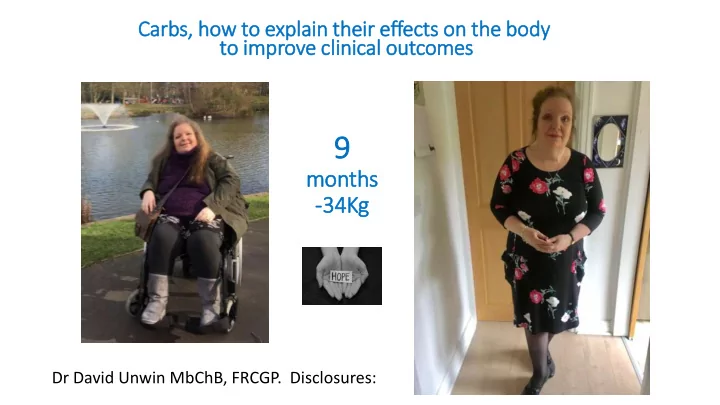
9 9
months
- 34Kg
Dr David Unwin MbChB, FRCGP. Disclosures:
Carbs, how to explain th their effects on th the body to im improve cli clinical outcomes
9 9 months -34Kg Dr David Unwin MbChB, FRCGP. Disclosures: Type - - PowerPoint PPT Presentation
Carbs, how to explain th their effects on th the body to im improve cli clinical outcomes 9 9 months -34Kg Dr David Unwin MbChB, FRCGP. Disclosures: Type 2 Diabetes a chronic, progressive, deteriorating condition. Dr David Unwin
months
Dr David Unwin MbChB, FRCGP. Disclosures:
Carbs, how to explain th their effects on th the body to im improve cli clinical outcomes
‘Type 2 Diabetes a chronic, progressive, deteriorating condition.’ Dr David Unwin 1986 - 2012
HbA1c in mmol/mol
1.psychology 2.physiology
Drug free T2 Diabetes Remission
psychology
32% 68% Fasting triglyceride level
>2mmol/L <2mmol/L
Out of 2458 Norwood practice patients having a lipid profile done in the last 3 years 791 had an abnormal triglyceride result
Explaining the physiology of insulin and carbs to patients in a way they can understand Including:
Triglyceride
? Fasting triglyceride level
Low-carb liposuction!!
HUNGER!
Chronic sodium-retaining action of insulin M. Marlina Manhiani. Am J Physiol Renal Physiol. 2011 Apr; 300(4): F957–F965. Published online 2011 Jan 12. doi:
10.1152/ajprenal.00395.2010
Insulin’s impact on renal sodium transport and blood pressure in health, obesity, and diabetes. Swasti Tiwari, Am J Physiol Renal Physiol 293:
F974–F984, 2007.
Renal effects of insulin in man. J Nephrol. Quiñones-Galvan A 1997 Jul-Aug;10(4):188-91.
In insulin resistant (T2D) individuals compensatory hyperinsulinemia imposes a chronic antinatriuretic and antiuricosuric pressure on the kidney. This may provide an explanation for the clustering of insulin resistance with hypertension and hyperuricemia.
A system view and analysis of essential hypertension Journal of Hypertension. Botzer A et al. 36(5):1094–1103, MAY 2018
Our analysis suggests that insulin plays a primary role in hypertension, highlighting the tight link between essential hypertension and diseases associated with the metabolic syndrome
Glycemic index, glycemic load, and blood pressure: a systematic review and meta-analysis of randomized controlled trials.
Evans C. et al The American Journal of Clinical Nutrition, Volume 105, Issue 5, 1 May 2017, Pages 1176–1190,
This review of healthy individuals indicated that a lower glycemic diet may lead to important reductions in blood pressure
35 or 21.5% 128
Net antihypertensives ‘deprescribed’ No. Ace inhibitors 11 Angiotensin 2 receptor antagonists 1 Alpha-adrenoceptor blockers 1 Beta-adrenoceptor blockers 4 Calcium-channel blockers 9 Diuretics 9 Total 35
Deprescribing of antihypertensive drugs for 154 patients on a low carb diet for an average of 24 months -21.5%
Substantial & Sustained Improvements in Blood Pressure, Weight & Lipid Profiles from a Carbohydrate Restricted Diet: An Observational Study of Insulin Resistant Patients in Primary Care. Unwin D. et al.
Explaining the physiology of insulin and carbs to patients in a way they can understand Including:
Liver fat: linked to insulin resistance Pancreatic fat: inhibits B cell function -cannot produce enough insulin
Reversal of type 2 diabetes: Normalisation of beta cell function in association with decreased pancreas and liver triacylglycerol. Lim EL1, Hollingsworth KG, Taylor R. Diabetologia. 2011 Oct;54(10):2506-14. doi: 10.1007/s00125-011-2204-7.
Triglyceride
*Reduce liver fat Lose weight *Reduce pancreas fat Reduce Insulin resistance Increase insulin secretion
*Reversal of type 2 diabetes: Normalisation of beta cell function in association with decreased pancreas and liver triacylglycerol. Lim EL1, Hollingsworth KG, Taylor R. Diabetologia. 2011 Oct;54(10):2506-14. doi: 10.1007/s00125-011-2204-7.
Rt Hon Matt Hancock MP UK Secretary of State for Health and Social Care
Google: NICE sugar Unwin
Food Item
Glycaemic
index Serving Size g How might each food affect blood glucose compared to one 4g teaspoon of table sugar
Potato boiled
96 150 9.1
Sweet corn
60 80 4.0
Frozen peas,
51 80 1.3
Cabbage
10 80 0.1
Raisins
64 60 10.3
Banana
62 120 5.7
Apple
39 120 2.3
Strawberry
40 120 0.4
Using the Glycaemic Index to predict blood glucose
As per calculations to be found in: It is the glycaemic response to, not the carbohydrate content of food that matters in diabetes and obesity: The glycaemic index revisited | Unwin | Journal of Insulin Resistance 2016 @lowcarbGP
A lower carb diet for type 2 diabetes: In this condition your metabolism struggles to deal with sugar- so its consumption needs cutting back dramatically- Sugar – cut it out altogether, although it will be in the blueberries,
strawberries and raspberries you are allowed to eat. Cakes and biscuits are a mixture of sugar and starch that make it almost impossible to avoid food cravings; they just make you hungrier!!
Reduce starchy carbs a lot… Remember they digest down into
surprising amounts of sugar. If possible just cut out the ‘White Stuff’ like bread, pasta, rice, crackers and breakfast cereals.
All green veg/salads are fine…Eat as much of these as you can –turn the white stuff green So that you still eat a good big dinner try
substituting veg such as broccoli, courgettes or green beans for your mash, pasta or rice – still covering them with your gravy, Bolognese or curry! Tip: try home-made soup – it can be taken to work for lunch and
Fruit is trickier…
Some tropical fruits like bananas, oranges, grapes, mangoes or pineapple have too much sugar in and can set those carb cravings off. Berries are better and can be eaten; blueberries, raspberries, strawberries, apples and pears too.
Eat healthy proteins…
Such as non-processed meat, eggs (three eggs a day is not too much), fish – particularly oily fish such as salmon, mackerel or tuna –are fine and can be eaten freely. Plain full fat yoghurt makes a good breakfast with the
as healthy and should only be eaten in moderation.
Fats are fine in moderation…
Yes, fats can be fine in moderation: olive oil is very useful, butter may be tastier than margarine and could be better for you! Coconut oil is great for stir fries. Four essential vitamins A, D, E and K are only found in some fats
Beware ‘low fat’ foods. They often have sugar or sweeteners added to make them palatable. Full fat mayonnaise and pesto are definitely on!!
Cheese only in moderation…
It’s a very calorific mixture of fat, and protein.
Snacks: avoid, as habit forming. But un-salted nuts such as almonds
chocolate 70% or more in small quantity is allowed.
Eating lots of green veg with protein and healthy fats leaves you properly full in a way that lasts Alcohol is full of carbs…
Sadly many alcoholic drinks are full of carbohydrate – for example, beer is almost ‘liquid toast’ hence the beer belly!! The odd glass of dry white, red wine or spirits is not too bad if it doesn’t make you hungry afterwards – or just plain water with a slice of lemon.
Sweeteners can trick you…
Finally, about sweeteners and what to drink – sweeteners have been proven to tease your brain into being even hungrier, making weight loss more difficult – drink tea, coffee, and water or herb teas. (100ml milk is 1 teaspoon of sugar) Important On medication? Check this first with your Doctor or HCP PS some folk need more salt on a low carb diet
HbA1c in mmol/mol Total Cholesterol HDL Cholesterol Cholesterol Ratio Triglyceride
Averages
71 in remission Start Finish Loss Start Finish Loss Start Finish Loss Start Finish Loss Start Finish Loss
71.0 49.5 21.7 4.9 4.4
0.5 1.2 1.3
4.0 3.5
0.5
2.5 1.6
0.9
HbA1c in % Weight
in Kg
Systolic BP
in mmHg
Diastolic BP
in mmHg Gamma-G.T Level in U/L Averages
50.7% remission Start Finish Loss Start Finish Loss Start Finish Loss Start Finish Loss Start Finish Loss
8.6 6.7
1.9
98.2 89.6
8.6
143 132
11
84 78
6
73 40
33
IN a case series of 138 T2D patients on a lower carb diet In a primary care setting over an average of 24 months @lowcarbGP
Significant improvements in weight, liver function, lipids and blood pressure.
Drug Group & example Action Hypo risk?
Suggested action (to continue/stop) Biguanides -Metformin Reduce hepatic gluconeogenesis, and reduce peripheral insulin resistance No Optional, consider clinical pros/cons. GLP-1 agonists -Liraglutide Slow gastric emptying. Glucose dependent pancreatic insulin secretion. No Optional, consider clinical pros/cons. Insulins Exogenous insulin Yes Reduce/Stop (*see below) Sulfonylureas -Gliclazide Increase pancreatic insulin secretion Yes Stop (or if gradual carbohydrate restriction then wean by e.g. halving dose successively) Meglitinides -Replaglinide Increase pancreatic insulin secretion Yes Stop (or if gradual carbohydrate restriction then wean by e.g. halving dose successively) SGLT-2 inhibitors -Dapagliflozin Increase renal glucose secretion No Stop (Concern over risk of ketoacidosis, unusually the blood glucose may be normal) Thiazolidinediones- Rosiglitazone Reduce peripheral insulin resistance No Usually stop. Concern over risks usually outweighs benefits. DPP-4 inhibitors -Sitagliptin Inhibit DPP-4 enzyme No
Type 2 Diabetes: Diabetic Medications on a Low Carbohydrate Diet - A Summary & Suggestions
There are 3 main considerations for the use of diabetic medications in type 2 diabetes with a low carbohydrate diet:
Murdoch C, Unwin D, Adapting diabetes medication for low carbohydrate management of type 2 diabetes: a practical guide. Br J Gen Pract. 2019;69(684):360-1
@lowcarbGP