9/9/19 GAs: What are they used for? Genetic Algorithms Problems - - PDF document

9 9 19
SMART_READER_LITE
LIVE PREVIEW

9/9/19 GAs: What are they used for? Genetic Algorithms Problems - - PDF document

9/9/19 GAs: What are they used for? Genetic Algorithms Problems can be classified in different ways: Black box model Search problems CS 419/519 Optimization vs constraint satisfaction NP problems / 20 Black box model


slide-1
SLIDE 1

9/9/19 1

Genetic Algorithms

CS 419/519

/ 20

GAs: What are they used for?

Problems can be classified in different ways:

  • Black box model
  • Search problems
  • Optimization vs constraint satisfaction
  • NP problems

/ 20

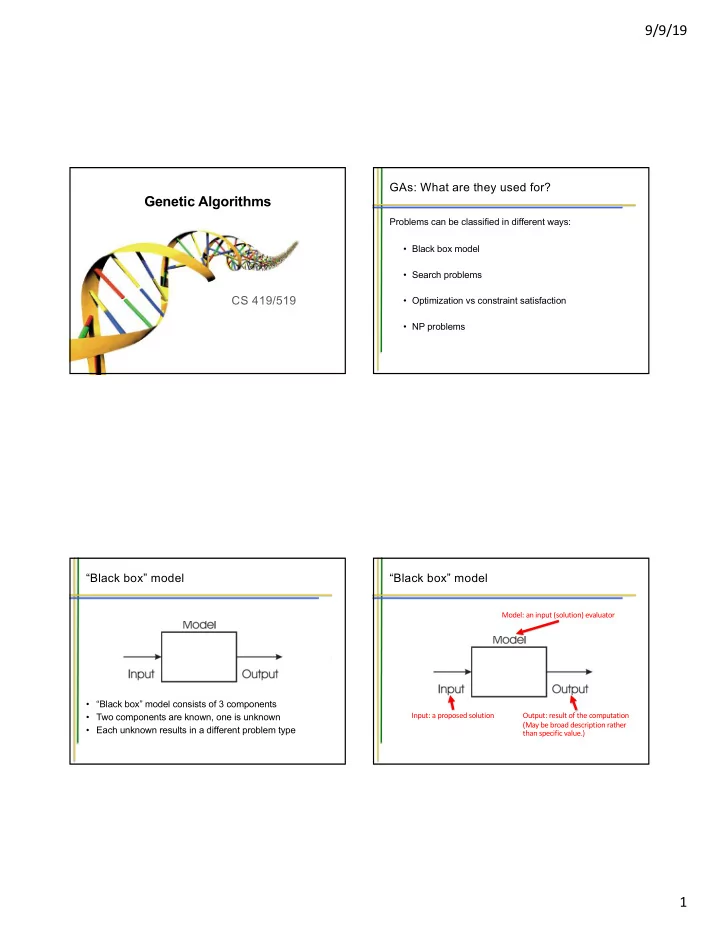
“Black box” model

  • “Black box” model consists of 3 components
  • Two components are known, one is unknown
  • Each unknown results in a different problem type

/ 20

“Black box” model

Model: an input (solution) evaluator Input: a proposed solution Output: result of the computation (May be broad description rather than specific value.)

slide-2
SLIDE 2

9/9/19 2

/ 20

Examples

  • Traveling salesperson problem:
  • Input: a sequence of destinations
  • Model: function to sum distances between adjacent destinations
  • Output: total distance traveled
  • University classroom scheduler:
  • Input: a schedule assigning classes to classrooms
  • Model: function to determine time conflicts, seat shortages, etc
  • Output: values for number of conflicts, seat delta, etc
  • Eight-queens problem:
  • Input: arrangement of eight queens on chessboard
  • Model: checker for conflicts
  • Output: indication of conflict or not

/ 20

Important distinction: problem instance vs. input

  • Problem instance: what we often think of as an “input” to
  • ur algorithms.
  • Input (for the purposes of this discussion): a candidate

solution to the problem.

  • Example: TSP
  • Problem instance: a set of destinations
  • Input: a sequence of the destinations
  • Example: Classroom scheduling
  • Problem instance: sets of classes and classrooms
  • Input: a schedule that may or may not satisfy all constraints

/ 20

“Black box” model: Input unknown Optimization

  • Model and desired output are known. We seek inputs

that maximize or minimize the desired variable(s)

  • Examples:
  • Time tables for university, call center, or hospital
  • Design specifications (circuit, probe placement)
  • Traveling salesperson problem (TSP)
  • Eight-queens problem

/ 20

“Black box” model: Optimisation example 1: university timetabling

Task: find a timetable

  • Enormously big search space
  • Timetables must be good
  • “Good” is defined by a number of

competing criteria

– Courses well distributed – Not too many late in the day

  • Timetables must be feasible

– Satisfies constraints

  • Enough seats
  • No time conflicts
  • Vast majority of search space is

infeasible

slide-3
SLIDE 3

9/9/19 3

/ 20 / 20

“Black box” model: Optimization example 2: satellite structure

Task: find a design

  • Optimized satellite designs for

NASA to maximize vibration isolation

  • Evolving: design structures
  • Fitness: vibration resistance
  • Evolutionary “creativity”

/ 20

“Black box” model: Optimization example 3: 8 queens problem

Task: find an arrangement

  • Given an 8-by-8 chessboard

and 8 queens

  • Place the 8 queens on the

chessboard without any conflict

  • Two queens conflict if they

share same row, column or diagonal

  • Can be extended to an n

queens problem (n>8)

/ 20

“Black box” model: Model unknown Modelling

  • We have corresponding sets of inputs & outputs. We

seek a model that delivers correct output for every known input

  • Examples:
  • Stock market prediction
  • Loan applicant evaluation
  • Facial recognition
  • Autonomous driving
slide-4
SLIDE 4

9/9/19 4

/ 20

“Black box” model: Model unknown Modelling

  • Note: modelling problems can be transformed into
  • ptimisation problems
  • Error rate (or success rate) of the model is quantity to be

minimized (or maximized)

  • Examples
  • Evolutionary machine learning
  • Evolve a neural network that maximizes hit rate of

identifications

  • Predicting stock exchange
  • Minimize difference between predicted value and actual value
  • Voice control system for smart homes
  • Minimize error in commands performed

/ 20

“Black box” model: Modeling example: loan applicant evaluation

  • British bank evolved

creditability model to predict loan paying behavior of new applicants

  • Evolving: prediction

models

  • Fitness: model accuracy
  • n historical data

/ 20

“Black box” model: Modeling example: stock market prediction

Two methods

  • Build a time machine
  • DeLoreans are hard to find
  • Evolve a predictive model
  • Fitness: difference between

actual value of DJIA and predicted value

  • What are the inputs?

/ 20

“Black box” model: Output unknown Simulation

  • We have a given model. We seek the outputs that arise

under different input conditions

  • Often used to answer “what-if” questions in evolving

dynamic environments

  • Examples
  • Evolutionary economics, Artificial Life
  • Weather forecast system
  • Impact analysis of new tax systems
slide-5
SLIDE 5

9/9/19 5

/ 20

“Black box” model: Simulation example: evolving artificial societies

  • Simulating trade, economic

competition, etc. to calibrate models

  • Use models to optimize

strategies and policies

  • Evolutionary economy
  • Survival of the fittest is

universal (big/small fish)

/ 20

“Black box” model: Simulation example 2: cosmology

Simulate the physics beginning at some point in time to test our understanding of the universe Large number of variables and values requires substantial computational resources

/ 20

Search problems

  • Simulation is different from optimization/modelling
  • Optimization/modeling problems search through huge

space of possibilities

  • Search space: collection of all objects of interest

including the desired solution(s)

  • Question: how large is the search space for different

tours through n destinations?

/ 20

Problems vs. problem solvers

Important distinction:

  • search problems: define search spaces
  • problem-solvers: describe how to move through search

spaces

slide-6
SLIDE 6

9/9/19 6

/ 20

Optimization vs. constraint satisfaction

  • Objective function: a way of assigning a value to a

possible solution that reflects its quality

– Number of un-checked queens (maximize) – Length of a tour visiting given set of destinations (minimize)

  • Constraint: binary evaluation telling whether a given

requirement holds or not

– Find a configuration of eight queens on a chessboard such that no two queens check each other – Find a tour with minimal length where city X is visited after city Y

/ 20

Optimization vs. constraint satisfaction Goal:

A solution that:

  • “performs well” according to the objective

function

  • satisfies all constraints

/ 20

Optimization vs. constraint satisfaction

  • When combining the two:

Objective function Constraints Yes No Yes Constrained

  • ptimization

problem Constraint satisfaction problem No Free

  • ptimization

problem No problem

/ 20

Optimization vs. constraint satisfaction

Problem: maximize number of unchecked queens on a chess board Which category? Free optimization problem (FOP)

Objective function Constraints Yes No Yes Constrained

  • ptimization

problem Constraint satisfaction problem No Free

  • ptimization

problem No problem

slide-7
SLIDE 7

9/9/19 7

/ 20

Optimization vs. constraint satisfaction

Problem: find a configuration of eight queens on a chess board such that no two queens check each other Which category? Constraint satisfaction problem (CSP)

Objective function Constraints Yes No Yes Constrained

  • ptimization

problem Constraint satisfaction problem No Free

  • ptimization

problem No problem

/ 20

Optimization vs. constraint satisfaction

Problem: minimize length of tour visiting every destination, in a set of n destinations, exactly once (TSP) Which category? Free optimization problem (FOP)

Objective function Constraints Yes No Yes Constrained

  • ptimization

problem Constraint satisfaction problem No Free

  • ptimization

problem No problem

/ 20

Optimization vs. constraint satisfaction

Problem: find a TSP tour with minimal length such that city X is visited after city Y Which category? Constrained optimization problem (COP)

Objective function Constraints Yes No Yes Constrained

  • ptimization

problem Constraint satisfaction problem No Free

  • ptimization

problem No problem

/ 20

Another classification scheme: P and NP

  • So far, we have only looked at classifying problems; we

have not discussed problem solvers

  • For this new classification scheme, we need the

properties of the problem solver – we will classify problems by how easy or hard they are to solve

  • Applies to combinatorial optimization problems – these

are problems for which the variables are discrete rather than continuous

slide-8
SLIDE 8

9/9/19 8

/ 20

NP problems: Key notions

  • Problem size: dimensionality of the problem at hand and

number of different values for the problem variables

  • Running-time: number of operations the algorithm takes

to terminate

– Worst-case as a function of problem size – Polynomial, super-polynomial, exponential

  • Problem reduction: transforming current problem into

another via mapping

/ 20

NP problems: Class

  • The ‘difficultness’ of a problem can now be classified:

– Class P: algorithm can solve the problem in polynomial time (worst-case running-time for problem size n is less than F(n) for some polynomial formula F) – Class NP: problem can be solved and any solution can be verified within polynomial time by some other algorithm (P subset of NP) – Class NP-complete: problem belongs to class NP and any other problem in NP can be reduced to this problem by an algorithm running in polynomial time – Class NP-hard: problem is at least as hard as any other problem in NP-complete but solution cannot necessarily be verified within polynomial time

/ 20

NP problems: Difference between classes

  • P is different from NP-hard
  • Not known whether P is different from NP

if: P ≠ NP P = NP

/ 20

NP problems: Why should you care?

Let’s say we have a computer with a clock rate defined by the speed of light: 3 x 10-24 sec (~13 orders of magnitude faster than any modern computer) What is size of search space for TSP? How many clock cycles for our computer since the dawn of the universe? ~1042 or about 2120 If our computer could evaluate one solution per clock cycle, for a TSP instance with 120 destinations it would take more time than the age of the universe to consider all

  • f them.
slide-9
SLIDE 9

9/9/19 9

/ 20

NP problems: Yeah, so?

So, this means that it is not possible to guarantee an optimal solution to even moderately sized instances of hard problems. Where does this leave us?

Approximation Algorithms

************************************************** * Genetic algorithms are a form of approximation algorithm * **************************************************