9/30/2016 I have no financial or business relationships to disclose - - PowerPoint PPT Presentation

9 30 2016
SMART_READER_LITE
LIVE PREVIEW

9/30/2016 I have no financial or business relationships to disclose - - PowerPoint PPT Presentation

9/30/2016 I have no financial or business relationships to disclose David M. Gordon, DNP Acute Care & Adult Nurse Practitioner Lung Transplantation Program University of California San Francisco 1950s: Medical specialization


slide-1
SLIDE 1

9/30/2016 1

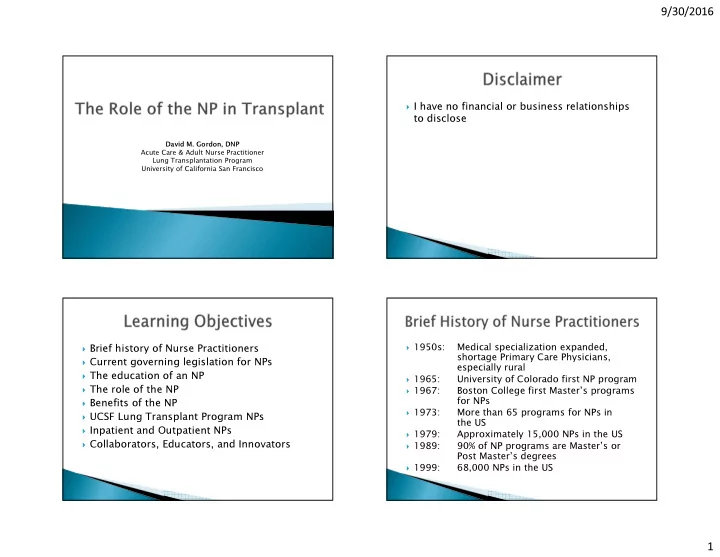
David M. Gordon, DNP Acute Care & Adult Nurse Practitioner Lung Transplantation Program University of California San Francisco I have no financial or business relationships

to disclose

Brief history of Nurse Practitioners Current governing legislation for NPs The education of an NP The role of the NP Benefits of the NP UCSF Lung Transplant Program NPs Inpatient and Outpatient NPs Collaborators, Educators, and Innovators 1950s:

Medical specialization expanded, shortage Primary Care Physicians, especially rural

1965:

University of Colorado first NP program

1967:

Boston College first Master’s programs for NPs

1973:

More than 65 programs for NPs in the US

1979:

Approximately 15,000 NPs in the US

1989:

90% of NP programs are Master’s or Post Master’s degrees

1999:

68,000 NPs in the US

slide-2
SLIDE 2

9/30/2016 2

50000 100000 150000 200000 250000 1979 1999 2003 2007 2010 2012 2014 NPs Resident Hours Currently there are more than 205,000 NPs

practicing in the U.S.

14,000 new NPs completed their academic

programs in 2014

NPs conducted over 900 million patient visits

in 2012

MDs 2013 1,045,910 in practice increasing

19,000 annually

DC

slide-3
SLIDE 3

9/30/2016 3

RNs with bachelors degree in nursing (BSN) Required all NPs have Masters Science Nursing (MSN),

preferred Doctorate (DNP)

Clinical hours

A minimum of 500 faculty-supervised clinical hours

Competency based, not time based National Board Certification Exam

AANP, ANCC Adult-Gerontology (Primary & Acute Care), Pediatrics Neonatal, Family, Psychiatric-Mental Health, Women’s Health Recognized in 50 states, Medicare, Medicaid, VA, private insurances, Canada Re-certify nationally every 5 years

Additional state requirements

Ohio and California additional education class and clinical hours for Schedule II authority

Attending NP? NP? Fellow Resident NP?

slide-4
SLIDE 4

9/30/2016 4

Systematic review 37 studies:

Consistent evidence LOS, ED visits, hospitalizations for NP care is equivalent to MD care (Newhouse et al, 2011)

Introduction NP Model in neuroscience practice

$2.4 million savings the first year, ROI 1600% Expansion of the NP model across the health system brought comparable savings (Larkin, 2003)

United Health NPs to manage nursing home pts

Predicted $166 billion healthcare savings (United Health, 2009)

Collaborative NP/MD management models

Decreased LOS and costs, higher hospital profit (Cowan et al., 2006; Ettner et al., 2006)

>100 studies NP care is not inferior to MD

2011 Fellow centered model

Rotate monthly, constant shuffle & flux

Consult service

Multiple layers to communication Increased potential for medical errors Transplant limited role

No direct transplant contact for RNs Outpatient education 2016 NP centered model

Permanent stability, continuity

NP Admitting service

Direct interaction patient to transplant provider Continuity of care through patient transplant life

NP available for triage contact for RNs Inpatient education Inpatient

Manage the day to day operations of patient care

Pre-operative, Post-operative, Medical & Surgical Dichotomy

Immunosuppression, pain management, blood pressure control, critical care, recovery from OR, chest tube management, glucose control, antimicrobial and infectious management, monitoring postoperative complications, transplant complications, medical co-morbidities management

First triage call from Admission to Discharge ICU critical care, Step-down acute care Examine, Diagnose, Order, Evaluate, Prescribe, Follow-up

Daily rounds with Transplant Surgeon and Pulmonologists Independent billing and Shared billing with Attending Procedures

Outpatient

Manage acute & chronic care of the transplant patients

Pre-operative, Post-operative, Medical & Surgical Dichotomy

Immunosuppression, pain management, blood pressure control, glucose control, antimicrobial and infectious management, monitoring postoperative complications, transplant complications, medical co-morbidities management

Examine, Diagnose, Order, Evaluate, Prescribe, Follow-up

Independent billing and Shared billing with Attending Procedures

slide-5
SLIDE 5

9/30/2016 5

Patient

Nursing Consult Services Family, Caregivers, Discharge Planning Social Work Financial Coordinators Pharmacy Nutritionists, Dieticians Respiratory Therapists Speech Therapists Physical and Occupational Therapists Case Management

Educator

Pulmonary Fellow Education

  • Weekly chalkboard lectures on transplant topics
  • ECMO, Immunosuppression, Post-op Management Lung Transplant

RN Education

  • Created formal, annual, core curriculum for all nursing staff caring for

transplant patients

  • Pharmacology, pathophysiology, annual research/clinical updates
  • Chalkboard lectures

NP Education

  • Precept
  • Mentor
  • Fellowship

Multi-disciplinary Students

  • Med, RN, NP, Pharm, Dieticians

Family/Caregiver Education

  • Education binders
  • Education videos

Innovator

Policy/Protocol

Removing barriers to care Initiation of NP pigtail catheter placement 30 day re-admit program

Procedures

Central lines, bronchoscopies, large and small bore chest tubes, arterial lines, procurements, OR assist, remove venous- venous ECMO

Research

Sildenafil use in pre-transplant hypoxic ILD w/PH Meditation & conscious awareness to ameliorate anxiety with dyspnea in pre-transplant patients Combining TPA and DNAse for trapped lung post lung transplant Nurse Practitioners have evolved to become a

vital member of any multi-disciplinary team based model

NPs offer time become experts in their

specialized population

NPs maintain continuity of care NPs can thrive in any setting as they are

adaptable, innovative, and collaborative

slide-6
SLIDE 6

9/30/2016 6

  • Accreditation Council for Graduate Medical Education. Duty Hours. http://www.acgme.org/What-We-Do/Accreditation/Duty-Hours
  • Institute of Medicine. The Future of Nursing: Leading Change, Advancing Health. http://iom.nationalacademies.org/reports/2010/the-future-of-nursing-leading-change-advancing-

health.aspx

  • American Nurses Credentialing Center. Certification. http://www.nursecredentialing.org/Certification
  • Institute of Medicine. Assessing Progress on the Institute of Medicine Report The Future of Nursing.

http://www.nationalacademies.org/hmd/~/media/Files/Report%20Files/2015/AssessingFON_releaseslides/Nursing-Report-in-brief.pdf

  • National Governors Association. The Role of Nurse Practitioners in Meeting Increasing Demand for Primary Care. http://www.nga.org/cms/home/nga-center-for-best-

practices/center-publications/page-healthpublications/col2-content/main-content-list/the-role-of-nurse-practitioners.html

  • National Council of State Boards of Nursing. Consensus Model for APRN Regulation: Licensure, Accreditation, Certification & Education. https://www.ncsbn.org/736.htm
  • Federal Trade Commission. Policy Perspectives: Competition and the Regulation of Advanced Practice Nurses. http://www.ftc.gov/policy/reports/policy-reports/commission-and-

staff-reports?title=Nurse

  • American Association of Nurse Practitioners. DNP Fact Sheet. http://www.aacn.nche.edu/media-relations/fact-sheets/dnp
  • American Association of Nurse Practitioners. Nurse Practitioner Cost-Effectiveness. https://www.aanp.org/images/documents/publications/costeffectiveness.pdf
  • American Association of Nurse Practitioners. Clinical Outcomes: The Yardstick of Educational Effectiveness.

https://www.aanp.org/images/documents/publications/clinicaloutcomesyardstick.pdf

  • American Association of Nurse Practitioners. State Practice Environment. https://www.aanp.org/legislation-regulation/state-legislation/state-practice-environment
  • American Association of Nurse Practitioners. Nurse Practitioners and Team Based Care. https://www.aanp.org/images/documents/publications/teambasedcare.pdf
  • American Association of Nurse Practitioners. Nurse Practitioner Key Facts. https://www.aanp.org/images/documents/federal-legislation/toolkit-talking-points.pdf
  • American Assoication of Nurse Practitioners. Historical Timeline. https://www.aanp.org/all-about-nps/historical-timeline
  • Larkin, H. (2003). The case for nurse practitioners. Hospitals and

Health Networks, (2003, Aug.), 54-59. Newhouse, R. et al (2011). Advanced practice nurse outcomes 1999-2008: A systematic review. Nursing Economic$, 29 (5), 1-22.

  • Simmons School of Nursing and Health Sciences. History of Nurse Practitioners in the United States [Slideshow]. https://onlinenursing.simmons.edu/nursing-blog/history-nurse-

practitioners/

  • Statista. Total doctors of medicine U.S. 1949-2013 | Statistic. http://www.statista.com/statistics/186260/total-doctors-of-medicine-in-the-us-since-1949/
  • Statista. Statistics and facts about U.S. physicians. https://www.statista.com/topics/1244/physicians/
  • Cowan, M.J., Shapiro, M., Hays, R.D., Afifi, A., Vazirani, S., Ward, C.R., et al. (2006). The effect of a multidisciplinary hospitalist physician and advanced practice nurse

collaboration on hospital costs. The Journal of Nursing Administration, 36(2), 79-85.

  • Ettner, S.L., Kotlerman,J., Abdemonem, A., Vazirani, S., Hays, R.D., Shapiro, M., et al. (2006). An alternative approach to reducing the costs of patient care? A controlled

trial of the multi-disciplinary doctor-nurse practitioner (MDNP) model. Medical Decision Making, 26, 9-17.

  • United Health. Group (2009). Federal health care cost containment: How in practice can it be done? Options with a real world track record of success. Retrieved February 7,

2013 from http://www.unitedhealthgroup.com/ hrm/UNH_WorkingPaper1.pdf.

  • Newhouse, R. et al (2011). Advanced practice nurse outcomes 1999-2008: A systematic review. Nursing Economic$, 29 (5), 1-22.