9/12/2018 An Inn nnovati tive Appr pproa oach to to Symptom - - PDF document

9 12 2018
SMART_READER_LITE
LIVE PREVIEW

9/12/2018 An Inn nnovati tive Appr pproa oach to to Symptom - - PDF document

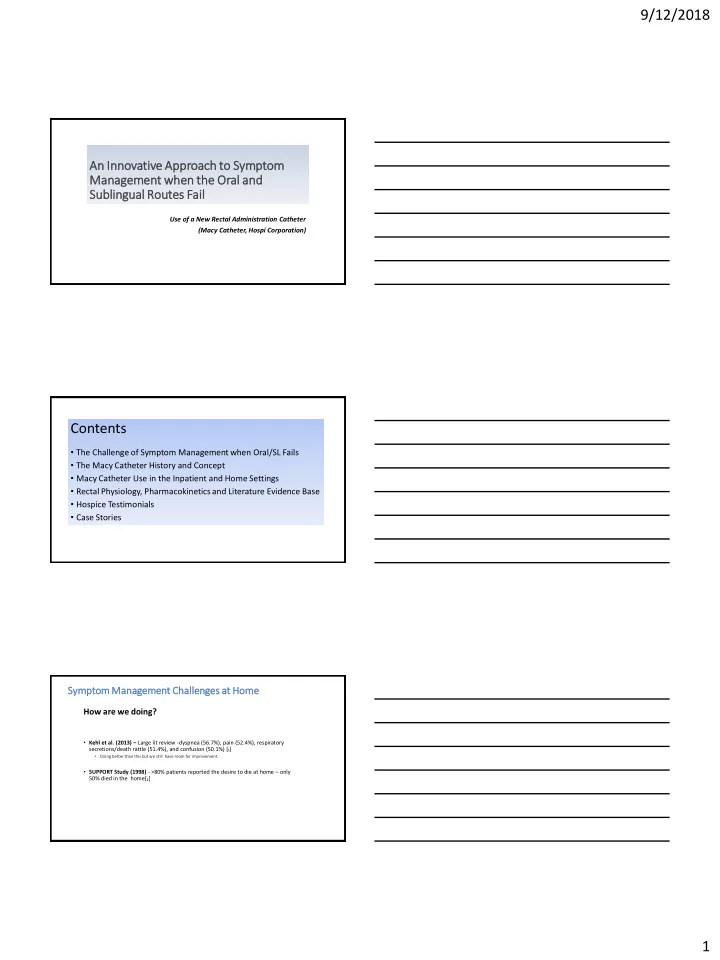
9/12/2018 An Inn nnovati tive Appr pproa oach to to Symptom Man anagement whe hen the he Oral al and and Sub ublingual Rou outes Fai ail Use of a New Rectal Administration Catheter (Macy Catheter, Hospi Corporation) Contents


slide-1
SLIDE 1

9/12/2018 1

An Inn nnovati tive Appr pproa

  • ach to

to Symptom Man anagement whe hen the he Oral al and and Sub ublingual Rou

  • utes Fai

ail

Use of a New Rectal Administration Catheter (Macy Catheter, Hospi Corporation)

Contents

  • The Challenge of Symptom Management when Oral/SL Fails
  • The Macy Catheter History and Concept
  • Macy Catheter Use in the Inpatient and Home Settings
  • Rectal Physiology, Pharmacokinetics and Literature Evidence Base
  • Hospice Testimonials
  • Case Stories

Symptom Mana nagem emen ent Cha Challenges es at Hom

  • me

How are we doing?

  • Kehl et al. (2013) – Large lit review -dyspnea (56.7%), pain (52.4%), respiratory

secretions/death rattle (51.4%), and confusion (50.1%) [₁]

  • Doing better than this but we still have room for improvement
  • SUPPORT Study (1998) - >80% patients reported the desire to die at home – only

50% died in the home[₂]

slide-2
SLIDE 2

9/12/2018 2

Managing Symptoms at The End of Life

  • Terminal Agitation
  • Seizures
  • Severe pain
  • Respiratory distress

Symptom Management

(c) Hospi Corp MAC-14-0017[B]

Oral and SL Oral and SL Symptoms well controlled ~80% Symptoms well controlled ~80% $ Symptoms Controlled $ Symptoms Controlled Oral/SL route no longer effective ~20% Oral/SL route no longer effective ~20% Macy Catheter Macy Catheter $$$ Delay in Sx. Control (hours to days) $$$ Delay in Sx. Control (hours to days)

  • SQ/IV
  • Suppositories
  • Transdermal
  • Continue SL
  • SQ/IV
  • Suppositories
  • Transdermal
  • Continue SL

$$ Immediate Symptom Control $$ Immediate Symptom Control

  • Easily placed by the nurse when oral and

sublingual fail

  • Use meds already at beside
  • No delay for delivery of alternatives
  • Discreet, comfortable, easy to use
  • Stays in place for ongoing delivery
  • No turning / bothering patient for medications
  • EOL meds quickly / effectively absorbed

The Macy Catheter Concept

slide-3
SLIDE 3

9/12/2018 3

Macy Catheter General Information

FDA Indication: Macy Catheter provides rectal access to administer liquids and medications Guidelines

  • MD/NP order for use
  • Can remain in place up to 28 days
  • Non-sterile placement
  • Latex free

The Macy Catheter Up Close

Placement Marker Lines Balloon Medication Delivery Holes Balloon Inflation Port Medication Administration Port

Catheter Placement

Step 1: Lubricate Step 2: Insert Step 3: Inflate Step 4: Secure

slide-4
SLIDE 4

9/12/2018 4

Most Common Macy Catheter Uses

When the is oral route is compromised and SL does not work:

  • Terminal agitation
  • Severe Pain (high dose opioids)
  • Nausea and Vomiting
  • Seizures
  • Shortness of Breath
  • Fever
  • Enables continuation of medication at

the bedside when oral/SL fails

  • Facilitates same-visit symptom relief
  • Eliminates the delay in symptom

control efforts

  • Empowers caregivers to easily and

safely medicate patient

  • Eliminates the costs associated with
  • ther alternatives and delivery

The Macy Catheter in the Home Setting

  • More cost-effective than parenteral options
  • Hospices reporting equivalent or more rapid

symptom relief vs SubQ in most instances

  • More comfortable and safer symptom

management

  • Easier set up, maintenance and drug disposal
  • A more home-like atmosphere
  • An easy way to discharge patients back into

the home

The Macy Catheter in the Inpatient Setting

slide-5
SLIDE 5

9/12/2018 5

  • Mucosa is highly vascularized
  • High % absorptive cells
  • Liquid medications absorbed

more quickly than suppositories

  • Rapidly enters the circulation

Balloon Rectal sphincter

Distal 1/3 of the rectum (Venous return bypasses liver) Inferior mesenteric vein Inferior vena cava

Why does it work so well?

Medication Absorption* Rectal SQ IV SL Trans- dermal Intra- nasal Opiates- (Morphine, fentanyl, Hydromorphone, methadone, more)

X X X X Fentanyl Fentanyl

NSAIDS - (Ibuprofen, Indomethacin, ASA, Ketoprofen)

X

  • Toradol
  • Local
  • Benzodiazepines (Lorazepam, Diazepam, Midazolam, Clonazepam)

X X X Ativan

  • Midazolam

Antinauseants- (Metoclopramide, Prochlorperazine, Odansetron,

promethazine) X X X

  • Anti Seizure - (Valproic Acid, Carbamazepine)

X

  • X
  • Sedatives- (Phenobarbital, Pentobarbital)

X X X

  • Anti-depressants - (Trazodone, Doxepin, Imipramine, Clomipramine)

X

  • Neuroleptics- (Haldol, Thorazine)

X X X

  • Anti-cholinergics - (Atropine, Dimenhydrate, Oxybutinin)

X

  • X

X

  • Steroids - (dexamethasone)

X X X

  • Antibiotics - (Amoxicillin, Erythromycin, Metronidazole, Fluconizole)

X

  • X
  • Acetaminophen

X

  • X($$)
  • Furosemide

X

  • X
  • Versatile Route of Delivery

*Pharmacokinetic studies have been done on the above drugs. Absorption has been found to be effective in the routes marked in green. For specific absorption via rectal route, see Davis et al. (2002)

American Journal of Pain and Symptom Management (2016): "Pharmacokinetics of Phenobarbital in Microenema via Macy Catheter vs. Suppository”

(c) Hospi Corp

Results

  • Phenobarb blood levels 12x higher for MC-20 and 8x higher for MC-6 compared

to suppository.

  • Concentrations achieved in 30 minutes via MC-20 took 4 hours to achieve by

supp.

  • Variability between subjects much less with ME vs Supp
  • Two suppositories failed to produce ANY blood level of Phenobarb

Conclusion

  • Results suggest that phenobarbital oral tablets crushed and suspended in water

and administered via the Macy Catheter is superior to suppository in delivering medication reliably and rapidly.

slide-6
SLIDE 6

9/12/2018 6

Journal of Hospice and Palliative Nursing (2016): Case Study: A New Intervention for Rapid End-of-Life Symptom Control in the Home Setting

(c) Hospi Corp

Reviews benefits and burdens of the usual alternative routes

  • Presents overview of SL, Parenteral Route, Transdermal, Rectal Route, Suppositories and

Macy Catheter

  • Presents Case Study with Macy Catheter Intervention

PATIENT

  • 62 y/o male end stage prostate cancer metastatic to liver/bone with goal to die at home
  • Oral medications not working to control nausea/vomiting, increased pain
  • Oral route eventually compromised

INTERVENTION

  • Macy Catheter initiated and same oral medication regimen was given via the Macy.

OUTCOME

  • 20 min following med administration via the MC the RN noted relief of agitation and pain

NH NHPCO 2016 2016 Pos

  • ster

er Pr Presen entation

Utilizing the Macy Catheter to Facilitate Rapid Symptom Control in the Home Setting: A Case Series

Pia Christensen RN, Hope Hospice Dublin CA

  • Case Series (Three Patients)
  • A 68 y/o male with Glioblastoma

Multiform Stage IV

  • A 56 y/o female with End Stage

Liver disease,

  • A 62 y/o male with Lung Cancer

mets to liver and bones

Patient SYMPTOMS PRESENT SEVERITY PRIOR TO INTERVENTIION SEVERITY AFTER INTERVENTIION TIME TO ACHIEVE COMFORT 1 RESTLESSNESS CONGESTION SEVERE SEVERE SLEEPING MODERATE 10 MINUTES 2 AGITATION PAIN SEVERE 10 CALM 3 15 MINUTES 3 PAIN 10 2 10 MINUTES

Davis (et al.) Literature Review on Rectal Absorption

(c) Hospi Corp

Support Cancer Center (2002): “Symptom control in cancer patients: the clinical pharmacology and therapeutic role of suppositories and rectal suspensions”

Pharmacology Review of rectally administered palliative medications Results:

  • Most classes of drugs used at the end of life have at least one and

usually several drugs within that class that have evidence for absorption rectally in either ME or suppository form.

slide-7
SLIDE 7

9/12/2018 7

Morphine - Oral vs. Rectal Micro-enema

  • DeConno et al. (“Journ. of Clin. Onc.” 1995)
  • 34 patients - Met. CA.
  • Randomized, double blind, double dummy crossover study

Results

  • Significant pain relief in 10 min (p=.03) via rectal ME vs 60 min oral
  • Pain intensity continued significantly lower only by rectal route at

180 min

(c) Hospi Corp MAC-14-0017[B]

Methadone Oral vs Rectal Micro-enema

Dale et al. (Brit. J Clinical Pharmacology (2004)) Compared Oral vs Rectal ME absorption Kinetics and Pain efficacy Results

  • Bioavailability 88% to oral
  • T-max 1.4 hr rectal vs. 2.8 oral
  • Took 60 minutes (oral) achieve same blood concentration

reached in 10 minutes (rectal)

Diazepam Rectal ME vs IM, oral, suppository

(c) Hospi Corp MAC-14-0017[B]

Moolinaar et al. (Int. Journal of Pharmaceutics (1980) Compared t-max, variability, and bioavailability for (IV, IM, Oral, Rectal Supp. and Rectal ME) Results

  • T-max 17 min (rectal ME) vs. 52 min (oral) vs. 95 min

(IM) vs. 82 min (supp.)

  • Rectal ME Bioavailability vs IV 100%
  • Intra-subject variability lowest via rectal ME
  • Intra-subject variability was highest for oral dosing
slide-8
SLIDE 8

9/12/2018 8

Ohio’s Hospice of Dayton Story

  • Agency had opioid shortage crisis at end of 2017
  • PBM gave them 4 days before out of morphine,

methadone and hydromorphone

  • Switched in mid-November
  • Have used in > 1000 patients since
  • Using Macy instead of SQ in almost all patients
  • Except patients that have contraindications for rectal

delivery

  • Finding Macy Catheter faster, easier and more cost efficient

(c) Hospi Corp MAC-14-0017[B]

“Based on my experience on our hospice inpatient unit, the Macy Catheter is faster than subcutaneous in controlling pain with opioids and I am able to control pain with less

  • pioid dose adjustments. It is also very effective in most

instances in quickly controlling terminal agitation and

  • ther symptoms. It saves nursing time and decreases

medication cost and waste. I will never go back to my prior practice and will continue using the Macy Catheter. ”

  • Dr. Wendy Schmitz, M.D. Vice President of Medical

Services, Ohio’s Hospice of Dayton

Hospice Buffalo

Cost Savings Experienced

  • Total 2017 Savings $92,000
  • Total Patients in IPU = 640
  • MC Patients = 230 (36%)
  • $401 savings per MC placed

64

patients

$40

saved per MC

$2k

saved

  • White paper done by CMO, Director of Pharm, Nursing

Leadership

  • Looked at the Challenges facing hospice
  • Clinical, quality and cost benefits their agency has experienced

using the Macy Catheter.

  • (Paper available at www.macycatheter.com )
slide-9
SLIDE 9

9/12/2018 9

Hospice Buffalo - Decreased PBM Costs in the IPU

Pre-change Ave Cost = $35.52 Post-change Ave. cost = $19.67 $15 $20 $25 $30 $35 $40 $45

May-16 Jun-16 Aug-16 Oct-16 Nov-16 Jan-17 Mar-17 Apr-17 Jun-17

COST IN PPD DATE Monthly PBM Medication Costs PPD

Hospice Buffalo - Infusion vs. MC (Home Care)

(c) Hospi Corp MAC-14-0017[B]

IV Costs

  • $40/day per diem
  • $50 delivery charge
  • $20 for 2 PCA cassettes MS

Hospice Buffalo – Suppositories vs. MC (Home)

(c) Hospi Corp MAC-14-0017[B]

Clinical Challenges with Suppositories

  • Hours of lag-time prior to treatment (delivery )
  • Ongoing repositioning and exposing private areas
  • Difficult to titrate for changing symptom intensity
  • Uncomfortable vs. MC comfortable
  • Delayed and variable absorption
  • Family/CG reluctant to use
slide-10
SLIDE 10

9/12/2018 10

Case Stories Heart and Home Hospice

PATIENT

  • 70 y/o female with a primary diagnosis of COPD and comorbidities of CHF, CAD, and DM
  • As patient transitioned, she started having seizures, quickly escalating to status epilepticus and

left her unresponsive. INTERVENTION

  • Discussed Macy Catheter with family who were open to try it
  • Placed easily
  • 10mg valium given

OUTCOME

  • Status epilepticus was controlled in 10 minutes
  • Family was very relieved to see patient resting so quickly after 8 hours of seizure activity
  • Family able to easily and comfortably administer medication
  • Patient passed comfortably and seizure-free

Hospice of Fairbanks Memorial Hospital, AK

PATIENT

  • Male with metastatic lung cancer, mid-50s experiencing symptoms of pain and agitation

escalating over several days

  • Haloperidol doses titrated upward, but symptoms continued to get worse
  • Became severely agitated, climbing out of bed, and now refusing to take medications

INTERVENTION

  • Wife initially reluctant to try rectal medication at first
  • Nurse explained he would not feel it and said if it did not work he would take it out
  • She agreed and same dose of haloperidol and morphine were given that were being given PO

OUTCOME

  • Within 20 minutes patient was calm and relaxed with no overt sign of pain or distress
  • Wife stated, “Why didn’t we do this sooner?”
  • Wife was able to continue giving medications through the catheter easily until he died peacefully

and comfortably at home

slide-11
SLIDE 11

9/12/2018 11

Hope Hospice, Dublin CA

PATIENT

  • A middle-aged male, brain tumor, unresponsive with terminal restlessness and severe pulmonary

congestion.

  • Patient was an MD and several family members were in medical profession
  • Patient’s doctor had told family that due to the location of the tumor in the brainstem, nothing but IV

morphine and Ativan would work to control symptoms

  • Family insisting on IV set up

INTERVENTION

  • Nurse explained IV would take hours to arrive and recommended trying Macy Catheter while waiting
  • Family agreed and MC was placed. MS 20mg and Ativan 1mg were given

OUTCOME

  • The patient’s symptoms were managed within 10 minutes.
  • The family was absolutely amazed, very much relieved and grateful.
  • The hospice never needed to start an IV and the patient died comfortably within 24 hours

Rainbow Hospice

PATIENT INTERVENTION OUTCOME

Rainbow Hospice

PATIENT INTERVENTION OUTCOME

slide-12
SLIDE 12

9/12/2018 12

Q & A

?