
SLIDE 1
8/3/2011 1
“PROTECTING OPEN SPACES” ISSUES IN NATIONAL PARKS OF PAKISTAN
Anis ur Rahman and Ali Ahmad Jan Photos by Ghulam Rasul and Usman Ghani Himalayan Wildlife Foundation July 24nd 2011
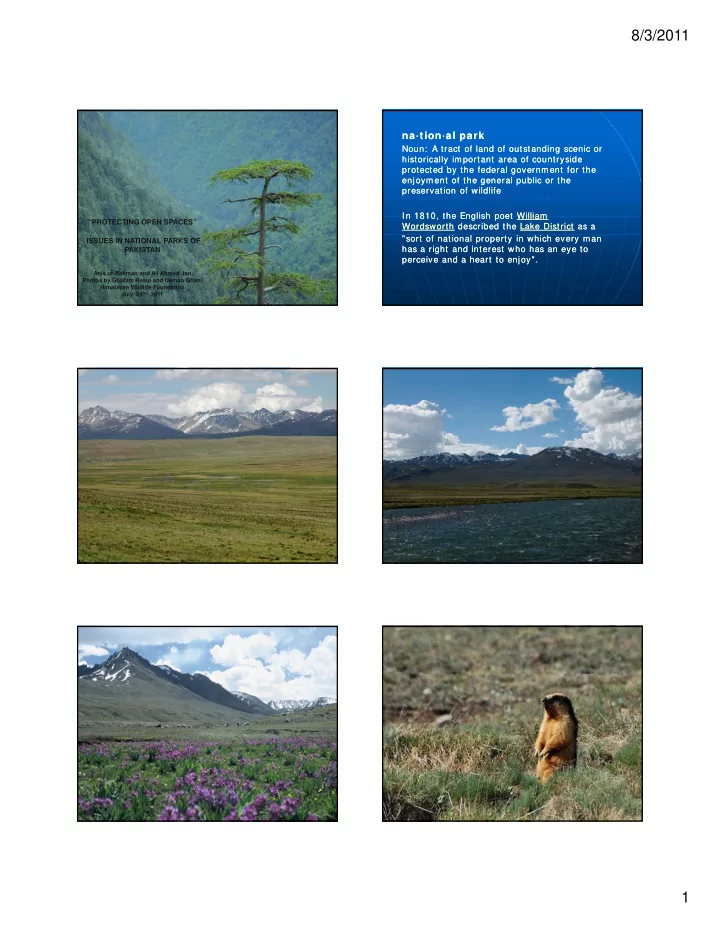
8/3/2011 national park national park Noun: A tract of land of - - PDF document
8/3/2011 national park national park Noun: A tract of land of outstanding scenic or Noun: A tract of land of outstanding scenic or historically important area of countryside historically important area of countryside protected by
“PROTECTING OPEN SPACES” ISSUES IN NATIONAL PARKS OF PAKISTAN
Anis ur Rahman and Ali Ahmad Jan Photos by Ghulam Rasul and Usman Ghani Himalayan Wildlife Foundation July 24nd 2011
Deosai
Involvement of HWF in
The project expanded into an effort to protect
Numerous parks and PA all over the
Capital city adjacent to a NP
AJK Wildlife Act 2010 approved
Trophy hunting program is an
Strong and vibrant NGO’s, well
3312 hectares (8184 acres) core area of about 33 sq km, peri peri protected area about 150 sq km. protected area about 150 sq km.
104 species of plants
The main floral species are Cedrus Cedrus deodara deodara, , Blue Blue Pine Pine, Yew Yew, Silver Fir Silver Fir, Horse Chestnut Horse Chestnut and and Oak
. The World World Wide Fund for Nature Wide Fund for Nature has launched an has launched an ethno ethno-
botanical initiative here "to demonstrate the sustainable use of initiative here "to demonstrate the sustainable use of botanical botanical initiative here to demonstrate the sustainable use of initiative here to demonstrate the sustainable use of plant resources as a means for protecting plant resources as a means for protecting biodiversity biodiversity." ."
The park harbors up to 203 species of birds. Many species of birds, including the birds, including the Golden Eagle Golden Eagle, the , the Vulture Vulture, , Sparrow Sparrow Hawk Hawk and the and the Hill Pigeon Hill Pigeon among others can be found here. It among others can be found here. It is also home to some of the rarer Himalayan pheasant species is also home to some of the rarer Himalayan pheasant species like the like the Kalij Kalij Pheasant Pheasant and and Koklass Koklass. . Ayubia Ayubia National Park National Park supports 31 species of mammals. Animals such as the supports 31 species of mammals. Animals such as the Asiatic Asiatic Leopard Leopard, Asiatic Black Bear Asiatic Black Bear, , Hill Fox Hill Fox and and Flying Squirrel Flying Squirrel can be can be found here. found here.
Conservation of Leopard in
Aumeeruddy Aumeeruddy-
Thomas, Y., Z.K. Shinwari Shinwari., A. ., A. Ayaz Ayaz, and , and A.A.Khan A.A.Khan, A. A. 2004. , A. A. 2004. Ethnobotany Ethnobotany and management of fodder and fuel wood at and management of fodder and fuel wood at Ayubia Ayubia National National Park, North Park, North-
West Frontier Province, Pakistan. People and plants working paper 13. WWF paper 13. WWF-
UK 08 villages
6,000 households
42,000 peoples dependent on the park
Fodder/ fuel wood/ Grazing/ Construction
500 kg/ per day or 14,000 kg per
Vacation houses
(Bribe -
Average Rs. 50-
200 Bundle of fuel-
wood
Cutting a small tree Rs. 100-
400.)
Recognizing and respecting the resource/ value of
Need for funding by government leading to
wildlife acts do not recognize peripheral or
Projects lapse and cause management problems
The need for involving local people for involving local people in formulation of the management in formulation of the management
maintaining human needs. maintaining human needs.
It is vital to identifying role and responsibilities of the key stakeholders and devise a mechanism for potential benefit sharing and and devise a mechanism for potential benefit sharing and find alternatives find alternatives for firewood/ for firewood/ fuelwood fuelwood collection, grazing rights, construction timber, and collection, grazing rights, construction timber, and use of other resources for local people in and around the PAs. use of other resources for local people in and around the PAs.
monitoring mechanism for Protected Areas at, Provincial and National level; level;
prepare Park Management Plans for all the Protected Areas. That should contain immediate, medium term and long term actions contain immediate, medium term and long term actions
Funding for putting plans into action is the key to achieve the objective/ s. is the key to achieve the objective/ s. It was agreed to access funding on priority basis for those Protected Areas It was agreed to access funding on priority basis for those Protected Areas which have already prepared Park Management Plans both for ecological which have already prepared Park Management Plans both for ecological integrity and improving living conditions of local people in and around the integrity and improving living conditions of local people in and around the
Trust Funds for PA’s PA’s was also recommended by the participants, was also recommended by the participants,
Managerial capacity of the existing staff in both in habitat in both in habitat improvement and community development. improvement and community development.
The workshop also suggested to involve key relevant credible civil society organization/ and experts already engaged in conservation society organization/ and experts already engaged in conservation efforts in different capacities. efforts in different capacities.
Developing linkages on scientific research institutions and
Dialogues and partnerships are needed for Trans-
Boundary conservation efforts with China, Iran and Afghanistan were also conservation efforts with China, Iran and Afghanistan were also suggested at federal level; suggested at federal level;
The need was also realized to involve civil society relevant
programs for the public; programs for the public;
Investment by the Government to wildlife
Strengthening institutions, staffing and training
Reforming the wildlife acts to recognize
Projects are a one time intervention and not
H I M A L A Y A N W I L D L I F E F O U N D A T I O N
The objectives of this Convention, to be pursued
According to the best available data on the status and trends on protected areas (see UNEP/ CBD/ SBSTTA/ 9/ 5), trends on protected areas (see UNEP/ CBD/ SBSTTA/ 9/ 5), the current global systems of protected areas are not the current global systems of protected areas are not sufficiently large, sufficiently well sufficiently large, sufficiently well-
planned, nor sufficiently well well-
managed to maximize their contribution to biodiversity
co se at o e e o e, t e e s a u ge t eed to ta e co se at o e e o e, t e e s a u ge t eed to ta e action to improve the coverage, representativeness and action to improve the coverage, representativeness and management of protected areas nationally, regionally and management of protected areas nationally, regionally and globally. globally.
Convention recognizes that biological diversity is