8/27/2020 INFECTIOUS DISEASE PREVENTION: VIRGINIA EMERGENCY - - PDF document

8 27 2020
SMART_READER_LITE
LIVE PREVIEW

8/27/2020 INFECTIOUS DISEASE PREVENTION: VIRGINIA EMERGENCY - - PDF document

8/27/2020 INFECTIOUS DISEASE PREVENTION: VIRGINIA EMERGENCY SARS-COV-2 VIRUS THAT CAUSES COVID-19 TEMPORARY STANDARD 8/26/20 H A Z A R D L E V E L S Your hazard level is based on exposure risk level presented by SARS-CoV-2 virus- related and


slide-1
SLIDE 1

8/27/2020 1 INFECTIOUS DISEASE PREVENTION: SARS-COV-2 VIRUS THAT CAUSES COVID-19

VIRGINIA EMERGENCY TEMPORARY STANDARD

8/26/20

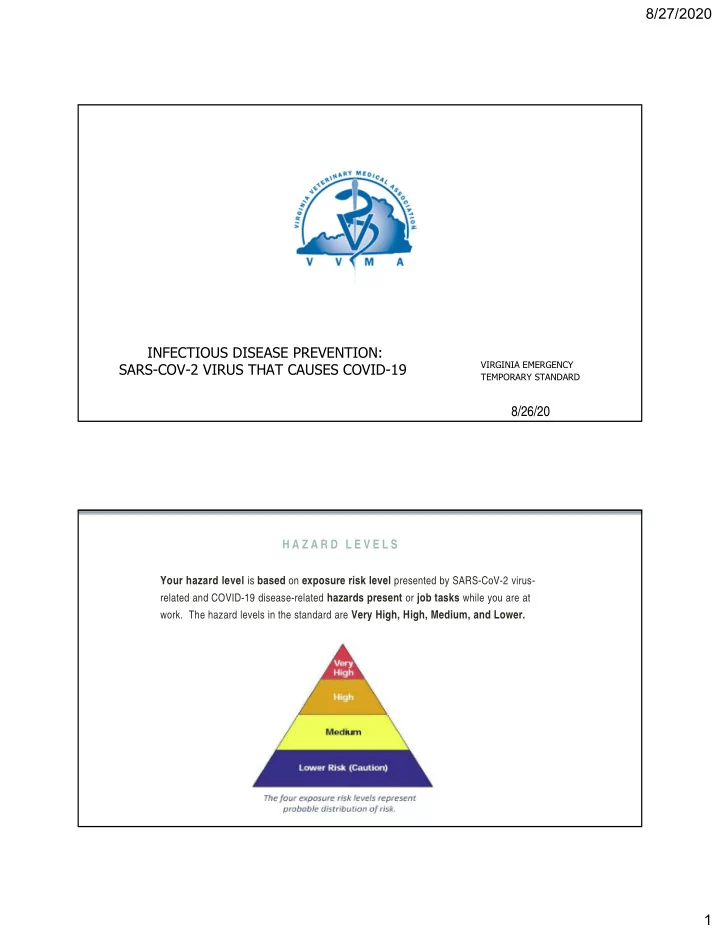
H A Z A R D L E V E L S

Your hazard level is based on exposure risk level presented by SARS-CoV-2 virus- related and COVID-19 disease-related hazards present or job tasks while you are at

  • work. The hazard levels in the standard are Very High, High, Medium, and Lower.
slide-2
SLIDE 2

8/27/2020 2

D E T E R M I N I N G E X P O S U R E R I S K L E V E L  The job tasks being undertaken  The work environment (e.g. indoors or outdoors)  The known or suspected presence of the virus  The presence of a person known or suspected to be infected with SARS-CoV-2 virus  The number of employees and/or other persons in relation to the size of the work area  The working distance between employees and other employees or person  The duration and frequency of employee exposure through contact (inside of six feet) with other employees or persons (e.g., including shift work exceeding 8 hours per day)

Job/Task

Presence of virus

D E T E R M I N I N G E X P O S U R E R I S K L E V E L  The type of hazards encountered, including potential exposure to the airborne transmission of SARS-CoV-2 virus  Contact with contaminated surfaces or objects (equipment, break room tables, rest rooms, workstations, entrances/exits,etc.)  Employer sponsored shared transportation.

slide-3
SLIDE 3

8/27/2020 3

§ 3 0 I M P O R T A N T D E F I N I T I O N S

 Asymptomatic means a person who does not have symptoms.  Cleaning means the removal of dirt and impurities, including germs, from surfaces. Cleaning alone does not kill germs. But by removing the germs, it decreases their number and therefore any risk of spreading

infection.

 Disinfecting means using chemicals approved for use against SARS-CoV-2, for example, EPA-registered disinfectants, to kill germs on surfaces. This process does not necessarily clean dirty surfaces or remove

  • germs. But killing germs remaining on a surface after cleaning further reduces any risk of spreading

infection.

I M P O R T A N T D E F I N I T I O N S

 Exposure risk level means an assessment of the possibility that an employee could be exposed to the hazards associated with SARS-CoV-2 virus and the COVID-19 disease. The exposure risk level assessment should address all risks and all modes of transmission including airborne transmission, as well as transmission by asymptomatic and pre-symptomatic individuals. Risk levels should be based

  • n the risk factors present that increase risk exposure to COVID-19 and are present during the course of

employment regardless of location. Hazards and job tasks have been divided into four risk exposure levels “Very High”, “High”, “Medium”, and “Lower”
slide-4
SLIDE 4

8/27/2020 4

L E V E L S O F R I S K  Medium - Exposure risk hazards or job tasks are those not otherwise classified as “very high” or “high” exposure risk in places of employment that require more than minimal occupational contact inside six feet with other employees, other persons, or the general public who may be infected with SARS-CoV-2, but who are not known or suspected to be infected with the virus. “Medium” exposure risk hazards or job tasks may include, but are not limited to, operations and services in veterinary settings. L O W E R L E V E L S O F R I S K

 Lower exposure risk hazards or job tasks are those that do not require contact inside six feet with persons known to be, or suspected of being, or who may be infected with SARS-CoV-2.  Employees in this category have minimal occupational contact with other employees, other persons, or the general public, such as in an office building setting; or are able to achieve minimal occupational contact through the implementation of engineering, administrative and work practice controls, such as, but not limited to

slide-5
SLIDE 5

8/27/2020 5

A C H I E V E M I N I M A L O C C U P A T I O N A L C O N T A C T T H R O U G H W O R K P R A C T I C E C O N T R O L S  Installation of floor to ceiling physical barriers constructed of impermeable material and not subject to unintentional displacement (e.g., such as clear plastic walls at convenience stores behind which only one employee is working at any one time)  Telecommuting  Staggered work shifts that allow employees to maintain physical distancing from other employees, other persons, and the general public  Delivering services remotely by phone, audio, video, mail, package delivery, curbside pickup or delivery, etc., that allows employees to maintain physical distancing from other employees, other persons, and the general public

W O R K P R A C T I C E C O N T R O L S C O N T I N U E D  Mandatory physical distancing of employees from other employees, other persons, and the general public.  Employee use of face coverings for contact inside six feet of coworkers, customers, or other persons is not an acceptable administrative or work practice control to achieve minimal occupational contact. However, when it is necessary for brief contact with others inside the 6 feet distance a face covering is required.

slide-6
SLIDE 6

8/27/2020 6

I M P O R T A N T D E F I N I T I O N S

 Face covering means an item normally made of cloth or various other materials with elastic bands or cloth ties to secure over the wearer’s nose and mouth in an effort to contain or reduce the spread of potentially infectious respiratory secretions at the source (i.e., the person’s nose and mouth).  A face covering is not intended to protect the wearer, but it may reduce the spread of virus from the wearer to others.  A face covering is not a surgical/medical procedure mask.

I M P O R T A N T D E F I N I T I O N S

 Physical distancing also called “social distancing” means keeping space between yourself and other persons while conducting work-related activities inside and outside of the physical establishment by staying at least 6 feet from other persons.  Physical separation of an employee from other employees

  • r persons by a permanent, solid floor to ceiling wall

constitutes physical distancing from an employee or other person stationed on the other side of the wall.

slide-7
SLIDE 7

8/27/2020 7

I M P O R T A N T D E F I N I T I O N S

 Symptomatic means the employee is experiencing symptoms similar to those attributed to COVID-19 including: fever or chills, cough, shortness of breath or difficulty breathing, fatigue, muscle or body aches, headache, sore throat, new loss of taste or smell, congestion or runny nose, nausea or vomiting, or diarrhea. Symptoms may appear in 2 to 14 days after exposure to the virus.

P H Y S I C A L D I S T A N C I N G

Employees must observe physical distancing while on the job and during breaks.

slide-8
SLIDE 8

8/27/2020 8

C O M M O N A R E A S – P H Y S I C A L D I S T A N C I N G

 Follow policies limiting the occupancy of the space  Observe requirements for physical distancing  Observe requirements for hand washing/hand sanitizing  Clean and disinfect shared surfaces Employees who gather in common areas, lunch and break rooms, locker rooms, time clocks, must: P H Y S I C A L D I S T A N C I N G – F A C E C O V E R I N G I N F O R M A T I O N If the work area does not allow employees to observe physical distancing requirements, employees must comply with applicable respiratory protection and personal protective equipment standards. Employees are not requires to use a respirator, surgical/medical procedure mask, or face covering if doing so would be contrary to their health or safety because of a medical condition; however, we must comply with personal protective equipment and all applicable respiratory protection standards.

slide-9
SLIDE 9

8/27/2020 9

S A N I T A T I O N A N D D I S I N F E C T I N G Employees that interact with customers, the general public, contractors, etc., will be provided with and immediately use supplies to clean and disinfectant surfaces contacted during the interaction where there is the potential for exposure to SARS-CoV-2 virus by themselves or other employees.

S A N I T A T I O N & D I S I N F E C T I N G

 Areas where individuals with known or suspected cases have been will be cleaned and disinfected prior to allowing employees to access the area. Where feasible, a period of 24 hours will be observed prior to cleaning and

  • disinfecting. This requirement shall not apply if the area(s) in question have been unoccupied for seven or more days.

 All common spaces, including bathrooms, frequently touched surfaces and doors, shall at a minimum be cleaned and disinfected at the end of each shift.

 All shared tools, equipment, workspaces, and vehicles shall be cleaned and disinfected prior to transfer from

  • ne employee to another.
slide-10
SLIDE 10

8/27/2020 10

S A N I T A T I O N & D I S I N F E C T I N G

 Employees have cleaning and disinfecting products readily available to accomplish the required cleaning and disinfecting.  Please follow the instructions on product labels.  Employees shall have easy, frequent access, and permission to use soap and water and hand sanitizer where feasible, for the duration of work.  Employees assigned to a workstation where job tasks require frequent interaction inside six feet with other persons shall be provided with hand sanitizer where feasible at their workstation. § 6 0 M E D I U M E X P O S U R E R I S K R E Q U I R E M E N T S The following requirements for employers with hazards or job tasks classified as “medium” exposure risk apply in addition to general requirements for all and “lower” hazard job tasks.

Medium

slide-11
SLIDE 11

8/27/2020 11

M E D I U M E X P O S U R E R I S K R E Q U I R E M E N T S

Administrative and Work Practice Controls

 To the extent feasible, we are implementing the following administrative and work practice controls:

 Prior to the commencement of each work shift, prescreening or surveying is required to verify each covered

employee does not have signs or symptoms of COVID-19.

 We are providing face coverings to non-employees suspected to be infected with SARS-CoV-2 to

contain respiratory secretions until they are able to leave the site (i.e., for medical evaluation/care or to return home).

MEDIUM EXPOSURE RISK REQUIREMENTS

Administrative & Work Practice Controls:

  • Flexible worksites / hours – telework, staggered shifts
  • Physical distancing for employees and other persons of 6 feet
  • Limit number of non-employee accessing worksites
  • To the extent feasible, employers shall install physical barriers (e.g., clear plastic sneeze

guards, etc.), where such barriers will aid in mitigating the spread of SARS-CoV-2 virus transmission

  • Flex meeting and travel options (phone, video, no non-essential travel)
  • Deliver services remotely, curbside pickup
slide-12
SLIDE 12

8/27/2020 12

MEDIUM EXPOSURE RISK REQUIREMENTS

Administrative & Work Practice Controls We are providing and requiring employees to wear face coverings when, because

  • f job tasks, they cannot feasibly practice physical distancing from another

employee or other person if the hazard assessment has determined that personal protective equipment, such as respirators or surgical masks, was not required for the job task. We are providing and requiring employees in client or resident facing jobs to wear face coverings.

MEDIUM EXPOSURE RISK REQUIREMENTS

Personal Protective Equipment (PPE) Employers covered by this section and not otherwise covered by the VOSH Standards for General Industry (Part 1910), shall comply with the following requirements for a SARS-CoV-2 virus and COVID-19 disease related hazard assessment, and personal protective equipment selection: Assess the workplace to determine if SARS-CoV-2 or COVID-19 hazards or job tasks are present, likely to be present which requires use of PPE. The employer shall provide for employee and employee representative involvement in the assessment process. If hazard or task are present, or likely to be present, the employer shall: Select and require affected employees use proper PPE; Communicate selection decisions to each affected employee; and, select PPE that properly fits each affected employee.

slide-13
SLIDE 13

8/27/2020 13

INFECTIOUS DISEASE PREPAREDNESS & RESPONSE PLAN

The plan shall contain:

 The person(s) responsible for administering the Plan.  Employee involvement in development and implementation of the plan.  Level(s) of risk, hazards employee are exposed to and job tasks.  Where, how, and to what sources of SARS- CoV-2 or COVID-19 might employees be exposed at work  Employees’ individual risk factors  Engineering, administrative, work practices, and personal protective equipment controls necessary to address risks

INFECTIOUS DISEASE PREPAREDNESS & RESPONSE PLAN

The plan shall contain:

 Contingency plans for situations that may arise as a result of outbreaks, such as:  Increased absenteeism;  The need for physical distancing, staggered work shifts, downsizing operations, delivering services remotely, and other exposure-reducing workplace control measures  Options for conducting essential operations with a reduced workforce, including cross-training employees; and  Interrupted supply chains or delayed deliveries.  Basic infection prevention measures such as:  Handwashing and hand sanitizer  Routine cleaning and disinfecting of surfaces, equipment, and other elements of the work environment.  Policies and procedures for managing and educating visitors to the place of employment.

slide-14
SLIDE 14

8/27/2020 14

I N F E C T I O U S D I S E A S E P R E P A R E D N E S S & R E S P O N S E P L A N

The plan shall contain:  Prompt identification and isolation of known or suspected to be infected with SARS-CoV-2 employees away from work, including procedures for employees to report when they are experiencing symptoms of COVID-19.  Infectious disease preparedness and response with outside businesses, including but not limited to subcontractors that enter the place of employment, business that provide or contract or temporary employees to the employer, as well as other persons accessing the place of employment to comply with the requirements of this standard and the employer’s plan. I N F E C T I O U S D I S E A S E P R E P A R E D N E S S & R E S P O N S E P L A N

The plan shall contain:  Mandatory and non-mandatory recommendations in any CDC guidelines or Commonwealth of Virginia guidance documents the employer is complying with.  Mandatory requirements of any applicable Virginia Executive Order or Order of Public Health emergency related to the SARS-CoV-2 virus or COVID-19 disease.

slide-15
SLIDE 15

8/27/2020 15

TRAINING

Training requirements includes:  The mandatory and non-mandatory recommendations in any CDC guidelines or State of Virginia guidance documents the employer is complying with, if any, in lieu of a provision

  • f this standard as provided for in section §§16VAC25-220-10.G.1 and -10.G.2.

 The characteristics and methods of spread of the SARS-CoV-2 virus  The signs and symptoms of the COVID-19 disease  Risk factors of severe COVID-19 illness with underlying health conditions  Awareness of the ability of pre-symptomatic and asymptomatic COVID-19 persons to transmit the SARS-CoV-2 virus  Safe and healthy work practices including:  Physical distancing, disinfection procedures and frequency, ventilation, noncontact methods of greeting, etc.,

TRAINING

PPE:  When PPE is required  What PPE is required  How to properly don, doff, adjust, and wear PPE  The limitations of PPE  The proper care, maintenance, useful life, and disposal of PPE  Heat-related illness prevention including the signs and symptoms of heat-related illness  The anti-discrimination provisions of the Standard in §16VAC25-220-90  The employer’s Infectious Disease Preparedness and Response Plan.

slide-16
SLIDE 16

8/27/2020 16

T R A I N I N G - C E R T I F I C A T I O N

 We will prepare a written certification record for those employees exposed to hazards or job tasks classified at “medium” exposure risk levels to confirm completion of the training.

T R A I N I N G - R E T R A I N I N G

 Retraining may be necessary if there are:  Changes in workplace, SARS-CoV-2 or COVID-19 disease hazards exposed to, or job task performed render previous training obsolete  Changes are made to the employer’s Infectious Disease Preparedness and Response Plan  Inadequacies in an affected employee’s knowledge or use of workplace control measures indicate that the employee has not retained the required understanding or skill.

slide-17
SLIDE 17

8/27/2020 17

I N F O R M A T I O N P R O V I D E D F O R “ L O W E R ” E X P O S U R E

The information shall include at a minimum:  Requirements of this standard,  Characteristics and methods of transmission of the SARS- VoV-2 virus,  Symptoms of the COVID-19 disease,  Ability of pre-symptomatic and asymptomatic COVID-19 persons to transmit the SARS-CoV-2 virus,  Safe and Healthy work practices and control measures, including but not limited to, physical distancing, sanitation and disinfection practices, and  The anti-discrimination provisions of this standard in §16VAC25-220-90. D I S C R I M I N A T I O N Discrimination against an employee for exercising rights under this standard is prohibited.  No person shall discharge or in any way discriminate against an employee because the employee has exercised rights under the safety and health provisions of this standard or Title 40.1 of the Code of Virginia, and implementing regulations under 16VAC25-60-110 for themselves or others.  No person shall discharge or in any way discriminate against an employee who voluntarily provides and wears his or her own personal protective equipment, including but not limited to a respirator, face shield, or gloves, or face covering if such equipment is not provided by the employer, provided that the PPE does not create a greater hazard to the employee, or create a serious hazard for other employees.

slide-18
SLIDE 18

8/27/2020 18

D I S C R I M I N A T I O N  No person shall discharge or in any way discriminate against an employee who raises a reasonable concern about infection control related to the SARS-CoV-2 virus and COVID-19 disease to the employer, the employer’s agent, other employees, a government agency, or to the public such as through print, online, social, or any other media.  Nothing in this standard shall limit an employee from refusing to do work or enter a location they feel is unsafe. See §16VAC25-60-110 for requirements concerning discharge or discipline of an employee who has refused to complete an assigned task because of a reasonable fear of injury or death.