8/19/2020 A changing landscape These cases are just starting to be - - PDF document

8 19 2020
SMART_READER_LITE
LIVE PREVIEW

8/19/2020 A changing landscape These cases are just starting to be - - PDF document

8/19/2020 A changing landscape These cases are just starting to be litigated at the Board, and we have already seen some changes in handling Why would an employee file a workers By Melanie M. Wojcik, Esq. compensation claim for a


slide-1
SLIDE 1

8/19/2020 Hamberger & Weiss Seminar 1

By Melanie M. Wojcik, Esq.

Hamberger & Weiss

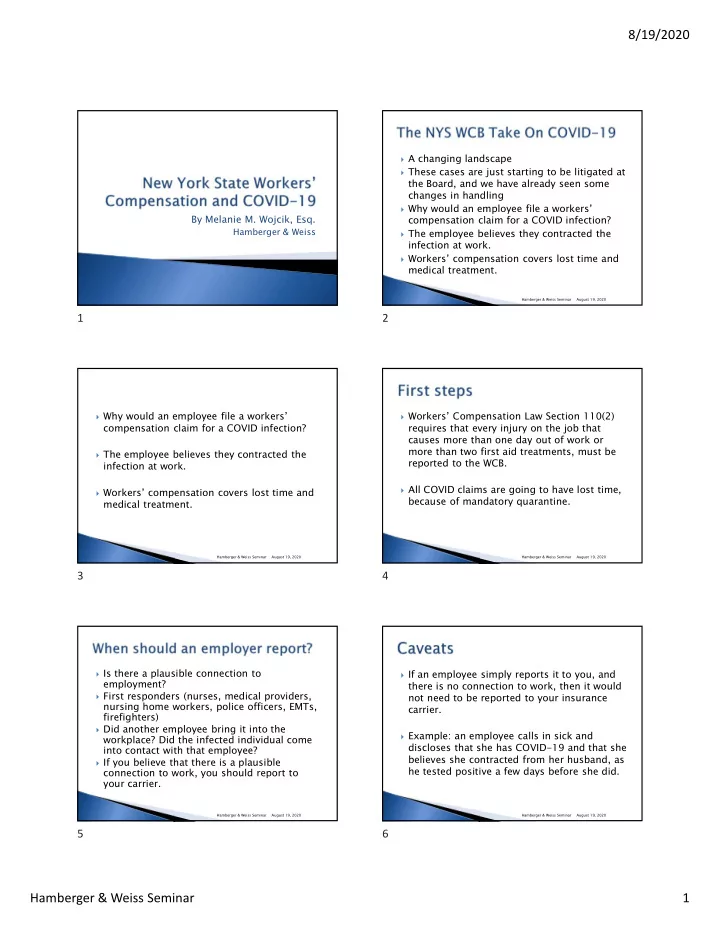
 A changing landscape  These cases are just starting to be litigated at

the Board, and we have already seen some changes in handling

 Why would an employee file a workers’

compensation claim for a COVID infection?

 The employee believes they contracted the

infection at work.

 Workers’ compensation covers lost time and

medical treatment.

August 19, 2020 Hamberger & Weiss Seminar

 Why would an employee file a workers’

compensation claim for a COVID infection?

 The employee believes they contracted the

infection at work.

 Workers’ compensation covers lost time and

medical treatment.

August 19, 2020 Hamberger & Weiss Seminar

 Workers’ Compensation Law Section 110(2)

requires that every injury on the job that causes more than one day out of work or more than two first aid treatments, must be reported to the WCB.

 All COVID claims are going to have lost time,

because of mandatory quarantine.

August 19, 2020 Hamberger & Weiss Seminar

 Is there a plausible connection to

employment?

 First responders (nurses, medical providers,

nursing home workers, police officers, EMTs, firefighters)

 Did another employee bring it into the

workplace? Did the infected individual come into contact with that employee?

 If you believe that there is a plausible

connection to work, you should report to your carrier.

August 19, 2020 Hamberger & Weiss Seminar

 If an employee simply reports it to you, and

there is no connection to work, then it would not need to be reported to your insurance carrier.

 Example: an employee calls in sick and

discloses that she has COVID-19 and that she believes she contracted from her husband, as he tested positive a few days before she did.

August 19, 2020 Hamberger & Weiss Seminar

1 2 3 4 5 6

slide-2
SLIDE 2

8/19/2020 Hamberger & Weiss Seminar 2

 We maintain that claims for COVID infections will

be treated as accidents, not occupational diseases.

 On the legal side of things, there is no case law

yet specific to COVID claims, so we must apply case law from other infectious disease claims.

 An injured worker must sustain an injury or

illness in order to qualify for workers’ compensation benefits. Mere exposure would not be sufficient. Must demonstrate an injury (a positive test).

August 19, 2020 Hamberger & Weiss Seminar

 You may have an employee report that he or she

was exposed to COVID-19 while on the job. Example: police officer who responded to a call, and was told while at the complainant’s home that she was positive for COVID-19. He reported this to his employer, and they reported it to the insurance carrier. At that point, he had not been tested.

 There is no claim until there is an injury. For a

COVID claim, unless an employee has a positive test, there is no claim.

August 19, 2020 Hamberger & Weiss Seminar

 Diagnostic testing would not be covered

unless the worker can demonstrate an injury.

 Quarantine alone would not be sufficient for a

  • claim. In the police officer example, he may

now need to quarantine, but that lost time would not fall under workers’ compensation.

 Practical point: quarantined worker could

collect NYS COVID pay so not likely to make a Workers’ Compensation claim.

August 19, 2020 Hamberger & Weiss Seminar

 As in all claims, in order to proceed the claimant

must complete a C-3 and produce medical evidence to support the claim. Once that is produced, the Board will schedule a pre-hearing conference if the claim is controverted.

 Initially, the Board was requiring that a claimant

produce a medical report which addressed causal

  • relationship. In other words, the doctor had to

provide an opinion that the claimant’s COVID-19 infection was related to work.

 For example: “Ms. Smith is a nurse, who was working

with COVID-19 positive patients in the hospital's COVID wing, and contracted COVID-19. I believe that her infection is related to her work activities.”

August 19, 2020 Hamberger & Weiss Seminar

 Within the last two weeks, the Board has

changed this policy. Now, the claimant only needs to produce a positive COVID test OR a medical report with a diagnosis of COVID-19.

 An opinion on causal relationship is no longer

required in order to move the claim to litigation.

 It remains to be seen whether the Board will

require additional medical evidence in order to establish the claim.

August 19, 2020 Hamberger & Weiss Seminar

 Investigating claims - Requires more detail about the

claimant’s activities, questions about outside

  • activities. As the employer, you are in the best

position to obtain this information at the outset of the claim, before the claimant hires counsel.

 Most important – job title, job duties, contact with

COVID-19 patients, customers, residents, other co- workers

 How do they know that they were in contact with

COVID-19 at work? What work activities caused the contact? How do they know that the person they had contact with has COVID-19?

August 19, 2020 Hamberger & Weiss Seminar

7 8 9 10 11 12

slide-3
SLIDE 3

8/19/2020 Hamberger & Weiss Seminar 3

 Confirmation regarding job duties, other

COVID-19 infections at work.

 Have other employees have tested positive?  If a hospital, did the claimant work in direct

contact with COVID patients?

 If a nursing home, how many residents tested

positive?

 Other employment – get as much detail as

possible regarding the alleged date, time and source of infection. Then as the employer, you will want to verify all of this information.

August 19, 2020 Hamberger & Weiss Seminar

 Out of work activities and questions  Who does the claimant live with? Have any of

those people tested positive? Before or after claimant? Where does the claimant’s spouse work? Other adults?

 Transportation  Travel – when, where, how?

August 19, 2020 Hamberger & Weiss Seminar

 PPE: health care workers – what was used early on,

when were additional measures taken? What equipment did the claimant have?

 Retail, restaurant workers – when did they start using

masks? Were they provided masks, or other equipment, and if so, beginning when?

 Concurrent employment? Where? Any exposure to

COVID there? Example: nurse who worked at two nursing homes; where did she contract it?

 Volunteer work, information about outside activities  Did claimant contract the infection during the PAUSE

  • rder? When it was in effect, less likely that workers

have contracted elsewhere because less contact with people.

August 19, 2020 Hamberger & Weiss Seminar

 We recommend creating an additional

questionnaire for COVID claims to be completed at time of accident report, addressing the issues noted above.

 One for employee to complete and one for

supervisor

August 19, 2020 Hamberger & Weiss Seminar

 What does the law say about infectious diseases?  Once you gather this information and provide it to your

carrier, they will consult with counsel to determine if the case should be accepted or denied.

 Claims for infectious diseases may be found

compensable when there is evidence that the source is endemic in the workplace, that the claimant had close contact due to the nature of the work with individuals diagnosed with the disease, that there was a plausible means of contraction and that the incubation period is consistent with an occupational onset.

August 19, 2020 Hamberger & Weiss Seminar

 Under this criteria, and supported by credible medical

evidence, cases of tuberculosis from working in close proximity to a symptomatic inmate, hepatitis developed by nurses, corrections officers and kitchen workers in employment with high incidence of the disease and plausible means of contraction, viral meningitis from daily contact with sick children, and mumps developed by a teacher where there was a schoolwide epidemic were deemed compensable.

 See Middleton v Coxsackie Correctional Facility, 38 NY2d 130

(1975)(hepatitis); Esposito v NYS Willowbrook State School, 46 AD2d 969 (3d Dept 1974)(hepatitis); McDonough v Whitney Point Central School, 15 AD2d 191 (3d Dept 1961)(mumps); Tutor Time, 2006 WL 3449459 (WCB 40401486, decided 11/1/06)(viral meningitis); NYS Dept. of Corrections, 2003 WL 22674511 (WCB 59800450, decided 10/31/03)(hepatitis); Saint Charles Hospital, 2003 WL 134461 (WCB 40101314, decided 1/8/03)(hepatitis).

August 19, 2020 Hamberger & Weiss Seminar

13 14 15 16 17 18

slide-4
SLIDE 4

8/19/2020 Hamberger & Weiss Seminar 4

Compensable if:

 Endemic in the workplace (most likely for

hospitals, nursing homes, possibly prisons)

 Close contact with diagnosed individuals (we

would maintain that this would also be individuals who were symptomatic at the time of the contact and later diagnosed with COVID-19)

 Plausible means of contraction  Incubation period consistent with occupational

contracture (the incubation period for COVID-19 is anywhere from 2-14 days per the CDC website.

August 19, 2020 Hamberger & Weiss Seminar

On the other hand, the Board and the courts have rejected infectious disease claims as compensable when there has been a failure of proof that the claimant came into contact with an infected individual, the illness was common in the community, the incubation period did not match or there were other, equally plausible sources of infection outside of work. See Williams v Buffalo General Hospital, 28 AD2d 777 (3d Dept 1967) (tuberculosis); Nassau County Police Department, 2014 WL 1302155 (WCB G0337646, decided 3/26/14)(mycoplasma pneumonia); Upstate Cerebral Palsy, 2006 WL 2711148 (WCB 60504642, decided 9/8/06)(viral mononucleosis); Sugarloaf Union Free School, 1993 WL 498413 (WCB 59104416, decided 11/22/93)(hepatitis); University of Rochester & Sedgwick James of NY Inc., 1992 WL 115037 (WCB 78713480, decided 5/8/92)(viral meningitis).

August 19, 2020 Hamberger & Weiss Seminar

Not compensable and claim should be denied if:

 Failure of proof of contact with an infected

individual (it is not enough for a claimant to say she works in a hospital where there are COVID-19 patients).

 Illness common in the community  Incubation period does not match  Other plausible sources of infection

August 19, 2020 Hamberger & Weiss Seminar

1.

Did claimant’s job put her in contact with COVID positive individuals? Was it direct contact? How does the claimant know that the individual had COVID?

2.

Confirmation of the claimant’s job duties and contact with COVID positive individuals?

3.

Are there other COVID positive co-workers?

4.

When did the symptoms start and do they correlate with the incubation period?

5.

Other plausible sources – family, other employment, public transportation, travel

August 19, 2020 Hamberger & Weiss Seminar

 Accepting the claim – it has been determined

that there was contact with infected individuals or the disease was endemic on the workplace, the incubation period is consistent with an occupational exposure, and other plausible sources of infection have been ruled

  • ut.

 Importance of gathering information  Advise your insurance carrier that you believe

that the claimant likely contracted at work.

August 19, 2020 Hamberger & Weiss Seminar

 Denying the claim  You have determined that the claimant did

not have direct contact with COVID-19 in the course of employment, there may have been

  • ther plausible means of infection, or the

incubation period does not match.

 Illness is common in the community – we may

learn more about the true rate of infection in the coming months.

 Be prepared to assist your insurance carrier in

defending the claim

August 19, 2020 Hamberger & Weiss Seminar

19 20 21 22 23 24

slide-5
SLIDE 5

8/19/2020 Hamberger & Weiss Seminar 5

 As noted before, as the employer, you have

the first contact with the infected employee, and the best opportunity to gather information at that time

 Recommend a list of COVID related questions

to ask when an employee reports a COVID infection

 This will help determine if it could be work

related, and also if any other employees may have been exposed.

August 19, 2020 Hamberger & Weiss Seminar

 Once you have determined that this could be

a work related COVID infection, and you report the claim to your carrier, you must be prepared to continue assisting with the defense of that claim

 Produce relevant documents, such as

accident reports, positive COVID tests or medical reports and notes, Board forms such as C-11, C-240 and reimbursement requests for wages paid.

 Logs of workers in certain areas, etc.

August 19, 2020 Hamberger & Weiss Seminar

 For a claim that is going to be denied, it is critical

to identify the appropriate witnesses; usually a supervisor

 It is important that the potential witness have

first hand knowledge of the claimant's job duties, and any potential exposure to COVID-19

 You may be asked to produce documentation

regarding how many other employees were infected, or if a hospital or nursing home, a list

  • f patients and residents that tested positive

 Be aware of HIPAA privacy concerns when

producing information, as names and other identifying information may need to be redacted

August 19, 2020 Hamberger & Weiss Seminar

 Death claims. There will be two claims: a disability

claim and then a second claim filed for the death

  • claim. Remember the death claim has a different

claimant (the spouse, estate, dependent).

 Death claims (and the accompanying disability claim)

may be more difficult to investigate because you may not have had an opportunity to interview the infected indvidual while he or she was still alive (may have been hospitalized). Therefore, you may have few details about exposure or other plausible means of contracting the disease, unless co-workers are able to provide details.

 The Board has to determine the appropriate

beneficiary.

August 19, 2020 Hamberger & Weiss Seminar

 COVID pay – file reimbursement requests. Some

employers are not seeking reimbursement.

 Business travel – if someone had traveled before

business before the companies began prohibiting this, and traveled to an area that had COVID

  • utbreak, the claim may be compensable.

 Consequential conditions, aggravation of pre-

existing conditions (examples; asthma, PTSD, depression)

 Legislation regarding presumption – no news.  There are two bills that are still in committee

regarding presumptions for death claims and for

  • ccupational diseases for “essential workers.”

August 19, 2020 Hamberger & Weiss Seminar

 If you advised your insurance carrier that the

claim should be accepted, forms will be filed with the Board indicating that the claim is

  • accepted. The Board will schedule a hearing

to address establishment of the claim, average weekly wage and awards for lost time.

 There will always be lost time on COVID

claims, due to the mandatory quarantine. It is important to file a C-11 with the Board documenting that lost time due to COVID.

August 19, 2020 Hamberger & Weiss Seminar

25 26 27 28 29 30

slide-6
SLIDE 6

8/19/2020 Hamberger & Weiss Seminar 6

 What about employees who are asymptomatic

but tested positive because they were required to take a test for work? Would this fall under Workers’ Compensation?

 The answer: it depends.  Was testing required because the person was

in contact with another employee or someone else at the place of employment who was COVID positive? Is COVID endemic in the workplace?

August 19, 2020 Hamberger & Weiss Seminar

 If not, then use the same analysis as we

discussed before.

 Note that employees who are asymptomatic

but have to quarantine will collect COVID pay, and are less likely to file a workers’ compensation claim.

 Example: employees in contact with COVID

positive youth at detention center

August 19, 2020 Hamberger & Weiss Seminar

 If the case is denied, the first step at the Board is

a pre-hearing conference, where the parties raise their issues and the Judge decides if there is sufficient medical evidence to proceed. If there is, then a trial hearing date will be scheduled.

 Employer witnesses will be required to attend the

trial hearing. Currently, all hearings are being held virtually through the Board’s virtual hearing system, so witnesses can appear over WebEx or by phone.

 Conference with attorney before trial to prepare

August 19, 2020 Hamberger & Weiss Seminar

 Can we use contact tracing to help us defend a

workers’ compensation claim?

 A New York State bill (S.8450C/A.10500C), which

aims to safeguard the confidentiality of COVID- 19 contact tracing information, passed in the State Senate on July 23, 2020, and will soon be transmitted to Governor Andrew Cuomo for his signature or veto.

August 19, 2020 Hamberger & Weiss Seminar

 The bill would amend New York’s public health law to

require COVID-19 contact tracers and contact tracing entities keep confidential any information that includes or can reveal the identity of: (i) an individual with a confirmed or probable COVID-19 diagnosis; or (ii) his or her possible contacts who may or may not have been exposed to or infected with COVID-19.

 Under the bill, contact tracers may only disclose the

protected information to facilitate further contact tracing or in other limited circumstances, such as disclosures to health care providers if an individual is in immediate need of medical attention and obtaining consent to the disclosure would jeopardize his or her life or health.

August 19, 2020 Hamberger & Weiss Seminar

 In addition, the bill:  Establishes the required format and contents of a valid

confidentiality waiver. Confidentiality waivers pertaining to contact tracing information must be written, informed and voluntary, in language understandable to the individual making the waiver, and must state the scope and limit of the waiver. Waivers must not be part of any other document. This would be in addition to a HIPAA authorization.

 Specifies that the possession, use, and disclosure of de-

identified, aggregate contact tracing information is permissible if certain conditions are met. Namely, the covered person or entity must maintain technical safeguards, policies and procedures that prevent re-identification, and must obtain the New York State Health Commissioner’s (or New York City Commissioner of Health and Mental Hygiene’s) approval to the disclosure, possession and/or use, upon a showing of its purpose, nature, and scope.

August 19, 2020 Hamberger & Weiss Seminar

31 32 33 34 35 36

slide-7
SLIDE 7

8/19/2020 Hamberger & Weiss Seminar 7

Prohibits a law enforcement agent, law enforcement entity, or immigration authority from serving as a contact tracer or contact tracing entity.

Prohibits a contact tracer or contact tracing entity from providing contact tracing information to a law enforcement agent, law enforcement entity, or immigration

  • authority. Further, contact tracing information and any evidence derived therefrom

may not be subject to or provided in response to any legal process, or be admissible in a judicial or administrative action, without the individual’s consent.

Requires the New York State Health Commissioner or New York City Commissioner

  • f Health and Mental Hygiene to promulgate regulations under the law. Most

significantly, the regulations must include a provision requiring non-governmental contact tracers or contract-tracing entities to, within 30 days of collecting contact tracing information: (i) remove information from its possession or control and deliver it to the appropriate governmental contact tracing entity; (ii) expunge the information from its possession or control; or (iii) de-identify the information. Expungement or de-identification of specific contact tracing information may be postponed for up to 15 days if it is actively being used in contact tracing, provided that the individual provides voluntary informed consent.

When the bill is formally transmitted to Governor Cuomo, he will have ten days (not including Sundays) to sign or veto. If enacted, the law will become effective immediately upon signature.

August 19, 2020 Hamberger & Weiss Seminar

 What does the mean for a workers’

compensation claim?

 Very difficult to obtain the contract tracer’s

report.

 Specific waiver is required, some information

may be expunged before we could secure a copy, and some information would be redacted.

 May not be able to share the information

August 19, 2020 Hamberger & Weiss Seminar

 If you have an employee who tests positive for

COVID and there may be a connection to work, you must report the claim to your carrier.

 Gather as much information as you can when the

claim is reported, have the claimant complete an accident report and a COVID specific questionnaire

 Identify potential witnesses for your carrier if

claim is denied

 Provide necessary documentation as requested

August 19, 2020 Hamberger & Weiss Seminar

 Contact Melanie Wojcik at Hamberger & Weiss

at mwojcik@hwcomp.com or 716-854-1539.

 Hamberger & Weiss has offices in Buffalo and

Rochester, and is able to handle workers’ compensation matters state-wide. In addition to handling Workers’ Compensation hearing work, we also prepare Section 32 settlements, prepare Medicare Set-asides, handle conditional payment liens, and handle loss transfer issues.

August 19, 2020 Hamberger & Weiss Seminar

37 38 39 40