79% O F CTC S T U D E N T S 1,811 course sections time fresh- time - - PDF document

79
SMART_READER_LITE
LIVE PREVIEW

79% O F CTC S T U D E N T S 1,811 course sections time fresh- time - - PDF document

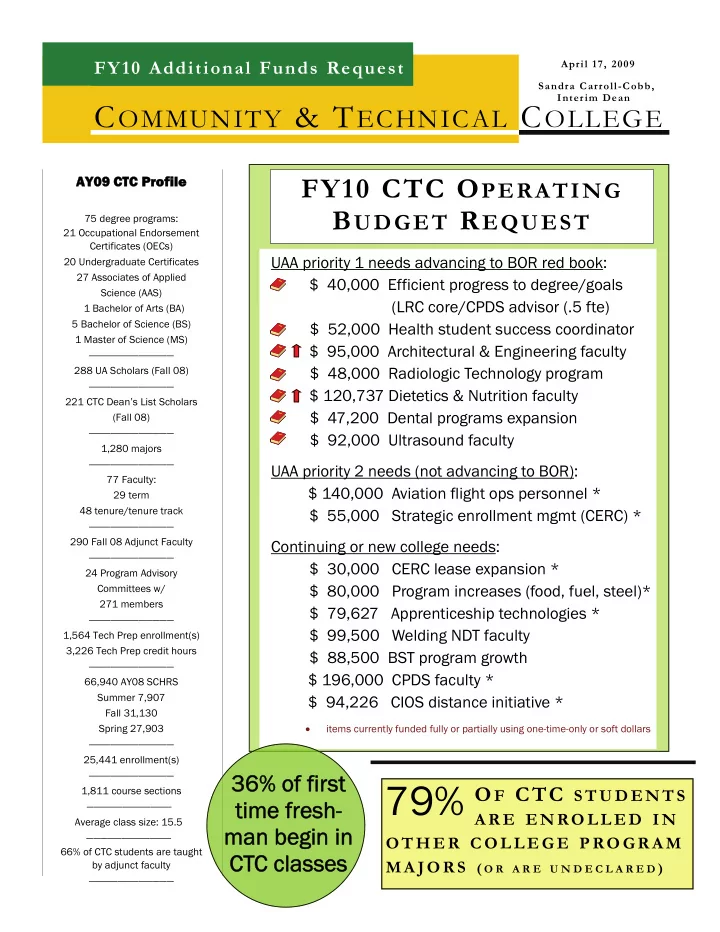
FY10 Additional Funds Request April 17, 2009 Sandra Carroll-Cobb, Interim Dean C OMMUNITY & T ECHNICAL C OLLEGE AY09 CTC Profile AY09 CTC Profile FY10 CTC O PERATING B UDGET R EQUEST 75 degree programs: 21 Occupational Endorsement


slide-1
SLIDE 1

FY10 Additional Funds Request

April 17, 2009 Sandra Carroll-Cobb, Interim Dean

COMMUNITY & TECHNICAL COLLEGE

O F CTC S T U D E N T S

A R E E N RO L L E D I N OT H E R C O L L E G E P RO G R A M M A J O R S ( O R A R E U N D E C L A R E D ) UAA priority 1 needs advancing to BOR red book: $ 40,000 Efficient progress to degree/goals (LRC core/CPDS advisor (.5 fte) $ 52,000 Health student success coordinator $ 95,000 Architectural & Engineering faculty $ 48,000 Radiologic Technology program $ 120,737 Dietetics & Nutrition faculty $ 47,200 Dental programs expansion $ 92,000 Ultrasound faculty UAA priority 2 needs (not advancing to BOR): $ 140,000 Aviation flight ops personnel * $ 55,000 Strategic enrollment mgmt (CERC) * Continuing or new college needs: $ 30,000 CERC lease expansion * $ 80,000 Program increases (food, fuel, steel)* $ 79,627 Apprenticeship technologies * $ 99,500 Welding NDT faculty $ 88,500 BST program growth $ 196,000 CPDS faculty * $ 94,226 CIOS distance initiative *

items currently funded fully or partially using one-time-only or soft dollars

FY10 CTC OPERATING BUDGET REQUEST

AY09 CTC Profile AY09 CTC Profile

75 degree programs: 21 Occupational Endorsement Certificates (OECs) 20 Undergraduate Certificates 27 Associates of Applied Science (AAS) 1 Bachelor of Arts (BA) 5 Bachelor of Science (BS) 1 Master of Science (MS) ———————————— 288 UA Scholars (Fall 08) ———————————— 221 CTC Dean’s List Scholars (Fall 08) ———————————— 1,280 majors ———————————— 77 Faculty: 29 term 48 tenure/tenure track ———————————— 290 Fall 08 Adjunct Faculty ———————————— 24 Program Advisory Committees w/ 271 members ———————————— 1,564 Tech Prep enrollment(s) 3,226 Tech Prep credit hours ———————————— 66,940 AY08 SCHRS Summer 7,907 Fall 31,130 Spring 27,903 ———————————— 25,441 enrollment(s) ———————————— 1,811 course sections ———————————— Average class size: 15.5 ———————————— 66% of CTC students are taught by adjunct faculty ————————————

79%

36% of fir 36% of first st time fresh- time fresh- man begin in man begin in CT CTC classes C classes

slide-2
SLIDE 2

Page 2

In 2007, CERC obtained 2,600 square feet of available space in the building and expanded from 5 small classrooms to 8 variable size rooms with significantly improved technology. At the same time, all administrative offices were consolidated into a single office suite. This change enabled CERC to support a greater number of high demand GER courses in-house and support new workforce development services and training. Along with this recent growth, lease costs increased by 38%. CERC moderated these costs through consolidation of course offerings which netted savings via decreased adjunct faculty costs. CERC also utilized revenue generated through professional service agreements with BP Alaska and others. While this strategy covered the majority of these increased lease costs, it has fallen

  • short. Funding this proposal will allow CERC to normalize increased lease costs and continue serving it’s

4,900 students per year at low costs per credit hour.

Chugiak Eagle Chugiak Eagle Riv River Le er Lease ase $30,000 $30,000

Continuing Continuing FY1 FY10 Priorities (or Priorities (or increases t increases to red book it red book items) ems)

Apprent Apprenticeship T ceship Technologies Pr echnologies Project Speci

  • ject Specialist $79,62

list $79,627 7

This project requests to hire an 11 month, full time project specialist in the AAS in Apprenticeship Technologies (APTC) program to develop an underutilized program into an effective, quality program for preparing the next generation of managers and super- visors across the spectrum of high-demand occupations. The AAS Apprenticeship Technologies program began admitting stu- dents in 1996, but until 2009, did not have staff or faculty solely dedicated to it. As a result, the program has been severely un-

  • derutilized. Starting this year as a 6-month, part-time position (funded by TVEP), the APTC project specialist has laid a foundation

for expanding the program. Continuing the position will build on that foundation by increasing student enrollment and success. The project specialist will focus on two programmatic areas: 1) provide student-centered services to increase enrollment, and facilitate retention and completion for APTC students; and 2) facilitate partnerships between the Office of Apprenticeship, em- ployers, and UA for the delivery of apprenticeship related instruction. The project specialist will act as the primary point of con- tact between UA programs and the State and Federal Offices of Apprenticeship, helping to grow that partnership and facilitate the delivery of UA-based training to apprenticeship programs. This project will increase the number of graduates by 25% in the coming year. The need for Nutrition courses has burgeoned. The original $78,500 request to hire a 9 month, full time tenure track Dietetics & Nutrition (DN) faculty seeks increased funding to enable the program to offer a BS degree in Dietetics and a BS in Nutrition. One 9 month faculty and 8 adjunct faculty teaching 3 credits each will be needed to make these on-line DN courses available statewide to students in every region of Alaska. The American Dietetics Association will not allow a BS degree to receive accreditation unless there are at least two full-time nutrition faculty members. UAA currently offers Dietetics and Nutrition courses to some 800 students a year, with 42 declared Nutrition minors, with one full time faculty. This funding will make it possible to address the increasing demand for registered dietitians, nutritionists and healthcare advocates. Approximately 15-20 registered dietitian positions become available each year in Alaska; additionally 20-25 dietetic related positions need to filled in areas such as nutritional counseling, nutrition researchers and healthcare advocates. Unsurprisingly, UAA logs approximately 70 student requests per year for a degree in Nutrition. This request will support the growing number of majors that rely on nutrition/dietetic courses, such as Nursing, Med Lab Tech, Dental Assisting, Culinary Arts, Early Childhood Development, Physical Education and several others.

Diet Dietetics & N etics & Nutrition BS degree f trition BS degree faculty aculty, increase red book t increase red book to $120,73 $120,737

The original $70,000 request to hire an Architectural & Engineering Technology (AET) faculty planned to use $25,000 in adjunct faculty salary savings to offset the cost, however, this did not anticipate rapid growth in the Construction Management (CM) program. High demand in the CM program has required the addition of new upper-division courses for juniors and seniors in the Bachelor of Science in Construction Management (BSCM). Also, demand by construction management students for evening classes has meant the addition of primarily lower division CM/AET sections. Since AET and CM share a core of 6 cross-listed courses, this has reduced availability of CM faculty to teach these cross-listed courses. The successful funding of this proposal will relieve the current AET faculty members of teaching large numbers of overload credits while also meeting the growth needs of the CM program. Although we will not be reducing the actual number of adjunct credits, the percentage of courses taught by adjuncts will be reduced to a more acceptable level for preserving program quality.

AET f AET faculty aculty, increase red increase red book t book to $95,000 $95,000

slide-3
SLIDE 3

The Welding/NDT program is currently running at over 100% capacity, leaving little room to respond to industry demands. Alaska Department of Labor projects a need of 1,080 positions related to this program by 2016. This proposal requests $99,500 to hire one additional faculty position for the Welding/NDT program to focus on

  • pportunities relating to professional development, apprenticeship, and other initiatives closely related to industry needs.

This will allow the Welding/NDT program to continue initiatives such as the Nondestructive Testing Boot Camp, offered during the summer 2009 semester (funded with one-time TVEP funding), and to better utilize facility resources during summer semester. The Career Pathway Planning process utilized by CTC has consistently shown that flexible scheduling and the ability to respond to industry needs based on funding for major oil field, construction, and transportation projects is important for student opportunity and success. The current program has 2 fulltime faculty, a total enrollment of 387, and is projected to produce 1510 student credit hours for AY09.

Page 3

College Preparatory and Developmental Studies requests funding for a math instructor, a composition instructor, and the continuation of the college readiness initiative. Approximately two-thirds of entering students who test at UAA’s Advising and Testing Center place into preparatory English courses and four-fifths place into preparatory math courses. Students who test into CPDS courses cannot move forward until they have gained the necessary skills in our English and math classes – from which they go on to virtually every major and program UAA offers. CPDS courses are currently at 97% capacity. For the past few years, the Community and Technical College has funded term and adjunct instructors to meet the growing need for more sections; however, this has been “soft”, one-time-only funding. If enough courses are offered to meet the demand, students can progress through the university in a timely and effective

  • manner. In addition, funding the college readiness initiative will allow the continuation of a very successful partnership with

the Anchorage School District to test high school juniors and seniors to determine whether they meet academic readiness requirements for UAA’s English and math courses. They then have the opportunity to increase their skills before attending the University, saving the student time and tuition when they arrive.

College Prep & De College Prep & Developmental Studies (CPDS) f lopmental Studies (CPDS) faculty $1 culty $196,000 96,000

Continuing or ne Continuing or new college needs f w college needs for FY1 r FY10

The CIOS program seeks funding to hire an instructional designer/faculty member to research latest technologies and best practices in distance education, and then create standardized tools and content for CIOS self paced and online courses. We believe that increasing student engagement and interaction will improve student success in completing these courses. This person will also teach

  • nline and noncredit/contract training courses.

The Computer and Electronics Technologies Department also requests funding for an Instructional Lab Technician (ILT). This position serves students in Computer Information and Office Systems (CIOS), Computer Networking Technologies (CNT) and Electronic Technologies (ET) programs. The ILT’s primary responsibility is to assist in staffing and maintaining the department’s Instructional Lab. The position provides technical and academic support for courses offered through the UAA campus and community campuses. In addition, this position proctors national certification tests (CCNA, Net +, A+ and CCNP), supports full time and adjunct faculty in developing and maintaining Blackboard content, and maintains departmental data.

W Welding/Nonde elding/Nondestructiv tructive T e Testing (ND esting (NDT) f ) facul culty $99,500 y $99,500 Com Comput uter er Inf Information rmation & Of & Office ice Syst Systems ems Distance Distance Initiativ Initiative e $9 $94,226 4,226

This request is to build capacity to accommodate a program that is experiencing student enrollment growth of over 50% a semester and to maintain program quality. The Bachelor of Science, Technology (BST) program is at 110% capacity and is expected to grow at a rapid pace in the next five years. Additional funding is needed for a full time faculty position, total cost estimated at $88,500. Faculty advising hours for the BST totaled 156 in 2008; an additional faculty will double advising capacity. The BST program is unique in the University of Alaska system. It provides managerial, leadership, project management and safety training to students who have completed an associate of applied science degree. Many associate degree programs at the Community and Technical College and in

  • utlying communities rely on the BST as a career pathway for their graduates. Without resources for

growth, the BST may be forced to restrict enrollment, impacting recruitment and retention in other

  • programs. Total credit hours in spring 2009 are 191, enrollment is 67 and the

number of students admitted to the program as of January 2009 is 227.

BS BST Pr T Program

  • gram

Gr Growth th $88,500 $88,500

slide-4
SLIDE 4

Page 4 Community & Technical College

In Fall 2008, over 79% of CTC’s 5,991 students (unduplicated) were enrolled in non-CTC majors or unde-

  • clared. You may not think of CTC when you think GER, but several CTC departments support all UAA student

efforts to complete general education requirements. For example, our biggest challenge in supporting the

  • verall growth of UAA is in our College Preparatory and Developmental Studies department. Well over half
  • f UAA’s students test into preparatory math and English courses, and as the University has grown, CTC has

used one-time funding to hire additional CPDS adjunct and term faculty to meet the growing demand and prevent delays in student degree progress. The Chugiak-Eagle River Campus produces 15,180 student credit hours each year offering 238 courses that include GER and developmental classes, releasing bottle- necks for students trying to register for foundation classes. Military Programs operates on both the Fort Richardson and Elmendorf Air Force bases providing GER courses, advising and other basic UAA services to

  • ver 2,386 military students enrolled in all UAA majors, not just CTC. Additionally, UAA’s Learning Resource

Center is housed within CTC, experiencing more than 4,000 visits a week for tutoring, testing, UAA media library, instructional materials reserve, quiet study areas, and computer, math, language and writing labs.

CTC serves all UAA students more than anyone realizes...

In FY04, CTC scrubbed every department budget clean in response to a large cut to general fund. Since then, departments have been increasingly challenged to pay basic operating needs as they increase each

  • year. Phones, food (for culinary instruction), copiers, costs for steel and gasses, have all increased, some

rising significantly last year in response to much higher fuel and transportation costs. Where appropriate, increases in student fees have been implemented, however, several programs are already constrained by high course fees that heavily burden student success and many central operational expenses cannot be charged to students through fees. CTC requests $50,000 to adjust twelve division operations budgets, and $30,000 to adjust for last year’s increase to the faculty overload rate. The Culinary Arts/Hospitality and Dietetics and Nutrition division alone requests $15,000 for increases in instructional supplies such as flour, the cost of one 50 lb sack rising from $20 to $40 in FY08. Our Welding and Nondestructive Testing program requests $9,600 to cover the increase in steel and gas costs impacted by worldwide demand and higher fuel costs. CPDS requests $2,000 to cover increased office equipment maintenance contracts and increased volumes in copies and other expenses impacted by more class offer-

  • ings. CET requests $2,150 to cover cell phone expenses and other contractual and commodities line items.

The Construction and Design Technology department requests $12,600 to cover expense increases such as printer and plotter paper costs. The Aviation Technology division requests $6,500 for increases to copy and computer lab paper, copier lease increases, etc…. Also, in FY08 the UAFT contract was finalized late in the budget year, increasing faculty overload rates from $802 to $1,200 per credit. No additional general fund was provided to cover this additional expense to CTC

  • f roughly $30,000 annually (63 credits Fall ‘07, Spring ‘08.) A meticulous college process reviews all over-

load approvals closely, however, overloads are increasingly required in programs where adjunct faculty are difficult to find, such as AET and developmental Math. CTC requests additional general fund to accommo- date this increase in basic instructional expense necessary to maintain current course offerings.

College-wide program increases of $80,000, we could use some general fund for general increases...

slide-5
SLIDE 5

Page 5

82% of CTC’s budget is used to hire faculty and staff and so any decrease in budget will require substantial planning to minimize reductions in ser- vice and instruction. Five years ago, when the college’s budget was cut $607,000 over two years, the decrease in general fund was covered with carry-forward and salary savings in the first year, and then a strategic review of every program org was made, account code by account

  • code. Dept budgets were scrubbed of all excess, and, all travel, professional development, IT

support and equipment funds were centralized and reduced. Program closures and downsizing were implemented in the following fiscal year. CTC suggests following a similar process in FY10 if cuts are implemented. We will substantially reduce centralized equipment, marketing and professional development funding pools first, use carry-forward funds and FY10 salary savings to cover the remaining amount in the first

  • year. Then, we will use the strategic planning process already in place, and the Directors and

Chairs Team (DCT), to determine where programs cuts can be made, or additional revenues can be found. Program reductions will be implemented in FY11. Since FY04, CTC has continually shifted internal college resources to support higher priority

  • programs. We have eliminated programs such as the Adult Learning Center, downsized the

Massage Therapy program and our Workforce and Professional Education division, cut back fac- ulty in the Electronics, MSVE and Aviation Maintenance Technology departments, moved Allied Health Pharmacy Tech faculty and an administrative assistant position to soft grant funding, and decreased the Dean’s office staff. These funds were then shifted to hire faculty in the high demand programs of Air Traffic Control, Prof Piloting, Computer Network Technology, and Developmental Studies Composition, and to hire academic support positions such as a Med Lab Tech technician, an automotive tool room tech, an ATC lab tech, an Aviation division admin assist, an Eagle River campus budget tech, and a grants/development officer. In recent years, CTC has received additional funding from SW for specific initiatives, most nota- bly $400,000 to shift several Allied Health program positions from “soft” Denali Commission grant funding to general fund. Initiative funds are purpose specific and cannot be shifted to

  • ther priorities. Frequently these funds replace soft funds already in place and do not increase
  • capacities. Other changes in personnel have provided unusual and one-time-only salary sav-

ings, however, the college now needs additional general fund to support growth in instruction that cannot be covered by SW initiatives or one-time only funding. For every cut to a program there is an offsetting loss of tuition, however, give us a year to strategize and we will implement the needed cuts when final numbers are determined.

Strategies to implement a decrease in base budget

slide-6
SLIDE 6

77.8 75.7 82.1 73.5 69.4 72.5 24%

  • 3%

8%

  • 10%
  • 6%

4%

20 40 60 80 100 FY03 FY04 FY05 FY06 FY07 FY08

FTFT Retention-Bachelor

13786 10149 9647 10221 10682 11134

  • 26%
  • 5%

6% 5% 4%

$0 $4,000 $8,000 $12,000 $16,000 FY03 FY04 FY05 FY06 FY07 FY08

Univ Generated Revenue

172 413 564 491 105 140% 37% -13%

  • 79%

$0 $100 $200 $300 $400 $500 $600 FY03 FY04 FY05 FY06 FY07 FY08

Research $

Page 6

CTC Performance Measures

The CTC Directors and Chairs Team has completed the college Strategic Enrollment Management (SEM) plan. A SEM Coor- dinator has been hired to direct the college’s focus on student recruitment, retention, achievement and performance.

CTC continues to monitor SCHRS, capacity and enrollment(s) closely through the monthly management report process.

Career Pathway planning focuses units on searching out funding from external resources such as industry partner dona- tions and grants and contracts proposals.

Monthly reporting now includes non-credit CEU statistics as we learn more about how to better track this new metric.

Pr Progress t

  • gress toward im

implementing plementing per perform

  • rmance based budgeting...

nce based budgeting...

BS/BA, AAS and cert awards all declined in AY08, but were offset by 39 new occupational endorsement certificate completions. Largest OEC increases: Limited Radiology (+11), CISCO Network Assoc (+8) Some CTC divisions increased SCHRS in FY08 and some declined, resulting in a net zero gain for the college. Big gains were made by Military and Dietetics/Nutrition, losses in Aviation Technologies. As SEM and pathway planning student success projects are implemented, we expect modest gains in retention in CTC’s six high demand BS/BA degrees, as well as in 27 associate, 20 certificate and 21 occupational endorsement programs. Research was impacted in Aviation due to delays in FAA funding availability and Capstone expense reversals. Health research continues to decline in later phases as Denali projects wind down. Focused development efforts increased the balance and # of foundation endowments. Fees increased in part due to increased BP Work Keys testing and additional Flight Simulator rentals.

(000’s 000’s) (000’s 000’s)

57210 63743 64964 68221 66674 66474

11% 2% 5%

  • 2%

0%

20000 40000 60000 FY03 FY04 FY05 FY06 FY07 FY08

SCHR Growth

52.8 65.1 65.5 59.6 64.8 61.8 23% 1%

  • 9%

9%

  • 5%

20 40 60 80 FY03 FY04 FY05 FY06 FY07 FY08

FTFT Retention-Assoc

% % % % 172 209 244 270 300 307 2% 22% 17% 11% 11% 2%

100 200 300 400 FY03 FY04 FY05 FY06 FY07 FY08

High Demand Awards

slide-7
SLIDE 7

Budget Strat Budget Strategies egies

Prioritize equipment, space and new position allocations through the Directors and Chairs Team (DCT).

Distribute carry forward funds first to projects that leverage resources.

Centralize all equipment, marketing, travel, computer and professional develop- ment expenses.

Collaborate with industry partners, through career pathway planning and active advisory board participation.

Reallocate personnel re- sources when retirements, division reorganizations, or program review provide op- portunity for restructure.

Du During t ring the e bu budget dget pl planning anning process, each process, each un unit it submits: submits:

1.

  • 1. ann

annual operat

  • perating rev

ing review detai ew details: s:

Performance against prior year goals

Forecast goals for next year

Metrics projections: SCHRS, enrollments, % capacity, cost per credit hour, and number of graduates. 2.

  • 2. prio

priori ritiz tized req d reques uest for addit t for addition

  • nal

al budget: budget:

Focuses the search for inter- nal and external funding on highest priority needs.

Annual Annually, leadersh ly, leadership reviews ip reviews all programs agains ll programs against meas- meas- ure ures of distinct

  • f distinction:

ion:

Production Cost Demand Quality … to determine ability of units to reach college and university goals.

  • Monthly, leadersh

Monthly, leadership reviews ip reviews each unit’s management each unit’s management report for: report for:

  •  Progress against perform-

ance targets

  •  Actual budget performance

Page 7

CTC B U D G E T P L A N N I N G P RO C E S S

April 17, 2009

Ho How the career pathw w the career pathway plan- y plan- ning mod ning model ser l serves CT es CTC: C:

Focus on industry by bringing them to the table early and often

Provide a primary vehicle to state our needs and facilitate Founda- tion accounts (fund raising)

Provide case statement for

  • ther external funding sources

and opportunities

Assist in decisions related to facility needs

Increase collaboration between programs and across campuses

Manage growth and make sound decisions based on demand

Focus on true demand and share resources in a global sense, rather than on individual program basis

CTC is responding to performance based budgeting by asking each career area to project and review metrics in the an- nual planning proc- ess and then review progress through monthly manage- ment reports. 9 Career Pathways 9 Career Pathways

Allied Health Aviation AFROTC/Army ROTC Career & Technical Ed Construction & Design Computer Technology Culinary Arts Health, PE, & Rec Transportation & Power

5 Student Success & 5 Student Success & Service Units Service Units

College Prep & Develop- mental Studies Learning Resource Ctr Military Programs Chugiak Eagle River Observer Training Ctr

C A R E E R P AT H WAY S T R AT E G I C P L A N N I N G

CTC Mission Goals: CTC Mission Goals:

  •  Student Success
  •  Programs of

Distinction

  •  Partners in

Progress

Wha What is Caree is Career Pathway Pathway Pla Planni nning ng? ?

The career pathway planning model moves away from planning solely around individual program needs and, instead, focuses on how CTC as a whole serves industry and students. More importantly, it takes a step be- yond status quo and allows us to identify areas of potential growth, strategies for achieving growth goals, and resources needed to accomplish these goals in an integrated way through the year 2014. For example, in order to serve the health industry in Alaska, CTC delivers educational opportunities to students in Medical Laboratory Technology, Dental Hygiene, Dental Assisting, Ra- diation Technology, Medical Assisting, Fire & Emergency Services and Phar- macy Technology. This cluster of pro- grams will collaborate to establish a plan on how they collectively and indi- vidually contribute to meeting student and health industry needs.

slide-8
SLIDE 8

Page 8

FY09 Budget Notes: CTC will likely carry forward $500,000 into FY10. Salary savings from the delay in hire of several fac- ulty positions (and a few admin positions), have contributed to the current lapse. As an extreme exam- ple, our Transportation and Power division will replace 3 of 7 faculty this year, causing over $100,000 in salary savings. Also, a large residual from a fixed price observer training contract will likely be car- ried forward into FY10. CTC committed this year to use large portions of the FY09 carry forward to fund several of CTC’s high- est budget priorities that were not funded in the FY08/FY09 budget process. We’ve committed to funding these needs using one-time-only money until general funds can be found. They include: sup- port to Aviation research efforts; student shuttle to Aviation Merrill Field facility; ARMY ROTC start up funding; Chugiak Eagle River Campus (CERC) student success coordinator; CERC lease increase; in- structional lab technician in Computer and Electronics Technologies; additional ESL, Math and PREP courses to include a p/t Math faculty in College Preparatory and Developmental Studies; additional Welding courses, higher salaries for new faculty hired in Transportation and Power, etc…. We also used carry forward funds to support an increase in the UAFT faculty overload rate (no base received for this in FY08 or FY09), and significant increases in contractual and commodities expense due to increases in fuel, food, copier and other inflationary increases in operational costs.

Where the Comm Where the Community & T unity & Technical College is no echnical College is now….. w…..

Year to Projected Total

Expenditures:

Adjusted Date Exp to YTD and Budget Budget Activity Year End Projections Variance

1000 Salaries/Ben 16,382,290 9,375,809 6,274,897 15,650,706 731,584 2000 Travel 127,135 72,055 67,275 139,330 (12,195) 3000 Contr Svcs 1,588,708 1,061,559 631,215 1,692,774 (104,066) 4000 Commdty 2,077,615 613,016 1,361,887 1,974,903 102,712 4500 Resale

  • 5000 Equipment

66,432 171,995 39,859 211,854 (145,422) 6000 Fin Aid 100 100 (100) 7000 Overhead

  • 8000 Misc

3,000 (48,612) 2,123 (46,489) 49,489 Total Expenditures 20,245,180 11,245,922 8,377,256 19,623,178 622,002

Year to Projected Total

Revenues:

Adjusted Date Exp to YTD and Budget Budget Activity Year End Projections Variance

9100 Tuition 7,440,784 6,739,638 707,991 7,447,629 (6,845) 9150 Lab Fees 1,740,813 1,030,740 467,319 1,498,059 242,754 9210 Gen Fund 9,481,983 9,472,528 9,455 9,481,983 - 9700 Aux Receipts

  • 9801 Interest Income
  • 9802 Overhead

73,194 24,274 61,944 86,218 (13,024) 9900 Intra Agency Rcpt 103,480 113,950 27,777 141,727 (38,247) 9960 CIP Receipts

  • Other 93/94/95/98

1,404,926 806,633 633,292 1,439,925 (34,999) Total Revenues 20,245,180 18,187,763 1,907,778 20,095,541 149,639 Net Surplus/(Deficit) 472,363

slide-9
SLIDE 9
slide-10
SLIDE 10
slide-11
SLIDE 11

FY10 PBAC Additional Funds Request

CTC Dept/Division: Culina ry Arts& Ho spita lity/ Die te tic s & Nutritio n Request Title: Die te tic s & Nutritio n F

a c ulty po sitio n (Continuing r

equest fr

  • m AY ’07-’08 r

ed book)

Total Requested: $120,737 Abstract:

T his re q ue st se e ks funding to e na b le the pro g ra m to o ffe r a Sta te wide Ba c he lo r o f Sc ie nc e de g re e in die te tic s a nd a Ba c he lo r o f Sc ie nc e de g re e in nutritio n, a nd to hire a n a dditio na l pro fe sso r to suppo rt the se de g re e s (T his fa c ulty po sitio n must b e in pla c e fo r AY ’ 09-’ 10 to me e t na tio na l a c c re dita tio n sta nda rds whe n pro g ra m is due fo r re a c c re dita tio n in 2010).

  • 1. Request Description

Culina ry Arts a nd Ho spita lity/ Die te tic s a nd Nutritio n o ffe rs a n Asso c ia te

  • f Applie d Sc ie nc e de g re e in Culina ry Arts a nd a Ba c he lo r’ s o f Arts in

Ho spita lity Re sta ura nt Ma na g e me nt de g re e . F urthe r the pro g ra m ma inta ins the o nly o ffic ia l, Ame ric a n Die te tic Asso c ia tio n (ADA) Clinic a l Die te tic s I nte rnship pro g ra m in the Sta te o f Ala ska . F ina lly the pro g ra m o ffe rs a Nutritio n mino r, with 100 pe rc e nt o f c o urse o ffe ring s a va ila b le o nline , sta te wide . T his re q ue st se e ks funding to e na b le the pro g ra m to o ffe r a BS de g re e in die te tic s a nd a BS de g re e in nutritio n, a nd to hire a n a dditio na l pro fe sso r to suppo rt this a nd to b e c o mplia nt with ADA/ CADE Ac c re dita tio n sta nda rds (Ame ric a n Die te tic Asso c ia tio n/ Co mmissio n o n Ac c re dita tio n Die te tic E duc a tio n). T he mo da lity fo r de live ry o f the die te tic s a nd nutritio n c o urse s wo uld b e

  • nline de live ry. T

his wo uld a llo w stude nts to c o mple te g e ne ra l e duc a tio n re q uire me nts (GE R) a nd pro g ra m pre -re q uisite s a t the Unive rsity o f Ala ska c a mpus c lo se st to the m, a nd the n c o mple te the nutritio n o r die te tic s de g re e re q uire me nts o nline . T his wo uld e na b le the de g re e pro g ra ms to b e a va ila b le sta te wide to stude nts in e ve ry re g io n

  • f Ala ska .

Appro xima te ly 15-20 re g iste re d die titia n po sitio ns b e c o me a va ila b le e a c h ye a r in Ala ska (Ala ska DOL ). Additio na lly a no the r 20-25 die te tic re la te d po sitio ns ne e d to b e fille d (he a lthc a re a dvo c a te s, nutritio na l c o unse ling , life -style c ha ng e c o a c he s, nutritio n re se a rc he rs, e tc .). T his funding wo uld ma ke it po ssib le to a ddre ss the inc re a sing de ma nd fo r re g iste re d die titia ns, nutritio nists a nd he a lthc a re a dvo c a te s. UAA c urre ntly o ffe rs die te tic a nd nutritio n c o urse s to so me 800 stude nts a ye a r (fa ll/ spring / summe r se me ste rs). T he re a re 42 de c la re d Nutritio n

slide-12
SLIDE 12

Mino rs a nd UAA g ra dua te s 5 stude nts e a c h ye a r tha t g o o n to c o mple te the Na tio na l Re g iste re d Die titia n E xa m. F ina lly, UAA lo g s so me 70 stude nt (o r po te ntia l stude nt) re q ue sts pe r ye a r fo r a de g re e in nutritio n.

  • 2. Strategic Purpose

Additio na l funding wo uld ma ke it po ssib le fo r the pro g ra m to re ma in a pro g ra m o f e xc e lle nc e a nd c o ntinue to b e tte r me e t the die te tic / nutritio n re q uire me nts fo r the g ro wing numb e r o f stude nts in the fo llo wing ma jo rs: Culina ry Arts, De nta l Hyg ie ne , De nta l Assisting , Die te tic I nte rnship (Gra dua te Ce rtific a te ), E a rly Childho o d De ve lo pme nt, Ho spita lity Re sta ura nt Ma na g e me nt, He a lth Physic a l E duc a tio n & Re c re a tio n, Me dic a l (WAMI ), Me d. L a b T e c h., Nursing a nd Nutritio n Mino rs. F urthe r a ll o f the se c o urse s a re inno va tive in tha t the y a re o ffe re d

  • nline a nd me e t the ne e ds o f ma ny UA stude nts thro ug ho ut Ala ska

a nd the y a re , o f c o urse , a lso o ffe re d in the tra ditio na l c la ssro o m se tting a t the Chug ia k-E a g le Rive r Ca mpus, the Ma t-Su Ca mpus a nd a t the ma in UAA (Go o se L a ke ) Ca mpus. By re ma ining a pro g ra m o f e xc e lle nc e ; the pro g ra m wo uld c o ntinue to pro mo te UAA 2017 a nd wo uld spe c ific a lly Str

e ngthe n and De ve lop the T

  • tal UAA Instr

uc tional Pr

  • gr

am, E xpand E duc ational Oppor tunity and Inc r e ase Stude nt Suc c e ss, Str e ngthe n the UAA c ommunity and the UA Community and finally E xpand and E nhanc e the Public Squar e b y

e xpa nding a nd c o ntinuing to e ng a g e a nd tra in fo r the Ala ska He a lthc a re I ndustry. With the a dditio na l fa c ulty me mb e r a nd a BS de g re e pro g ra m in pla c e the pro g ra m c o uld furthe r e xplo re NI H a nd NSF re se a rc h o ppo rtunitie s tha t a re c urre ntly misse d a s the pro g ra m is no t a de q ua te ly sta ffe d. Also , re se a rc h c o mpo ne nts a re inte g ra te d in b o th de g re e tra c ks.

  • 3. Operational Focus

T he two ne w de g re e pro g ra ms wo uld b e c o mpo se d o f simila r c o urse s, ho we ve r the die te tic s tra c k wo uld pre pa re stude nts fo r e ntry into a die te tic inte rnship (a nd upo n c o mple tio n the y wo uld b e e lig ib le to sit fo r the re g iste re d die titia n [RD] e xa m), whe re a s the nutritio n de g re e wo uld pre pa re stude nts fo r no n-RD re q uire d jo b s in he a lth a nd we llne ss se tting s. T he re q uire me nts fro m the Ame ric a n Die te tic Asso c ia tio n will no t a llo w a BS de g re e pro g ra m to re c e ive a c c re dita tio n unle ss the re a re a t le a st two full-time nutritio n fa c ulty me mb e rs.

slide-13
SLIDE 13

As re ve a le d in the No b ma nn Sta te wide Ne e ds Asse ssme nt (June 2005) a c le a r a nd pe rsiste nt ne e d e xists in Ala ska fo r hig he r e duc a tio n in die te tic s a nd nutritio n. T his wa s de te rmine d to b e a ne e d tha t must b e a ddre sse d if Ala ska ’ s nutritio n he a lthc a re issue s a re to b e re so lve d. Ala ska is the o nly sta te tha t do e s no t o ffe r a de g re e in nutritio n. T his re q ue st se e ks to re me dy tha t a nd a lso to re so lve the issue o f b e ing no n-c o mplia nt with ADA-CADE Ac c re dita tio n sta nda rds.

  • 4. FY10 GF and NGF Request

T he a mo unt o f g e ne ra l funds re q ue ste d is $120,737 fo r a ne w full time Die te tic s a nd Nutritio n Assista nt Pro fe sso r, 8 a djunc ts pe r fisc a l ye a r a nd pro g ra m e xpe nse s. T he a dditio n o f a full time pro fe sso r a nd 8 a djunc ts will g e ne ra te a n a dditio na l 320 SCHRS. T his a dditio na l SCHRS o f 320 will g e ne ra te $45,120 x 80% = $36,096 in no n-g e ne ra l funds tuitio n

  • 5. Operational Expense

F a c ulty 1: Ne w Die te tic s & Nutritio n Asst Pro f 86,956 Adjunc t L a b o r Po o l 12 c re dits pe r se me ste r 26,381

Per sonnel T

  • tal

113,337 T ra ve l 2,000 Co ntra c tua l 3,400 Co mmo ditie s 2,000

T

  • tal E

xpenses

120,737 One 9 mo nth full time a ssista nt pro fe sso r is ne e de d a nd 8 a djunc ts te a c hing 3 c re dits e a c h will b e ne e de d to o ffe r the ne w c o urse s. T ra ve l funds will b e ne e de d fo r the pro fe sso r to a tte nd the Ame ric a n Die te tic Asso c ia tio n Co nfe re nc e tha t is re q uire d fo r a c c re dita tio n pre pa ra tio n. Co ntra c tua l se rvic e s will inc lude CADE a c c re dita tio n, pho ne , c o pie s a nd c o mmo ditie s fo r o ffic e supplie s.

  • 6. Department/Program Investment

T hro ug h g ra nt funding fro m K a re n Pe rdue ’ s o ffic e a t UA – Sta te wide a ppro xima te ly $100,000 ha s suppo rte d the No b ma nn Ne e ds Asse ssme nt a nd the Nutritio n De g re e c urric ulum de ve lo pme nt. T he de pa rtme nt ha s no funds to a llo c a te fo r this, no r is it re a so na b le to a ntic ipa te suppo rt fro m o the r de pa rtme nts who ha ve ma jo rs tha t re q uire the nutritio n c o urse s. T he pro g ra m do e s re c e ive tre me ndo us suppo rt fro m he a lthc a re industry inte rnship pre c e pto rs. So me 16 pre c e pto rs wo rking a t va rio us ho spita ls, sta te he a lth fa c ilitie s a nd Ala ska Na tive he a lth c o nso rtia pro vide so me 1,000 g ra tis ho urs o f instruc tio na l c o nta c t e a c h

slide-14
SLIDE 14

a c a de mic ye a r (a nd ha ve do ne so fo r 15 ye a rs). T his suppo rt ha s a n e stima te d va lue o f $50,000 (1,000 ho urs time s $50 pe r ho ur).

  • 7. Collaboration

T his de g re e de ve lo pme nt pro c e ss ha s b e e n e ntire ly a c o lla b o ra tive

  • ne invo lving fa c ulty fro m UAA, UAF

& UAS. As suc h it sha re s a sta te wide ste e ring c o mmitte e . T hro ug h K a re n Pe rdue a nd UAA Sta te wide the de g re e de ve lo pme nt a nd c o urse ma te ria l de ve lo pme nt funding ha s b e e n c o mple te ly c o ve re d fro m sta te wide he a lthc a re initia tive funds.

  • 8. UA SWS Performance Measures

T he imple me nta tio n o f two ne w de g re e s pro g ra ms will impa c t the PBB me a sure s b y inc re a sing student c r

edit hour s and headc ount e nro llme nt

b y a ppro xima te ly 320 SCHRS. He a lthc a re is o ne o f the fa ste st g ro wing jo b fie lds na tio na lly a nd in Ala ska a nd is c o nside re d a high demand job ar

  • ea. I

n 2005 a Sta te wide Ne e ds Asse ssme nt study c o nduc te d b y Dr. Be tsy No b ma nn, RD indic a te d the ne e d fo r a b a c c a la ure a te de g re e pro g ra m in nutritio n in Ala ska . T his finding , in a dditio n to the e ve r inc re a sing ra te s

  • f dia b e te s a nd o b e sity a lo ng with c o nsta nt (a ppro xima te ly 70)

re q ue sts pe r ye a r fo r a nutritio n de g re e suppo rt the stro ng ne e d fo r a BS in nutritio n a nd in die te tic s. T his is no t a c a se o f b uild it a nd the y will c o me ; in a c tua lity the re a re stude nts wa iting fo r a de g re e pro g ra m in die te tic s a nd nutritio n. Offe ring a de g re e in nutritio n a nd die te tic s wo uld inc r

ease univer sity- gener ated inc ome b y o ffe ring two ne w de g re e s tha t ha ve no t b e e n

a va ila b le in Ala ska a nd a ttra c t stude nts who wo uld ha ve to g o e lse whe re .

  • 9. Other Output Measures

Pro g ra m is inte nde d to b e a c o mple te ly o nline pro g ra m. T his will a llo w stude nts fro m a ll o ve r Ala ska to pursue this de g re e using GE R c o urse s fro m a ny o f the MAUs. Also , b e ing a n o nline pro g ra m me a ns no a dditio na l fa c ilitie s/ c la ssro o ms o r la b o ra to ry spa c e a re re q uire d. Pe r a c c re dita tio n sta nda rds; a c a de mic a dvising is ma nda to ry. T his ha s pro ve n to e nha nc e stude nt re te ntio n a nd ma tric ula tio n. T his pro g ra m is de sig ne d to b e de live re d spring / summe r/ fa ll se me ste rs with g e ne ra l c la ss size s o f 25-45 stude nts.

slide-15
SLIDE 15

With so me 16 he a lthc a re industry pre c e pto rs vo lunte e ring time to me nto r inte rns; a nd with a UA Sta te wide Ste e ring Co mmitte e , a Pre c e pto r Co unc il a nd a n a dviso ry c o mmitte e , this pro g ra m is a mo de l

  • f c o mmunity e ng a g e me nt.

T he Die te tic I nte rnship pro g ra m ha s g ra dua te d 75 inte rns in the la st 15 ye a rs; a ppro xima te ly 40 o f tho se inte rns a re c urre ntly e mplo ye d a s Re g iste re d Die titia ns in Ala ska ’ s he a lthc a re industry.

  • 10. Productivity and Efficiency

So me 800 sta te wide stude nts a ye a r ta ke die te tic a nd nutritio n c o urse s fro m UAA. Appro xima te ly 80 pe rc e nt o f tho se stude nts a re ta king sa id c o urse s via dista nc e de live ry (o n-line ). T he die te tic s a nd nutritio n pro g ra m sho uld b e a ppla ude d fo r this le ve l o f e ffic ie nc y; e spe c ia lly whe n o ne c o nside rs tha t no a dditio na l c la ssro o m o r fa c ility spa c e ha s b e e n re q ue ste d a nd furthe r whe n o ne c o nside rs tha t this c re dit ho ur pro duc tio n is c a rrie d o ut b y 1 F T E 9 mo nth fa c ulty me mb e r a nd 8 a djunc t fa c ulty. T he o nline nutritio n c o urse s fa c ulty/ stude nt ra tio ra ng e s fro m 25-45 stude nts pe r instruc to r. I n the tra ditio na l c la ssro o m se tting the fa c ulty/ stude nt ra tio ra ng e s fro m 45-65 stude nts pe r instruc to r. I t is no te wo rthy to me ntio n tha t no nutritio n c o urse s ha ve b e e n c a nc e le d in the la st five ye a rs due to lo w e nro llme nt. T he c o urse s fill a nd if a dditio na l se c tio ns o f DN A203 we re a dde d e a c h se me ste r (spring / summe r/ fa ll) the y wo uld fill to o due to hig h de ma nd.

  • 11. Effectiveness and Quality

I n re spo nse to industry a nd c o mmunity ne e ds the pro g ra m is wo rking to e xpa nd a nd o ffe r a sta te wide de g re e in nutritio n. Curre ntly 800 stude nts a re re g iste re d in Die te tic a nd Nutritio n c o urse s e a c h a c a de mic ye a r a t UAA. T his c o urse lo a d is de live re d b y 1 F T E 9 mo nth fa c ulty a nd 8 a djunc t fa c ulty. T his is una c c e pta b le fro m a n a c c re dita tio n po int-o f-vie w a nd the pro g ra m simply c a nno t e xpa nd to me e t industry a nd c o mmunity ne e ds witho ut the a dditio na l fa c ulty po sitio n. F unding fo r the a dditio na l fa c ulty me mb e r will a llo w UAA to b e g in to

  • ffe r the a lre a dy de ve lo pe d BS in Die te tic s a nd Nutritio n a nd will ma ke

the pro g ra m c o mplia nt fo r ADA-CADE a c c re dita tio n in 2010.

slide-16
SLIDE 16
  • 12. Sustainability

As me ntio ne d e a rlie r this pro g ra m is inte nde d to b e o ffe re d o n-line a nd no a dditio na l re so urc e s a re re q ue ste d. All is in pla c e to la unc h a fo ur ye a r de g re e in nutritio n a t UAA (this pro g ra m wo uld b e de live re d sta te wide via o nline de live ry). T

  • da te , the de ve lo pme nt o f the fo ur

ye a r de g re e in nutritio n wa s funde d with g ra nt mo nie s fro m K a re n Pe rdue ’ s o ffic e . As fo r o ffic e , suppo rt sta ff is in pla c e .

  • 13. Priority Ranking

T he a dditio n o f a ne w Die te tic s a nd Nutritio n Assista nt pro fe sso r is prio rity numb e r o ne fo r the unit b udg e t a nd ha s b e e n so fo r so me five ye a rs. Quite simply put; the pro g ra m c a n’ t c o ntinue to se rve the stude nt wo rklo a d tha t we c urre ntly a c c o mmo da te with 1 F T E 9 mo nth fa c ulty a nd 8 a djunc t fa c ulty. T he pro g ra m c a pa c ity ha s b e e n e xc e e de d. Witho ut the a dditio na l fa c ulty the fully de ve lo pe d de g re e (pe nding BOR a ppro va l) c a nno t b e imple me nte d a nd the pro g ra m will re ma in no n-c o mplia nt with a c c re dita tio n sta nda rds. T hro ug h a n a nnua l CT C b udg e t pro c e ss this re q ue st ha s b e e n o ne o f CT C’ s to p ra nke d re q ue sts in AY ’ 07-’ 08 a nd AY ’ 08-’ 09. T imo thy Do e b le r April 4, 2009 Sig na ture o f Dire c to r/ Cha ir Da te

slide-17
SLIDE 17

FY10 PBAC Additional Funds Request

CTC Dept/Division: Chugiak-Eagle River Campus Request Title: Cover Increased Lease Expense Total Requested: $30,000

  • 1. Request Description

The Chugiak-Eagle River Campus (CERC) is requesting $30,000 to cover leasing costs of campus classroom space and administrative offices. CERC located in Eagle River offers alternative and flexibly scheduled courses for working adults and those in need of evening and/or weekend offerings to meet their educational, personal enrichment, and/or workforce training goals. The campus serves approximately 4,900 students per year, produces an average of 15,000 SCHRS, and has experienced a 296% growth in non-credit workforce development and testing services since 2007. CERC administrative offices and eight classrooms are housed in leased space in the Eagle Center office building owned by Denali Commercial. Approximately 50% of all academic offerings (up to 300 per year) are offered in leased space with the remainder offered in Anchorage School District classroom space at a local high school. Leased space classrooms also support significant levels

  • f non-credit workforce development, contract training, specialty offerings, and are

used by community organizations throughout the year. The campus has resided in this location since 1989. With the exception of an ACT Testing Center and a small office space for the Workforce and Professional Education staff, very little growth had occurred in the facility. In 2007, CERC obtained 2,600 square feet of available space in the building and expanded from 5 small classrooms to 8 variable size rooms with significantly improved technology. At the same time, all administrative offices were consolidated into a single office suite. This change enabled CERC to support a greater number of high demand GER courses in-house and support new workforce development services and training. Along with this recent growth, lease costs increased by 38%. CERC moderated these costs through consolidation of course offerings which netted savings via decreased adjunct faculty costs. CERC also utilized revenue generated through professional service agreements with BP Alaska and others. While this strategy covered the majority of these increased lease costs, it has fallen short. Funding this proposal will allow CERC to normalize increased lease costs.

  • 2. Operational Focus

This request remedies a shortfall in leasing costs at the Chugiak-Eagle River Campus.

  • 3. FY10 GF and NGF Request

This is a GF request for $30,000.

slide-18
SLIDE 18
  • 4. Operational Expense

$30,000 will cover the 38% increase in leasing costs.

  • 5. Department/Program Investment

Internally, CERC already consolidated academic offerings for a savings in adjunct faculty costs while maintaining convenient offerings for students. CERC also utilized revenue generated through contractual service agreements with BP Alaska, Municipality of Anchorage, and a recent agreement with the U.S. Army.

  • 6. Sustainability

Funding this request enables CERC to stabilize lease expenditures within the budget process rather than through the use of “soft” funding sources. Stable leasing costs allow the campus to maintain operations and improve student services by allowing the use of contract generated revenue for facility improvement and expanded offering

  • f high demand, lower division GER courses.

Peter Risse April 4, 2009 Signature of Director/Chair Date

slide-19
SLIDE 19

FY10 PBAC Additional Funds Request

CTC Dept/Division: Career and Technical Education Request Title: Strategic Enrollment Plan for Apprenticeship Technologies Total Requested: $79,627 Abstract

This project will develop an underutilized program into an effective, quality program for preparing the next generation of managers and supervisors across the spectrum of high- demand occupations. It requests to hire an 11-month full-time project specialist in the AAS in Apprenticeship Technologies (APTC) program to:

  • 1. Provide student-centered services to increase enrollment, and facilitate retention

and completion for APTC students. This project maximizes utilization of the APTC program, which has capacity for significant growth, and increases enrollment in existing classes that have capacity.

  • 2. Facilitate partnerships between the Office of Apprenticeship, employers, and UA

for the delivery of apprenticeship related instruction.

  • 1. Request Description

This project requests to hire an 11-month full-time project specialist in the AAS in Apprenticeship Technologies (APTC) program. The project specialist will focus on two programmatic areas:

  • 1. Provide student-centered services to increase enrollment, and facilitate retention

and completion for APTC students. This project maximizes utilization of the APTC program, which has capacity for significant growth, and increases enrollment in existing classes that have capacity. APTC is delivered collaboratively by UAA, UAF, and UAS.

  • 2. Facilitate partnerships between the Office of Apprenticeship, employers and UA

for the delivery of apprenticeship related instruction. The University of Alaska will work with the Office of Apprenticeship to define and provide instruction for apprenticeships that correspond with current UA occupational certificate programs. Outcomes Activities Program Area 1: Student Success Increase enrollment in the APTC program by 25% Coordinate marketing to increase enrollments across MAUs and community campuses. Enhance collaboration between MAUs to assure program coherence statewide. Advise students to facilitate completion of applications and ACCUPLACER testing.

slide-20
SLIDE 20

Partner with training organizations to support concurrent enrollment in APTC and apprenticeship to enhance and reinforce contextual learning in both programs. Increase degree completion by 25% Implement retention and student success strategies: Help students navigate the UA system to select courses that accommodate their work schedule and education

  • plans. Examples: Compile a listing of evening and

distance delivery classes offered from all campuses statewide each term; walk new students through their first time logging into UAonline. Refer students with barriers that interfere with academic success. Example: Learning Resource Center for academic assistance. Implement mid-term progress reports based on Alaska Scholars system to identify and assist students who are struggling academically. Develop Blackboard resource, newsletter, or distance delivered credit course that promotes the development of student cohorts and peer mentoring, career planning and engagement in the program. Enrollment Management Obtain baseline statistics on two measures of Enrollment Management: head count and first-time undergraduate retention (number of students enrolled in the fall who are also enrolled the following fall). Program Area 2: Partnership for Apprenticeship Related Instruction Facilitate delivery of related technical instruction for apprentices. Utilize capacity in existing courses available statewide. Serve as UA point of contact for Office of Apprenticeship to coordinate: Identification of desired outcomes for related instruction. Review of UA curriculum to meet desired outcomes. Provision of related instruction. Additional Outcomes Increase program revenue that will help cover program expenses Student fees for certified credit evaluation of apprenticeship training average $350. Additional graduates increase revenue. Increase other revenue Develop revenue-generating opportunities for the University of Alaska such as providing related technical instruction required in apprenticeships.

slide-21
SLIDE 21
  • 2. Strategic Purpose

Vision for 2017: Proposal: Expanding educational opportunity and supporting lifelong learning Expand educational opportunity for apprentices, a population that traditionally does not seek university education. Building student success with special attention to serving Alaska Natives, other under-represented populations, and first- generation college students Facilitate retention and completion for students who traditionally do not engage in university education and of whom many may be first- generation college students. Driving Alaska’s social and economic development through education and training for workforce development and high demand careers Enhance utilization of APTC to develop students in Alaska's top 10 needed job skills, as identified in the Alaska WIA Strategic Plan: active learning, active listening, critical thinking, coordination, instructing, monitoring, reading comprehension, social perceptiveness, speaking and writing (WIA State Plan, p. 27). Position students for supervisory and management positions that will grow by 18-22% through 2014 (WIA State Plan, p.25). Develop UA's role in providing instruction to apprenticeship programs, a strategic partnership identified in the WIA State Plan (p. 45). http://www.labor.state.ak.us/awib/WIA_State_Pl an_PY07-08FINAL.pdf Strategic Priority: Instruction Successful and sustainable programs that support student success, general education, workforce development, high- demand careers and high student demand Support student success in high-demand careers. Develop UA’s role in providing instruction in high-demand apprenticeable careers. Collaborative partnerships for workforce development and high-demand careers Develop the UA-apprenticeship programs partnership and position UA as an essential provider of apprenticeship related instruction in a number of high-demand careers. Distance education and collaborative programs Help APTC students access distance education from all campuses, an essential part of program completion for students who often travel to remote locations for work. APTC is a collaborative program of UAA, UAF, and UAS.

slide-22
SLIDE 22

Strategic Priority: Educational Opportunity and Student Success Focus on market share of Alaska’s college-bound students and their transition to higher education Expand outreach to an underserved market of potential college-bound students: current and former apprentices (journey workers), and facilitate their transition into higher education. Open access paired with retention and completion of educational goals Increase student retention and completion of educational goals by 25%. Efficiency of educational progress from entry to completion Help students navigate the system more efficiently; utilize mid-term assessments to identify students who are struggling academically and provide appropriate assistance. Strategic Priority: Community Collaborations between and among program, schools, colleges, campuses, and universities Enhance collaboration in this statewide program: Coordinate statewide recruitment; Offer an on-line resource for APTC students statewide; and Increase enrollment at community campuses. Diversified funding from donors, partnerships, grants, and contracts The Office of Apprenticeship is aggressively developing new apprenticeship programs in Alaska, and wants to partner with UA where possible to provide the required related

  • instruction. This partnership will increase tuition

in certificate programs, and there is the possibility of funding for expansion of those programs. Community partnerships in training, education, research, and service Enhance the UA-apprenticeship programs partnership and UA’s position as a provider of high-quality training for a priority segment of Alaska's workforce development system.

  • 3. Operational Focus

The Apprenticeship Technologies program began admitting students in 1996, but until this year, did not have staff or faculty solely dedicated to it. As a result, the program has been severely underutilized. Starting this year as a 6-month, part-time position, the APTC Program Specialist has laid a foundation for expanding the

  • program. Continuing the position will build on that foundation by enhancing student

enrollment and success. The project specialist will fill another gap by acting as the primary point of contact between UA programs and the State and Federal Offices of Apprenticeship, helping to grow that partnership and facilitate the delivery of UA-based training to apprenticeship programs.

slide-23
SLIDE 23
  • 4. FY10 GF and NGF Request

GF request: $79,627 The program will generate NGF revenue from student fees for apprenticeship certified credit evaluations averaging $350. Estimated revenue over three years: AY 2010 3 graduates $1,050 AY 2011 4 graduates $1,400 AY 2012 5 graduates $1,750

  • 5. Operational Expense

Personnel expense (1 project specialist): $76,640 Travel 500 Supplies 500 Equipment – laptop 1,987

  • 6. Department/Program Investment

N/A

  • 7. Collaboration

APTC is provided collaboratively across MAUs. This program will increase enrollment system-wide, including community campuses and all MAUs.

  • 8. UA SWS Performance Measures

High-Demand Job Area Degrees Awarded

Increase graduates in high-demand career areas.

Increased degree completion: 25% Student Credit Hours

Increase student credit hours:

In required and elective credit courses. 25% In two occupational certificate programs by aligning those programs with apprenticeship related instruction needs. Strategic Enrollment Management Plans

Increase APTC enrollment and student success (retention) in high demand job areas.

Increase APTC enrollment system- wide: 25% University Generated Revenue

Increase University Generated Revenue: From Certified Experience Credit evaluation and transcription fees. Tuition revenue from apprentices enrolled in general education requirements and technical training classes.

slide-24
SLIDE 24
  • 9. Other Output Measures

From 1996 to 2007, 16 students completed the APTC program. In the same period, 1540 completed their apprenticeships to become journey workers. There is considerable potential for growth in the program, and increased support for the program on the part of government and apprenticeship training organizations. This project proposes to increase enrollments and graduates by 25 percent per year. Having a single point of contact to facilitate the training partnership with apprenticeship will facilitate the identification of appropriate UA programs for providing apprenticeship instruction. It will be possible to develop a matrix or cross- walk with corresponding apprenticeships and occupational certificate programs

  • ffered across the UA system.
  • 10. Productivity and Efficiency

Maximizing existing resources:

  • Increases student access to advising
  • Maximizes utilization of existing courses
  • Frees faculty time from administrative details
  • Increases collaboration with industry
  • Increases collaboration with MAUs and community campuses

Utilization of technology

  • Meets the needs of students who are working and/or in remote locations by

utilizing distance delivery.

  • Promotes cohort formation and peer mentoring through development of a

Blackboard class.

  • 11. Effectiveness and Quality

This project develops an underutilized program that serves the spectrum of high- demand occupations by increasing the number of graduates by 25 percent per year. It will develop an effective partnership between apprenticeship programs and UA for the delivery of high-quality training in high-demand occupations.

  • 12. Sustainability

This request will help sustain and expand the Apprenticeship Technologies program.

  • 13. Priority Ranking

This request was ranked as one of CTC’s top priorities for FY10. Rankings were determined in a three-level process including the program Advisory Committee, Department Industry Forum, and the CTC leadership group. Categories and rankings (on scale of 1-5) were:

  • Market demand

5

slide-25
SLIDE 25
  • Facilitates student success

5

  • Additional UAA resources required/Sustainability

4

  • Outside resources committed/Collaboration

3

  • Effectiveness/Efficiencies

5 Weighed Score total: 91 out of 100 points Sally Spieker and Morgan Grey April 4, 2009 Signature of Director/Chair Date

slide-26
SLIDE 26

FY10 PBAC Additional Funds Request

CTC Dept/Division: Welding and Nondestructive Testing/ADTP Request Title: Welding/NDT Faculty Position Total Requested: $99,500 Abstract

The Welding/NDT program is currently running at over 100% capacity, leaving little room to respond to industry demands. Alaska Department of Labor projects a need of 1,080 positions related to this program by 2016. This proposal requests $99,500 to hire one additional faculty position for the Welding/NDT program to focus on

  • pportunities relating to professional development, apprenticeship, and other

initiatives closely related to industry needs. This will allow the Welding/NDT program to continue initiatives such as the Nondestructive Testing Boot Camp,

  • ffered during the summer 2009 semester (funded with one-time TVEP dollars), and

to better utilize facility resources during summer semester. The current program has 2 fulltime faculty, a total enrollment of 387, and is projected to produce 1,510 student credit hours in AY09.

  • 1. Request Description

The Welding and Nondestructive Testing Technology program requests funding to provide one additional fulltime faculty position. This position will focus on

  • pportunities relating to professional development, apprenticeship, and other

initiatives closely related to industry needs. The anticipated cost for this position is $99,500. The Career Pathways Planning process continues to identify flexibility in responding to industry needs as the top priority. Alaska Department of Labor projects a need of 1,080 positions related to this program by 2016. Additional related positions are not tracked by DOL, but are reported by industry to be in high demand. (http://labor.alaska.gov/research/iodata/occproj.htm#trans) The program has a 2 fulltime faculty, a total enrollment of 387, and is projected to produce 1,510 student credit hours for AY09. This figure includes Fall 08 and Spring

  • 09. It does not include the NDT Summer Boot Camp, estimated to produce 160

credit hours.

  • 2. Strategic Purpose- UAA 2017 Relevance

Priority A, 1 and 2: The purpose of this initiative is to build capacity within the program to respond to workforce and employer needs. The need for additional faculty was identified through a collaborative process involving industry representatives and CTC faculty and staff (CTC Career Pathway Planning). Priority A, 4 and 7: Welding/NDT students receive certification through the American Welding Society relative to the specific course in which they are enrolled. These certifications are industry recognized and required for specific career

  • pportunities.
slide-27
SLIDE 27

Priority C, 1 and 2: Funding for this proposal will increase long-term viability for programs such as the Nondestructive Testing Boot Camp that is running during the summer 2009. This program was developed in collaboration with Kakivik and other industry partners. Outreach efforts have involved Bristol Bay Native Corporation, UAA Chugiak-Eagle River personnel, and UAA/CTC Transportation and Power Division personnel. Recruitment for this position will focus in part on the candidate’s capacity and desire to coordinate collaborative outreach for the program. The Welding NDT program currently participates in the Tech Prep program through agreements with the Anchorage School District and the Mat-Su School District. Priority D, 1: Increasing the ability to respond to industry needs in the areas of transportation, construction, and oilfield support increases the opportunity for Alaska

  • Natives. Native corporations are participating as employers and partners in rural
  • utreach and scholarship funding in these areas.
  • 3. Operational Focus

The Welding/NDT program is currently running at 101% capacity, leaving little room to respond to industry needs. The Career Pathway Planning process utilized by CTC consistently shows that flexible scheduling and the ability to respond to industry needs based on funding for major oil field, construction, and transportation projects are important for student opportunity and success. The additional faculty position would allow the program to respond to workforce development needs, including the coordination of a potential apprenticeship project.

  • 4. FY10 GF and NGF Request

This request is for $99,500 in general funds. Additional funds will be generated through student fees, and more may be generated as we focus on workforce development initiatives.

  • 5. Operational Expense

The funds requested will be used to recruit and hire one fulltime faculty position.

  • 6. Department/Program Investment

This position will allow better use of facility and equipment assets during times of low utilization such as summer sessions.

  • 7. Collaboration

Although welding programs exist at campus locations throughout the UA system, the capacity for nondestructive testing instruction exists only at UAA. The specialized equipment and lab space required to deliver an NDT program is a significant impediment to replication of the program in other locations.

slide-28
SLIDE 28
  • 8. UA SWS Performance Measures.

High Demand Job Area Degrees Awarded The Welding/Nondestructive Testing program produced 2 AAS graduates in AY07. The course of study was changed at the beginning of AY08 and the number of AAS graduates increased to 6. The program has started the process of further revision to create occupational endorsement certificates. Students and related employers tend to focus on industry certification. Student

  • utcomes are based on industry standards through the American Welding Society

(AWS) and the American Society for Nondestructive Testing (ASNT). Welder qualification tests are administered as prescribed in AWS D1.1, API Standard 1104,

  • r ASME IX welding codes. Student qualifications in NDT are administered as

prescribed in the ASNT recommended practice No. SNT-TC-1A. Undergraduate Retention Although no specific data is available, it is anticipated that additional cohort programs made possible by the additional faculty position will lead to increased student retention. This outcome should result from scheduling blocks of classes related to a specific industry and student need. (E.g. the NDT Summer Boot Camp.) Student Credit Hours The program is currently running at capacity and is producing 1,510 student credit hours for AY09. Initially the additional faculty will deliver a combination of new sections and some existing sections currently taught by adjunct faculty. (The cost of this proposal will not be offset by the reduction of adjuncts faculty because 12 credits

  • f adjunct instruction for this year are funded from a one-time source.) It is

anticipated that the initial increase will be 60 enrollments and 198 student credit hours. University-Generated Revenue There is no specific plan for revenue generation with this proposal. However, one of the focus areas for this position will be workforce development which may lead to revenue generation potential.

  • 9. Other Output Measures
  • 10. Productivity and Efficiency

We expect program related courses to remain at 100%. Facilities and equipment will be utilized during the summer which will leverage those resources. Student credit hour production is projected to increase by 198 with potential to increase further as program offerings are prudently increased.

  • 11. Effectiveness and Quality

We project an increase of at least 10 AAS degree or certificate awards per year within 2 years. The increase will result from cohorts of students enrolling in blocked classes scheduled to meet a specific industry related needs.

slide-29
SLIDE 29
  • 12. Sustainability

Greater industry involvement will result from increased flexibility and responsiveness from the program.

  • 13. Priority Ranking

This project ranked #1 in the Welding/NDT program during the annual CTC Career Pathway Planning process and was ranked as one of ten top priorities for the college

  • verall. During this process, projects are ranked by the following criteria:
  • Market Demand
  • Facilitates Student Success
  • Additional UA Resources Required/Sustainability
  • Outside Resources Committed/Collaboration
  • Effectiveness & Efficiencies

This proposal ranked particularly high in the areas of market demand (DOL projection of an increased demand of 1080 related positions by 1016) and student success (due in large part to the industry recognized certifications earned by students in the program). Kelly Smith April 4, 2009 Signature of Director/Chair Date

slide-30
SLIDE 30

FY10 PBAC Additional Funds Request

CTC Dept: Career and Technical Education Request Title: Strategic Growth for Bachelor of Science, Technology Total Requested: $88,500 Abstract

T his funding re q ue st is to b uild c a pa c ity to a c c o mmo da te stude nt e nro llme nt g ro wth

  • f o ve r 50% o n a se me ste r b a sis a nd to ma inta in pro g ra m q ua lity. T

he BST pro g ra m is a t 110% c a pa c ity this spring . T

  • ta l c re dit ho urs in spring 2009 a re 191, e nro llme nt is 67

a nd the numb e r o f stude nts a dmitte d to the pro g ra m a s o f Ja nua ry 2009 is 227. T he pro g ra m is e xpe c te d to g ro w a t a ra pid pa c e in the ne xt five ye a rs. Additio na l funding is ne e de d fo r a full time fa c ulty po sitio n. Co st fo r this po sitio n is e stima te d a t $86,000 with a n a dditio na l $2,500 fo r e q uipme nt a nd pro fe ssio na l de ve lo pme nt. T

  • ta l

c o st is e stima te d a t $88,500 with b e ne fits.

  • 1. Request Description

T he pro g ra m is re q ue sting re so urc e s ne e de d fo r a full time fa c ulty me mb e r. T he pro g ra m c urre ntly ha s o ne full time fa c ulty me mb e r a nd o ne a djunc t instruc to r te a c hing o ne c o urse pe r a c a de mic ye a r. Additio na l funding is ne e de d fo r a no the r full time fa c ulty me mb e r. A ne w fa c ulty me mb e r wo uld e limina te the ne e d fo r a djunc ts, inc re a se the c a pa c ity to de live r the pro g ra m dista nc e , a nd e xpa nd the pro g ra m to me e t de ma nd. T

  • ta l a mo unt re q ue ste d is $86,000 whic h inc lude s sa la rie s,

b e ne fits a nd $2,500 fo r c o mpute r e q uipme nt a nd hiring e xpe nse s. Pro g ra m c a pa c ity is a t 110% in spring 2009; e nro llme nt g ro wth wa s 50% fro m fa ll 2008 to spring 2009 to a to ta l o f 67 stude nts, a nd 72% fro m spring 2008 to spring 2009. T

  • ta l

c re dit ho urs in spring 2009 a re 191, e nro llme nt is 67 a nd the numb e r o f stude nts a dmitte d to the pro g ra m a s o f Ja nua ry 2009 is 227. Witho ut a dditio na l re so urc e s, the pro g ra m will ne e d to sig nific a ntly c urta il g ro wth. Co urse s tha t a re c urre ntly o ve r c a pa c ity will ne e d to re stric t a dmissio n. Sinc e the re will b e no funding to a dd se c tio ns, stude nts will ne e d to wa it o ne ye a r o r mo re to ta ke re q uire d c o urse s.

  • 2. Strategic Purpose

T his pro je c t drive s Ala ska ’ s so c ia l a nd e c o no mic de ve lo pme nt thro ug h e duc a tio n a nd tra ining fo r wo rkfo rc e de ve lo pme nt a nd hig h de ma nd c a re e rs. T he fa c ulty po sitio n suppo rte d b y this pro po sa l stre ng the ns the e duc a tio n pa thwa y fo r te c hnic ia ns a spiring pro fe ssio na l c a re e rs.

slide-31
SLIDE 31
  • 3. Operational Focus

T he Ba c he lo r o f Sc ie nc e , T e c hno lo g y pro g ra m is uniq ue in the Unive rsity o f Ala ska syste m. I t pro vide s ma na g e ria l, le a de rship , pro je c t ma na g e me nt a nd sa fe ty tra ining to stude nts who ha ve c o mple te d a n a sso c ia te o f a pplie d sc ie nc e de g re e . Ma ny a sso c ia te de g re e pro g ra ms a t the Co mmunity a nd T e c hnic a l Co lle g e a nd in o utlying c o mmunitie s re ly o n the BST a s a c a re e r pa thwa y fo r the ir g ra dua te s. Witho ut re so urc e s fo r g ro wth, the BST ma y b e fo rc e d to re stric t e nro llme nt, impa c ting re c ruitme nt a nd re te ntio n in o the r pro g ra ms. F urthe rmo re , with re stric te d e nro llme nt,

  • the r pro g ra ms ma y b e fo rc e d to b uild the ir o wn c a re e r pa thwa ys to wa rds the ir o wn

Ba c he lo r’ s de g re e s whic h ma y b e mo re c o stly tha n inc re me nta l re so urc e a llo c a tio n to the BST . T he BST is c urre ntly the prima ry de g re e c o mple tio n pro g ra m fo r the fo llo wing de pa rtme nts: Appre ntic e ship T e c hno lo g ie s, Auto mo tive T e c hno lo g y, Co mpute r E le c tro nic s, Co mpute r I nfo rma tio n a nd Offic e Syste ms, Co mpute r Syste ms T e c hno lo g y, E le c tro nic s a nd Co mpute r T e c hno lo g y, F ire & E me rg e nc y Se rvic e s T e c hno lo g y, I ndustria l T e c hno lo g y (PWSCC), I ndustria l Pro c e ss I nstrume nta tio ns (K PC), Ope ra tio na l Sa fe ty a nd He a lth (K PC), Milita ry Pro g ra ms, He a vy Duty T ra nspo rta tio n a nd E q uipme nt, Pa ra me dic a l T e c hno lo g y (K PC & Ma t-Su), Re frig e ra tio n a nd He a ting T e c hno lo g y, T e c hno lo g y (Ma t-Su), T e le c o mmunic a tio ns, We lding a nd No nde struc tive T e c hno lo g ie s Pro c e ss T e c hno lo g ie s (K PC).

  • 4. FY10 GF and NGF Request

Ge ne ra l funds a re re q ue ste d fo r a full time , 9 mo nth, fa c ulty me mb e r c o sting a ppro xima te ly $86,000 with b e ne fits a nd a n a dditio na l $2,500 fo r e q uipme nt a nd pro fe ssio na l de ve lo pme nt. T

  • ta l c o st is e stima te d a t $88,500 with b e ne fits.
  • 5. Operational Expense

T he ma jo rity o f funding will b e re la te d to pe rso na l se rvic e s, a ppro xima te ly $86,000. Pro fe ssio na l de ve lo pme nt a nd e q uipme nt funds to ta ling $2,500 a re a lso re q ue ste d. T he se funds will b e re la te d to c o ntra c tua l se rvic e s o r c o mmo ditie s.

  • 6. Department/Program Investment

T he de pa rtme nt a nd the pro g ra m will c lo se ly mo nito r e xpe nse s to e nsure tha t a ny c o st sa ving s c a n b e use d to he lp fund this po sitio n.

  • 7. Collaboration

BST c o lla b o ra te s with a ll a sso c ia te de g re e s within the Co mmunity a nd T e c hnic a l Co lle g e , K e na i Pe ninsula Co lle g e , the Princ e Willia m So und Co mmunity Co lle g e , the Co mmunity Co lle g e o f the Air F

  • rc e , Ca re e r Se rvic e s, UA Co rpo ra te Pro g ra ms,

Ma ste r o f Sc ie nc e in Pro je c t Ma na g e me nt a s we ll a s o the r pro g ra ms within Ca re e r a nd T e c hnic a l E duc a tio n. Re stric te d e nro llme nt fo r the BST will ne g a tive ly impa c t c a re e r pa thwa y o ptio ns fo r o the r CT C pro g ra ms.

slide-32
SLIDE 32
  • 8. UA SWS Performance Measures

Co lla b o ra tio n o ppo rtunitie s b e twe e n a nd a mo ng pro g ra ms, sc ho o ls, c o lle g e s, a nd c a mpuse s will ha ve the po te ntia l to e xpa nd. T e n de g re e s we re a wa rde d in 2008 a nd o ve r 12 a re e xpe c te d in 2009. With a dditio na l fa c ulty the c a pa c ity to g ra dua te mo re stude nts who a re q ua lifie d fo r hig h de ma nd jo b s in supe rvisio n a nd ma na g e me nt inc re a se s. Stude nt c re dit ho urs a re a lso e xpe c te d to g ro w. I n 2007 the re we re 198 T e c h c re dits pro duc e d, in 2008 the re we re 285, a nd to da te (April 8, 2009) stude nts ha ve sig ne d up fo r 288 c re dits fo r 2009. An a dditio na l fa c ulty pe rso n will a llo w c e rtific a tio n pre pa ra tio n c o urse s using T e c h A412 to e xpa nd.

  • 9. Other Output Measures

Dista nc e e duc a tio n, inte rnships with b usine ss, a nd hig he r pro fe ssio na l te st re sults will b e inc re a se d.

  • 10. Productivity and Efficiency

Advising ho urs fo r 2008 to ta le d 156 ho urs, a dditio na l a dvising ho urs will b e a va ila b le with this funding , with a n e stima te o f b e twe e n 250 to 300 ho urs pe r a c a de mic ye a r. Re te ntio n: E ve ry BST stude nt ha s a n a dviso r-pre pa re d study pla n tha t de pic ts pla nne d c o urse s a nd pro pe r pro g re ssio n. Stude nts find this pla n a n e xtre me ly he lpful to o l. T his pla n is upda te d e ve ry time the stude nt me e ts with a dviso r. E mplo ya b ility: BST stude nts a re hig hly e mplo ya b le . T he y usua lly po sse ss a hig hly de sira b le te c hnic a l b a c kg ro und a nd o fte n o nly ne e d the Ba c he lo r’ s de g re e to g ro w in the ir pro fe ssio ns. Stude nt distinc tio n: Ma ny BST stude nts ha ve a 3.5 GPA o r hig he r. F

  • ur BST

stude nts a re

  • n the De a n’ s L

ist in Spring 2009. T his is a sig nific a nt a c hie ve me nt c o nside ring the de ma nds o f a te c hnic a l jo b a nd sc ho o l fo r mo st BST stude nts. T he BST c a psto ne pro je c t pre se nta tio n is a n a nnua l sho wc a se o f stude nt a c hie ve me nt. Stude nts a c hie ving the ir g o a ls: BST stude nts a re drive n to suc c e e d. T his is e vide nc e d b y e le c tive e nro llme nt in se lf study to wa rds pro fe ssio na l c e rtific a tio ns a nd inte rnships.

  • 11. Effectiveness and Quality

T e c hno lo g y will b e use d to impro ve instruc tio n: Bla c kb o a rd is utilize d in a ll c o urse s o ffe re d. With a ne w fa c ulty me mb e r, the po te ntia l fo r e ntire ly dista nc e de live re d c o urse s will inc re a se . Co o rdina tio n fo r de live ry o f a udio -visua l c o urse s will b e ma de thro ug h the lo c a l c o mmunity c a mpuse s.

  • 12. Sustainability

Minima l impa c t is e xpe c te d o n e nviro nme nta l susta ina b ility. Only o ne te rm fa c ulty po sitio n is re q ue ste d.

slide-33
SLIDE 33
  • 13. Priority Ranking

T his re q ue st wa s ra nke d a s o ne o f CT C’ s to p prio ritie s fo r F Y10.

Sa lly Spie ke r a nd Ang e la Dirks April 4, 2009 Sig na ture o f Dire c to r/ Cha ir Da te

slide-34
SLIDE 34

FY10 PBAC Additional Funds Request

CTC Dept/Division: College Preparatory and Developmental Studies Request Title: Preparation for College Success Total Requested: $196,000 Abstract

College Preparatory and Developmental Studies requests funding for a mathematics instructor, a composition instructor, and the continuation of the College Readiness Initiative. Approximately two-thirds of entering students testing at UAA’s Advising and Testing Center place into preparatory English courses and four-fifths place into preparatory math courses. Students testing into these courses cannot move forward until gaining the necessary skills in English and math. These students go on to virtually every major and program UAA offers. These developmental courses represent the first step to success, and these courses are currently at 97% capacity.

  • 1. Request Description

For the past five years, the Community and Technical College has managed to fund stop-gap hiring of term and adjunct instructors to meet the growing need for more sections of these courses; however, this has been “soft” funding. The funds remain uncertain from one year to the

  • next. The department has juggled funds to squeeze in an urgently needed section here, an adjunct

instructor there; these bits of money, too, have finally dwindled. If the instructor positions are funded, we will be able to continue to serve arriving students who are not yet ready for courses in their majors; by offering enough courses to meet the demand, students can progress through the university in a timely and effective manner. Funding the College Readiness Initiative will allow the continuation of a very successful partnership with the Anchorage School District, and collaboration with extended campuses at Kodiak and MatSu; in this program, high school juniors and seniors are tested to determine whether they meet academic readiness requirements for UAA’s English and math courses. They then have the opportunity to increase their skills before attending the University, and thereby to be far more successful when they do arrive and begin taking college classes. The faculty positions being requested will assist in the implementation of the College Readiness Initiative; at the same time, when students can take preparatory classes through the College Readiness Initiative and thereby proceed directly to freshman-level courses, the strain on these current resources is eased. Demand is very high, and students can best be served with the combination of full-time faculty to teach already over-full courses plus the College Readiness Initiative to ensure that more entering students are prepared for university-level academic work.

  • 2. Strategic Purpose

College Preparatory and Developmental Studies is an exemplar of the UAA 2017 priorities. Helping first-generation college students attain their educational goals: CPDS is the first step for more than half of students arriving at the University of Alaska Anchorage, many of whom are Alaska Natives and first-generation college students; the expertise

  • f full-time faculty, along with the outreach of our College Readiness program, helps this group
  • f students gain the skills that will allow them to reach their educational goals.

Increase student success:

slide-35
SLIDE 35

Without these courses, under-prepared students cannot proceed to their majors or programs, yet the college and university are on the verge of canceling classes because of insufficient full-time instructors to teach the courses, to train adjunct instructors, and to provide the quality of instruction inherent in a ratio of full-time to part-time teachers that meets universally established educational standards. In order to increase student success, there must be enough full-time teachers to give students the instruction that will send them forward, ready for their future

  • careers. At the same time, the College Readiness Initiative gives arriving students a combination
  • f advising, placement, and coursework to increase their success as they begin their academic

endeavors. Educational partnerships and collaborative programs that help college-bound students in their transition to higher education: The College Readiness Initiative represents an educational partnership – a remarkably effective collaborative program with the Anchorage School District, Kodiak College, and MatSu College designed to help under-prepared students make their transition to higher education. For this program to continue, the professor who created it and who still coordinates it needs a one-course release and administrative support. [At the same time, our full-time faculty partners with Alaska Native Studies to teach a linked course in Native Studies and writing, while our composition, reading, and math faculty partner with the English and math departments, and with the Advising Center, to refine academic placement and advising.] Only full-time faculty are able to engage in these partnerships and collaborations, all of which help college-bound and entering students launch successful university careers. Efficiency of educational progress from entry to completion: College Preparatory and Developmental Studies, as the required entering phase for the majority

  • f UAA students, is the university’s key to efficiency of educational progress from entry to
  • completion. From the College Readiness Initiative, which provides early placement advising and

supplementary courses, to our preparatory English and math courses that take students past “entry” and on their way to “completion,” full-time faculty are a crucial component of a student’s ability to move efficiently towards graduation. Open access paired with retention and completion of educational goals: UAA’s Vision for 2017 recognizes the indissoluble bond between this goal and the highest quality faculty and staff. UAA is an open-entry institution, and, thus, many arriving students are under-prepared. Most of those students, with a semester or two of developmental coursework, are ready to proceed. However, the “catch” is this: If their enrollment in developmental courses is to result in students remaining in college and continuing through their majors and programs, they must have the finest possible instructors – which we are. By all criteria – transition from high school to college, student evaluations, retention rates, and progression to virtually every major on campus – students succeed because our teachers are the best. CPDS has exemplary faculty and staff, and enough full-time instructors are needed to maintain our superlative standard. Successful and sustainable programs that support student success, general education, workforce development, high-demand careers, and high student demand: More than half of students who take UAA placement exams need developmental courses; these students are in virtually every program and major on campus; and developmental courses are at 97% capacity. The College Readiness Initiative, along with two more full-time teachers, urgently requires funding to meet the demand.

slide-36
SLIDE 36
  • 3. Operational Focus

The National Association for Developmental Education has established standards (based on a large body of research) for part-time-to-full-time faculty ratios. CPDS currently does not meet these standards, and yet students are retained at better than national rates. In addition, qualified part-time teachers are difficult to find and to retain, especially in math. Nonetheless, we offer a level of in-depth teaching, advising, and tutoring unique on the university campus – and this ability to prepare students is increasingly difficult with limited resources.

slide-37
SLIDE 37

Virtually every major requires Math 105 or higher; virtually every major requires an English competency level of PRPE 108 or higher. If students are to progress to their major fields of study, and if the university is to keep producing successful graduates in the near future, CPDS must have a sufficient complement of full-time faculty. One full-time faculty member uses a workload portion to coordinate the College Readiness Initiative, which increases departmental retention both because students are aware that they will need our courses and because they have been given expert advising to help them make the transition to enroll and succeed in those courses. The College Readiness Initiative simultaneously increases institutional retention because high school students can enroll in our preparatory classes and thus be fully prepared to succeed when they arrive at UAA.

  • 4. FY10 GF and NGF Request

These courses are required for more than half of entering students, and these courses are currently

  • perating at 97% capacity. CTC is requesting a total of $196,000 to fund desperately needed

math and composition instructors and to maintain a highly successful College Readiness

  • Initiative. The Anchorage School District contributes $20,000 to the College Readiness Initiative

for building use, test proctors, student transportation, and publication materials; we need funding to continue supplying the university expertise, advising, communication, and courses for this project.

  • 5. Operational Expense

Composition faculty: Salary $53,000; Benefits $22,000; Total $75,000 Math faculty: Salary $59,000; Benefits $25,000; Total $84,000 College Readiness Initiative: Travel to extended campuses and UAF, UAS $1000; Travel to College Readiness Conference $1500; One-course faculty release and administrative support $35,000 (includes benefits); Total $37,000

  • 6. Department/Program Investment

Funds have been reallocated until there are no more funds; the Community and Technical College filled a gap with approximately $125,000 each year to continue teaching very full courses. If students are to continue moving through these courses in a timely manner, and thereby through the university in a timely manner, funding for faculty positions and the College Readiness Initiative is imperative.

  • 7. Collaboration

Students testing into developmental courses go on to major in Nursing, Culinary Arts, History, English, and virtually every other major UAA offers. Approximately two-thirds of all entering students testing at UAA’s Advising and Testing Center place into preparatory English courses and approximately four-fifths into preparatory math courses, and they cannot move forward until they have gained the necessary skills in English and math. These courses are the first step to success and are at 97% capacity. CPDS collaborates with the Anchorage School District to offer early advising and placement, along with the opportunity for high school students to take part in a transition program so they are prepared for Freshman Composition when they arrive at UAA. On campus, CPDS also collaborates closely with the Learning Resources Center to provide tutoring services and other learning assistance, as well as with the Advising Center, the English Department, and the Math Department to ensure proper placements and smooth transitions for our students to majors and programs throughout the university and on to graduation.

slide-38
SLIDE 38

Every major on campus – and, thereby, graduation rates across the university – is affected by UAA’s ability to provide developmental instruction.

  • 8. UA SWS Performance Measures.

High Demand Job Area Program Awards: Consistent with the open-entry university mission, many of our arriving students are under-prepared. In order for them to proceed to each of their majors and to enter the workforce as UAA graduates, they must pass through developmental classes, which are at 97% capacity. The College Readiness Initiative eases the crunch slightly, but the need continues to grow. Students transition through our department to Nursing, Radiation Technology, Culinary Arts, and every other high-demand program or major on UAA’s campus, and we need the instructors to meet this demand. First-time Full-time Undergraduate Retention: The College Readiness Program speaks directly to this measure. It sustains and enhances the current Anchorage School District- University of Alaska Anchorage collaboration to test students so that more juniors and seniors have placement information to guide their selection of senior-year courses and to increase their skills so they can place into freshman-level courses and proceed more efficiently towards

  • graduation. This project was initiated in 2006, has proven a highly successful partnership

between the Anchorage School District and the University. The arriving students who have not had the benefit of this program – still the vast majority – need College Preparatory and Developmental courses, and these courses are currently at maximum enrollment. Student Credit Hours: In 2006-07, CPDS offered 9,230 credit hours. In 2007-08, CPDS

  • ffered 9510 credit hours. College Preparatory and Developmental Studies has one of the lowest

cost-per-credit-hour rates in the Community and Technical College; additional faculty will allow us to maintain our high standard for both cost and academic excellence. University Generated Revenue: As noted above, College Preparatory and Developmental Studies has one of the lowest cost-per-credit-hour rates in the Community and Technical College. If we can hire these two badly-needed instructors, the University will continue to receive, not

  • nly the tuition and lab fees from our courses, but the tuition of students who, because they can

transition efficiently through our courses (without which they cannot proceed), are able to progress efficiently to majors, programs, graduation, and the work force. Academic Program Outcome Assessment: In 2006-07, CPDS offered 9,230 credit hours and had 3,238 students who achieved a pass rate of 65% in their CPDS coursework, a high standard for developmental courses. In 2007-08, CPDS offered 9510 credit hours and had 3,220 students who achieved a pass rate of 68% in their CPDS coursework. Math pass rates, although slightly higher than national standards, are considerably lower than those for PRPE and ESL, both of which can boast pass rates above 80%. The College Readiness Initiative further bolsters academic program outcomes by increasing the numbers of entering students who are prepared to engage in academic coursework at the university level. Strategic Enrollment Management Plans: More than 1,000 high school juniors and seniors have participated in the College Readiness Program early placement testing and advising. This program creates a connection between area high schools and the university, increasing the likelihood that students will attend and succeed at UAA. College Preparatory and Developmental Studies is a crucial component in SEM “Time-To-Degree” goals. With better than half of entering students needing one or more developmental courses to proceed, a sufficiency of full- time instructors for developmental courses will allow a growing volume of students to move towards graduation in a timely manner.

slide-39
SLIDE 39
  • 9. Other Output Measures

If College Preparatory and Developmental Studies can maintain our College Readiness Initiative, and at the same time gain the two full-time instructors we desperately need, the number of Alaska high-school students who choose the University of Alaska for their education increases, their readiness to participate in university courses increases, and their ability to succeed and to graduate increases. Retention and success rates remain dramatically excellent if students are

  • prepared. Students have the opportunity to be prepared if they encounter high-quality, full-time
  • faculty. Excellent teachers who are on campus full time meet with students to give individual

help; train writing and math tutors; create educational partnerships with the Anchorage School District, with Advising and Testing, with Alaska Native Studies, with MatSu and Kodiak Colleges, and with the English and Math Departments; work across campus on student success programs; mentor adjunct instructors; and pour countless hours into course preparation and

  • improvement. Students regularly say, about the full-time instructors in College Preparatory and

Developmental Studies, "This is the best teacher I have ever had." Students' finding the best possible instructors as they enter UAA increases student retention, first-to-second year persistence, graduation rates, and student satisfaction with their university education.

  • 10. Productivity and Efficiency

Under-prepared students entering the university are three times less likely to graduate than their colleagues who enter with freshman-level skills. The College Readiness Initiative dramatically improves these odds by providing early testing, advising, and preparatory courses. One faculty member with a one-course release coordinates this program; maintains a close collaboration with the Anchorage School District, Kodiak College, and MatSu College; serves on state-wide college readiness, student success, and retention groups; markets the program; and acts as a resource for students, teachers, and advisors across the Anchorage area and beyond. With over 9,000 student credit hours and one of the lowest per-credit costs in the Community and Technical College, College Preparatory and Developmental Studies is an extremely efficient user

  • f its funds. CPDS helps students (more than half of entering students!) to acquire the skills they

need to transition to their majors and programs. With developmental courses at 97% of capacity, UAA urgently needs two basic skills instructors – English and math – so that University of Alaska Anchorage students can successfully continue, in line with the 2017 Strategic Plan, to “attain their educational goals.”

  • 11. Effectiveness and Quality

Every study of developmental education comes to the same conclusion: effective instruction always includes excellent teachers, relatively small class sizes, and a majority of courses taught by full-time instructors. Full-time faculty consistently achieve splendid evaluations from students – consistently higher than norms across the rest of the university – and student retention rates are better than national norms. UAA has reason to boast of the superlative quality of its Developmental Education, and Alaska can maintain these high standards by supplying the full-time instructors to meet intense and increasing student demand. Full-time instructors can mentor the part-time faculty, train tutors for

  • ur writing labs, hold extra office hours, coordinate with other campus departments, form

partnerships with the Anchorage School District, and participate in university planning and quality improvement. Most of all, full-time instructors who have been recruited through national searches and hired for their excellence in teaching are the gold standard for student success.

slide-40
SLIDE 40
  • 12. Sustainability

More than half of entering students need developmental courses before they can progress to their majors and programs; CPDS serves that need with the highest standard of excellence, reaching

  • ut to area high schools, giving students first-rate coursework when they arrive, and sending

students to every department at UAA. Programs across campus, and the institution itself, rely on students' ability to move efficiently through preparatory math and English. For the programs that rely on developmental instruction, and for the university as a whole, sustainability depends from the outset on this instruction.

  • 13. Priority Ranking

College Preparatory and Developmental Studies' urgent need for an added full-time math instructor has been a top Community and Technical College priority for the past three years. This year's equally -- one might say increasingly -- urgent request is ranked within the top ten priority projects of the Community and Technical College's Career Pathway Planning.

Helena Spector April 2, 2009 Signature of Director/Chair Date

slide-41
SLIDE 41

FY10 PBAC Additional Funds Request

CTC Dept/Division: Computer & Electronics Technologies Request Title: CIOS Excellence in Distance Education Initiative Total Requested: $94,226 Abstract

The CIOS program is seeking funding to hire an instructional designer/faculty member to research latest technologies and best practices in distance education, and then create standardized tools and content for CIOS self paced and online courses. We believe that increasing student engagement and interaction will improve student success in completing these courses. This person will also teach online and noncredit/contract training courses. The Computer and Electronics Technologies Department is requesting general funding for an Instructional Lab Technician (ILT). This position serves students in Computer Information and Office Systems (CIOS), Computer Networking Technologies (CNT) and Electronic Technologies (ET) programs. The ILT’s primary responsibility is to assist in manning and maintaining the department’s Instructional Lab. The position provides technical and academic support for courses offered through the UAA campus and community campuses. In addition, this position proctors national certification tests (CCNA, Net +, A+ and CCNP), supports full time and adjunct faculty in developing and maintaining Blackboard content, and maintains departmental data.

  • 1. Request Description

The purpose of this request is also to secure funding for an instructional designer/faculty member to develop online instructional tools and deliver workforce development courses and for the CIOS Instructional Lab Technician position to maintain an open lab where students can seek assistance with self-paced and online courses. The (CIOS) program strives to meet increased demand for online/self-paced courses that meet the needs of working adults who require more flexible ways to complete their certificate or degree requirements. Evening classes are difficult to schedule with competing demands for computer labs; daytime classes consistently see low enrollments as students cannot leave work to attend. Online and self-paced courses do not require classroom space beyond the CIOS open lab; however, they must be developed with interactive features to promote student engagement and increase retention and success in completing these courses. We must explore and implement current and emerging technologies and instructional tools that connect to different learning styles and promote student engagement and success in online courses. Alaska DOL data indicates that the administrative assistant profession will see continued growth through 2014 with an increase of over 600 jobs. Additionally, the Tech Prep Program enables students to connect their high school Career and Technical Education classes with career pathways in CTC. Sixty percent of all Tech Prep students are enrolled in CIOS courses and CIOS credits constitute 37 percent

Page 1 of 1

slide-42
SLIDE 42

Page 2 of 2

  • f all Tech Prep credits awarded. High school students can complete five courses

toward the CIOS Office Foundations Occupational Endorsement Certificate (OEC). The final two courses can be completed online, which can enable them to start working while they complete the certificate. This funding will enable the CIOS program to increase the quality of online and self- paced courses to meet standards of excellence while continuing to provide an open lab and instructor support.

  • 2. Strategic Purpose

This proposal supports the following strategic priorities: Priority A: Strengthen and Develop the Total UAA Instructional Program CIOS open-entry courses constitute 80 percent of all CIOS enrollments, and students rely heavily on the instructional lab for academic and technical support. The instructional lab technician enables the CIOS department to keep the lab open enough hours to serve students needing assistance and to meet the required number of hours to continue receiving the supported lab initiative funding CIOS depends on to replace computers when needed. Additionally, with the 1.25 faculty both on overload assignments, funding an instructional designer would facilitate a focus on developing interactive, engaging online course content to be used in as many CIOS courses as possible. Full time and adjunct faculty can then collaborate and share course content and information to ensure all CIOS students receive consistent instruction, course materials, and evaluation. Priority C: Expand Educational Opportunity and Increase Student Success CIOS courses are a student-centered scheduling approach that allows working adults to create their own schedule for completing course requirements that better fits personal and professional needs. Lab hours from 10:00 a.m. – 7:00 p.m. on Mondays through Thursdays and from 10:00 a.m. – 5:00 p.m. on Fridays and Saturdays offer students the opportunity to access the lab on their own schedule. Other UAA students also seek assistance from the CIOS lab to learn Blackboard, register for classes and receive basic assistance in navigating UAA technology. The ILT works one-on-one with students to orient them not only to their coursework, but also the UA system. The CIOS lab is one of the few labs on campus that offer instructional support. Other campus labs do not offer assistance with software or course material. When students have challenges, they come to the lab for help. This funding would enable the department to keep the ILT and student assistant positions funded to keep the lab open. Online and self-paced courses also serve military, North Slope, and other traveling students, enabling them to complete their degree or certificate if they travel or

  • move. CIOS online courses also serve community campuses that cancel classes due

to low enrollments. With increased demand for online courses, we must explore and implement current and emerging technologies and instructional tools that

slide-43
SLIDE 43

Page 3 of 3

respond to different learning styles and promote student engagement and success in these courses. The instructional designer/faculty member will develop and deploy the technological and instructional tools to engage distance learners and then work with full time and adjunct faculty to train them on the use of these tools and then evaluate their success. Priority D: Strengthen the UAA Community The CIOS department coordinates with UAA community campuses to provide support for students enrolled in their classes. CIOS courses are articulated with the statewide Information Technology Specialist program offered through the UAF Tanana Valley Campus. CIOS collaborates with community campuses to create a mirrored scheduling approach to increase student opportunity rates to take CIOS courses and coordinates specific support requirements such as software and testing. Online courses accommodate community campuses with low enrollments.

  • 3. Operational Focus

The CIOS program provides workforce development skills and prepares administrative professionals in any industry for today’s office environment. Additionally, the program provides skills for students just entering or returning to the workforce, or students needing to develop more advanced technological and

  • ffice skills. Students from every industry depend on the CIOS program for specific

skill sets using software such as Microsoft Office 2007 and Adobe. CIOS online courses also support community campuses that experience low enrollments and cancel classes. Online courses enable students throughout the state and military students who must leave the state to complete their degree or certificate program. Working adults require more flexible ways to complete their certificate or degree

  • requirements. Evening classes are difficult to schedule with competing demands for

computer labs; daytime classes consistently see low enrollments as students cannot leave work to attend. Online courses do not require classroom space; however, they must be developed with interactive features to promote student engagement and increase retention. An instructional designer/faculty member could focus solely

  • n researching and exploring current and emerging technologies and instructional

tools that promote student learning and success in online courses and then deploy those tools in all CIOS courses. This content can then be shared with adjunct faculty to reduce development time and encourage them to continue teaching. High quality online courses take time and technology to develop. The CIOS program has one full-time faculty member. To supplement faculty, the CIOS department employs one full-time Instructional Lab Technician and a student assistant to maintain 42 open lab hours per week to assist students with coursework and solve technical problems. There is a high demand for help in the CIOS Lab. Usage increased 23 percent between fall 2007 and fall 2008. The lab supports an average of 96 students per week, including students from other UAA programs and community

  • campuses. In addition to student support, the ILT supports adjunct faculty, serves as

a proctor for national exams (CCNA, Net +, A+ and CCNP), tracks student progress in self-paced courses, and manages student welcome and follow-up letters and emails.

slide-44
SLIDE 44

Page 4 of 4

  • 4. FY10 GF and NGF Request

$94,226 general fund is requested.

  • 5. Operational Expense

Object Code Amount Requested Match (not required) 1000 (personnel) Instructional Designer ILT $50000 $23392 1900 (benefits) Instructional Designer ILT $21000 $17834 2000 (travel) 3000 (contractual) 4000 (commodities) 5000 (capital expenditures) 9000 (revenue) $18000

  • 6. Department/Program Investment

The ILT position is currently general $18,000. CIOS collaborated with the Chugiak Eagle River campus to provide office space for the instructional designer.

  • 7. Collaboration

CIOS continues to collaborate with community campuses to ensure course schedules “mirror” each other, which enables community campuses with low enrollments to direct students to online courses offered through the Anchorage

  • Campus. CIOS deploys online courses through the Western Interstate Commission

for Higher Education Internet Course Exchange (WICHE ICE) program, a regional

  • rganization created to facilitate resource sharing among the higher education

systems of the West. This is a possible external revenue generator. The Anchorage CIOS program is also developing a Corporate Specified Occupational Endorsement Certificate (OEC) to provide proof of business-endorsed skill sets. CIOS can partner with businesses to review job descriptions and then choose skills that fit the job. Employers could also have applicants who fail screening tests take specific courses and then return to reapply for specific positions. This enables employers seeking entry-level applicants with a higher level of technical skills, communication skills, or soft skills, to pair job descriptions with specific courses to design a custom OEC. Employers can also target specific skills for entry- level positions or provide a path to lateral or upward promotions. This will require office space, a computer, and the technology programs necessary for development. The Chugiak-Eagle River campus has agreed to provide office space for the instructional designer. Once the instructional designer deploys CIOS

  • nline course tools, he or she will engage in teaching online courses and

contract/noncredit training. This is a possible revenue generator.

slide-45
SLIDE 45

Page 5 of 5

  • 8. UA SWS Performance Measures

First-Time, Full-Time Undergraduate Retention Since many CIOS courses are online and self-paced, first time students may have difficulty completing them. Faculty advise new students to work in the lab until they are comfortable with the self-paced and online format. The ILT provides

  • ne-on-one instruction and assistance which boosts student confidence and self
  • sufficiency. The instructional designer will develop content to engage different

learning styles, which should result in a higher completion rate in self paced and

  • nline courses. We expect the assessment data to show higher completion rates

with a grade of C or higher. The CIOS program maintains a strong partnership with the Tech Prep Program, which enables students to connect their high school Career and Technical Education classes with career pathways in CTC. Sixty percent of all Tech Prep students are enrolled in CIOS courses and CIOS credits constitute 37 percent of all Tech Prep credits awarded. High school students can complete five courses toward the CIOS Office Foundations Occupational Endorsement Certificate. The instructional designer would develop the final two courses for online delivery and coordinate with the Tech Prep program to offer them to high school students, which would enable high school students to complete the entire OEC. Student Credit Hours Student enrollments in CIOS courses increased 23.7 percent between spring 2008 and spring 2009. The current seat count is 676 students, up from 633 in AY07-08. CIOS instructional lab usage increased 23 percent between fall 2007 and fall 2008. Academic Program Outcome Assessment Assessment data consistently indicates low completion rates in CIOS online, self- paced courses—between 1/3 and 1/2 of students enrolled in these courses do not complete all course requirements and fail the course. On the other hand, CIOS online synchronous courses consistently see higher student engagement and completion rates. We hope this project will increase those numbers, especially for students who can only take courses via distance. Strategic Enrollment Management Planning Conforming to best practices in distance education delivery will promote student success and retention in online and self paced courses. Non-Credit Instructional Productivity The instructional designer will teach noncredit and contract training, a possible source of revenue. Additionally, CIOS will be able to deploy more courses through the WICHE ICE program, another possible source of revenue.

slide-46
SLIDE 46

Page 6 of 6

  • 9. Other Output Measures

The instructional designer will increase the CIOS program’s ability to offer workforce development and noncredit instruction. The instructional lab technician supports full time and adjunct faculty, which increases time available for advising, providing student feedback on assignments, and

  • ther academic tasks. No estimate available.
  • 10. Productivity and Efficiency

Since the instructional lab technician is well-versed in most CET courses, this position offers faculty flexible time to increase advising appointments and class preparation time while allowing students to seek assistance when they need it. Faculty can use the time to handle student issues and questions in online and self- paced courses. The ILT can answer most student questions and provide one-on-one instruction in the lab for self-paced courses when students need it. The instructional designer will focus solely on researching and developing online content for use in as many CIOS courses as possible. This content will be shared with adjunct instructors to decrease course development time and increase standardization and evaluation of

  • courses. Since the instructional designer will be housed at the Chugiak-Eagle River

campus, he/she will also be able to conduct contract training and/or teach other

  • nline courses.

Number of CIOS students served by full time faculty: Number of CIOS students served by adjunct faculty: 152 61 Average class size: 14.9 Cost per student: $290 Cost per SCHR AY08: $206 Cost per SCHR AY09: $180

  • 11. Effectiveness and Quality

We will use the assessment report for the following measures: Measure #1: Increase the number of students who complete CIOS self-paced and

  • nline courses to 80 percent of the total enrolled.

Measure #2: The CIOS lab will remain fully staffed and will continue to provide current service of 50 hours per week. Measure #3: Two CIOS courses will be ready for spring 2011 deployment.

slide-47
SLIDE 47

Page 7 of 7

  • 12. Sustainability

This funding will enable the CIOS program to maintain an open instructional lab 50 hours per week, which will also maintain ITS supported lab funding requirements and enable the program to replace the computers when needed. The funding for the instructional designer will enable the program to improve online and self paced courses to ensure they meet standards of excellence. This will promote student engagement, retention, and learning in these courses.

  • 13. Priority Ranking

This request has been one of CTC’s top priorities for the last three years because there is high demand for online courses due to space limitations and most students requiring alternative scheduling. Online courses take time and resources to develop properly, but many faculty don’t have the time or experience to explore the resources available and understand how to deploy them in their online courses. An instructional designer who specializes in this area can help by doing all the legwork and development and then training faculty on how to improve their online courses using the appropriate tools and technologies. The CIOS Instructional Lab Technician has proven vital to not only students, but both full time and adjunct faculty and the Computer and Electronics Technologies

  • programs. Students from many UAA programs seek help in the CIOS lab because

we provide individual assistance; in fact; 80 percent of lab users are non-CIOS

  • students. It would be detrimental to students, faculty and the programs if this

position were not permanently funded. This project was submitted last fiscal year but was not funded. The department is applying for other funding sources. Darlene Gill April 2, 2009 Signature of Director/Chair Date

slide-48
SLIDE 48

CTC 3 Year Funding Status Reports

slide-49
SLIDE 49

CTC Status Reports for Funds Received FY07, FY08 and FY09

Allied Health Programs $400,000 ($36,654 .5 FTE Medical Assisting faculty, $170,100 2 FTE Medical Laboratory Technology faculty, $101,700 1.25 Radiologic Technology faculty, $56,300 .5 FTE Pharmacy Technology faculty, $18,300 .25 Student Success Coordinator, and $16,710 .25 Instructional Designer/Media Technician) The goal of the initiative was to fund Allied Health faculty (4.25 FTE) and support positions (.5 FTE) that were previously supported through Denali Commission funds. The majority of the positions were filled in FY08. The Pharmacy Technology faculty position and one of the MLT faculty positions were posted during FY08 but were not filled until FY09. The Medical Assisting faculty position was filled mid-year. All positions have been filled at this time. During FY 08, $272,000 was spent; the remaining $127,000 was not spent because two faculty positions were not filled. These positions were advertized nationally, but no viable candidates were available for hire. In FY 09, a second MLT faculty and a .5 FTE pharmacy technology faculty were hired, so at the current time, all positions have been filled. The goal of offering distance-delivery courses in 5 program areas is being met. All funds will be spent in FY 09. AHS Point of Care Instrumentation $10,000 The Allied Health Sciences Division requested funds to purchase an i-STAT Point of Care

  • analyzer. The i-STAT instrument was purchased, along with cartridges late in the Fall 08

semester and is being utilized for the first time during Spring 09 semester. A total of $10,000 was received. The cost of the i-STAT was $8,350 and the remainder of funds was used to purchase cartridges for point-of-care testing. The goal of this initiative is to provide current technology/instrumentation for training of UAA students so that they will enter the workforce as competence phlebotomists and clinical lab assistants. Strengthening Career Pathways for Apprentices $30,558 Project goals included building partnerships with government, training providers, and employers; developing rubrics and procedures for converting apprenticeship certifications to credit; developing and printing recruitment and advising materials; and making presentations to apprenticeship groups. A part-time coordinator was hired as of December 22, 2008 who has met those goals and more. Aviation English Program Development $13,409 The objective was to develop and deliver an Aviation English program designed to elevate the English language proficiency of pilots and controllers of non-native English speaking countries from level 3 to level 4. The end product was to be 5-6 week intensive course,

  • ffered six times per year on a 100% cost recovery basis. The SOF and additional CTC funds

were expended to complete curriculum development. Following curriculum development, a sober assessment of the many risks and costs attendant to moving from development to delivery resulted in putting the project was put on hold at the end of FY2008. To be viable in the marketplace, full time paid employees were required to market, manage and administer the program. Launching the program without adequate resources posed a risk to the quality

slide-50
SLIDE 50
  • f the product and the University’s reputation, as well as further straining CTC’s limited
  • budget. Additionally, ICAO was not being “hard-nosed” about enforcing the mandate.

Annual Merrill Field Land Lease Costs $28,100 The objective was to fulfill financial obligations to the Municipality of Anchorage for annual lease payments for purchased facility on Merrill Field drive. The funds pay the land lease costs associated with the November 2004 acquisition of the old Era property adjacent to the Aviation Technology Center on 2811 Merrill Field Drive, Anchorage. Partial Funding of Flight Operations Personnel Costs $136,109 The objective of this initiative was to ensure a safe and efficient student flight training program and to keep student flight training costs affordable by funding the salaries of the flight operations manager and the coordinator / dispatcher. These two positions are critical to proper management and safety of the training program for our Professional Piloting students. We were able to hold student flight training costs at approximately $200 per hour. Without this help, we would have had to raise the rates and additional $40 - $50 per hour. Eagle River Infrastructure FY07 SB/TVEP $78,000 The original objective of this initiative was to expand classroom space and consolidate administrative functions of the Chugiak-Eagle River Campus (CERC) in the existing leased

  • space. All goals of this initiative were met. The number of classrooms was expanded by 33%

and additional seating capacity for high demand and technology dependent courses grew by 36%. This change has allowed CERC to support over 50% of all academic offerings and 100% of locally offered workforce development courses within space controlled by UAA/CERC. This provided improved student and adjunct faculty support services and greatly improved access to classroom technology. Eagle River Lease FY07 Initiative $60,000 The objective of this initiative was to obtain funding necessary to cover a 38% increase in lease costs that occurred during a lease renegotiation in the fall of 2006. The funding provided covered the costs of the increased lease cost at the time. Eagle River Support FY07, 08, 09 SB/TVEP $30,000 The objective of this initiative was to maintain an adequate staffing level in the CERC Workforce and Professional Education (WPE) and ACT Testing Center (ACT). The goal of this funding was met. The funding enabled CERC to convert one part- time temporary employee to a full time term employee thus creating a stable staffing level which allows both departments to function adequately. The funding provided was spent in full for the original intent of converting this position to a full time term. CIOS AAS Certificate $102,000 The objective was to revise and implement the CIOS program in fall 2008 and to increase the program’s ability to meet increased demand for online/self-paced courses to meet the needs

  • f working adults who require more flexible ways to complete their requirements. As part of

the revision, six OEC’s were implemented: the Office Foundations and Office Support OECs are directly articulated with the CIOS AAS degree and the other certificates,

slide-51
SLIDE 51

Bookkeeping Support, Medical Office Support, Office Digital Media and Technology Support focus on developing skills in other areas of the administrative support profession. Also, CIOS now offers 78 percent of courses online. Many are self-paced and open-entry, which allows students to customize their schedule. CIOS also deploys online courses through the Western Interstate Commission for Higher Education Internet Course Exchange (WICHE ICE) program, a regional organization created to facilitate resource sharing among the higher education systems of the West. This is a possible external revenue generator. Step-Up to College Readiness – SOF Grant $39,400 The purpose of the “Step-Up to College Readiness” project is to offer an early opportunity for high school seniors to take a skill-building college reading and/or writing course. This project targets current ASD seniors identified as “underprepared” for college-level English (based on ACCUPLACER reading/writing scores). Since last status report (November 2008), Trish Grega, Step-Up coordinator met numerous times with ASD administrators, counselors, and UAA faculty to plan and implement two UAA courses at King Career Center; permission to waive fees for high school students taking “Step-Up” classes was approved; two PRPE classes began at the King Career Center on February 24 with 10 seniors in PRPE A107 Intro to College Reading and 11 seniors in PRPE A108 Intro to College Writing; and King Career Center has asked UAA to offer Step-In to College event on April 7, 8, and 9. This three-day event is targeted to ASD seniors who intend to begin classes at UAA Fall 2009. This project partners KCC, UAA’s Advising and Testing Center, Enrollment Services, and Orientation to

  • ffer more students early opportunity to take a placement test, complete admission, meet

with an advisor, and begin to register for classes. Computer Networking Technology $120,000 Since the Computer Networking Technology was updated in 2001, it was necessary to hire additional faculty to support the increase in credit hours, adding new equipment for CISCO,

  • ffering CISCO wireless classes and classes at Elmendorf AFB, expanding the adjunct pool,

and creating an additional full-time faculty position. The additional faculty member was hired and the CISCO classes implemented. The Elmendorf classes did not fill and were cancelled due to the high deployment rate on the military bases. Lab equipment was upgraded and a server class was implemented through collaboration with the CIOS program to remodel an instructional lab for dual-use between the two programs. Construction Management TVEP Support FY07/08 $115,000 The primary goal for this funding was to support the immediate requirements for faculty salary and adjunct instructor salary to facilitate the instructional needs necessary to support the growth of the AAS and BS in Construction Management. A new full-time term faculty member was hired was hired for FY 07/08. Adjunct faculty were hired and paid. All funds were spent. Strategic planning objectives for the growth of the construction management program have been realized. Construction Management FY09 Initiative $142,900 The primary goal for this funding was for faculty salary, administrative support staff salary and adjunct instructor faculty to facilitate the instructional needs necessary for the growth of the AAS and BS in Construction Management. A new full-time term faculty member was

slide-52
SLIDE 52

hired for FY 09. The salary for a full-time program administrative support staff member was

  • paid. Adjunct faculty were hired and paid. All funds were spent. Strategic planning
  • bjectives for the growth of the construction management program have been realized.

Construction Management FY07 Initiative $205,000 The primary goal for this funding was for faculty salary, administrative support staff salary and adjunct instructor salary to facilitate the instructional needs necessary for the AAS degree in Construction Management. One new tenure-track faculty and one new full-time term faculty member were hired for FY 07. A portion of the salary for a full-time program administrative support staff member was paid. Adjunct faculty were hired and paid. All funds were spent. Strategic planning objectives for the growth of the construction management program have been realized. CTC Budget Reduction, plus Report on FY09 Internal Reallocation for Dean’s Priorities $75,000 The original objective of this initiative was to cut 1% of CTC’s general fund budget of $81,239. The 1% cut to CTC’s general fund budget was covered using the FY09 internal reallocation to the college of $75,000. This left a remaining cut of $6,239. Several cuts were made within CTC to balance the bottom line budget for FY09, including elimination of a CTC tuition waiver program for staff and faculty, saving $9,000. Dental Hygiene $39,700 AHS requested a .5FTE Dental Hygiene faculty due to the Dental Clinic remodel that was completed in fall 2007 created 2 additional dental hygiene operatories for a total of 14. This initiative both meets the accreditation ratio and significantly expands the hands-on student support by a third hygienist/faculty. The vacancy announcement was posted during Fall 08 semester, and a faculty was hired and began in January 2009. She is currently teaching 6 credits of lecture, lab and practicum courses during Spring 2009 semester, working closely with other faculty to become oriented to the program requirements. Because this position was filled mid-year, only ½ of the funds will be spent this year. We project spending $19,968 with $19,731 remaining. The entire initiative will be spent in FY10 because the faculty will be on contract during both fall and spring semesters. GM ASEP AAS Program $75,000 This initiative provides $75,000 to fund the sole faculty position for the General Motors ASEP option in the Automotive Technology AAS degree program. GM ASEP is a partnership between General Motors, Alaskan GM dealers and fleets, and the University of Alaska Anchorage. Instructor Darrin Marshall was hired to fill this position. He has achieved and maintained the requisite level of certification and is working with his second cohort of students. Health Distance Education Partnership (HDEP) SOF $25,000 The goal of the initiative was to provide instructional design support to faculty for the development of distance-delivered courses in various allied health fields. Funds were used in support of two personnel ($16,728) and for software ($8,272) in FY07. The two positions were instructional designers who assisted Radiologic Technology faculty, Medical

slide-53
SLIDE 53

Laboratory Technology faculty, and the Pharmacy Technology faculty in the development of distance-delivered courses. Student Success Advisor $20,500 The advisor was to develop and eventually oversee a new peer advising program. This new program would affect students in several ways: engage students at UAA by identifying them as “Emerging Scholars”; leverage advising time by increasing the contact hours available for advising; create cohorts for students consisting of other students who care about a college

  • degree. We had three failed searches to replace the advisor. This problem has seriously

affected our retention and completion program. We are not doing the needed workshops, and we have not developed the peer advising program. Consequences of this problem will be documented in May during our planning retreat, when we look at overall retention and completion statistics. We did hire a placement advisor with some of the money and began a computerized advising pilot program. Two of the searches were unsuccessful because the position is only hard funded at 50% and qualified applicants did not apply. One search had irregularities in the search process and was terminated. Tech Prep Coordinator $100,000 The objectives of this initiative were to increase outreach to students, teachers, parents, and high school counselors to help students make an informed decision about Tech Prep and CTC; continue the development of a Statewide Tech Prep System; increase personnel in

  • rder to meet community needs and provide smoother administrative processes; increase the

availability of marketing materials by developing brochures and classroom posters; and increase the number of Tech Prep opportunities and participants. A part-time Project Specialist was hired, and job descriptions re-written so that now a Tech Prep Student Services Specialist registers students and sets up course CRNs. This has streamlined the process, providing efficient registration and rapid turnaround. Also, Tech Prep developed a brochure and three posters, all of which are hanging in the high schools. Tech Prep staff also did the initial career pathway information research for the CTC program brochures. Virtual Math Tutor $8,285 Our campus math lab is open until 9:00 PM Monday through Thursday, 6:00 PM on Friday, and 5:00 PM Saturday and Sunday. This initiative will use a tablet PC and E-Live to offer virtual math tutoring services from 9:00 pm until midnight Monday through Thursday. The Virtual Math tutor project is fully operational. The Dell Latitude XT Tablet PC model recommended by UAA’s IT department was purchased from Government Computing for $2537.09. This item was over budget by $537.09. Two headset microphones were purchased for a total of $48.28. Three tutors were given an orientation on using a tablet PC in addition to moderator training for Elluminate Live. Two tutors alternate working the evening hours with the third tutor being available as a substitute. A total of $1,179 was spent on personnel as of January 31, 2009. This project continues through the end of spring semester. At the current spending rate, I anticipate to have $2,255 in excess funds. Welding Nondestructive Testing Equipment $70,000 The purpose of this initiative is to meet the need of the Welding/NDT program equipment to provide current technology equipment for program lab activities. The following equipment

slide-54
SLIDE 54

was purchased for the program and is currently operating in the Nondestructive Testing lab: magna cut pipe beveler, sort nipple pipe beveler, flaw detectors, upright milling machine and a magnaflux particle testing unit. This equipment was identified by faculty and industry representatives as necessary for students in the program to become familiar with equipment and procedures. Welding and Nondestructive Testing $208,000 The Welding and Nondestructive Testing Technology program requested funding to provide

  • ne additional fulltime faculty position and 12 credits of adjunct faculty. Additional funding

is also requested to purchase 2 welding simulators and a teaching station. The funding for the 12 credits of adjunct funding have been spent as projected. The classed continue at 100% capacity and above. Due in large part to the timing of funding approval, it was decided to use summer assignments with current CTC faculty to run the Nondestructive Testing Technology summer boot camp for 2009. The courses are set to begin April 6. At last count we have 10 students in the program. The purchase for the welding simulators is working its way through the UA purchasing department. Other commodities within the proposal have been purchased.