7 Knowledge Representation 7.0 Issues in Knowledge 7.4 Agent - - PowerPoint PPT Presentation

7
SMART_READER_LITE
LIVE PREVIEW

7 Knowledge Representation 7.0 Issues in Knowledge 7.4 Agent - - PowerPoint PPT Presentation

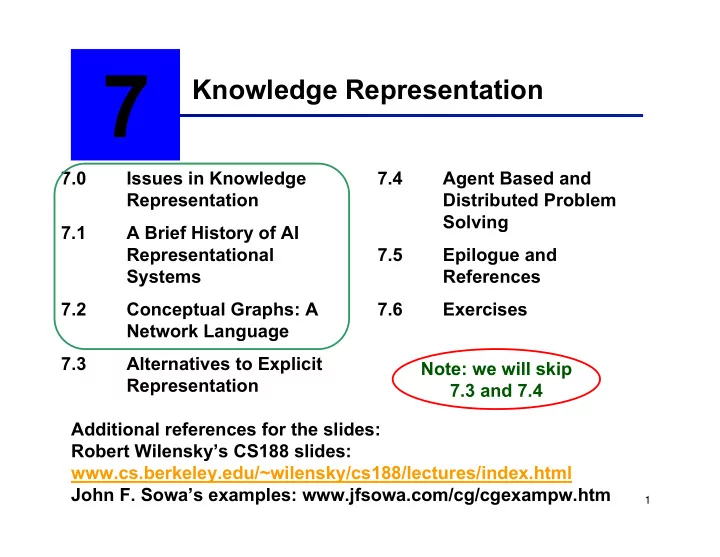
7 Knowledge Representation 7.0 Issues in Knowledge 7.4 Agent Based and Representation Distributed Problem Solving 7.1 A Brief History of AI Representational 7.5 Epilogue and Systems References 7.2 Conceptual Graphs: A 7.6


slide-1
SLIDE 1

1

Knowledge Representation

7

7.0 Issues in Knowledge Representation 7.1 A Brief History of AI Representational Systems 7.2 Conceptual Graphs: A Network Language 7.3 Alternatives to Explicit Representation 7.4 Agent Based and Distributed Problem Solving 7.5 Epilogue and References 7.6 Exercises Additional references for the slides: Robert Wilensky’s CS188 slides: www.cs.berkeley.edu/~wilensky/cs188/lectures/index.html John F. Sowa’s examples: www.jfsowa.com/cg/cgexampw.htm Note: we will skip 7.3 and 7.4

slide-2
SLIDE 2

2

Chapter Objectives

  • Learn different formalisms for Knowledge

Representation (KR)

  • Learn about representing concepts in a

canonical form

  • Compare KR formalisms to predicate calculus
  • The agent model: Transforms percepts and

results of its own actions to an internal representation

slide-3
SLIDE 3

3

“Shortcomings” of logic

  • Emphasis on truth-preserving operations rather

than the nature of human reasoning (or natural language understanding)

  • if-then relationships do not always reflect how

humans would see it: ∀X (cardinal (X) → red(X)) ∀X(¬ red (X) → ¬ → ¬ cardinal(X))

  • Associations between concepts is not always clear

snow: cold, white, snowman, slippery, ice, drift, blizzard

  • Note however, that the issue here is clarity or ease
  • f understanding rather than expressiveness.
slide-4
SLIDE 4

4

Network representation of properties of snow and ice

slide-5
SLIDE 5

5

Semantic network developed by Collins and Quillian (Harmon and King 1985)

slide-6
SLIDE 6

6

Meanings of words (concepts)

The plant did not seem to be in good shape. Bill had been away for several days and nobody watered it. OR The workers had been on strike for several days and regular maintenance was not carried out.

slide-7
SLIDE 7

7

Three planes representing three definitions of the word “plant” (Quillian 1967)

slide-8
SLIDE 8

8

Intersection path between “cry” and “comfort” (Quillian 1967)

slide-9
SLIDE 9

9

“Case” oriented representation schemes

  • Focus on the case structure of English verbs
  • Case relationships include:

agent location

  • bject

time instrument

  • Two approaches

case frames: A sentence is represented as a verb node, with various case links to nodes representing other participants in the action conceptual dependency theory: The situation is classified as one of the standard action types. Actions have conceptual cases (e.g., actor, object).

slide-10
SLIDE 10

10

Case frame representation of “Sarah fixed the chair with glue.”

slide-11
SLIDE 11

11

Conceptual Dependency Theory

  • Developed by Schank, starting in 1968
  • Tried to get as far away from language as

possible, embracing canonical form, proposing an interlingua

  • Borrowed
  • from Colby and Abelson, the terminology that sentences

reflected conceptualizations, which combine concepts

  • from case theory, the idea of cases, but rather assigned

these to underlying concepts rather than to linguistic units (e.g., verbs)

  • from the dependency grammar of David Hayes, idea of

dependency

slide-12
SLIDE 12

12

Basic idea

  • Consider the following story:

Mary went to the playroom when she heard Lily crying. Lily said, “Mom, John hit me.” Mary turned to John, “You should be gentle to your little sister.” “I’m sorry mom, it was an accident, I should not have kicked the ball towards her.” John replied.

  • What are the facts we know after reading this?
slide-13
SLIDE 13

13

Basic idea (cont’d)

Mary’s location changed. Lily was sad, she was crying. John hit Lily (with an unknown object). John is Lily’s brother. John is taller (bigger) than Lily. John kicked a ball, the ball hit Lily. Mary went to the playroom when she heard Lily crying. Lily said, “Mom, John hit me.” Mary turned to John, “You should be gentle to your little sister.” “I’m sorry mom, it was an accident, I should not have kicked the ball towards her.” John replied.

slide-14
SLIDE 14

14

“John hit the cat.”

  • First, classify the situation as of type Action.
  • Actions have cocceptual cases, e.g., all actions require
  • Act (the particular type of action)
  • Actor (the responsible party)
  • Object (the thing acted upon)

ACT: [apply a force] or PROPEL ACTOR: john OBJECT: cat john ⇔ PROPEL ← cat

slide-15
SLIDE 15

15

Conceptual dependency theory

Four primitive conceptualizations:

  • ACTs

actions

  • PPs
  • bjects (picture producers)
  • AAs

modifiers of actions (action aiders)

  • PAs

modifiers of objects (picture aiders)

slide-16
SLIDE 16

16

Conceptual dependency theory (cont’d)

Primitive acts:

  • ATRANS

transfer a relationship (give)

  • PTRANS

transfer of physical location of an object (go)

  • PROPEL

apply physical force to an object (push)

  • MOVE

move body part by owner (kick)

  • GRASP

grab an object by an actor (grasp)

  • INGEST

ingest an object by an animal (eat)

  • EXPEL

expel from an animal’s body (cry)

  • MTRANS

transfer mental information (tell)

  • MBUILD

mentally make new information (decide)

  • CONC

conceptualize or think about an idea (think)

  • SPEAK

produce sound (say)

  • ATTEND

focus sense organ (listen)

slide-17
SLIDE 17

17

Basic conceptual dependencies

slide-18
SLIDE 18

18

Examples with the basic conceptual dependencies

slide-19
SLIDE 19

19

Examples with the basic conceptual dependencies (cont’d)

slide-20
SLIDE 20

20

CD is a decompositional approach

“John took the book from Pat.”

John

  • The representation analyzes surface forms

into an underlying structure, in an attempt to capture common meaning elements.

Pat

John <≡> *ATRANS* ← book The above form also represents: “Pat received the book from John.”

slide-21
SLIDE 21

21

CD is a decompositional approach

“John gave the book to Pat.”

Pat

  • Note that only the donor and recipient have

changed.

John

John <≡> *ATRANS* ← book

slide-22
SLIDE 22

22

Ontology

  • Situations were divided into several types:
  • Actions
  • States
  • State changes
  • Causals
  • There wasn’t much of an attempt to classify
  • bjects
slide-23
SLIDE 23

23

“John ate the egg.”

slide-24
SLIDE 24

24

“John prevented Mary from giving a book to Bill”

slide-25
SLIDE 25

25

Representing Picture Aiders (PAs) or states

thing <≡> state-type (state-value)

  • “The ball is red”

ball <≡> color (red)

  • “John is 6 feet tall”

john <≡> height (6 feet)

  • “John is tall”

john <≡> height (>average)

  • “John is taller than Jane”

john <≡> height (X) jane <≡> height (Y) X > Y

slide-26
SLIDE 26

26

More PA examples

  • “John is angry.”

john <≡> anger(5)

  • “John is furious.”

john <≡> anger(7)

  • “John is irritated.”

john <≡> anger (2)

  • “John is ill.”

john <≡> health (-3)

  • “John is dead.”

john <≡> health (-10) Many states are viewed as points on scales.

slide-27
SLIDE 27

27

Scales

  • There should be lots of scales
  • The numbers themselves were not meant to be taken

seriously

  • But that lots of different terms differ only in how they

refer to scales was

  • An interesting question is which semantic
  • bjects are there to describe locations on a

scale? For instance, modifiers such as “very”, “extremely” might have an interpretation as “toward the end of a scale.”

slide-28
SLIDE 28

28

Scales (cont’d)

  • What is “John grew an inch.”
  • This is supposed to be a state change:

somewhat like an action but with no responsible agent posited

Height (X) John < Ξ Height (X+1)

slide-29
SLIDE 29

29

Variations on the story of the poor cat

“John applied a force to the cat by moving some object to come in contact with the cat” John <≡> *PROPEL* ← cat John <≡> *PTRANS* ← [ ] ←

  • loc(cat)

i

  • The arrow labeled ‘i’ denotes instrumental case
slide-30
SLIDE 30

30

Variations on the cat story (cont’d)

“John kicked the cat.” John <≡> *PROPEL* ← cat John <≡> *PTRANS* ← foot ← kick = hit with one’s foot

  • loc(cat)

i

slide-31
SLIDE 31

31

Variations on the cat story (cont’d)

“John hit the cat.” John <≡> *PROPEL* ← cat cat <≡ Hitting was detrimental to the cat’s health.

  • Health(-2)

< ≡

slide-32
SLIDE 32

32

Causals

“John hurt Jane.” John <≡> DO ← Jane Jane <≡ John did something to cause Jane to become hurt.

  • Pain( > X)

< ≡ Pain (X)

slide-33
SLIDE 33

33

Causals (cont’d)

“John hurt Jane by hitting her.” John <≡> PROPEL ← Jane Jane <≡ John hit Jane to cause Jane to become hurt.

  • Pain( > X)

< ≡ Pain (X)

slide-34
SLIDE 34

34

How about?

“John killed Jane.” “John frightened Jane.” “John likes ice cream.”

slide-35
SLIDE 35

35

“John killed Jane.”

John <≡> *DO* Jane <≡

Health(-10) < ≡ Health(> -10)

slide-36
SLIDE 36

36

“John frightened Jane.”

John <≡> *DO* Jane <≡

Fear (> X) < ≡ Fear (X)

slide-37
SLIDE 37

37

“John likes ice cream.”

John <≡> *INGEST* ← IceCream John <≡

  • Joy ( > X)

< ≡ Joy ( X )

slide-38
SLIDE 38

38

Comments on CD theory

  • Ambitious attempt to represent information in

a language independent way

  • formal theory of natural language semantics, reduces

problems of ambiguity

  • canonical form, internally syntactically identical
  • decomposition addresses problems in case theory by

revealing underlying conceptual structure. Relations are between concepts, not between linguistic elements

  • prospects for machine translation are improved
slide-39
SLIDE 39

39

Comments on CD theory (cont’d)

The major problem is incompleteness

  • no quantification
  • no hierarchy for objects (and actions), everything is a

primitive

  • are those the right primitives?
  • Is there such a thing as a conceptual primitive?

(e.g., MOVE to a physiologist is complex)

  • how much should the inferences be carried? CD didn’t

explicitly include logical entailments such as “hit” entails “being touched”, “bought” entails being at a store

  • fuzzy logic? Lots of linguistic details are very lexically-

dependent, e.g., likely, probably

  • still not well studied/understood, a more convincing

methodology never arrived

slide-40
SLIDE 40

40

Understanding stories about restaurants

John went to a restaurant last night. He ordered

  • steak. When he paid he noticed he was running
  • ut of money. He hurried home since it had

started to rain. Did John eat dinner? Did John pay by cash or credit card? What did John buy? Did he stop at the bank on the way home?

slide-41
SLIDE 41

41

Restaurant stories (cont’d)

Sue went out to lunch. She sat at a table and called a waitress, who brought her a menu. She ordered a sandwich. Was Sue at a restaurant? Why did the waitress bring Sue a menu? Who does “she” refer to in the last sentence?

slide-42
SLIDE 42

42

Restaurant stories (cont’d)

Kate went to a restaurant. She was shown to a table and ordered steak from a waitress. She sat there and waited for a long time. Finally, she got mad and she left. Who does “she” refer to in the third sentence? Why did Kate wait? Why did she get mad? (might not be in the “script”)

slide-43
SLIDE 43

43

Restaurant stories (cont’d)

John visited his favorite restaurant on the way to the

  • concert. He was pleased by the bill because he liked

Mozart. Which bill? (which “script” to choose: restaurant or concert?)

slide-44
SLIDE 44

44

Scripts

  • Entry conditions: conditions that must be true

for the script to be called.

  • Results: conditions that become true once the

script terminates.

  • Props: “things” that support the content of the

script.

  • Roles: the actions that the participants

perform.

  • Scenes: a presentation of a temporal aspect of

a script.

slide-45
SLIDE 45

45

A RESTAURANT script

Script: RESTAURANT Track: coffee shop Props: Tables, Menu, F = food, Check, Money Roles: S= Customer W = Waiter C = Cook M = Cashier O = Owner

slide-46
SLIDE 46

46

A RESTAURANT script (cont’d)

Entry conditions: S is hungry S has money Results: S has less money O has more money S is not hungry S is pleased (optional)

slide-47
SLIDE 47

47

A RESTAURANT script (cont’d)

slide-48
SLIDE 48

48

A RESTAURANT script (cont’d)

slide-49
SLIDE 49

49

A RESTAURANT script (cont’d)

slide-50
SLIDE 50

50

Frames

Frames are similar to scripts, they organize stereotypic situations. Information in a frame:

  • Frame identification
  • Relationship to other frames
  • Descriptors of the requirements
  • Procedural information
  • Default information
  • New instance information
slide-51
SLIDE 51

51

Part of a frame description of a hotel room

slide-52
SLIDE 52

52

Conceptual graphs

A finite, connected, bipartite graph Nodes: either concepts or conceptual relations Arcs: no labels, they represent relations between concepts Concepts: concrete (e.g., book, dog) or abstract (e.g., like)

slide-53
SLIDE 53

53

Conceptual relations of different arities

bird flies dog color brown child parents mother father

Flies is a unary relation Color is a binary relation Parents is a ternary relation

slide-54
SLIDE 54

54

“Mary gave John the book.”

slide-55
SLIDE 55

55

Conceptual graph indicating that a particular (but unnamed) dog is brown: Conceptual graph indicating that a dog named emma is brown:

Conceptual graphs involving a brown dog

Conceptual graph indicating that the dog named emma dog is brown:

slide-56
SLIDE 56

56

Conceptual graph of a person with three names

slide-57
SLIDE 57

57

“The dog scratches its ear with its paw.”

slide-58
SLIDE 58

58

The type hierarchy

A partial ordering on the set of types: t ≤ s where, t is a subtype of s, s is a supertype of t. If t ≤ s and t ≤ u, then t is a common subtype of s and u. If s ≤ v and u ≤ v, then v is a common supertype

  • f s and u.

Notions of: minimal common supertype maximal common subtype

slide-59
SLIDE 59

59

A lattice of subtypes, supertypes, the universal type, and the absurd type

⊥ ⊥ w r v s u t

slide-60
SLIDE 60

60

Four graph operations

  • copy: exact copy of a graph
  • restrict: replace a concept node with a node

representing its specialization

  • join: combines graph based on identical

nodes

  • simplify: delete duplicate relations
slide-61
SLIDE 61

61

Restriction

slide-62
SLIDE 62

62

Join

slide-63
SLIDE 63

63

Simplify

slide-64
SLIDE 64

64

Inheritance in conceptual graphs

slide-65
SLIDE 65

65

“Tom believes that Jane likes pizza.”

experiencer likes pizza agent person:jane believe proposition

  • bject
  • bject

person:tom

slide-66
SLIDE 66

66

“There are no pink dogs.”

slide-67
SLIDE 67

67

Translate into English

instrument

  • bject

hand person:john eat pizza agent part

slide-68
SLIDE 68

68

Translate into English

attr rock person place hard between 1 2

slide-69
SLIDE 69

69

Translate into English

slide-70
SLIDE 70

70

Algorithm to convert a conceptual graph, g, to a predicate calculus expression

  • 1. Assign a unique variable, x1, x2, …, xn, to each one of

the n generic concepts in g.

  • 2. Assign a unique constant to each individual constant

in g. This constant may simply be the name or marker used to indicate the referent of the concept.

  • 3. Represent each concept by a unary predicate with the

same name as the type of that node and whose argument is the variable or constant given that node.

  • 4. Represent each n-ary conceptual relation in g as an n-

ary predicate whose name is the same as the relation. Let each argument of the predicate be the variable or constant assigned to the corresponding concept node linked to that relation.

  • 5. Take the conjunction of all the atomic sentences

formed under 3 and 4. This is the body of the predicate calculus expression. All the variables in the expression are existentially quantified.

slide-71
SLIDE 71

71

Example conversion

  • 1. Assign variables

to generic concepts X1

  • 2. Assign constants

to individual concepts emma

  • 3. Represent each

concept node dog(emma) brown(X1)

  • 4. Represent each

n-ary relation color(emma, X1)

  • 5. Take the conjunction

all the predicates from 3 and 4 dog(emma) ∧ color(emma, X1) ∧ brown(X1) All the variables are existentially quantified. ∃ X1 dog(emma) ∧ color(emma, X1) ∧ brown(X1)

slide-72
SLIDE 72

72

Universal quantification

cat mat

  • n

A cat is on a mat.

Cat: ∀ mat

  • n

Every cat is on a mat.