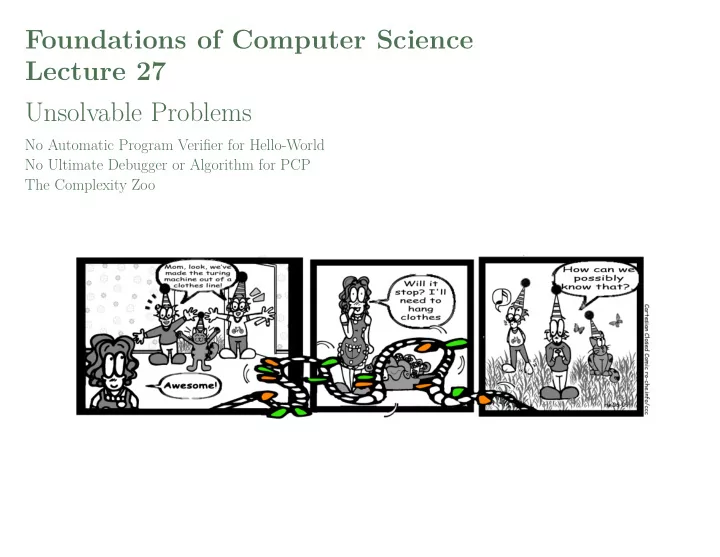
Foundations of Computer Science Lecture 27 Unsolvable Problems No - - PowerPoint PPT Presentation
Foundations of Computer Science Lecture 27 Unsolvable Problems No Automatic Program Verifier for Hello-World No Ultimate Debugger or Algorithm for PCP The Complexity Zoo Last Time: Turing Machines Intuitive notion of algorithm Turing Machine
Last Time: Turing Machines
Intuitive notion of algorithm
≡
Turing Machine Solvable problem
≡
Turing-decidable
1 2 3 4
L = {G | G is connected} G =
2; 1; 3; 4 # 1,2; 2,3; 1,3; 3,4
(G is the encoding of graph G as a string.)
Creator: Malik Magdon-Ismail Unsolvable Problems: 2 / 13 Today →
Last Time: Turing Machines
Intuitive notion of algorithm
≡
Turing Machine Solvable problem
≡
Turing-decidable
1 2 3 4
L = {G | G is connected} G =
2; 1; 3; 4 # 1,2; 2,3; 1,3; 3,4
(G is the encoding of graph G as a string.)
M = Turing Machine that solves graph connectivity input: G, the encoding of a graph G.
Creator: Malik Magdon-Ismail Unsolvable Problems: 2 / 13 Today →
Last Time: Turing Machines
Intuitive notion of algorithm
≡
Turing Machine Solvable problem
≡
Turing-decidable
1 2 3 4 1 2 3 4
L = {G | G is connected} G =
2; 1; 3; 4 # 1,2; 2,3; 1,3; 3,4
(G is the encoding of graph G as a string.)
M = Turing Machine that solves graph connectivity input: G, the encoding of a graph G.
1: Check that G is a valid encoding of a graph and mark the first vertex in G.
Creator: Malik Magdon-Ismail Unsolvable Problems: 2 / 13 Today →
Last Time: Turing Machines
Intuitive notion of algorithm
≡
Turing Machine Solvable problem
≡
Turing-decidable
1 2 3 4 1 2 3 4 1 2 3 4
L = {G | G is connected} G =
2; 1; 3; 4 # 1,2; 2,3; 1,3; 3,4
(G is the encoding of graph G as a string.)
M = Turing Machine that solves graph connectivity input: G, the encoding of a graph G.
1: Check that G is a valid encoding of a graph and mark the first vertex in G. 2: repeat: Find an edge in G between a marked and an unmarked vertex.
Mark the unmarked node or goto step 3 if there is no such edge.
Creator: Malik Magdon-Ismail Unsolvable Problems: 2 / 13 Today →
Last Time: Turing Machines
Intuitive notion of algorithm
≡
Turing Machine Solvable problem
≡
Turing-decidable
1 2 3 4 1 2 3 4 1 2 3 4 1 2 3 4
L = {G | G is connected} G =
2; 1; 3; 4 # 1,2; 2,3; 1,3; 3,4
(G is the encoding of graph G as a string.)
M = Turing Machine that solves graph connectivity input: G, the encoding of a graph G.
1: Check that G is a valid encoding of a graph and mark the first vertex in G. 2: repeat: Find an edge in G between a marked and an unmarked vertex.
Mark the unmarked node or goto step 3 if there is no such edge.
Creator: Malik Magdon-Ismail Unsolvable Problems: 2 / 13 Today →
Last Time: Turing Machines
Intuitive notion of algorithm
≡
Turing Machine Solvable problem
≡
Turing-decidable
1 2 3 4 1 2 3 4 1 2 3 4 1 2 3 4 1 2 3 4
L = {G | G is connected} G =
2; 1; 3; 4 # 1,2; 2,3; 1,3; 3,4
(G is the encoding of graph G as a string.)
M = Turing Machine that solves graph connectivity input: G, the encoding of a graph G.
1: Check that G is a valid encoding of a graph and mark the first vertex in G. 2: repeat: Find an edge in G between a marked and an unmarked vertex.
Mark the unmarked node or goto step 3 if there is no such edge.
Creator: Malik Magdon-Ismail Unsolvable Problems: 2 / 13 Today →
Last Time: Turing Machines
Intuitive notion of algorithm
≡
Turing Machine Solvable problem
≡
Turing-decidable
1 2 3 4 1 2 3 4 1 2 3 4 1 2 3 4 1 2 3 4 1 2 3 4
L = {G | G is connected} G =
2; 1; 3; 4 # 1,2; 2,3; 1,3; 3,4
(G is the encoding of graph G as a string.)
M = Turing Machine that solves graph connectivity input: G, the encoding of a graph G.
1: Check that G is a valid encoding of a graph and mark the first vertex in G. 2: repeat: Find an edge in G between a marked and an unmarked vertex.
Mark the unmarked node or goto step 3 if there is no such edge.
Creator: Malik Magdon-Ismail Unsolvable Problems: 2 / 13 Today →
Last Time: Turing Machines
Intuitive notion of algorithm
≡
Turing Machine Solvable problem
≡
Turing-decidable
1 2 3 4 1 2 3 4 1 2 3 4 1 2 3 4 1 2 3 4 1 2 3 4
L = {G | G is connected} G =
2; 1; 3; 4 # 1,2; 2,3; 1,3; 3,4
(G is the encoding of graph G as a string.)
M = Turing Machine that solves graph connectivity input: G, the encoding of a graph G.
1: Check that G is a valid encoding of a graph and mark the first vertex in G. 2: repeat: Find an edge in G between a marked and an unmarked vertex.
Mark the unmarked node or goto step 3 if there is no such edge.
3: reject if there is an unmarked vertex remaining in G; otherwise accept.
To tell your friend on the other coast about this fancy Turing Machine M, encode its description into the bit-string M and send over the telegraph. You want to solve a different problem? Build another Turing Machine!
Creator: Malik Magdon-Ismail Unsolvable Problems: 2 / 13 Today →
Today: Unsolvable Problems
1
Programmable Turing Machines.
2
Examples of unsolvable problems.
Post’s Correspondence Problem (PCP)? HalfSum? Auto-Grade? Ultimate-Debugger?
3
Ltm: The language recognized by a Universal Turing Machine.
Ltm is undecidable – cannot be solved!
4
Auto-Grade and Ultimate-Debugger do not exist.
5
What about HalfSum?
Creator: Malik Magdon-Ismail Unsolvable Problems: 3 / 13 Programmable Turing Machine →
Programmable Turing Machine: Universal Turing Machine
A Turing Machine M has a binary encoding M. Its input w is a binary string.
Creator: Malik Magdon-Ismail Unsolvable Problems: 4 / 13 PCP and HalfSum →
Programmable Turing Machine: Universal Turing Machine
A Turing Machine M has a binary encoding M. Its input w is a binary string.
M#w can be the input to another Turing Machine Utm. Utm(M#w) =
halt with accept if M(w) = halt with accept; halt with reject if M(w) = halt with reject; loop forever if M(w) = loop forever;
Utm outputs on M#w whatever M outputs on w. Utm simulates M
Creator: Malik Magdon-Ismail Unsolvable Problems: 4 / 13 PCP and HalfSum →
Programmable Turing Machine: Universal Turing Machine
A Turing Machine M has a binary encoding M. Its input w is a binary string.
M#w can be the input to another Turing Machine Utm. Utm(M#w)
computer
=
halt with accept if M(w) = halt with accept; halt with reject if M(w) = halt with reject; loop forever if M(w) = loop forever;
Utm outputs on M#w whatever M outputs on w. Utm simulates M
Creator: Malik Magdon-Ismail Unsolvable Problems: 4 / 13 PCP and HalfSum →
Programmable Turing Machine: Universal Turing Machine
A Turing Machine M has a binary encoding M. Its input w is a binary string.
M#w can be the input to another Turing Machine Utm. Utm(M#w)
computer program
=
halt with accept if M(w) = halt with accept; halt with reject if M(w) = halt with reject; loop forever if M(w) = loop forever;
Utm outputs on M#w whatever M outputs on w. Utm simulates M
Creator: Malik Magdon-Ismail Unsolvable Problems: 4 / 13 PCP and HalfSum →
Programmable Turing Machine: Universal Turing Machine
A Turing Machine M has a binary encoding M. Its input w is a binary string.
M#w can be the input to another Turing Machine Utm. Utm(M#w)
computer program program input
=
halt with accept if M(w) = halt with accept; halt with reject if M(w) = halt with reject; loop forever if M(w) = loop forever;
Utm outputs on M#w whatever M outputs on w. Utm simulates M
Creator: Malik Magdon-Ismail Unsolvable Problems: 4 / 13 PCP and HalfSum →
Programmable Turing Machine: Universal Turing Machine
A Turing Machine M has a binary encoding M. Its input w is a binary string.
M#w can be the input to another Turing Machine Utm. Utm(M#w)
computer program program input
=
halt with accept if M(w) = halt with accept; halt with reject if M(w) = halt with reject; loop forever if M(w) = loop forever;
Utm outputs on M#w whatever M outputs on w. Utm simulates M
Challenge: Utm is fixed but can simulate any M, even one with a million states.
Creator: Malik Magdon-Ismail Unsolvable Problems: 4 / 13 PCP and HalfSum →
Programmable Turing Machine: Universal Turing Machine
A Turing Machine M has a binary encoding M. Its input w is a binary string.
M#w can be the input to another Turing Machine Utm. Utm(M#w)
computer program program input
=
halt with accept if M(w) = halt with accept; halt with reject if M(w) = halt with reject; loop forever if M(w) = loop forever;
Utm outputs on M#w whatever M outputs on w. Utm simulates M
Challenge: Utm is fixed but can simulate any M, even one with a million states.
*
w states instructions M #
1 1 ␣ ␣
Entire simulation is done on the tape.
Creator: Malik Magdon-Ismail Unsolvable Problems: 4 / 13 PCP and HalfSum →
Programmable Turing Machine: Universal Turing Machine
A Turing Machine M has a binary encoding M. Its input w is a binary string.
M#w can be the input to another Turing Machine Utm. Utm(M#w)
computer program program input
=
halt with accept if M(w) = halt with accept; halt with reject if M(w) = halt with reject; loop forever if M(w) = loop forever;
Utm outputs on M#w whatever M outputs on w. Utm simulates M
Challenge: Utm is fixed but can simulate any M, even one with a million states.
*
w states instructions M #
1 1 ␣ ␣
mark M’s R-W head
Entire simulation is done on the tape.
Creator: Malik Magdon-Ismail Unsolvable Problems: 4 / 13 PCP and HalfSum →
Programmable Turing Machine: Universal Turing Machine
A Turing Machine M has a binary encoding M. Its input w is a binary string.
M#w can be the input to another Turing Machine Utm. Utm(M#w)
computer program program input
=
halt with accept if M(w) = halt with accept; halt with reject if M(w) = halt with reject; loop forever if M(w) = loop forever;
Utm outputs on M#w whatever M outputs on w. Utm simulates M
Challenge: Utm is fixed but can simulate any M, even one with a million states.
*
w states instructions M #
1 1 ␣ ␣
mark M’s R-W head mark M’s state
Entire simulation is done on the tape.
Creator: Malik Magdon-Ismail Unsolvable Problems: 4 / 13 PCP and HalfSum →
Programmable Turing Machine: Universal Turing Machine
A Turing Machine M has a binary encoding M. Its input w is a binary string.
M#w can be the input to another Turing Machine Utm. Utm(M#w)
computer program program input
=
halt with accept if M(w) = halt with accept; halt with reject if M(w) = halt with reject; loop forever if M(w) = loop forever;
Utm outputs on M#w whatever M outputs on w. Utm simulates M
Challenge: Utm is fixed but can simulate any M, even one with a million states.
*
w states instructions M #
1 1 ␣ ␣
mark M’s R-W head mark M’s state mark M’s instruction
Entire simulation is done on the tape.
Creator: Malik Magdon-Ismail Unsolvable Problems: 4 / 13 PCP and HalfSum →
Programmable Turing Machine: Universal Turing Machine
A Turing Machine M has a binary encoding M. Its input w is a binary string.
M#w can be the input to another Turing Machine Utm. Utm(M#w)
computer program program input
=
halt with accept if M(w) = halt with accept; halt with reject if M(w) = halt with reject; loop forever if M(w) = loop forever;
Utm outputs on M#w whatever M outputs on w. Utm simulates M
Challenge: Utm is fixed but can simulate any M, even one with a million states.
*
w states instructions M #
1 1 ␣ ␣
Utm
mark M’s R-W head mark M’s state mark M’s instruction
Entire simulation is done on the tape.
Creator: Malik Magdon-Ismail Unsolvable Problems: 4 / 13 PCP and HalfSum →
Post’s Correspondence Problem (PCP) and HalfSum
PCP: Consider 3 dominos:
d1 d2 d3 100 01 00 110 11
Creator: Malik Magdon-Ismail Unsolvable Problems: 5 / 13 Auto-Grade →
Post’s Correspondence Problem (PCP) and HalfSum
PCP: Consider 3 dominos:
d1 d2 d3 100 01 00 110 11
d3d2d3d1 =
110 11 01 00 110 11 100
=
110011100 110011100
← Top and bottom strings match. That’s the goal.
Creator: Malik Magdon-Ismail Unsolvable Problems: 5 / 13 Auto-Grade →
Post’s Correspondence Problem (PCP) and HalfSum
PCP: Consider 3 dominos:
d1 d2 d3 100 01 00 110 11
d3d2d3d1 =
110 11 01 00 110 11 100
=
110011100 110011100
← Top and bottom strings match. That’s the goal.
input: Dominos {d1, d2, . . . , dn}. For example
10 101 , 011 11 , 101 011
.
task: Can one line up finitely many dominos so that the top and bottom strings match?
Creator: Malik Magdon-Ismail Unsolvable Problems: 5 / 13 Auto-Grade →
Post’s Correspondence Problem (PCP) and HalfSum
PCP: Consider 3 dominos:
d1 d2 d3 100 01 00 110 11
d3d2d3d1 =
110 11 01 00 110 11 100
=
110011100 110011100
← Top and bottom strings match. That’s the goal.
input: Dominos {d1, d2, . . . , dn}. For example
10 101 , 011 11 , 101 011
.
task: Can one line up finitely many dominos so that the top and bottom strings match? HalfSum: Consider the multiset S = {1, 1, 1, 3, 4, 4, 5, 6, 9}, and subset A = {1, 3, 4, 9}. sum(A) = 17 = 1
2 × sum(S).
Creator: Malik Magdon-Ismail Unsolvable Problems: 5 / 13 Auto-Grade →
Post’s Correspondence Problem (PCP) and HalfSum
PCP: Consider 3 dominos:
d1 d2 d3 100 01 00 110 11
d3d2d3d1 =
110 11 01 00 110 11 100
=
110011100 110011100
← Top and bottom strings match. That’s the goal.
input: Dominos {d1, d2, . . . , dn}. For example
10 101 , 011 11 , 101 011
.
task: Can one line up finitely many dominos so that the top and bottom strings match? HalfSum: Consider the multiset S = {1, 1, 1, 3, 4, 4, 5, 6, 9}, and subset A = {1, 3, 4, 9}. sum(A) = 17 = 1
2 × sum(S).
input: Multiset S = {x1, x2, . . . , xn}. For example, S = {1, 1, 1, 3, 4, 4, 5, 6, 9}. task: Is there a subset whose sum is 1
2 × sum(S) = 1 2 × (x1 + x2 + · · · + xn)?
Creator: Malik Magdon-Ismail Unsolvable Problems: 5 / 13 Auto-Grade →
Auto-Grade
Your first CS assignment: Write a program to print “Hello World!” and halt. CS1: 700+ submissions! Naturally, we do not grade these by hand. Auto-Grade: runs each submission and determines if its correct.
←program verification
Creator: Malik Magdon-Ismail Unsolvable Problems: 6 / 13 Ultimate-Debugger →
Auto-Grade
Your first CS assignment: Write a program to print “Hello World!” and halt. CS1: 700+ submissions! Naturally, we do not grade these by hand. Auto-Grade: runs each submission and determines if its correct.
←program verification
What does Auto-Grade say for this program:
n = 4;
while(n > 0){ if(n is not a sum of two primes){ print("Hello World!") and exit; }
n ← n + 2;
}
Creator: Malik Magdon-Ismail Unsolvable Problems: 6 / 13 Ultimate-Debugger →
Ultimate-Debugger
Wouldn’t it be nice to have the Ultimate-Debugger.
← solves the Halting Problem
Halts
n = 4; while(n > 0){ if(n is not a sum of two primes){ print("Hello World!") and exit; } n ← n + 2; }
=
yes
if program halts
no
if program infinitely loops
Creator: Malik Magdon-Ismail Unsolvable Problems: 7 / 13 Ltm →
Ultimate-Debugger
Wouldn’t it be nice to have the Ultimate-Debugger.
← solves the Halting Problem
Halts
n = 4; while(n > 0){ if(n is not a sum of two primes){ print("Hello World!") and exit; } n ← n + 2; }
=
yes
if program halts
no
if program infinitely loops We can grade the students program correctly. We can solve Goldbach’s conjecture. Just think what you could do with Ultimate-Debugger.
◮ No more infinite looping programs. Creator: Malik Magdon-Ismail Unsolvable Problems: 7 / 13 Ltm →
Verification: Does A Program Successfully Terminate?
Creator: Malik Magdon-Ismail Unsolvable Problems: 8 / 13 Ltm is Undecidable →
Verification: Does A Program Successfully Terminate?
Ltm = {M#w | M is a Turing Machine and M accepts w}.
Creator: Malik Magdon-Ismail Unsolvable Problems: 8 / 13 Ltm is Undecidable →
Verification: Does A Program Successfully Terminate?
Ltm = {M#w | M is a Turing Machine and M accepts w}. Utm is a recognizer for Ltm.
Creator: Malik Magdon-Ismail Unsolvable Problems: 8 / 13 Ltm is Undecidable →
Verification: Does A Program Successfully Terminate?
Ltm = {M#w | M is a Turing Machine and M accepts w}. Utm is a recognizer for Ltm.
Is there a Turing Machine Atm which decides Ltm? A decider must always halt with an answer.
Utm may loop forever if M loops forever on w.
Creator: Malik Magdon-Ismail Unsolvable Problems: 8 / 13 Ltm is Undecidable →
Verification: Does A Program Successfully Terminate?
Ltm = {M#w | M is a Turing Machine and M accepts w}. Utm is a recognizer for Ltm.
Is there a Turing Machine Atm which decides Ltm? A decider must always halt with an answer.
Utm may loop forever if M loops forever on w.
Question: What do these mean: M(M) and Atm(M#M) ?
Creator: Malik Magdon-Ismail Unsolvable Problems: 8 / 13 Ltm is Undecidable →
Verification: Does A Program Successfully Terminate?
Ltm = {M#w | M is a Turing Machine and M accepts w}. Utm is a recognizer for Ltm.
Is there a Turing Machine Atm which decides Ltm? A decider must always halt with an answer.
Utm may loop forever if M loops forever on w.
Question: What do these mean: M(M) and Atm(M#M) ? A diabolical Turing Machine D built from Atm:
D = “Diagonal” Turing Machine derived from Atm (the decider for Ltm) input: M where M is a Turing Machine.
Verification: Does A Program Successfully Terminate?
Ltm = {M#w | M is a Turing Machine and M accepts w}. Utm is a recognizer for Ltm.
Is there a Turing Machine Atm which decides Ltm? A decider must always halt with an answer.
Utm may loop forever if M loops forever on w.
Question: What do these mean: M(M) and Atm(M#M) ? A diabolical Turing Machine D built from Atm:
D = “Diagonal” Turing Machine derived from Atm (the decider for Ltm) input: M where M is a Turing Machine.
1: Run Atm with input M#M.
D does the opposite of Atm. Is D a decider?
Verification: Does A Program Successfully Terminate?
Ltm = {M#w | M is a Turing Machine and M accepts w}. Utm is a recognizer for Ltm.
Is there a Turing Machine Atm which decides Ltm? A decider must always halt with an answer.
Utm may loop forever if M loops forever on w.
Question: What do these mean: M(M) and Atm(M#M) ? A diabolical Turing Machine D built from Atm:
D = “Diagonal” Turing Machine derived from Atm (the decider for Ltm) input: M where M is a Turing Machine.
1: Run Atm with input M#M. 2: If Atm accepts then reject; otherwise (Atm rejects) accept
D does the opposite of Atm. Is D a decider?
Creator: Malik Magdon-Ismail Unsolvable Problems: 8 / 13 Ltm is Undecidable →
- Theorem. Atm does not exist (Ltm Cannot be Solved)
Atm exists → D exists. D exists means it will appear on the list of all Turing Machines, M1, M2, M3, M4, D, . . .
Creator: Malik Magdon-Ismail Unsolvable Problems: 9 / 13 Ultimate-Debugger and Auto-Grade →
- Theorem. Atm does not exist (Ltm Cannot be Solved)
Atm exists → D exists. D exists means it will appear on the list of all Turing Machines, M1, M2, M3, M4, D, . . .
Consider what happens when Mi runs on Mj, that is Atm(Mi#Mj).
Atm(Mi#Mj) M1 M2 M3 M4 D · · · M1 M2 M3 M4 D
. . .
Creator: Malik Magdon-Ismail Unsolvable Problems: 9 / 13 Ultimate-Debugger and Auto-Grade →
- Theorem. Atm does not exist (Ltm Cannot be Solved)
Atm exists → D exists. D exists means it will appear on the list of all Turing Machines, M1, M2, M3, M4, D, . . .
Consider what happens when Mi runs on Mj, that is Atm(Mi#Mj).
Atm(Mi#Mj) M1 M2 M3 M4 D · · · M1
accept accept reject accept accept
· · · M2 M3 M4 D
. . .
Creator: Malik Magdon-Ismail Unsolvable Problems: 9 / 13 Ultimate-Debugger and Auto-Grade →
- Theorem. Atm does not exist (Ltm Cannot be Solved)
Atm exists → D exists. D exists means it will appear on the list of all Turing Machines, M1, M2, M3, M4, D, . . .
Consider what happens when Mi runs on Mj, that is Atm(Mi#Mj).
Atm(Mi#Mj) M1 M2 M3 M4 D · · · M1
accept accept reject accept accept
· · · M2 M3 M4 D
reject . . .
D(Mi) does the opposite of Atm(Mi#Mi).
Creator: Malik Magdon-Ismail Unsolvable Problems: 9 / 13 Ultimate-Debugger and Auto-Grade →
- Theorem. Atm does not exist (Ltm Cannot be Solved)
Atm exists → D exists. D exists means it will appear on the list of all Turing Machines, M1, M2, M3, M4, D, . . .
Consider what happens when Mi runs on Mj, that is Atm(Mi#Mj).
Atm(Mi#Mj) M1 M2 M3 M4 D · · · M1
accept accept reject accept accept
· · · M2
reject reject reject accept accept
· · · M3 M4 D
reject . . .
D(Mi) does the opposite of Atm(Mi#Mi).
Creator: Malik Magdon-Ismail Unsolvable Problems: 9 / 13 Ultimate-Debugger and Auto-Grade →
- Theorem. Atm does not exist (Ltm Cannot be Solved)
Atm exists → D exists. D exists means it will appear on the list of all Turing Machines, M1, M2, M3, M4, D, . . .
Consider what happens when Mi runs on Mj, that is Atm(Mi#Mj).
Atm(Mi#Mj) M1 M2 M3 M4 D · · · M1
accept accept reject accept accept
· · · M2
reject reject reject accept accept
· · · M3 M4 D
reject accept . . .
D(Mi) does the opposite of Atm(Mi#Mi).
Creator: Malik Magdon-Ismail Unsolvable Problems: 9 / 13 Ultimate-Debugger and Auto-Grade →
- Theorem. Atm does not exist (Ltm Cannot be Solved)
Atm exists → D exists. D exists means it will appear on the list of all Turing Machines, M1, M2, M3, M4, D, . . .
Consider what happens when Mi runs on Mj, that is Atm(Mi#Mj).
Atm(Mi#Mj) M1 M2 M3 M4 D · · · M1
accept accept reject accept accept
· · · M2
reject reject reject accept accept
· · · M3
accept accept reject reject accept
· · · M4 D
reject accept . . .
D(Mi) does the opposite of Atm(Mi#Mi).
Creator: Malik Magdon-Ismail Unsolvable Problems: 9 / 13 Ultimate-Debugger and Auto-Grade →
- Theorem. Atm does not exist (Ltm Cannot be Solved)
Atm exists → D exists. D exists means it will appear on the list of all Turing Machines, M1, M2, M3, M4, D, . . .
Consider what happens when Mi runs on Mj, that is Atm(Mi#Mj).
Atm(Mi#Mj) M1 M2 M3 M4 D · · · M1
accept accept reject accept accept
· · · M2
reject reject reject accept accept
· · · M3
accept accept reject reject accept
· · · M4 D
reject accept accept . . .
D(Mi) does the opposite of Atm(Mi#Mi).
Creator: Malik Magdon-Ismail Unsolvable Problems: 9 / 13 Ultimate-Debugger and Auto-Grade →
- Theorem. Atm does not exist (Ltm Cannot be Solved)
Atm exists → D exists. D exists means it will appear on the list of all Turing Machines, M1, M2, M3, M4, D, . . .
Consider what happens when Mi runs on Mj, that is Atm(Mi#Mj).
Atm(Mi#Mj) M1 M2 M3 M4 D · · · M1
accept accept reject accept accept
· · · M2
reject reject reject accept accept
· · · M3
accept accept reject reject accept
· · · M4
accept reject reject reject accept
· · · D
reject accept accept . . .
D(Mi) does the opposite of Atm(Mi#Mi).
Creator: Malik Magdon-Ismail Unsolvable Problems: 9 / 13 Ultimate-Debugger and Auto-Grade →
- Theorem. Atm does not exist (Ltm Cannot be Solved)
Atm exists → D exists. D exists means it will appear on the list of all Turing Machines, M1, M2, M3, M4, D, . . .
Consider what happens when Mi runs on Mj, that is Atm(Mi#Mj).
Atm(Mi#Mj) M1 M2 M3 M4 D · · · M1
accept accept reject accept accept
· · · M2
reject reject reject accept accept
· · · M3
accept accept reject reject accept
· · · M4
accept reject reject reject accept
· · · D
reject accept accept accept . . .
D(Mi) does the opposite of Atm(Mi#Mi).
Creator: Malik Magdon-Ismail Unsolvable Problems: 9 / 13 Ultimate-Debugger and Auto-Grade →
- Theorem. Atm does not exist (Ltm Cannot be Solved)
Atm exists → D exists. D exists means it will appear on the list of all Turing Machines, M1, M2, M3, M4, D, . . .
Consider what happens when Mi runs on Mj, that is Atm(Mi#Mj).
Atm(Mi#Mj) M1 M2 M3 M4 D · · · M1
accept accept reject accept accept
· · · M2
reject reject reject accept accept
· · · M3
accept accept reject reject accept
· · · M4
accept reject reject reject accept
· · · D
reject accept accept accept accept? · · · . . . . . . . . . . . . . . . . . . ...
D(Mi) does the opposite of Atm(Mi#Mi).
Creator: Malik Magdon-Ismail Unsolvable Problems: 9 / 13 Ultimate-Debugger and Auto-Grade →
- Theorem. Atm does not exist (Ltm Cannot be Solved)
Atm exists → D exists. D exists means it will appear on the list of all Turing Machines, M1, M2, M3, M4, D, . . .
Consider what happens when Mi runs on Mj, that is Atm(Mi#Mj).
Atm(Mi#Mj) M1 M2 M3 M4 D · · · M1
accept accept reject accept accept
· · · M2
reject reject reject accept accept
· · · M3
accept accept reject reject accept
· · · M4
accept reject reject reject accept
· · · D
reject accept accept accept reject? · · · . . . . . . . . . . . . . . . . . . ...
D(Mi) does the opposite of Atm(Mi#Mi).
Creator: Malik Magdon-Ismail Unsolvable Problems: 9 / 13 Ultimate-Debugger and Auto-Grade →
- Theorem. Atm does not exist (Ltm Cannot be Solved)
Atm exists → D exists. D exists means it will appear on the list of all Turing Machines, M1, M2, M3, M4, D, . . .
Consider what happens when Mi runs on Mj, that is Atm(Mi#Mj).
Atm(Mi#Mj) M1 M2 M3 M4 D · · · M1
accept accept reject accept accept
· · · M2
reject reject reject accept accept
· · · M3
accept accept reject reject accept
· · · M4
accept reject reject reject accept
· · · D
reject accept accept accept accept? · · · . . . . . . . . . . . . . . . . . . ...
D(Mi) does the opposite of Atm(Mi#Mi).
Creator: Malik Magdon-Ismail Unsolvable Problems: 9 / 13 Ultimate-Debugger and Auto-Grade →
Ultimate-Debugger and Auto-Grade Don’t Exist
No general program/algorithm to analyze any other program M and tell if M will accept or not a particular input.
Creator: Malik Magdon-Ismail Unsolvable Problems: 10 / 13 The Computing Landscape →
Ultimate-Debugger and Auto-Grade Don’t Exist
No general program/algorithm to analyze any other program M and tell if M will accept or not a particular input. No Ultimate-Debugger to analyze
- ther programs and tell if they halt.
Suppose Ultimate-Debugger Htm exists and decides if any other program halts. We can use Htm to construct a solver Atm for Ltm.
Creator: Malik Magdon-Ismail Unsolvable Problems: 10 / 13 The Computing Landscape →
Ultimate-Debugger and Auto-Grade Don’t Exist
No general program/algorithm to analyze any other program M and tell if M will accept or not a particular input. No Ultimate-Debugger to analyze
- ther programs and tell if they halt.
Suppose Ultimate-Debugger Htm exists and decides if any other program halts. We can use Htm to construct a solver Atm for Ltm.
Atm = Turing Machine derived from Htm (the decider for Lhalt) input: M#w where M is a Turing Machine and w an input to M.
Creator: Malik Magdon-Ismail Unsolvable Problems: 10 / 13 The Computing Landscape →
Ultimate-Debugger and Auto-Grade Don’t Exist
No general program/algorithm to analyze any other program M and tell if M will accept or not a particular input. No Ultimate-Debugger to analyze
- ther programs and tell if they halt.
Suppose Ultimate-Debugger Htm exists and decides if any other program halts. We can use Htm to construct a solver Atm for Ltm.
Atm = Turing Machine derived from Htm (the decider for Lhalt) input: M#w where M is a Turing Machine and w an input to M.
1: Run Htm on input M#w. If Htm rejects, then reject. 2: Run Utm on input M#w and output the decision Utm gives.
Creator: Malik Magdon-Ismail Unsolvable Problems: 10 / 13 The Computing Landscape →
Ultimate-Debugger and Auto-Grade Don’t Exist
No general program/algorithm to analyze any other program M and tell if M will accept or not a particular input. No Ultimate-Debugger to analyze
- ther programs and tell if they halt.
No Auto-Grade for CS-1 programs.
Suppose Ultimate-Debugger Htm exists and decides if any other program halts. We can use Htm to construct a solver Atm for Ltm.
Atm = Turing Machine derived from Htm (the decider for Lhalt) input: M#w where M is a Turing Machine and w an input to M.
1: Run Htm on input M#w. If Htm rejects, then reject. 2: Run Utm on input M#w and output the decision Utm gives.
- Exercise. Show that Auto-Grade does not exist.
- Exercise. Show that HalfSum is solvable by giving a decider.
Creator: Malik Magdon-Ismail Unsolvable Problems: 10 / 13 The Computing Landscape →
Ultimate-Debugger and Auto-Grade Don’t Exist
No general program/algorithm to analyze any other program M and tell if M will accept or not a particular input. No Ultimate-Debugger to analyze
- ther programs and tell if they halt.
No Auto-Grade for CS-1 programs. No solver for PCP.
Suppose Ultimate-Debugger Htm exists and decides if any other program halts. We can use Htm to construct a solver Atm for Ltm.
Atm = Turing Machine derived from Htm (the decider for Lhalt) input: M#w where M is a Turing Machine and w an input to M.
1: Run Htm on input M#w. If Htm rejects, then reject. 2: Run Utm on input M#w and output the decision Utm gives.
- Exercise. Show that Auto-Grade does not exist.
- Exercise. Show that HalfSum is solvable by giving a decider.
Creator: Malik Magdon-Ismail Unsolvable Problems: 10 / 13 The Computing Landscape →
The Landscape
DFA
(no external memory)
(regular expressions) {∗01∗}, {0•3n+1}
Creator: Malik Magdon-Ismail Unsolvable Problems: 11 / 13 The Path Forward →
The Landscape
DFA
(no external memory)
(regular expressions) {∗01∗}, {0•3n+1} CFG
(stack)
{0•n1•n}, {wwr}
Creator: Malik Magdon-Ismail Unsolvable Problems: 11 / 13 The Path Forward →
The Landscape
DFA
(no external memory)
(regular expressions) {∗01∗}, {0•3n+1} CFG
(stack)
{0•n1•n}, {wwr} TM-Decider
(RAM)
{ww}, {02n}, {0•n1•n0•n}
HalfSum Creator: Malik Magdon-Ismail Unsolvable Problems: 11 / 13 The Path Forward →
The Landscape
DFA
(no external memory)
(regular expressions) {∗01∗}, {0•3n+1} CFG
(stack)
{0•n1•n}, {wwr} TM-Decider
(RAM)
{ww}, {02n}, {0•n1•n0•n}
HalfSum
TM-Recognizer Ltm
Ultimate-Debugger Auto-Grade PCP Creator: Malik Magdon-Ismail Unsolvable Problems: 11 / 13 The Path Forward →
The Landscape
DFA
(no external memory)
(regular expressions) {∗01∗}, {0•3n+1} CFG
(stack)
{0•n1•n}, {wwr} TM-Decider
(RAM)
{ww}, {02n}, {0•n1•n0•n}
HalfSum
TM-Recognizer Ltm
Ultimate-Debugger Auto-Grade PCP
Non-Recognizable Ltm, Lhalt most languages
Creator: Malik Magdon-Ismail Unsolvable Problems: 11 / 13 The Path Forward →
The Path Forward: Focus on Decidable Problems
FOCS
Creator: Malik Magdon-Ismail Unsolvable Problems: 12 / 13 Epic Disasters →
The Path Forward: Focus on Decidable Problems
FOCS
Theory of Computing Discrete Math
Creator: Malik Magdon-Ismail Unsolvable Problems: 12 / 13 Epic Disasters →
The Path Forward: Focus on Decidable Problems
FOCS
Theory of Computing Discrete Math
Decider Utm = computer TM = Algorithm CFG Parsing DFA RegExp Creator: Malik Magdon-Ismail Unsolvable Problems: 12 / 13 Epic Disasters →
The Path Forward: Focus on Decidable Problems
FOCS
Theory of Computing Discrete Math
Decider Utm = computer TM = Algorithm CFG Parsing DFA RegExp Proof, logic INDUCTION Recursion
- Struct. Induction
Sums, Asymptotics Number theory Graphs Counting Probability Creator: Malik Magdon-Ismail Unsolvable Problems: 12 / 13 Epic Disasters →
The Path Forward: Focus on Decidable Problems
FOCS
Theory of Computing Discrete Math
Decider Utm = computer TM = Algorithm CFG Parsing DFA RegExp Proof, logic INDUCTION Recursion
- Struct. Induction
Sums, Asymptotics Number theory Graphs Counting Probability Multivariate Calc. Linear Algebra Probability Theory Graph theory Creator: Malik Magdon-Ismail Unsolvable Problems: 12 / 13 Epic Disasters →
The Path Forward: Focus on Decidable Problems
FOCS
Theory of Computing Discrete Math
Decider Utm = computer TM = Algorithm CFG Parsing DFA RegExp Proof, logic INDUCTION Recursion
- Struct. Induction
Sums, Asymptotics Number theory Graphs Counting Probability Multivariate Calc. Linear Algebra Probability Theory Graph theory FAST (P) Polynomial FAST (NP) Unbounded Parallelism SLOW Exponential Boolean Circuits efficiency
P = NP?
Chapters 28 & 29
Creator: Malik Magdon-Ismail Unsolvable Problems: 12 / 13 Epic Disasters →
The Path Forward: Focus on Decidable Problems
FOCS
Theory of Computing Discrete Math
Decider Utm = computer TM = Algorithm CFG Parsing DFA RegExp Proof, logic INDUCTION Recursion
- Struct. Induction
Sums, Asymptotics Number theory Graphs Counting Probability Multivariate Calc. Linear Algebra Probability Theory Graph theory FAST (P) Polynomial FAST (NP) Unbounded Parallelism SLOW Exponential Boolean Circuits efficiency
P = NP?
Chapters 28 & 29
Introduction to Algorithms Computability&Complexity Creator: Malik Magdon-Ismail Unsolvable Problems: 12 / 13 Epic Disasters →
The Path Forward: Focus on Decidable Problems
FOCS
Theory of Computing Discrete Math
Decider Utm = computer TM = Algorithm CFG Parsing DFA RegExp Proof, logic INDUCTION Recursion
- Struct. Induction
Sums, Asymptotics Number theory Graphs Counting Probability Multivariate Calc. Linear Algebra Probability Theory Graph theory FAST (P) Polynomial FAST (NP) Unbounded Parallelism SLOW Exponential Boolean Circuits efficiency
P = NP?
Chapters 28 & 29
Introduction to Algorithms Computability&Complexity Algorithms & DS – Approximation – Randomized – Distributed Cryptography Data – ML/AI/DM/NLP – Vision – Graphics – Comp. Finance Networks – Computers – Social – Data (e.g. www) Robotics Security Programming Languages – Compilers – Distributed Program Analysis – Testing – Verification
Theory Algorithms AI
Creator: Malik Magdon-Ismail Unsolvable Problems: 12 / 13 Epic Disasters →
The Path Forward: Focus on Decidable Problems
FOCS
Theory of Computing Discrete Math
Decider Utm = computer TM = Algorithm CFG Parsing DFA RegExp Proof, logic INDUCTION Recursion
- Struct. Induction
Sums, Asymptotics Number theory Graphs Counting Probability Multivariate Calc. Linear Algebra Probability Theory Graph theory FAST (P) Polynomial FAST (NP) Unbounded Parallelism SLOW Exponential Boolean Circuits efficiency
P = NP?
Chapters 28 & 29
Introduction to Algorithms Computer Organization Principles
- f
Software Computability&Complexity Algorithms & DS – Approximation – Randomized – Distributed Cryptography Data – ML/AI/DM/NLP – Vision – Graphics – Comp. Finance Networks – Computers – Social – Data (e.g. www) Robotics Security Programming Languages – Compilers – Distributed Program Analysis – Testing – Verification DB Systems Parallel computing Operating systems Architecture
Theory Algorithms AI Software Systems
Creator: Malik Magdon-Ismail Unsolvable Problems: 12 / 13 Epic Disasters →
. . . the high technology so celebrated today is essentially a mathematical technology.
“To err is human, but to really foul things up you need a computer.” – Paul Ehrlich
Creator: Malik Magdon-Ismail Unsolvable Problems: 13 / 13
. . . the high technology so celebrated today is essentially a mathematical technology.
“To err is human, but to really foul things up you need a computer.” – Paul Ehrlich Mariner rocket explodes (1962). Formula into code bug resulted in no smoothing of deviations. WWWIII (1983)? Soviet EWS detects 5 US-missiles (bug detected sunlight reflections).
◮ Luckily Stanislav “funny feeling in my gut” Petrov thought: “surely they’d use more missiles?”
Therac 25 (1985). Concurrent programming bug killed patients through massive 100× radiation overdose. AT&T Lines Go Dead (1990). 75 million calls dropped (one line of buggy code in software upgrade). Patriot missile defense fails (1991). 28 soldiers dead, 100 injured (rounding error in scud-detection). Pentium floating point long-division bug (1993). Cost: $475 million – flawed division table. Ariane rocket explosion (1996). Cost: $500 million – overflow in 64-bit to 16-bit conversion. Y2K (1999). Cost: $500 billion spent because year was stored as 2 digits to save space. Mars Climate Orbiter Crash (1998). Cost: $125 million lost due to metric to imperial units bug. Tesla Self-Driving Car (2016). 1 dead. Auto-pilot didn’t “see” tractor-trailer. Financial Disasters: London Stock Exchange down due to single server bug (2009; billions of pounds of trading); Knight Capital computer glitch trigers stock sale (2012; 500 million lost and Knight’s value drops by 75%). Airline Disasters:
◮ AirFrance 447 2009, 228 dead: pitot-tube failure feeds inconsistent data to programs which then panic pilot. ◮ Spanair 5022, 2008, 154 dead: malware virus. ◮ AdamAir 574, 2007, 102 dead: navigation system errors (and pilot errors). ◮ KoreanAir 801, 1997, 228 dead: ground proximity warning system bug. ◮ AeroPerú 603, 1996, 70 dead: altimeter failures. ◮ Scottish RAF Chinook, 1994, 29 dead: faulty test program ◮ AirFrance 296, 1988, 3 dead: altimeter bug. ◮ IranAir 655, 1988, 290 dead: shot down by US Aegis combat system (misidentified as attacking military plane). ◮ KoreanAir 007, 1983, 269 dead: autopilot took plane into Soviet airspace where it got shot down. ◮ Boeing 737 Max, 2018,2019, 346 dead: attack sensor + algorithm errors.
Creator: Malik Magdon-Ismail Unsolvable Problems: 13 / 13
. . . the high technology so celebrated today is essentially a mathematical technology.
“To err is human, but to really foul things up you need a computer.” – Paul Ehrlich Mariner rocket explodes (1962). Formula into code bug resulted in no smoothing of deviations. WWWIII (1983)? Soviet EWS detects 5 US-missiles (bug detected sunlight reflections).
◮ Luckily Stanislav “funny feeling in my gut” Petrov thought: “surely they’d use more missiles?”
Therac 25 (1985). Concurrent programming bug killed patients through massive 100× radiation overdose. AT&T Lines Go Dead (1990). 75 million calls dropped (one line of buggy code in software upgrade). Patriot missile defense fails (1991). 28 soldiers dead, 100 injured (rounding error in scud-detection). Pentium floating point long-division bug (1993). Cost: $475 million – flawed division table. Ariane rocket explosion (1996). Cost: $500 million – overflow in 64-bit to 16-bit conversion. Y2K (1999). Cost: $500 billion spent because year was stored as 2 digits to save space. Mars Climate Orbiter Crash (1998). Cost: $125 million lost due to metric to imperial units bug. Tesla Self-Driving Car (2016). 1 dead. Auto-pilot didn’t “see” tractor-trailer. Financial Disasters: London Stock Exchange down due to single server bug (2009; billions of pounds of trading); Knight Capital computer glitch trigers stock sale (2012; 500 million lost and Knight’s value drops by 75%). Airline Disasters:
◮ AirFrance 447 2009, 228 dead: pitot-tube failure feeds inconsistent data to programs which then panic pilot. ◮ Spanair 5022, 2008, 154 dead: malware virus. ◮ AdamAir 574, 2007, 102 dead: navigation system errors (and pilot errors). ◮ KoreanAir 801, 1997, 228 dead: ground proximity warning system bug. ◮ AeroPerú 603, 1996, 70 dead: altimeter failures. ◮ Scottish RAF Chinook, 1994, 29 dead: faulty test program ◮ AirFrance 296, 1988, 3 dead: altimeter bug. ◮ IranAir 655, 1988, 290 dead: shot down by US Aegis combat system (misidentified as attacking military plane). ◮ KoreanAir 007, 1983, 269 dead: autopilot took plane into Soviet airspace where it got shot down. ◮ Boeing 737 Max, 2018,2019, 346 dead: attack sensor + algorithm errors.
Software errors cost the U.S. $60 billion annually in rework, lost productivity and actual damages.
Put effort to make sure your program works fully correctly all the time.
Creator: Malik Magdon-Ismail Unsolvable Problems: 13 / 13