7/8/2018 Air Barrier Association of America (ABAA) is a Registered - - PDF document

7 8 2018
SMART_READER_LITE
LIVE PREVIEW

7/8/2018 Air Barrier Association of America (ABAA) is a Registered - - PDF document

7/8/2018 Air Barrier Association of America (ABAA) is a Registered Provider with Building Enclosure The American Institute of Architects Continuing Education Systems. Credit earned on completion of this program will be reported to CES


slide-1
SLIDE 1

7/8/2018 1

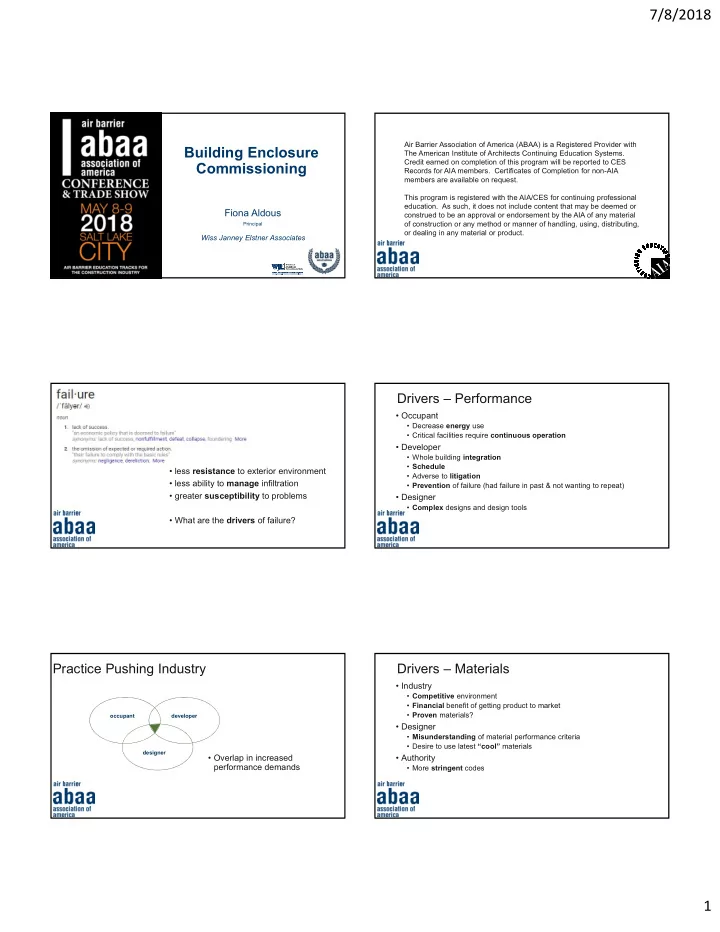
Building Enclosure Commissioning

Fiona Aldous

Principal

Wiss Janney Elstner Associates Air Barrier Association of America (ABAA) is a Registered Provider with The American Institute of Architects Continuing Education Systems. Credit earned on completion of this program will be reported to CES Records for AIA members. Certificates of Completion for non-AIA members are available on request. This program is registered with the AIA/CES for continuing professional

  • education. As such, it does not include content that may be deemed or

construed to be an approval or endorsement by the AIA of any material

  • f construction or any method or manner of handling, using, distributing,
  • r dealing in any material or product.
  • less resistance to exterior environment
  • less ability to manage infiltration
  • greater susceptibility to problems
  • What are the drivers of failure?

Drivers – Performance

  • Occupant
  • Decrease energy use
  • Critical facilities require continuous operation
  • Developer
  • Whole building integration
  • Schedule
  • Adverse to litigation
  • Prevention of failure (had failure in past & not wanting to repeat)
  • Designer
  • Complex designs and design tools

Practice Pushing Industry

  • Overlap in increased

performance demands

  • ccupant

designer developer

Drivers – Materials

  • Industry
  • Competitive environment
  • Financial benefit of getting product to market
  • Proven materials?
  • Designer
  • Misunderstanding of material performance criteria
  • Desire to use latest “cool” materials
  • Authority
  • More stringent codes
slide-2
SLIDE 2

7/8/2018 2

Industry Pushing Practice

  • Overlap in material options

and compliance with Code criteria

designer industry authority

Drivers – Welfare & Durability

  • Occupants / Owners
  • Want healthy environment, without disruptions
  • Want durability and long service
  • Designer
  • Require knowledge
  • Challenged to stay current with multiple facets of buildings
  • Authority
  • Lax enforcement of codes

Lack of Knowledge

  • Disconnect between

Occupants/Owners and Authorities

designer

  • ccupant

authority

Drivers – Liability

  • Designer
  • Pushing responsibility to Contractors (delegation of design)
  • Developer / Owner
  • Cost constraints
  • Alternative project delivery methods
  • Contractor
  • Value engineering of designs
  • Pushing responsibility to Sub-Contractors
  • Purchasing building enclosure design from one Sub-Contractor
  • Sub is responsible for design, coordination, quality, schedule, installation
  • The rise of the specialty subcontractor, engineer of record, design assist

and consultant

Delegated Responsibility

  • Total disconnect

designer developer contractor

slide-3
SLIDE 3

7/8/2018 3

Cause & Effect

  • Slack building codes
  • Low energy costs
  • Budget constraints
  • Performance demands
  • Sustainability goals
  • Knowledge, education or training
  • Errors and omissions
  • Reduce responsibility to reduce liability
  • The rise of the specialist and programs to mitigate failure

Commissioning (Cx)

US Navy

  • The systems and equipment required to transform the new hull into

an operating and habitable warship are installed and tested.

  • The commanding officer and crew report for training of new ship.

Manufacturing

  • A good manufacturing practice (GMP) is a production and testing

practice that helps to ensure a quality product.

  • GMP guidelines are not prescriptive instructions.
  • It is the company's responsibility to determine the most effective

and efficient quality process.

MEP System Cx

  • Quality oriented process for achieving and verifying performance

Cx History

Project Committee, 2006 Joe Deringer, Committee Chair Don Acker Fiona Aldous David Altenhofen, Design Chair Wagdy Anis, Pre-Design Chair Dave Bailey Bill Brodt Paul Brosnahan Brad Carpenter Tim Corbett, Occupancy/Operations Chair David Eakin

  • H. Jay Enck

Walter Grondzik

  • K. Quinn Hart

Earle Kennett Marc LaFrance Dan Lemieux William R. Nash, Construction Chair Andrew Persily Nik Vigener Paul Totten Paul Tseng Thomas Smith Richard Walker Mohammed Ettouney, Liaison, ASCE Charles E. Dorgan, Liaison, NIBS/ASHRAE Guideline 1 Jim Graf/ Lindy Johnston, Liaison, IESNA

BECx 2005 - 2011

  • ASHRAE Guideline 0 – 2005: The Commissioning Process
  • The purpose of this guideline is to describe the Commissioning

Process capable of verifying that the facility and its systems meet the Owner’s Project Requirements.

  • NIBS Guideline 3 – 2006 Exterior Enclosure Technical

Requirements for the Commissioning Process

  • CSA Z320-11 Building Commissioning

2012 - 2018

  • NIBS Guideline 3 – 2012 Building Enclosure Commissioning

Process

  • ASTM E2813-12e1 (2012) Standard Practice for Building

Enclosure Commissioning

  • ANSI/ASHRAE/IES Standard 202-2013 Published Standard:

Commissioning Process for Buildings and Systems

  • ASTM E2947-2016a Standard Guide for BECx
  • WORKING DRAFT - ISO 21105 Building enclosure thermal

performance verification and commissioning

slide-4
SLIDE 4

7/8/2018 4

NIBS Guideline 3 2012 - BECx

“… the process by which the design and constructed performance of building enclosure materials, components, assemblies and systems are validated to meet defined objectives and requirements of the project, as established by the Owner.”

The Guideline 3-2012 Building Enclosure Commissioning Process available at: https://www.wbdg.org/ccb/NIBS/nibs_gl3.pdf

BECx – what it is … and is not

  • Not a party responsible for design or construction
  • Not a guarantee
  • Not expensive relatively speaking (Approx. 0.1% of

project cost!)

  • The Owner’s advocate
  • Is independent (not part of the design or construction

team)

  • Is an advisor
  • Is engaged directly to Owner or through Cx Provider

… focus is on defining project expectations

  • BECx Pre-Design Phase

… focus is on quality assurance

  • BECx Design Phase

… focus switch to quality control & verification

  • BECx Pre-Construction Phase
  • BECx Construction Phase

… focus switch to Owner training & maintenance

  • BECx Occupancy and Operation Phase

BECx Process

The OPR produces a list documenting the requirements against which the Pre-Design, Design and Construction phases are executed.

Owner Project Requirements (OPR) Basis of Design (BOD)

A narrative and analytical document prepared by the design A-E along with design submissions to explain how the Owner's Project Requirements (OPR) are met by the proposed design.

BECx Plan

The Commissioning Plan helps the owner understand the requirements and risks associated with each enclosure system in delivering the anticipated level of performance and the cost and schedule impact of the Commissioning activities.

  • NIBS Guideline 03-2012

Define Expectations Assess Results Document Update

  • Technical review, refine

details

  • Review interactions

between systems

  • Review specifications
  • Finalize project

commissioning plan

  • Draft / Finalize BECx

specification

  • Document
  • Back check

Design Review

slide-5
SLIDE 5

7/8/2018 5

Design: Complex / unique forms; building height Enclosure Assembly: Barrier; drainage/rainscreen; combination of assemblies Building Function and IAQ Requirements: Performance critical facility; multi-family high- rise; high performance Location: coastal/high wind zone, defined by ASCE -7; contaminated ground

Building Enclosure Test Program

Laboratory Test Program Field Test Program Field Test Program

BECx Specification 01 91 19

1.1 WORK INCLUDED Commissioning requirements common to all Building Enclosure-Related Sections. Verification of proper and thorough installation of Building Enclosure components. Documentation of tests, procedures, and installations. Coordination and requirements for field mock-up, trial installation and Performance Testing events. 1.2 GENERAL DESCRIPTION A. Statement of Building Enclosure Design Intent (BEDI): B. Building Enclosure Commissioning (BECx) is the process of ensuring that all building enclosure components are installed and perform collectively according to the BEDI and that the installation is adequately tested and that the specified performance is verified and documented. It serves as a tool to identify deficiencies in the building enclosure during the preconstruction and construction phases in an effort to advance the building enclosure components from mock-up installations, through installation of the separate components on the structure, to a fully integrated, weather-tight assembly prior to occupancy, thereby reducing impact on the building end user.

Pre-Construction Phase

  • Purchasing
  • Review of exclusions and/or

substitutions

  • Performance Mock-Up
  • Lab
  • Field

Construction Phase

  • Safety
  • BECx Kick-off meeting
  • Submittal Reviews
  • Mock-Ups
  • Development &

Refinement of Installation check lists with assistance

  • f trades
  • Individual Trade Pre-con

Meetings

  • Ongoing BECx meetings
  • Construction Observation
  • Performance Tests
  • Documentation

Performance Testing Keep testing real!

No testing for the sake of testing!

slide-6
SLIDE 6

7/8/2018 6

Occupancy Phase

  • Review of Close-out

report

  • Training of the facility

maintenance personnel.

  • Educate the Owner to

properly maintain the building enclosure.

  • Review prior to 12 month

end of warranty period.

  • Lifetime persistence plan
  • Review Current Facility

Requirements (CFR)

BECx success

  • Reduced Risk
  • Proved the system works

at install

  • Gained validity for energy

efficiency claims

  • Improved Durability

BECx dilemma

  • Why isn’t every BE commissioned?
  • Perception
  • Cost prohibitive
  • When do owner’s embrace the Cx

process?

  • When they have experienced failure
  • Proactive / experience
  • Required by LEED or government body
  • Challenges BECx faces moving forward

Every building enclosure is unique Be adaptable to each design & situation Levels of BECx appropriate and determined by Owner

BECx process

Risk Budget

  • Building Type
  • Exposure
  • Design Complexity
  • Team Expertise
  • Certification Program
  • Code / Authority Having

Jurisdiction

  • Owner risk tolerance
  • Cost of loss per square meter of area

repaired

  • Building use or function
  • Area of building envelope
  • Building envelope design complexity
  • Environment
  • Level of innovation and/or performance,

and/or building sustainability goals

  • Owner’s number of prior projects and

bidding requirements

  • Level
  • f
  • wner’s

representatives commitment to the project throughout all phases

  • Schedule
  • Project delivery method
  • Experience and knowledge of contractor
slide-7
SLIDE 7

7/8/2018 7

Team expertise

  • Who is a BECx Provider
  • Technical knowledge
  • Free of fiduciary conflicts
  • Hands-on
  • Retained by Owner
  • Separate from Architect (may be size

limitations where this is acceptable)

  • Separate from Contractor – Design/Build

challenges this scenario

  • The BECx Team
  • Owner, Cx Provider, Architect, Contractor, Subs, Specialty

Subs, Manufacturer’s, AHJ

  • Collaborative

How to retain a BECx Provider

  • How are Cx Providers retained?
  • Request For Qualifications
  • Request For Proposal
  • Invitation
  • Interview
  • SF330
  • Cost
  • Experience
  • Certifications

BECx Provider Education & Certification

University of Wisconsin, Professional Development Program

  • 3 day education based certification
  • On-going education / experience requirements to be met, 5 years following exam
  • BECxP Classes & Certification:

http://epdweb.engr.wisc.edu/Courses/course.lasso?myCourseChoice=N426

  • CxA + BE
  • BECxP

NEBB

  • Certification for building enclosure air testing only
  • Provides both firm and individual certifications
  • Training & exam
  • Experience & education pre-requisites

ASHRAE Building Commissioning Association (BCA) ACG

  • Limited BE educational programs

Others in development

Challenges of certification

  • Commoditization of the industry
  • Who really benefits?
  • What is the value certification brings?
  • Who is really “qualified”
  • Adhesion to industry standards
  • No controlling authority, standardization board, or accrediting

agency to validate that the training and certification have value

  • Vendors are biased toward their own certification and training
  • Become a victim of the initial intent

For better or worse, training and certification is not going to go away IECC 2012 and 2015

Commissioning is a systematic process of verification and documentation that ensures the selected building systems have been designed, installed and function properly and can be maintained in accordance with the contract documents in order to satisfy the building

  • wner’s design intent and operational

requirements.

Cx and Code / AHJ

IECC 2015, Section 408 System Commissioning IECC 2018 – will include a check list of

  • documentation. The preliminary report will

be required in order to obtain C of O

Air barrier code compliance

IECC 2015 Air leakage – thermal envelope (Mandatory)

The thermal envelope shall comply with sections C402.5.1 through .8, or the completed building shall be tested and the air leakage rate of the building envelope shall not exceed 2.0L/(s•m2) @ 75Pa (0.40 cfm/ft2 @ 1.57 psf) per ASTM E779 or equivalent.

Code compliance by design or testing

slide-8
SLIDE 8

7/8/2018 8

  • ASHRAE/ANSI/IES Standard 202-

2013 -- Commissioning Process for Buildings and Systems

  • ICC Committee 1000, Guideline – soon

to be published, will aid AHJ to understand Cx requirements

  • Standard 202 (rev in June ‘18)

anticipated to be basis for new ISO Cx document

Standards

IgCC & 189.1 (to merge in 2018)

ANSI/ASHRAE/USGBC/IES

Standard 189.1-2011

  • Cx for all buildings over 5,000sf
  • Systems include: HVAC, Building Envelope Thermal, Moisture & Pressurization,

Lighting, Irrigation, Plumbing, Renewable Energy, Water & Energy Management

IGCC – 2012

  • Chapter 9: Commissioning, Operation & Maintenance
  • Definition of Cx: A process that verifies and documents that the selected building and the

site systems have been designed, installed and function in accordance with the owner’s project Requirements, construction documents and minimum code requirements.

  • Section 903.1: The Registered Design Professional in responsible charge or approved

agency shall perform commissioning during construction and after occupancy.

  • 903.1 – Construction or system requiring verification:
  • Vegetative Roofs
  • SubSoil Drainage
  • Foundation damp proofing
  • Flashings
  • Exterior Wall coverings

IgCC - 2015

  • 605.1.2.1 Air Barriers – A continuous air

barrier shall be provided for buildings in climate zones 1 through 8.

  • 605.1.2.2 Testing Requirement. Test in

accordance with ASTM E779. Air leakage rate of total area of building thermal envelope shall not exceed 0.25cfm/sf under pressure differential of 0.3-inch water column (1.57psf/sf)

  • Section 903.1: The Registered Design

Professional in responsible charge or approved agency shall perform commissioning during construction and after occupancy.

  • Experience or training shall be

considered relevant where the documented experience or training is related to the complexity of the Cx activities

903.1 – Commissioning Plan

When:

  • By the end of the design development phase, engage a

commissioning authority with the following qualifications:

Who:

  • The CxA must have documented commissioning process

experience on at least two building projects with a similar scope of work. The experience must extend from early design phase through at least 10 months of occupancy;

  • The CxA may be a qualified employee of the owner, an

independent consultant, or a disinterested subcontractor of the design team.

  • For projects smaller than 20,000 square feet (1,860 square meters), the

CxA may be a qualified member of the design or construction team. In all cases, the CxA must report his or her findings directly to the owner.

LEED v4 (adopted October 2016)

Energy & Atmosphere Credit

Who: Qualified Member of Design or Construction Team, not associated with project Same as NC2009, ADDS one Design Review of Building Enclosure Building Enclosure included in OPR and BOD References Cx to be performed per ASHRAE Guidelines 0, 1.1 and Guideline 3, 2012

LEED v4 Fundamental Cx - Energy & Atmosphere Credit

LEED v4 Enhanced Cx - Energy & Atmosphere Credit

Who: Independent CxA (may be a qualified employee of

  • wner, or disinterested subcontractor of the design team)

BECx 2 points, MBCx 1 point References BECx to be performed per ASHRAE Guidelines 0, 1.1 and Guideline 3, 2012

CxA prepares a CFR & O&M Plan (including training in CDs) CxA develops on-going Cx Plan CxA documents Operator and Occupant training delivery & effectiveness

slide-9
SLIDE 9

7/8/2018 9

Challenges of BECx as viewed by LEED

  • Poorly defined BECx scope in LEED V4
  • Lack of understanding from Owner as to what is difference between

Fundamental & Enhanced Cx, or how LEED status is achieved

  • RFP’s purchasing Cx services don’t outline scope of work for BECx
  • Heavy reliance upon industry to honestly implement G’line 3
  • BECx Providers “under scoping” BECx tasks to win jobs
  • No auditing by LEED to verify BECx met G’line 3
  • Most Cx Providers don’t know that Fundamental now includes BE –

simply ignore this component or attempt to self-perform

Value of BECx

  • OPR
  • Design review
  • Construction observation
  • Performance testing
  • Submittal review

knowledge experience

Specific air barrier experience

It’s not necessarily a vapor barrier …the terms are not interchangeable! Air barrier will control the passage of air from/between spaces …more than one? ASTM E2178 (CAN/ULC-S741) ASTM E2357 (CAN/ULC-S742)

standard

Air infiltration & exfiltration

  • major cause of rain penetration
  • uncontrolled, untreated infiltrating air
  • waste energy, increased condensation

& envelope deterioration

  • limits transfer of noise, odor, fire and

smoke

  • disrupts ability to control indoor

humidity

  • disrupts interior HVAC design

pressures (comfort, infection control and IAQ problems)

Straube, High Performance Buildings

Exterior air barrier assembly

The air barrier can be located anywhere in the enclosure assembly On the warm side, it can be a combination air and vapor barrier If it is located on the cold side, it should have a permeance at least 10 times the permeance of the vapor barrier

Building Science Corp, Lstiburek

Air barrier commissioning (Cx)

Achieving the owner’s air barrier expectations

  • ASHRAE
  • 0.1cfm/sf at 1.57psf – “tight”
  • 0.25cfm/sf at 1.57psf – “average”
  • 0.6cfm/sf at 75Pa – “leaky”
  • USACE - 0.25cfm/sf at 1.57psf
  • GSA – 0.4cfm/sf at 1.57psf
  • IECC 2015 - 0.4cfm/sf at 1.57psf
  • IgCC 2015 - 0.25cfm/sf at 1.57psf
  • DOE Building America – 0.25cfm/sf at

50Pa

slide-10
SLIDE 10

7/8/2018 10

Pre-Design Phase - air barrier Cx

Owners Project Requirements (OPR) BECx Plan Basis of Design

"Air/Moisture Barrier. Provide connections to prevent air leakage, moisture infiltration (and vapor migration as applicable) at the following locations:

  • Foundation and walls, including penetrations, ties and

anchors.

  • Walls, windows, curtain walls, storefronts, louvers or

doors.

  • Different wall assemblies and fixed openings within

those assemblies.

  • Wall and roof connections and penetrations.
  • Floors over unconditioned space.
  • Walls, floor and roof across construction, control and

expansion joints.

  • Walls, floors and roof to utility, pipe and duct

penetrations.

  • Seismic and expansion joints.
  • All other leakage pathways in the building enclosure.“

Coordinate air barrier criteria with mechanical system design

Design Phase - air barrier Cx

Design Review BECx specification

  • Incorporate project specific air

barrier into Cx process - adapt as necessary

  • Determine extent to which

each task will be performed

  • Testing matrix

"Assembly shall perform as a liquid drainage plane flashed to discharge condensation or water penetration to the exterior. Assembly shall accommodate movements of building materials by providing expansion and control joints as required, with accessory air and vapor seal materials at such locations, changes in substrate and perimeter conditions. The assembly shall:

  • be capable of withstanding combined positive and

negative design wind, fan and stack pressures on the enclosure without damage or displacement, and shall transfer the load to the structure.

  • not displace adjacent materials under full load.
  • be joined in an airtight and flexible manner to the air

barrier material of adjacent assemblies, allowing for the relative movement of assemblies due to thermal and moisture variations and creep, and anticipated seismic

  • movement. "

material: air leakage of the air barrier may not exceed 0.02 l/m²·s @75 Pa (0.004 cfm of air per ft² at a pressure difference of 0.3 inches of water 1.57 psf) per ASTM E2178 ….which equates to the air permeance of ½ inch thick drywall assembly: air leakage of the air barrier assembly may not exceed 0.2L/(s•m2) @ 75Pa. (0.04 cfm/ft2 @ 1.57 psf) test combines the primary air barrier material with supporting air barrier accessories such as transition membranes and sealants to form a complete air barrier assembly per ASTM E2357

Define Specify

  • one air barrier section in division 1
  • mock-up – perform testing
  • transitions to windows responsibility of window sub
  • transitions to roof and waterproofing responsibility of air barrier sub
  • air barrier association of america (abaa) specifications, guidelines & test

protocols

  • abaa quality assurance program (qap)
  • site observations
  • commissioning & verification
  • testing

Every building is unique, however field quality control usually approach the building enclosure in the same manner. Test!

Verify Contract documents

  • provide air barrier details
  • air barrier division 1 section
  • include certified and experienced installers
  • coordinate air barrier with building enclosure and interior air barrier

sections

  • include ABAA quality assurance program
  • specify mock-ups and testing of mock-up prior to cladding
  • field testing (additional tests if failure occurs, who pays)
  • provide for alternates (as applicable)
  • GC to include dedicated building enclosure superintendent
  • air barrier testing and commissioning
slide-11
SLIDE 11

7/8/2018 11

Scope of Work Package review Bid review Mock-Up and testing

Pre-Construction Phase - air barrier Cx Mock-Up test of Opaque Wall Air Tightness

0.04 cfm / ft2 at 1.57psf when tested in accordance with ASTM E283 Standard Test Method for Determining Rate of Air Leakage Through Exterior Windows, Curtain Walls, and Doors Under Specified Pressure Differences Across the Specimen. ASTM E1186 Standard Practices for Air leakage site detection in Building Envelopes and Air Barrier Systems

Submittal Reviews Checklists Construction Observation Observation Schedule Testing Schedule Field Verification System tests: Level 1 Field Verification System tests: Level 2 Field Verification System tests: Level 3 BE System Maintenance Manual BECx Report

Construction Phase - air barrier Cx Construction observation

  • informs the

design & review process

  • experience

material

substrate

  • moisture

content

slide-12
SLIDE 12

7/8/2018 12

substrate

  • moisture

content

substrate

  • primers
  • terminations

substrate

  • termination

substrate

  • preparation

substrate

  • damage

substrate

  • compatibility
slide-13
SLIDE 13

7/8/2018 13

substrate

  • porosity

substrate

  • movement

substrate

  • movement

application

  • adhesion

application

  • adhesion

transition

  • interruption
slide-14
SLIDE 14

7/8/2018 14

transition

  • interruption

penetrations

  • cladding

attachment

  • cladding

support

penetrations

  • permeability

penetrations

  • fasteners
  • adhesion

penetrations

  • attachment

penetrations

  • construct-

ability

slide-15
SLIDE 15

7/8/2018 15

interface

  • adjacent

substrates

interface interface

  • compatibility

interface

  • redundancy

interface

  • isolation

separation

  • isolation
slide-16
SLIDE 16

7/8/2018 16

field air barrier tests

ASTM E1186-17 Standard Practices for Air leakage site detection in Building Envelopes and Air Barrier Systems (7 practices for detecting air leakage) ASTM E779-10 Standard Test Method for Determining Air Leakage Rate by Fan Pressurization ASTM E1105-15 Standard Test Method for Field Determination of Water Penetration of Installed Exterior Windows, Skylights, Doors, and Curtain Walls, by Uniform or Cyclic Static Air Pressure Difference AAMA 501.2 Quality Assurance and Diagnostic Water Leakage Field Check of Installed Storefronts, Curtain Walls, and Sloped Glazing Systems ASTM C1060-11a(2015) Standard Practice for Thermographic Inspection of Insulation Installations in Envelope Cavities of Frame Buildings

aama 501.2 / e1105 e1105

e1186 - 1 Thermographic Survey

e1186 - 2 Smoke tracer e1186 - 2 Theatrical fog

slide-17
SLIDE 17

7/8/2018 17

e1186 - 6 e1186 - 7 e1186 - 7 E1186 - 7 d4541

Typical 16psi for air barrier materials – each manufacturer may be different

c1521 e1827 / e779

ASTM E1827 Standard Test Methods for Determining Airtightness of Buildings Using an Orifice Blower Door ASTM E779 Determining Airtightness

  • f Buildings Air Leakage Rate by

Single Zone Air Pressurization

slide-18
SLIDE 18

7/8/2018 18

  • Report and track field action

items

  • Document test locations
  • Building Enclosure Cx Report

Action Item No. 38 System Reviewed: Waterproofing Date: 23 May 2008 Area Reviewed: NW Reentrant Corner (Column Line C: 1 to 3 and Column Line 3: A to C), Ground Floor Weather: 60 Deg F / Mostly Cloudy WJE Rep: MK Present: GC (DB & JM) Description: WJE observed unprotected waterproofing membrane that included the following deficiencies: 1) large pockets of water beneath the waterproofing membrane; 2) tears at slab edge transitions along the perimeter of the first floor slab; 3) exposure to excessive debris including welding rods, miscellaneous metals (some partially melted into the waterproofing membrane), and concrete debris. It is important to note that the large pockets of water observed beneath the waterproof membrane currently appear to be isolated to areas outboard of the precast concrete panels. WJE continues to recommend that all exposed waterproofing membrane is protected from on-going work in these and adjacent

  • areas. GC to confirm that these deficiencies are repaired and that protection will

be provided.

Documentation Action Item Log

…air barrier and PVC roofing membrane are in contact The incompatible materials should be separated similar to previous detailing.

Close Out Report

Facility Engineer Training Requirements Warranty Review Monitoring / On-Going Commissioning

Current Facility Requirements (CFR) Plan

Occupancy Phase - air barrier Cx Facility Engineer Training

  • BECxP train facility

maintenance personnel. Verify operators understand the building

  • peration and how O&M

activities affects its performance

  • Implementation of on-

going BECx process (measurement and verification plan)

Warranty Review

  • Perform pre-expiration of

warranty review at approx. 10 month post completion

  • Perform visual review and

diagnostic testing if concerns are noted

  • Evaluate operator

maintenance practices

  • Back check open items

remaining from construction phase

slide-19
SLIDE 19

7/8/2018 19

Fiona Aldous

Principal

faldous@wje.com Phone: +1 703 297 1909 www.wje.com

Experience is the teacher of all things.

Julius Caesar