7/2/2014 Established 1959 1959 Comprehensive Approach: Housing, - - PDF document

7 2 2014
SMART_READER_LITE
LIVE PREVIEW

7/2/2014 Established 1959 1959 Comprehensive Approach: Housing, - - PDF document

7/2/2014 Established 1959 1959 Comprehensive Approach: Housing, Employment, Recovery Served annually 6700+ Million budget $65 $65 Staff 1100+ 70% 70% Services Delivered in Community Units of Housing Managed by Thresholds 1500


slide-1
SLIDE 1

7/2/2014 1

Serving Chicago Metro area, Kankakee, and McHenry Counties

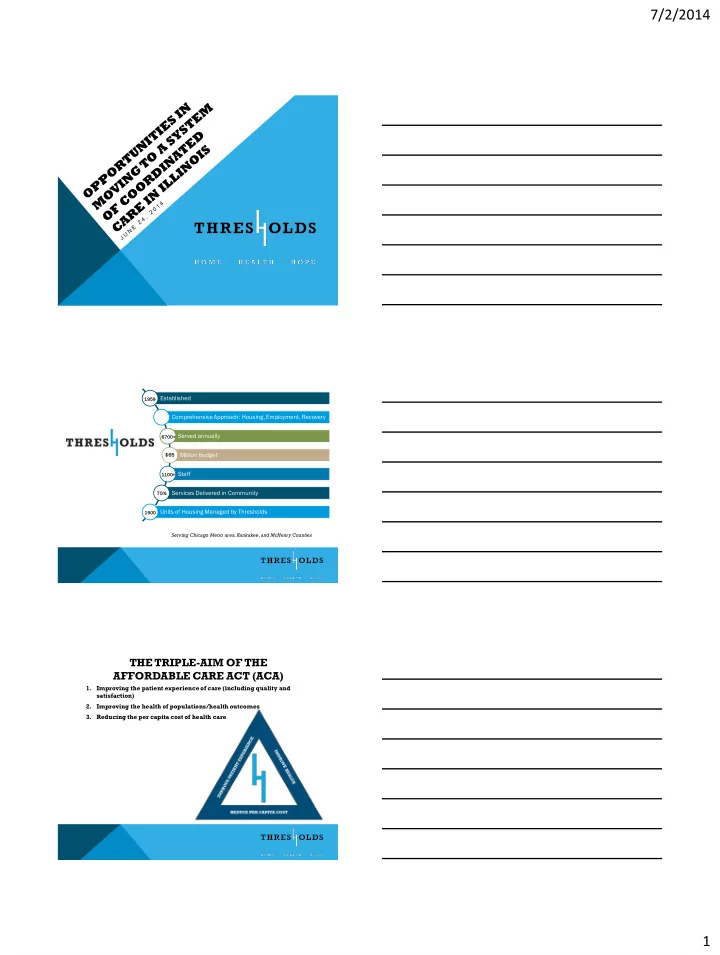
Established Comprehensive Approach: Housing, Employment, Recovery Served annually Million budget Staff Services Delivered in Community Units of Housing Managed by Thresholds

1959 1959 6700+ $65 $65 1100+ 70% 70% 1500

THE TRIPLE-AIM OF THE AFFORDABLE CARE ACT (ACA)

  • 1. Improving the patient experience of care (including quality and

satisfaction)

  • 2. Improving the health of populations/health outcomes
  • 3. Reducing the per capita cost of health care
slide-2
SLIDE 2

7/2/2014 2

FEE-FOR-SERVICE PAYMENT MODEL INCENTIVES VOLUME OVER OUTCOMES

  • 1. The historic payment structure of Medicaid – Fee for Service (FFS) –

incentivizes the wrong behavior: volume rather than good health

  • utcomes.
  • 2. Restrictive FFS billing rules inhibit care delivery.
  • 3. Health outcomes are irrelevant under FFS.
  • 4. The ACA and the triple aim moves the health care system to an
  • utcomes-based system.

SERIOUS MENTAL ILLNESS (SMI) POPULATION

C H A L L E N G E S T O T H E S Y S T E M

  • Between 2009-2012, hospital ER visits

for psychiatric/substance abuse crisis in Illinois increased by 19%—more than 35,000 additional visits—12% higher than other medical ER visits.

This cost Illinois $71.5 million.

ILLINOIS AND MEDICAID REFORM

M E D I C A I D R E D E S I G N I N L I N E W I T H T H E A C A

  • P.A. 96-1501 requires 50% of Medicaid enrollees to be in a system of coordinated

care by 2015. (An integrated delivery system that includes primary care, diagnostic and treatment services, behavioral health care, hospital services and long-term care).

  • A patient-centered system with a focus in improved health outcomes.
  • Breaking down system, state and provider silos. Partnerships are key.
  • Multiple provider models being tested rather than only the MCO model.
  • Medicaid Expansion implementation: Over 350,000 new enrollees to date, many
  • f whom have significant mental and behavioral health needs. Pursuit of 1115

Medicaid Waiver.

slide-3
SLIDE 3

7/2/2014 3

Ca Seniors and Persons with Disabilities (SPD) - in mandatory managed care regions Children with complex health needs (CCEs)

  • Statewide (growth based
  • n capacity)

JUL 2014 * Integrated Care Program (ICP) Demo Area – Suburban Cook/Collar MAY 2011 6 awarded (4 in Chicago area, 2 downstate) and additional projects statewide as they become available Medicare Medicaid Alignment Initiative (MMAI) MAR 2014 - voluntary enrollment JUN 2014 - mandatory enrollment Mandatory Managed Care Expansion Rockford (Aetna, IlliniCare, CCAI) JUL 2013 (SP 1 and 2) Central IL (Molina, Meridian, Health Alliance, Macon County CCE) SEP 2013 (SP 1 and 2) Metro East (Molina, Meridian) SEP 2013 (SP 1 and 2) Quad Cities (IlliniCare, Precedence CCE) NOV 2013 (SP 1 and 2) Chicago (Greater Chicago MMAI plans & CCAI) Expand to - Cook – MAR 2014 Collar – JUL 2014 CCEs (5) 1) Be Well Partners in Health (Chicago area) - FEB 2014 2) EntireCare- Healthcare Consortium

  • f Illinois (Chicago area)
  • FEB 2014

3) My Health Care Coordination-Macon County (down state) - SEP 2013 4) Precedence Care Coordination (down state) - OCT 2013 5) Together4Health (Chicago area) – FEB 2014 MCCNs (1) Community Care Alliance of Illinois (CCAI) = Subsidiary of Family Health Network Rockford -JUL 2013 Chicago only – MAR 2014 Collar Counties – JUL 2014

Care Coordination Roll-Out by Health Plans

Children/family and caregivers – in mandatory managed care regions JUL 2014 MCO s Greater Chicago Area: Aetna Better Health Illinicare Health Plan Meridian Health Plan of Illinois HealthSpring of Illinois Humana Health Plan Blue Cross/Blue Shield of Illinois Central Illinois: Molina Healthcare Health Alliance Medical Plans Types of managed care entities: MCOs – Accepting full-risk capitation payments MCCNs – Provider-organized entities accepting full-risk capitation payments CCEs – Provider-organized networks providing care coordination ACEs – Provider-organized entities on a 3 year path to full-risk capitation payments Newly eligible adults under ACA (Adults 19-64) – in mandatory managed care regions JAN 2014 – All counties except Cook Illinois Health Connect (IHC) Primary Care Case Management (PCCM) program

  • outside mandatory

managed care regions Medical Home Network (MHN) Targeted start dates in red bold March 2014 Managed Long Term Supports & Services (MLTSS) – All MMAI Plans Accountable Care Entities (some to begin JUL 2014) MCOs Same regions as ICP, same MCOs as MMAI, plus Harmony and Family Health Network (FHN) County Care (Cook County

  • nly)

Cook County Waiver - First Enrollment - NOV 2012 JUN 2014 County Care MCCN: JUL 2014 (May serve SPD & children/families) * CCMN/CCEs Lurie Children’s CCE La Rabida CCE OSF CCE

OPPORTUNITIES FOR PROVIDERS IN MOVING TO AN OUTCOMES-BASED PAYMENT MODEL

  • 1. Flexibility in service delivery aimed at achieving good health and

mental health outcomes for clients.

  • 2. Innovation in service delivery.
  • 3. Getting out from under restrictive FFS rules.

CASE STUDY: ILLINICARE PILOT

This partnership between Thresholds and IlliniCare brought together community-based mental healthcare with high-cost insurance users. Thresholds proposed to utilize our extensive experience in community-based care and wraparound services to help reduce costs for 50 of IlliniCare’s highest-cost users with a diagnosis of serious mental illness. By paying Thresholds a flat per-user rate that was below the average pre-pilot cost, IlliniCare received guarenteed cost savings, while Thresholds had a guaranteed rate and high motivation to both improve health outcomes and significantly reduce costs. This pilot project’s stellar initial outcomes was featured in May 2014 at the National Council for Behavioral Health Conference in Washington, D.C.

+
slide-4
SLIDE 4

7/2/2014 4

THE THRESHOLDS/ILLINICARE/CENP ATICO PILOT

O V E R V I E W

HOW THE PILOT CAME ABOUT

Both Illinicare and Thresholds were looking Development of the partnership

12

What Payers Want to Know

  • How will you help solve our problem?
  • Use of Evidence Based Practices
  • How do you measure outcomes?
  • Client satisfaction
  • Readmissions
  • How do you know someone is ready to leave

care?

  • HEDIS scores (7 day follow up)
  • Integration between medical and behavioral
  • Internal monitoring of utilization management
slide-5
SLIDE 5

7/2/2014 5

13

What Providers Want to Know

  • What are the payer’s business problems?
  • Will the payer share data?
  • How big a priority is this?
  • Invested in the collaboration?
  • Are they moving toward a shared risk mindset?
  • How much do they care about the lives of the

people in their plans?

  • Will the payer consider alternate payment

arrangements?

RUTHIE’S STORY IMPACT ON PEOPLE’S LIVES

Housing was key Connection to family Linked to psychiatry (telepsychiatry) Connected with primary care A few were employed Not 100% success, but outcomes overall were very good

slide-6
SLIDE 6

7/2/2014 6

OUTCOME DATA

  • 50% reduction in behavioral health admissions
  • 55% reduction in 30 day readmissions
  • 58% reduction in 90 day readmissions
  • 63% reduction in costs for behavioral health inpatient (with 12 months

in pilot)

  • Optimistic about future: 69.2% 92.3%
  • Contact with friends 61.5% 80.8%
  • Living independently 42.3% 57.7%

#NatCon14

17

CONTACT INFORMATION

Heather O’Donnell

Vice President, Public Policy and Advocacy hodonnell@thresholds.org (773) 572-5438

Debra Howard-Frye

Associate Director, Chief Clinical Officer debra.howard-frye@thresholds.org (773) 572-5401