
SLIDE 1
1
Google File System
CSE 454
From paper by Ghemawat, Gobioff & Leung
The Need
- Component failures normal
– Due to clustered computing
- Files are huge
– By traditional standards (many TB)
- Most mutations are mutations
– Not random access overwrite
- Co-Designing apps & file system
- Typical: 1000 nodes & 300 TB
Desiderata
- Must monitor & recover from comp failures
- Modest number of large files
- Workload
– Large streaming reads + small random reads – Many large sequential writes
- Random access overwrites don’t need to be efficient
- Need semantics for concurrent appends
- High sustained bandwidth
– More important than low latency
Interface
- Familiar
– Create, delete, open, close, read, write
- Novel
– Snapshot
- Low cost
– Record append
- Atomicity with multiple concurrent writes
Architecture
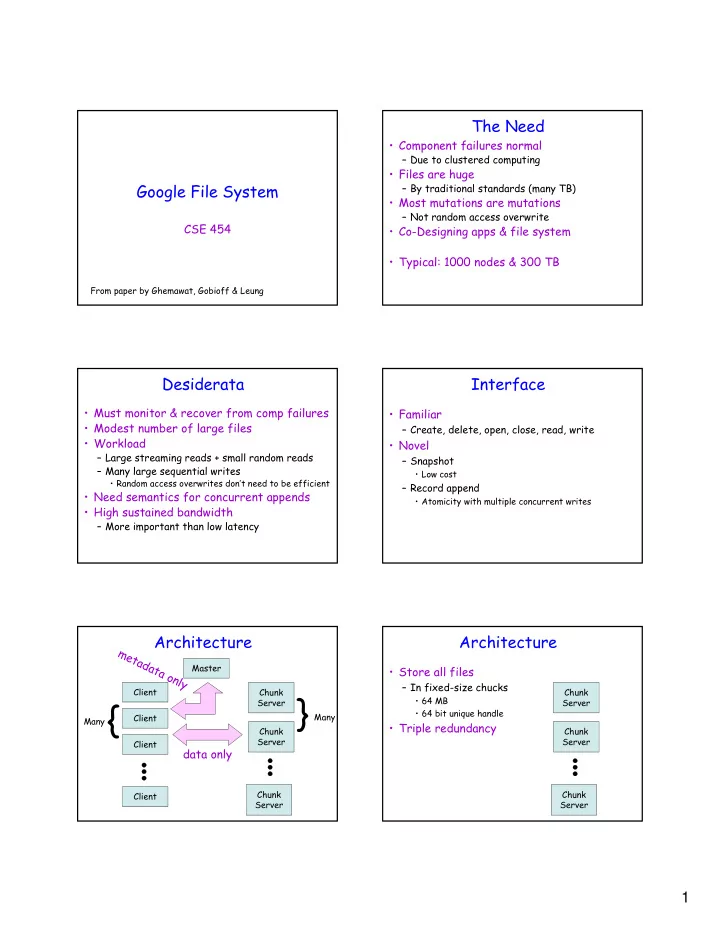
Client Client Client Client Master Many Many
{
Chunk Server Chunk Server Chunk Server
}
metadata only data only
Architecture
- Store all files
– In fixed-size chucks
- 64 MB
- 64 bit unique handle
- Triple redundancy