61A Lecture 27 Friday, November 8 2 Dynamic Scope The way in which - - PDF document

61a lecture 27
SMART_READER_LITE
LIVE PREVIEW

61A Lecture 27 Friday, November 8 2 Dynamic Scope The way in which - - PDF document

Announcements Homework 8 due Tuesday 11/12 @ 11:59pm, and it's in Scheme! Project 4 due Thursday 11/21 @ 11:59pm, and it's a Scheme interpreter! Also, the project is very long. Get started today. 61A Lecture 27 Friday, November 8 2


slide-1
SLIDE 1

61A Lecture 27

Friday, November 8

Announcements

  • Homework 8 due Tuesday 11/12 @ 11:59pm, and it's in Scheme!
  • Project 4 due Thursday 11/21 @ 11:59pm, and it's a Scheme interpreter!
  • Also, the project is very long. Get started today.
2

Dynamic Scope

Dynamic Scope

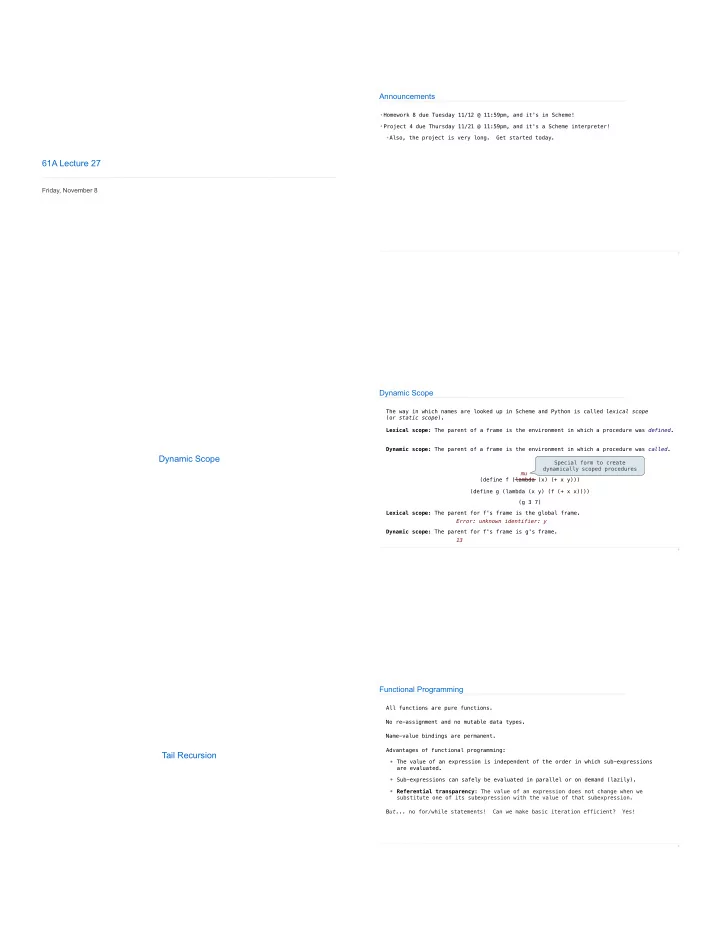
The way in which names are looked up in Scheme and Python is called lexical scope (or static scope). Lexical scope: The parent of a frame is the environment in which a procedure was defined. Dynamic scope: The parent of a frame is the environment in which a procedure was called. (define f (lambda (x) (+ x y))) (define g (lambda (x y) (f (+ x x)))) (g 3 7) Lexical scope: The parent for f's frame is the global frame. Dynamic scope: The parent for f's frame is g's frame. Error: unknown identifier: y 13 mu Special form to create dynamically scoped procedures

4

Tail Recursion

Functional Programming

All functions are pure functions. No re-assignment and no mutable data types. Name-value bindings are permanent. Advantages of functional programming:

  • The value of an expression is independent of the order in which sub-expressions

are evaluated.

  • Sub-expressions can safely be evaluated in parallel or on demand (lazily).
  • Referential transparency: The value of an expression does not change when we

substitute one of its subexpression with the value of that subexpression. But... no for/while statements! Can we make basic iteration efficient? Yes!

6
slide-2
SLIDE 2

Θ(1) Recursion and Iteration in Python

Time Space def factorial(n, k): if n == 0: return k else: return factorial(n-1, k*n) def factorial(n, k): while n > 0: n, k = n-1, k*n return k

Θ(n) Θ(n) Θ(n)

In Python, recursive calls always create new active frames. factorial(n, k) computes: k * n!

7

Tail Recursion

From the Revised7 Report on the Algorithmic Language Scheme: "Implementations of Scheme are required to be properly tail-recursive. This allows the execution of an iterative computation in constant space, even if the iterative computation is described by a syntactically recursive procedure." (define (factorial n k) (if (zero? n) k (factorial (- n 1) (* k n)))) def factorial(n, k): while n > 0: n, k = n-1, k*n return k How? Eliminate the middleman!

8

Should use resources like

Θ(1)

Time Space

Θ(n)

(Demo)

http://goo.gl/tu9sJW

Tail Calls

(define (factorial n k) (if (= n 0) k (factorial (- n 1) (* k n)) ) )

Tail Calls

A procedure call that has not yet returned is active. Some procedure calls are tail

  • calls. A Scheme interpreter should support an unbounded number of active tail calls

using only a constant amount of space. A tail call is a call expression in a tail context:

  • The last body sub-expression in a lambda expression
  • Sub-expressions 2 & 3 in a tail context if expression
  • All non-predicate sub-expressions in a tail context cond
  • The last sub-expression in a tail context and or or
  • The last sub-expression in a tail context begin
10

Example: Length of a List

A call expression is not a tail call if more computation is still required in the calling procedure. Linear recursive procedures can often be re-written to use tail calls.

11

(define (length s) (if (null? s) 0 (+ 1 (length (cdr s)) ) ) ) Not a tail context (define (length-tail s) (define (length-iter s n) (if (null? s) n (length-iter (cdr s) (+ 1 n)) ) ) (length-iter s 0) ) Recursive call is a tail call

Eval with Tail Call Optimization

The return value of the tail call is the return value of the current procedure call. Therefore, tail calls shouldn't increase the environment size.

12

(Demo)

slide-3
SLIDE 3

Tail Recursion Examples

Which Procedures are Tail Recursive?

14

Which of the following procedures run in constant space?

Θ(1)

;; Compute the length of s. (define (length s) (+ 1 (if (null? s)

  • 1

(length (cdr s))) ) ) ;; Return the nth Fibonacci number. (define (fib n) (define (fib-iter current k) (if (= k n) current (fib-iter (+ current (fib (- k 1))) (+ k 1)) ) ) (if (= 1 n) 0 (fib-iter 1 2))) ;; Return whether s contains v. (define (contains s v) (if (null? s) false (if (= v (car s)) true (contains (cdr s) v)))) ;; Return whether s has any repeated elements. (define (has-repeat s) (if (null? s) false (if (contains? (cdr s) (car s)) true (has-repeat (cdr s))) ) )

Map and Reduce

Example: Reduce

(define (reduce procedure s start) (if (null? s) start (reduce procedure (cdr s) (procedure start (car s)) ) ) ) Recursive call is a tail call. Other calls are not; constant space depends on whether procedure requires constant space. (reduce * '(3 4 5) 2) 120 (reduce (lambda (x y) (cons y x)) '(3 4 5) '(2)) (5 4 3 2)

16

Example: Map with Only a Constant Number of Frames

(define (map procedure s) (define (map-reverse s m) (if (null? s) m (map-reverse (cdr s) (cons (procedure (car s)) m)))) (reverse (map-reverse s nil))) (define (reverse s) (define (reverse-iter s r) (if (null? s) r (reverse-iter (cdr s) (cons (car s) r)))) (reverse-iter s nil))

17

(define (map procedure s) (if (null? s) nil (cons (procedure (car s)) (map procedure (cdr s)))))

1 Pair 2 Pair nil s s s 4 Pair 3 Pair

(map (lambda (x) (- 5 x)) (list 1 2))

General Computing Machines

slide-4
SLIDE 4

An Analogy: Programs Define Machines

Programs specify the logic of a computational device factorial 5 120 =

  • factorial

* 1 1 1

19

Interpreters are General Computing Machine

An interpreter can be parameterized to simulate any machine Scheme Interpreter 5 120

(define (factorial n) (if (zero? n) 1 (* n (factorial (- n 1)))))

Our Scheme interpreter is a universal machine A bridge between the data objects that are manipulated by our programming language and the programming language itself Internally, it is just a set of evaluation rules

20