
SLIDE 1
61A Lecture 26
Wednesday, November 6
Announcements
- Project 1 composition revisions due Thursday 11/7 @ 11:59pm.
- Homework 8 due Tuesday 11/12 @ 11:59pm, and it's in Scheme!
- Project 4 due Thursday 11/21 @ 11:59pm, and it's a Scheme interpreter!
- New Policy: An improved final exam score can make up for low midterm scores.
- If you scored less than 60/100 midterm points total, then you can earn some points back.
- You don't need a perfect score on the final to do so.
Interpreting Scheme
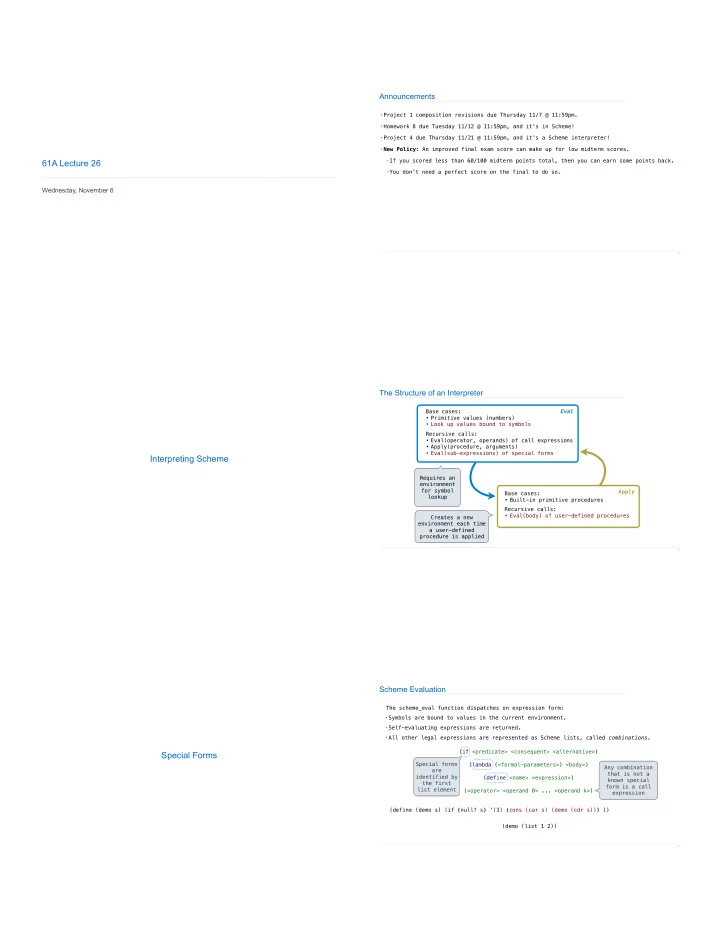
The Structure of an Interpreter
4Apply Eval Recursive calls:
- Eval(operator, operands) of call expressions
- Apply(procedure, arguments)
- Eval(sub-expressions) of special forms
Base cases:
- Primitive values (numbers)
- Look up values bound to symbols
Base cases:
- Built-in primitive procedures
Recursive calls:
- Eval(body) of user-defined procedures
Requires an environment for symbol lookup Creates a new environment each time a user-defined procedure is applied
Special Forms
Scheme Evaluation
The scheme_eval function dispatches on expression form:
- Symbols are bound to values in the current environment.
- Self-evaluating expressions are returned.
- All other legal expressions are represented as Scheme lists, called combinations.
(if <predicate> <consequent> <alternative>) (define <name> <expression>) (lambda (<formal-parameters>) <body>) (<operator> <operand 0> ... <operand k>) Special forms are identified by the first list element Any combination that is not a known special form is a call expression (define (demo s) (if (null? s) '(3) (cons (car s) (demo (cdr s))) )) (demo (list 1 2))
6