Announcements Scheme Scheme is a Dialect of Lisp What are people - - PDF document

announcements scheme
SMART_READER_LITE
LIVE PREVIEW

Announcements Scheme Scheme is a Dialect of Lisp What are people - - PDF document

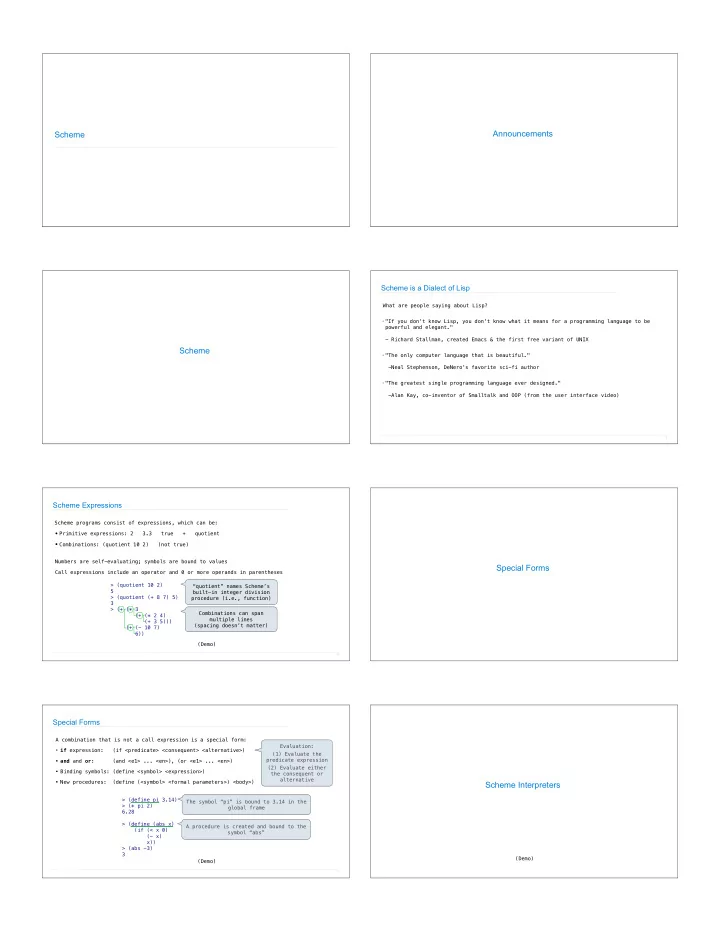
Announcements Scheme Scheme is a Dialect of Lisp What are people saying about Lisp? "If you don't know Lisp, you don't know what it means for a programming language to be powerful and elegant." - Richard Stallman, created Emacs


slide-1
SLIDE 1

Scheme Announcements Scheme

Scheme is a Dialect of Lisp

What are people saying about Lisp?

  • "If you don't know Lisp, you don't know what it means for a programming language to be

powerful and elegant."

  • Richard Stallman, created Emacs & the first free variant of UNIX
  • "The only computer language that is beautiful."
  • Neal Stephenson, DeNero's favorite sci-fi author
  • "The greatest single programming language ever designed."
  • Alan Kay, co-inventor of Smalltalk and OOP (from the user interface video)
4

Scheme Expressions

Scheme programs consist of expressions, which can be:

  • Primitive expressions: 2 3.3 true + quotient
  • Combinations: (quotient 10 2) (not true)

Numbers are self-evaluating; symbols are bound to values Call expressions include an operator and 0 or more operands in parentheses (Demo)

5

> (quotient 10 2) 5 > (quotient (+ 8 7) 5) 3 > (+ (* 3 (+ (* 2 4) (+ 3 5))) (+ (- 10 7) 6)) “quotient” names Scheme’s built-in integer division procedure (i.e., function) Combinations can span multiple lines (spacing doesn’t matter)

Special Forms

Special Forms

A combination that is not a call expression is a special form:

  • if expression: (if <predicate> <consequent> <alternative>)
  • and and or: (and <e1> ... <en>), (or <e1> ... <en>)
  • Binding symbols: (define <symbol> <expression>)
  • New procedures: (define (<symbol> <formal parameters>) <body>)

> (define pi 3.14) > (* pi 2) 6.28 > (define (abs x) (if (< x 0) (- x) x)) > (abs -3) 3 The symbol “pi” is bound to 3.14 in the global frame A procedure is created and bound to the symbol “abs”

7

Evaluation: (1) Evaluate the predicate expression (2) Evaluate either the consequent or alternative (Demo)

Scheme Interpreters

(Demo)

slide-2
SLIDE 2

Lambda Expressions

Lambda Expressions

Lambda expressions evaluate to anonymous procedures

λ

(lambda (<formal-parameters>) <body>) Two equivalent expressions: (define (plus4 x) (+ x 4)) (define plus4 (lambda (x) (+ x 4))) An operator can be a call expression too: ((lambda (x y z) (+ x y (square z))) 1 2 3) Evaluates to the x+y+z2 procedure

10

12

Sierpinski's Triangle

(Demo)

More Special Forms

Cond & Begin

The cond special form that behaves like if-elif-else statements in Python

13

if x > 10: print('big') elif x > 5: print('medium') else: print('small') (cond ((> x 10) (print 'big)) ((> x 5) (print 'medium)) (else (print 'small))) (cond ((> x 10) 'big) ((> x 5) 'medium) (else 'small)) (print ) The begin special form combines multiple expressions into one expression if x > 10: print('big') print('guy') else: print('small') print('fry') (cond ((> x 10) (begin (print 'big) (print 'guy))) (else (begin (print 'small) (print 'fry)))) (if (> x 10) (begin (print 'big) (print 'guy)) (begin (print 'small) (print 'fry)))

Let Expressions

The let special form binds symbols to values temporarily; just for one expression

14

a = 3 b = 2 + 2 c = math.sqrt(a * a + b * b) (define c (let ((a 3) (b (+ 2 2))) (sqrt (+ (* a a) (* b b))))) a and b are still bound down here a and b are not bound down here

Lists

Scheme Lists

In the late 1950s, computer scientists used confusing names

  • cons: Two-argument procedure that creates a linked list
  • car: Procedure that returns the first element of a list
  • cdr: Procedure that returns the rest of a list
  • nil: The empty list

Important! Scheme lists are written in parentheses with elements separated by spaces > (1 2) > (define x (cons 1 (cons 2 nil)) > x (1 2) > (car x) 1 > (cdr x) (2) > (cons 1 (cons 2 (cons 3 (cons 4 nil)))) (1 2 3 4) (Demo) 2 (cons 1 ) (cons 2 nil) 1 (cons 2 nil) 2 nil 1 2 3 4 2

slide-3
SLIDE 3

Symbolic Programming

Symbolic Programming

Symbols normally refer to values; how do we refer to symbols? > (define a 1) > (define b 2) > (list a b) (1 2) Quotation is used to refer to symbols directly in Lisp. No sign of “a” and “b” in the resulting value > (list 'a 'b) (a b) > (list 'a b) (a 2) Quotation can also be applied to combinations to form lists. > '(a b c) (a b c) > (car '(a b c)) a > (cdr '(a b c)) (b c) Short for (quote a), (quote b): Special form to indicate that the expression itself is the value.

18

(Demo)

Programs as Data

A Scheme Expression is a Scheme List

Scheme programs consist of expressions, which can be:

  • Primitive expressions: 2 3.3 true + quotient
  • Combinations: (quotient 10 2) (not true)
20

scm> (list 'quotient 10 2) (quotient 10 2) scm> (eval (list 'quotient 10 2)) 5 (Demo) The built-in Scheme list data structure (which is a linked list) can represent combinations In such a language, it is straightforward to write a program that writes a program

Generating Code

Quasiquotation

There are two ways to quote an expression Quote: '(a b) => (a b) Quasiquote: `(a b) => (a b) They are different because parts of a quasiquoted expression can be unquoted with , (define b 4) Quote: '(a ,(+ b 1)) => (a (unquote (+ b 1)) Quasiquote: `(a ,(+ b 1)) => (a 5) Quasiquotation is particularly convenient for generating Scheme expressions: (define (make-add-procedure n) `(lambda (d) (+ d ,n))) (make-add-procedure 2) => (lambda (d) (+ d 2))

22

Example: While Statements

What's the sum of the squares of even numbers less than 10, starting with 2?

23

x = 2 total = 0 while x < 10: total = total + x * x x = x + 2 (define (f x total) (if (< x 10) (f (+ x 2) (+ total (* x x))) total)) (begin ) (f 2 0)) x = 1 total = 0 while x * x < 50: total = total + x x = x + 1 (define (f x total) (if (< (* x x) 50) (f (+ x 1) (+ total x)) total)) (begin ) (f 1 0)) What's the sum of the numbers whose squares are less than 50, starting with 1? (Demo)