61A LECTURE 14 An abstrac/on might have more than one - - PDF document

61a lecture 14
SMART_READER_LITE
LIVE PREVIEW

61A LECTURE 14 An abstrac/on might have more than one - - PDF document

7/16/13 Generic Functions 61A LECTURE 14 An abstrac/on might have more than one representa/on. MULTIPLE Python has many sequence types: tuples, ranges, lists, etc.


slide-1
SLIDE 1

7/16/13 ¡ 1 ¡

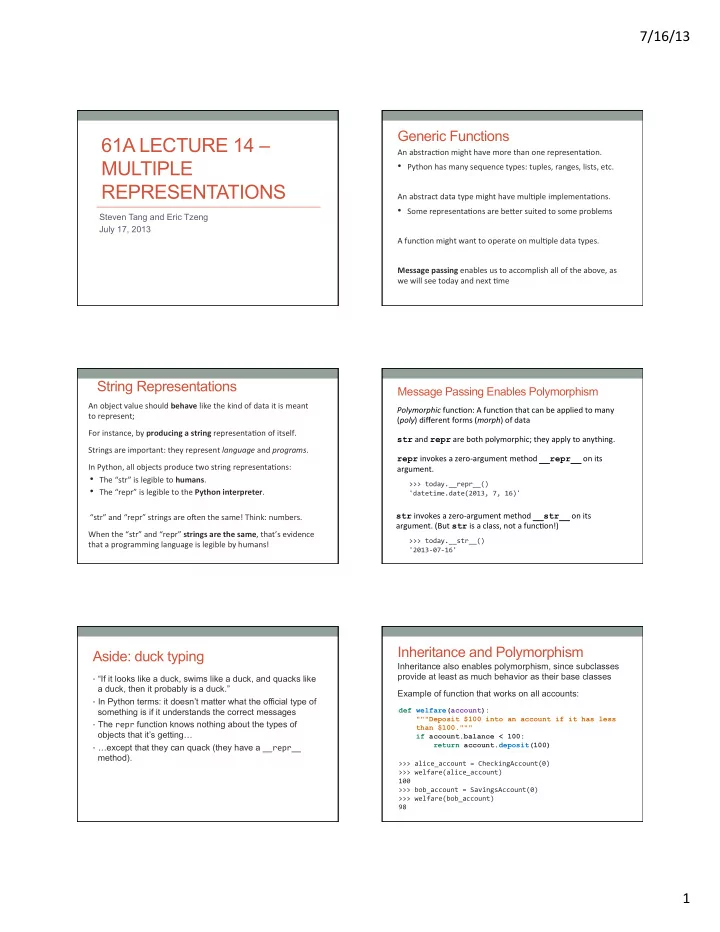
61A LECTURE 14 – MULTIPLE REPRESENTATIONS

Steven Tang and Eric Tzeng July 17, 2013

Generic Functions

An ¡abstrac/on ¡might ¡have ¡more ¡than ¡one ¡representa/on. ¡

  • Python ¡has ¡many ¡sequence ¡types: ¡tuples, ¡ranges, ¡lists, ¡etc. ¡

¡ An ¡abstract ¡data ¡type ¡might ¡have ¡mul/ple ¡implementa/ons. ¡

  • Some ¡representa/ons ¡are ¡beBer ¡suited ¡to ¡some ¡problems ¡

¡ A ¡func/on ¡might ¡want ¡to ¡operate ¡on ¡mul/ple ¡data ¡types. ¡ ¡ Message ¡passing ¡enables ¡us ¡to ¡accomplish ¡all ¡of ¡the ¡above, ¡as ¡ we ¡will ¡see ¡today ¡and ¡next ¡/me ¡

String Representations

An ¡object ¡value ¡should ¡behave ¡like ¡the ¡kind ¡of ¡data ¡it ¡is ¡meant ¡ to ¡represent; ¡ For ¡instance, ¡by ¡producing ¡a ¡string ¡representa/on ¡of ¡itself. ¡ Strings ¡are ¡important: ¡they ¡represent ¡language ¡and ¡programs. ¡ In ¡Python, ¡all ¡objects ¡produce ¡two ¡string ¡representa/ons: ¡

  • The ¡“str” ¡is ¡legible ¡to ¡humans. ¡
  • The ¡“repr” ¡is ¡legible ¡to ¡the ¡Python ¡interpreter. ¡

“str” ¡and ¡“repr” ¡strings ¡are ¡oNen ¡the ¡same! ¡Think: ¡numbers. ¡ When ¡the ¡“str” ¡and ¡“repr” ¡strings ¡are ¡the ¡same, ¡that’s ¡evidence ¡ that ¡a ¡programming ¡language ¡is ¡legible ¡by ¡humans! ¡

Message Passing Enables Polymorphism

Polymorphic ¡func/on: ¡A ¡func/on ¡that ¡can ¡be ¡applied ¡to ¡many ¡ (poly) ¡different ¡forms ¡(morph) ¡of ¡data ¡ str ¡and ¡repr ¡are ¡both ¡polymorphic; ¡they ¡apply ¡to ¡anything. ¡ repr ¡invokes ¡a ¡zero-­‑argument ¡method ¡__repr__ ¡on ¡its ¡

  • argument. ¡

str ¡invokes ¡a ¡zero-­‑argument ¡method ¡__str__ ¡on ¡its ¡

  • argument. ¡(But ¡str ¡is ¡a ¡class, ¡not ¡a ¡func/on!) ¡

>>> ¡today.__repr__() ¡ 'datetime.date(2013, ¡7, ¡16)' ¡ >>> ¡today.__str__() ¡ '2013-­‑07-­‑16' ¡

Aside: duck typing

  • “If it looks like a duck, swims like a duck, and quacks like

a duck, then it probably is a duck.”

  • In Python terms: it doesn’t matter what the official type of

something is if it understands the correct messages

  • The repr function knows nothing about the types of
  • bjects that it’s getting…
  • …except that they can quack (they have a __repr__

method). Inheritance also enables polymorphism, since subclasses provide at least as much behavior as their base classes Example of function that works on all accounts:

Inheritance and Polymorphism

def welfare(account): """Deposit $100 into an account if it has less than $100.""" if account.balance < 100: return account.deposit(100) >>> ¡alice_account ¡= ¡CheckingAccount(0) ¡ >>> ¡welfare(alice_account) ¡ 100 ¡ >>> ¡bob_account ¡= ¡SavingsAccount(0) ¡ >>> ¡welfare(bob_account) ¡ 98 ¡

slide-2
SLIDE 2

7/16/13 ¡ 2 ¡

Interfaces

Message ¡passing ¡allows ¡different ¡data ¡types ¡to ¡respond ¡to ¡the ¡ same ¡message. ¡ A ¡shared ¡message ¡that ¡elicits ¡similar ¡behavior ¡from ¡different ¡

  • bject ¡classes ¡is ¡a ¡powerful ¡method ¡of ¡abstrac/on. ¡

An ¡interface ¡is ¡a ¡set ¡of ¡shared ¡messages, ¡along ¡with ¡a ¡ specifica/on ¡of ¡what ¡they ¡mean. ¡ Classes ¡that ¡implement ¡__repr__ ¡and ¡__str__ ¡methods ¡ that ¡return ¡Python-­‑ ¡and ¡human-­‑readable ¡strings ¡thereby ¡ implement ¡an ¡interface ¡for ¡producing ¡Python ¡string ¡ representa/ons. ¡ Classes ¡that ¡implement ¡__len__ ¡and ¡__getitem__ ¡are ¡

  • sequences. ¡ ¡

Python operators and generic functions make use of methods with names like “__name__” These are special or magic methods Examples: len __len__ +, += __add__, __iadd__ [], []= __getitem__, __setitem__ . __getattr__, __setattr__

Special Methods Example: Rational Numbers

class Rational(object): def __init__(self, numer, denom): g = gcd(numer, denom) self.numerator = numer // g self.denominator = denom // g def __repr__(self): return 'Rational({0}, {1})'.format(self.numerator, self.denominator) def __str__(self): return '{0}/{1}'.format(self.numerator, self.denominator) def __add__(self, num): denom = self.denominator * num.denominator numer1 = self.numerator * num.denominator numer2 = self.denominator * num.numerator return Rational(numer1 + numer2, denom) def __eq__(self, num): return (self.numerator == num.numerator and self.denominator == num.denominator)

Property Methods

ONen, ¡we ¡want ¡the ¡value ¡of ¡instance ¡aBributes ¡to ¡be ¡linked. ¡

>>> ¡f ¡= ¡Rational(3, ¡5) ¡ >>> ¡f.float_value ¡ 0.6 ¡ >>> ¡f.numerator ¡= ¡4 ¡ >>> ¡f.float_value ¡ 0.8 ¡ >>> ¡f.denominator ¡-­‑= ¡3 ¡ >>> ¡f.float_value ¡ 2.0 ¡

The ¡@property ¡decorator ¡on ¡a ¡method ¡designates ¡that ¡it ¡will ¡ be ¡called ¡whenever ¡it ¡is ¡looked ¡up ¡on ¡an ¡instance. ¡ ¡ It ¡allows ¡zero-­‑argument ¡methods ¡to ¡be ¡called ¡without ¡an ¡explicit ¡ call ¡expression. ¡

@property def float_value(self): return (self.numerator // self.denominator)

Multiple Representations of Abstract Data

Rectangular ¡and ¡polar ¡representa/ons ¡for ¡complex ¡numbers ¡ Most ¡opera/ons ¡don't ¡care ¡about ¡the ¡representa/on. ¡ Some ¡mathema/cal ¡opera/ons ¡are ¡easier ¡on ¡one ¡than ¡the ¡other. ¡

Arithmetic Abstraction Barriers

add_complex ¡ ¡mul_complex ¡ real ¡ ¡imag ¡ ¡magnitude ¡ ¡angle ¡

Complex ¡numbers ¡as ¡whole ¡data ¡values ¡ Complex ¡numbers ¡as ¡two-­‑dimensional ¡vectors ¡ Rectangular ¡ representa=on ¡ Polar ¡ representa=on ¡

slide-3
SLIDE 3

7/16/13 ¡ 3 ¡

An Interface for Complex Numbers

All ¡complex ¡numbers ¡should ¡have ¡real ¡and ¡imag ¡components. ¡ All ¡complex ¡numbers ¡should ¡have ¡a ¡magnitude ¡and ¡angle. ¡ Using ¡this ¡interface, ¡we ¡can ¡implement ¡complex ¡arithme/c: ¡

def add_complex(z1, z2): return ComplexRI(z1.real + z2.real, z1.imag + z2.imag) def mul_complex(z1, z2): return ComplexMA(z1.magnitude * z2.magnitude, z1.angle + z2.angle)

The Rectangular Representation

class ComplexRI(object): def __init__(self, real, imag): self.real = real self.imag = imag @property def magnitude(self): return (self.real ** 2 + self.imag ** 2) ** 0.5 @property def angle(self): return atan2(self.imag, self.real) def __repr__(self): return 'ComplexRI({0}, {1})'.format(self.real, self.imag) math.atan2(y,x): ¡Angle ¡between ¡ x-­‑axis ¡and ¡the ¡point ¡(x,y) ¡ Property ¡decorator: ¡"Call ¡this ¡func/on ¡

  • n ¡aBribute ¡look-­‑up" ¡

The Polar Representation

class ComplexMA(object): def __init__(self, magnitude, angle): self.magnitude = magnitude self.angle = angle @property def real(self): return self.magnitude * cos(self.angle) @property def imag(self): return self.magnitude * sin(self.angle) def __repr__(self): return 'ComplexMA({0}, {1})'.format(self.magnitude, self.angle)

Using Complex Numbers

Either ¡type ¡of ¡complex ¡number ¡can ¡be ¡passed ¡as ¡either ¡ argument ¡to ¡add_complex ¡or ¡mul_complex: ¡

>>> ¡from ¡math ¡import ¡pi ¡ >>> ¡add_complex(ComplexRI(1, ¡2), ¡ComplexMA(2, ¡pi/2)) ¡ ComplexRI(1.0000000000000002, ¡4.0) ¡ >>> ¡mul_complex(ComplexRI(0, ¡1), ¡ComplexRI(0, ¡1)) ¡ ComplexMA(1.0, ¡3.141592653589793) ¡ def add_complex(z1, z2): return ComplexRI(z1.real + z2.real, z1.imag + z2.imag) def mul_complex(z1, z2): return ComplexMA(z1.magnitude * z2.magnitude, z1.angle + z2.angle)

We ¡can ¡also ¡define ¡__add__ ¡and ¡__mul__ ¡in ¡both ¡classes. ¡

The Independence of Data Types

Data ¡abstrac/on ¡and ¡class ¡defini/ons ¡keep ¡types ¡separate ¡ Some ¡opera/ons ¡need ¡to ¡cross ¡type ¡boundaries ¡

add_rational ¡ ¡mul_rational ¡

Ra=onal ¡numbers ¡as ¡ numerators ¡& ¡denominators ¡

add_complex ¡ ¡mul_complex ¡

Complex ¡numbers ¡as ¡ two-­‑dimensional ¡vectors ¡ How ¡do ¡we ¡add ¡a ¡complex ¡number ¡ and ¡a ¡ra=onal ¡number ¡together? ¡ There ¡are ¡many ¡different ¡techniques ¡for ¡doing ¡this! ¡

Type Dispatching

Define ¡a ¡different ¡func/on ¡for ¡each ¡possible ¡combina/on ¡of ¡ types ¡for ¡which ¡an ¡opera/on ¡(e.g., ¡addi/on) ¡is ¡valid ¡

def iscomplex(z): return type(z) in (ComplexRI, ComplexMA) def isrational(z): return type(z) is Rational def add_complex_and_rational(z, r): return ComplexRI(z.real + r.numerator / r.denominator, z.imag) def add_by_type_dispatching(z1, z2): """Add z1 and z2, which may be complex or rational.""" if iscomplex(z1) and iscomplex(z2): return add_complex(z1, z2) elif iscomplex(z1) and isrational(z2): return add_complex_and_rational(z1, z2) elif isrational(z1) and iscomplex(z2): return add_complex_and_rational(z2, z1) else: add_rational(z1, z2)

Converted ¡to ¡a ¡ real ¡number ¡(float) ¡

slide-4
SLIDE 4

7/16/13 ¡ 4 ¡

Tag-Based Type Dispatching

Idea: ¡Use ¡dic/onaries ¡to ¡dispatch ¡on ¡type ¡(like ¡we ¡did ¡for ¡ message ¡passing) ¡

def type_tag(x): return type_tags[type(x)] type_tags = {ComplexRI: 'com', ComplexMA: 'com', Rational: 'rat'} def add(z1, z2): types = (type_tag(z1), type_tag(z2)) return add_implementations[types](z1, z2) add_implementations = {} add_implementations[('com', 'com')] = add_complex add_implementations[('rat', 'rat')] = add_rational add_implementations[('com', 'rat')] = add_complex_and_rational add_implementations[('rat', 'com')] = add_rational_and_complex lambda r, z: add_complex_and_rational(z, r)

Declares ¡that ¡ComplexRI ¡ and ¡ComplexMA ¡should ¡be ¡ treated ¡uniformly ¡

Type Dispatching Analysis

Minimal ¡viola/on ¡of ¡abstrac/on ¡barriers: ¡we ¡define ¡cross-­‑type ¡ func/ons ¡as ¡necessary, ¡but ¡use ¡abstract ¡data ¡types ¡ Extensible: ¡Any ¡new ¡numeric ¡type ¡can ¡"install" ¡itself ¡into ¡the ¡ exis/ng ¡system ¡by ¡adding ¡new ¡entries ¡to ¡various ¡dic/onaries ¡ Ques=on: ¡How ¡many ¡cross-­‑type ¡implementa/ons ¡are ¡required ¡to ¡ support ¡m ¡types ¡and ¡n ¡opera/ons? ¡

def add(z1, z2): types = (type_tag(z1), type_tag(z2)) return add_implementations[types](z1, z2)

integer, ¡ra/onal, ¡real, ¡ complex ¡ add, ¡subtract, ¡mul/ply, ¡ divide ¡

Type Dispatching Analysis

Minimal ¡viola/on ¡of ¡abstrac/on ¡barriers: ¡we ¡define ¡cross-­‑type ¡ func/ons ¡as ¡necessary, ¡but ¡use ¡abstract ¡data ¡types ¡ Extensible: ¡Any ¡new ¡numeric ¡type ¡can ¡"install" ¡itself ¡into ¡the ¡ exis/ng ¡system ¡by ¡adding ¡new ¡entries ¡to ¡various ¡dic/onaries ¡ Arg ¡1 ¡ Arg ¡2 ¡ Add ¡ Mul=ply ¡ Complex ¡ Complex ¡ Ra/onal ¡ Ra/onal ¡ Complex ¡ Ra/onal ¡ Ra/onal ¡ Complex ¡ Message ¡Passing ¡ Type ¡Dispatching ¡

Data-Directed Programming

There's ¡nothing ¡addi/on-­‑specific ¡about ¡add Idea: ¡One ¡dispatch ¡func/on ¡for ¡(operator, ¡types) ¡pairs ¡

def apply(operator_name, x, y): tags = (type_tag(x), type_tag(y)) key = (operator_name, tags) return apply_implementations[key](x, y)

apply_implementations = { ('add', ('com', 'com')): add_complex, ('add', ('rat', 'rat')): add_rational, ('add', ('com', 'rat')): add_complex_and_rational, ('add', ('rat', 'com')): add_rational_and_complex, ('mul', ('com', 'com')): mul_complex, ('mul', ('rat', 'rat')): mul_rational, ('mul', ('com', 'rat')): mul_complex_and_rational, ('mul', ('rat', 'com')): mul_rational_and_complex }

Coercion

Idea: ¡Some ¡types ¡can ¡be ¡converted ¡into ¡other ¡types ¡ Takes ¡advantage ¡of ¡structure ¡in ¡the ¡type ¡system ¡

def rational_to_complex(x): return ComplexRI(x.numerator / x.denominator, 0) coercions = {('rat', 'com'): rational_to_complex}

Ques=on: ¡Can ¡any ¡numeric ¡type ¡be ¡coerced ¡into ¡any ¡other? ¡ Ques=on: ¡Have ¡we ¡been ¡repea/ng ¡ourselves ¡with ¡data-­‑directed ¡ programming? ¡

Applying Operators with Coercion

  • 1. ABempt ¡to ¡coerce ¡arguments ¡into ¡values ¡of ¡the ¡same ¡type ¡
  • 2. Apply ¡type-­‑specific ¡(not ¡cross-­‑type) ¡opera/ons ¡

def coerce_apply(operator_name, x, y): tx, ty = type_tag(x), type_tag(y) if tx != ty: if (tx, ty) in coercions: tx, x = ty, coercions[(tx, ty)](x) elif (ty, tx) in coercions: ty, y = tx, coercions[(ty, tx)](y) else: return 'No coercion possible.' assert tx == ty key = (operator_name, tx) return coerce_implementations[key](x, y)

slide-5
SLIDE 5

7/16/13 ¡ 5 ¡

Coercion Analysis

Minimal ¡viola/on ¡of ¡abstrac/on ¡barriers: ¡we ¡define ¡cross-­‑type ¡ coercion ¡as ¡necessary, ¡but ¡use ¡abstract ¡data ¡types ¡ Requires ¡that ¡all ¡types ¡can ¡be ¡coerced ¡into ¡a ¡common ¡type ¡ More ¡sharing: ¡All ¡operators ¡use ¡the ¡same ¡coercion ¡scheme ¡

Arg ¡1 ¡ Arg ¡2 ¡ Add ¡ Mul=ply ¡ Complex ¡ Complex ¡ Ra/onal ¡ Ra/onal ¡ Complex ¡ Ra/onal ¡ Ra/onal ¡ Complex ¡ From ¡ To ¡ Coerce ¡ Complex ¡ Ra/onal ¡ Ra/onal ¡ Complex ¡ Type ¡ Add ¡ Mul=ply ¡ Complex ¡ Ra/onal ¡