SLIDE 1
CS 445 Introduction to Machine Learning Features and the KNN Classifier
Instructor: Dr. Kevin Molloy
SLIDE 2
Quick Review of KNN Classifier
If it walks like a duck, and quacks like a duck, it probably is a duck. k = 1 k = 5
SLIDE 3
Define a method to measure the distance between two observations. This distance incorporates all the features at once. Idea: Small distances between observations imply similar class labels.
Distance (dissimilarity) between observations
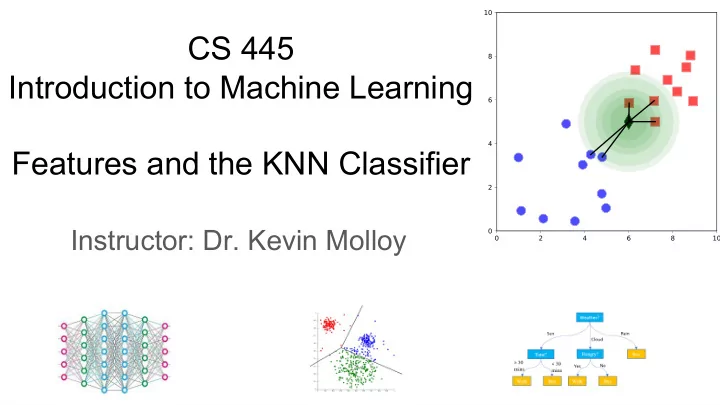
Euclidean Distance and Nearest Point Classifier 1. Compute distance from new point p (the black diamond) and the training set. 2. Identify the nearest point and assign its label to point p
point Dist to p
1 2.45 2 1.30 3 0.99 … … n 8.23
SLIDE 4
Decision Boundaries
Boundaries are perpendicular (orthogonal) to the feature being split. What do the KNN decision boundaries look like?
SLIDE 5
Where is the model?
SLIDE 6
High Dimensionality Lab
Complete Question 1 and the Activity 2. Take 12 minutes.
SLIDE 7
Features – The more the better, right?
Start with a single feature (real number) dataset with values in the range [0, 5]. In general, 5d examples minimally cover the space such that each example has another example less than 1 unit away. Question: What is the minimal number of data points to cover the unit interval (that is, at least one sample for each unit (1) on a line? Question: Now, increase that to two-dimensional. How many data points? 52 samples
SLIDE 8 KNN Implications
How will KNN perform with 1,000 data points (X) with 3 features (X has 3 columns)? How will KNN perform with 1,000 data points (X) with 8 features (X has 8 columns)?
- Most points have another point close by, so, it has a
chance of generalizing (but not guaranteed, why?) The distance between a point and its closest neighbor has increased.
- Experiment. Generate data with 3 dimensions, each
data value is between 0 and 1.
SLIDE 9 KNN Implications
How will KNN perform with 1,000 data points (X) with 25 features (X has 25 columns)?
- All points are similar distances away. Nothing is
close by and all points look the same.
- Solution is to add data?
- Nope. Increasing the dataset size by 10
times makes almost no difference
SLIDE 10
Curse of Dimensionality
https://en.wikipedia.org/wiki/Curse_of_dimensionality Richard Bellman Given a point p, the distances to all other points in the dataset is fairly uniform and far away.
SLIDE 11
Lowering the Dimensionality
Idea: Try a subset of the features. By how many subsets are there for 30 features? Imagine a binary string, each position in the string represents a feature: 0 = exclude, 1 = include. Trying all the combinations of features is too computationally expensive. However, this is the only way we know of right now to find the "best" set of features. 2d features! For 30 features, we have 1 billion different combinations!
SLIDE 12 Greedy Approximation (again)
Forward selection:
1.
Evaluate each individual feature, pick the one that performs the best on validation data.
2.
Now try adding all single
- features. Did it improve,
repeat, Otherwise stop. 1 2 3 4 3,4 2,4 1,4 2,3 1,3 1,2 2,3,4 1,3,4 1,2,4 1,2,3 1,2,3,4
SLIDE 13
Confidence in Decisions
Question: For any given prediction p, should I have the same confidence that my prediction is correct?
SLIDE 14 For Next Time
- I will send out some information about the exam before next class
(the exam is next Thursday).
- PA 1 is due next Tuesday.
- Next class we are going to discuss comparing decision trees and KNN
in more ways.