Data Mining Classification: Alternative Techniques Lecture Notes - - PDF document

data mining classification alternative techniques lecture
SMART_READER_LITE
LIVE PREVIEW

Data Mining Classification: Alternative Techniques Lecture Notes - - PDF document

Data Mining Classification: Alternative Techniques Lecture Notes for Chapter 4 Instance-Based Learning Introduction to Data Mining , 2 nd Edition by Tan, Steinbach, Karpatne, Kumar 1 Nearest Neighbor Classifiers Basic idea: If it


slide-1
SLIDE 1

Data Mining Classification: Alternative Techniques Lecture Notes for Chapter 4 Instance-Based Learning Introduction to Data Mining , 2nd Edition

by Tan, Steinbach, Karpatne, Kumar

9/30/2020 Introduction to Data Mining, 2nd Edition 2
Nearest Neighbor Classifiers

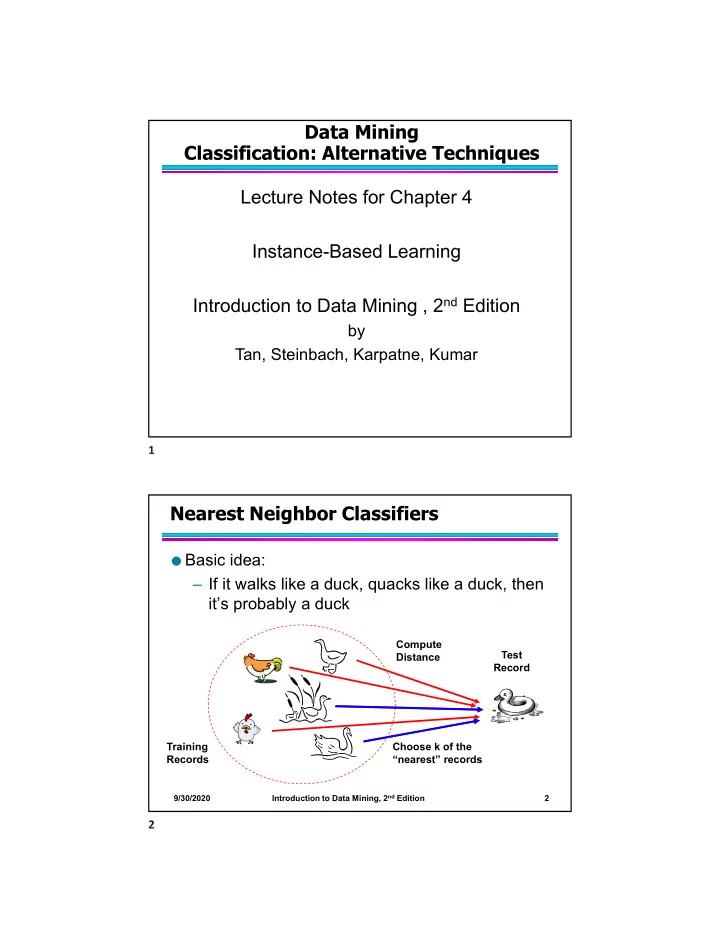
 Basic idea:

– If it walks like a duck, quacks like a duck, then it’s probably a duck

Training Records Test Record Compute Distance Choose k of the “nearest” records

1 2

slide-2
SLIDE 2

9/30/2020 Introduction to Data Mining, 2nd Edition 3

Nearest-Neighbor Classifiers

Requires the following: – A set of labeled records – Proximity metric to compute distance/similarity between a pair of records (e.g., Euclidean distance) – The value of k, the number of nearest neighbors to retrieve – A method for using class labels of K nearest neighbors to determine the class label of unknown record (e.g., by taking majority vote)

Unknown record 9/30/2020 Introduction to Data Mining, 2nd Edition 4

How to Determine the class label of a Test Sample?

 Take the majority vote of class labels among the k-

nearest neighbors

 Weight the vote according to distance

– weight factor, 𝑥 1/𝑒2

3 4

slide-3
SLIDE 3

9/30/2020 Introduction to Data Mining, 2nd Edition 5

Choice of proximity measure matters

 For documents, cosine is better than correlation or

Euclidean 1 1 1 1 1 1 1 1 1 1 1 0 0 1 1 1 1 1 1 1 1 1 1 1 0 0 0 0 0 0 0 0 0 0 0 1 1 0 0 0 0 0 0 0 0 0 0 0 vs

Euclidean distance = 1.4142 for both pairs, but the cosine similarity measure has different values for these pairs.

9/30/2020 Introduction to Data Mining, 2nd Edition 6

Nearest Neighbor Classification…

 Choosing the value of k:

– If k is too small, sensitive to noise points – If k is too large, neighborhood may include points from

  • ther classes

5 6

slide-4
SLIDE 4

9/30/2020 Introduction to Data Mining, 2nd Edition 7

Nearest Neighbor Classification…

 Data preprocessing is often required

– Attributes may have to be scaled to prevent distance measures from being dominated by one of the attributes

Example:

– height of a person may vary from 1.5m to 1.8m – weight of a person may vary from 90lb to 300lb – income of a person may vary from $10K to $1M

– Time series are often standardized to have 0 means a standard deviation of 1

9/30/2020 Introduction to Data Mining, 2nd Edition 8

Nearest-neighbor classifiers

1-nn decision boundary is a Voronoi Diagram

 Nearest neighbor

classifiers are local classifiers

 They can produce

decision boundaries of arbitrary shapes.

7 8

slide-5
SLIDE 5

9/30/2020 Introduction to Data Mining, 2nd Edition 9

Nearest Neighbor Classification…

 How to handle missing values in training and

test sets? – Proximity computations normally require the presence of all attributes – Some approaches use the subset of attributes present in two instances

 This may not produce good results since it

effectively uses different proximity measures for each pair of instances

 Thus, proximities are not comparable

9/30/2020 Introduction to Data Mining, 2nd Edition 10

Nearest Neighbor Classification…

 Handling irrelevant and redundant attributes

– Irrelevant attributes add noise to the proximity measure – Redundant attributes bias the proximity measure towards certain attributes – Can use variable selection or dimensionality reduction to address irrelevant and redundant attributes

9 10

slide-6
SLIDE 6

9/30/2020 Introduction to Data Mining, 2nd Edition 11

Improving KNN Efficiency

 Avoid having to compute distance to all objects in

the training set – Multi-dimensional access methods (k-d trees) – Fast approximate similarity search – Locality Sensitive Hashing (LSH)

 Condensing

– Determine a smaller set of objects that give the same performance

 Editing

– Remove objects to improve efficiency

11