6 symptomatic rabies (2009) Exploited by Edward Jenner who used - - PDF document

6
SMART_READER_LITE
LIVE PREVIEW

6 symptomatic rabies (2009) Exploited by Edward Jenner who used - - PDF document

Presentation by Dr Lindsay Nicholson LDA Conference 2011 Overview Immune Responses: The Good, the Bad and the Ugly Where does immunology come from? Where is the immune system? Lindsay Nicholson How does the immune system


slide-1
SLIDE 1

Presentation by Dr Lindsay Nicholson LDA Conference 2011 1 Immune Responses: The Good, the Bad and the Ugly

Lindsay Nicholson l.nicholson@bristol.ac.uk www.bris.ac.uk/cellmolmed/air

Overview

  • Where does immunology

come from?

  • Where is the immune system?
  • How does the immune system

recognise infection?

  • What happens when this goes

wrong?

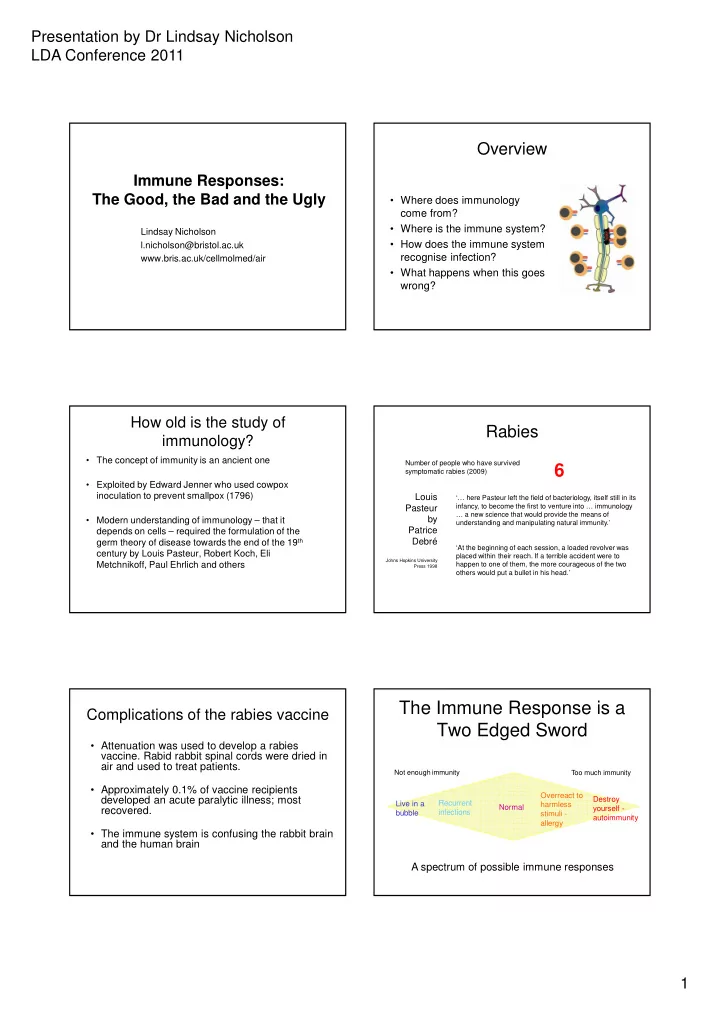
How old is the study of immunology?

  • The concept of immunity is an ancient one
  • Exploited by Edward Jenner who used cowpox

inoculation to prevent smallpox (1796)

  • Modern understanding of immunology – that it

depends on cells – required the formulation of the germ theory of disease towards the end of the 19th century by Louis Pasteur, Robert Koch, Eli Metchnikoff, Paul Ehrlich and others

Rabies

‘… here Pasteur left the field of bacteriology, itself still in its infancy, to become the first to venture into … immunology … a new science that would provide the means of understanding and manipulating natural immunity.’ ‘At the beginning of each session, a loaded revolver was placed within their reach. If a terrible accident were to happen to one of them, the more courageous of the two

  • thers would put a bullet in his head.’

Louis Pasteur by Patrice Debré

Johns Hopkins University Press 1998

Number of people who have survived symptomatic rabies (2009)

6

Complications of the rabies vaccine

  • Attenuation was used to develop a rabies
  • vaccine. Rabid rabbit spinal cords were dried in

air and used to treat patients.

  • Approximately 0.1% of vaccine recipients

developed an acute paralytic illness; most recovered.

  • The immune system is confusing the rabbit brain

and the human brain

Not enough immunity Too much immunity

The Immune Response is a Two Edged Sword

Live in a bubble Recurrent infections Normal Overreact to harmless stimuli - allergy Destroy yourself - autoimmunity

A spectrum of possible immune responses

slide-2
SLIDE 2

Presentation by Dr Lindsay Nicholson LDA Conference 2011 2

Immune function depends on cells

Macrophage (in tissues) Neutrophil (60%) Monocyte (5%) Lymphocyte (30%)

  • How many cells are

there in a millilitre

  • f blood?
  • Red cells – 500m
  • White cells - 1,000,000

en.wikipedia.org/wiki/White_blood_cells

Pathogens and lymphocytes drawn to scale

Bacteria

Lymphocyte

Virus

How does the immune system recognise infection

  • 1. Antibodies recognise infection directly
  • 2. Lymphocytes recognise infection

indirectly

Antibodies bind directly

commons.wikimedia.org/wiki/File:Antibody_IgG2.png

Made by the cell Peptide taken from the infection

MHC molecule

Made by the cell

T cell receptor molecule

commons.wikimedia.org/wiki/File:TCR-MHC_II.png

T cells recognise infection indirectly

  • 1. Antigen presenting

cell digests infection to produce peptides

  • 2. Peptides are

shown to T cell

  • 3. T cell with specific

receptor activated to produce helper cells and killer cells

How T cells recognise infections

slide-3
SLIDE 3

Presentation by Dr Lindsay Nicholson LDA Conference 2011 3

Primary TCR Contact Secondary TCR Contact

H S L G K W L G H P D K F

139 140 141 142 143 144 145 146 147 148 149 150 151

Pathogenic cells

H S L G K W L G H P D K F

139 140 141 142 143 144 145 146 147 148 149 150 151

Non-pathogenic cells

  • T cells focus on a limited set of

amino acids

The immune system constantly patrols the body

  • Samples the environment for evidence of

infection

  • Examines cells to see if they are infected
  • Examines cells to see if they are

cancerous

Calls for Help Starts killing Produces inflammation

Inflammation of the retina

  • Invest. Ophthal. Vis. Sci. 49:5458 (2008)

Autoimmunity occurs because…

  • … the sufferer has a ‘permissive’ set of

genes (so it runs in families)

  • …the environment triggers disease (e.g.

some viral or bacterial infections)

  • …the immune system mistakes a healthy

cell for an infected or a cancerous cell

Sympathetic Ophthalmia

  • In 1583 George Bartisch wrote that after injury

the eye may shrink and become painful, “in this case the other eye is in great danger”

  • 80% of cases develop within 3 months; can
  • ccur up to 50 years after initial injury

How do the T cells get activated? Bystander Activation

Eye protein

+

Danger Signals

slide-4
SLIDE 4

Presentation by Dr Lindsay Nicholson LDA Conference 2011 4

Molecular Mimcry

H S L G K W L G H P D K F

139 140 141 142 143 144 145 146 147 148 149 150 151

Autoantigen

E Q L V K W L G L P A P I

Bacterial antigen

Carrizosa, A. M et al. (1998) Journal of Immunology 161(7): 3307-3314.

What amino acid substitution studies tell us

  • TCRs can be exquisitely sensitive to single

amino acid changes

  • TCRs can accept multiple substitutions

without losing the ability to respond

  • TCRs can be activated by two peptides of

completely different sequence

  • A single TCR in a mouse has the potential

to be stimulated by about 13 self-peptides

The Complexity of Infection

Tissue Damage Molecular mimicry

What can we study

  • Genetics:

– To find all the genes that play a role and to establish the effect of individual genes on disease

  • Immune mechanisms:

– To find out which cells are important and what molecular programmes they use to cause disease

  • Treatments:

– To test new drugs or therapies quickly before trying them in patients

Treatments for autoimmune disease

  • Anti-inflammatory (Aspirin-like; steroids)
  • Immunosuppressive (Killing immune cells
  • r inhibiting their function)
  • Antigen specific ‘anti-vaccination’
  • Modulate immunity selectively in the

affected organ

Important questions for future research

  • Understand what triggers human disease
  • Predict how bad disease is going to be
  • Target drugs to a specific immune

response not to the whole immune system

slide-5
SLIDE 5

Presentation by Dr Lindsay Nicholson LDA Conference 2011 5

Summary

  • The ‘immune system’ is a collection of cells

that respond to pathogens.

  • This response causes inflammation
  • The response can be life saving

(e.g. rabies vaccination)

  • The response can destroy normal life

(e.g. multiple sclerosis; uveitis)

  • There is still lots to learn
  • Aaron

Postlethwaite

  • Ana Anderson
  • Andrew Dick
  • Ben Raveney
  • Carly Guyver
  • Claudia Calder
  • Dave Copland
  • David Nicholson
  • David Wraith
  • Emma Kerr
  • Estelle Bettelli
  • Jay Reddy

Acknowledgements

  • Jez Fordham
  • Jian Liu
  • Jo Boldison
  • Lauren Schewitz
  • Markus Munder
  • Mercy Prabhu-Das
  • Richard Lee
  • Sarah Morwood
  • Tarnjit Khera
  • Vadim Turchin
  • Vijay Kuchroo
  • Wei-Kang Wu
  • Zsolt Illes