
SLIDE 1
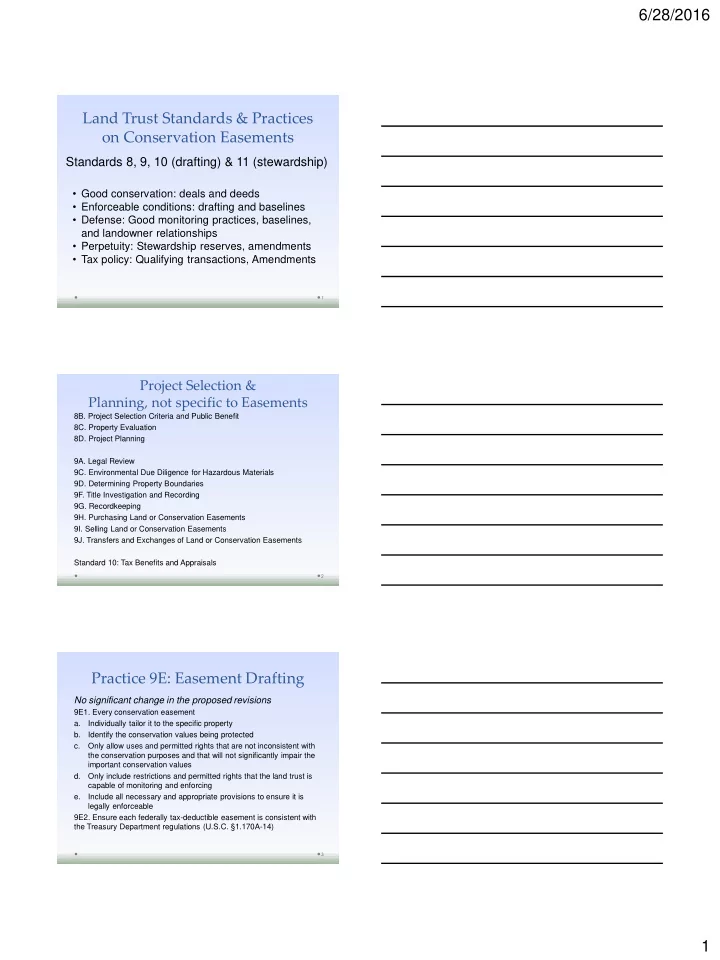
6/28/2016 1 Land Trust Standards & Practices
- n Conservation Easements
Standards 8, 9, 10 (drafting) & 11 (stewardship)
1
- Good conservation: deals and deeds
- Enforceable conditions: drafting and baselines
- Defense: Good monitoring practices, baselines,
and landowner relationships
- Perpetuity: Stewardship reserves, amendments
- Tax policy: Qualifying transactions, Amendments
Project Selection & Planning, not specific to Easements
- 8B. Project Selection Criteria and Public Benefit
- 8C. Property Evaluation
- 8D. Project Planning
- 9A. Legal Review
- 9C. Environmental Due Diligence for Hazardous Materials
- 9D. Determining Property Boundaries
- 9F. Title Investigation and Recording
- 9G. Recordkeeping
- 9H. Purchasing Land or Conservation Easements
- 9I. Selling Land or Conservation Easements
- 9J. Transfers and Exchanges of Land or Conservation Easements
Standard 10: Tax Benefits and Appraisals
2
Practice 9E: Easement Drafting
No significant change in the proposed revisions
- 9E1. Every conservation easement
a. Individually tailor it to the specific property b. Identify the conservation values being protected c. Only allow uses and permitted rights that are not inconsistent with the conservation purposes and that will not significantly impair the important conservation values d. Only include restrictions and permitted rights that the land trust is capable of monitoring and enforcing e. Include all necessary and appropriate provisions to ensure it is legally enforceable
- 9E2. Ensure each federally tax-deductible easement is consistent with
the Treasury Department regulations (U.S.C. §1.170A-14)
3