
SLIDE 1
5G systems
meeting the expectations of the Networked Society
2020
Dr Magnus Frodigh Director Wireless Access Networks
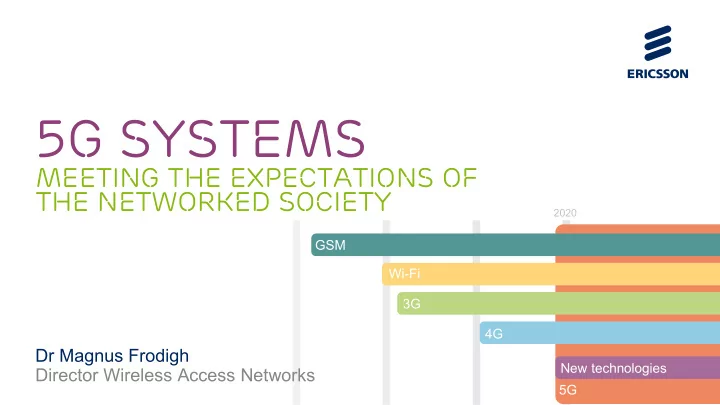
3G 4G New technologies Wi-Fi 5G GSM
5G systems meeting the expectations of the Networked Society 2020 - - PowerPoint PPT Presentation
5G systems meeting the expectations of the Networked Society 2020 GSM Wi-Fi 3G 4G Dr Magnus Frodigh New technologies Director Wireless Access Networks 5G Ericsson Research Technology leadership the main driver of GSM, HSPA,
meeting the expectations of the Networked Society
2020
Dr Magnus Frodigh Director Wireless Access Networks
3G 4G New technologies Wi-Fi 5G GSM
Ericsson Research
› Technology leadership
– the main driver of GSM, HSPA, LTE, LTE-A and 5G
› Innovation
– 50 % of Ericsson patent filings – a major creator of conference papers, journal articles and books
› Cooperation
– leading universities, research organizations and operators
› Strength
– a global organization spanning 3 continents – 40 % holding a Ph.D. degree
In the networked society people, knowledge, devices, and information are networked for the growth of society, life and business.
Mobile Data TRAFFIC
2013 the monthly mobile data traffic volume was
exabytes
By 2019 the monthly mobile data traffic volume will increase to
exabytes
1 exabyte = 1018 bytes
Smartphones
2013 the number of smartphones was
billion
By 2019 the number of smartphones will increase to
billion
Mobile Subscriptions
by technology 2010-2019 [Billions]
Source: Ericsson (November 2013) M2M subscriptions not included
THE Networked Society
Network Cloud Services Devices
From an operator-centric to an user-driven landscape Redefining the network & connected devices The network drives new value in connected devices
5G system
Network Infrastructure
Data Center
Relay Device
DU
Antenna
Antenna
RU RU Cloud Execution Environment
NF NF NF
Device Device
Infra-structure layer
Affordable and sustainable
Massive growth in
Connected Devices
Massive growth in
Traffic Volume
>1000x
Wide range of
Requirements & Characteristics
speed latency
Key Challenges
Diversified wireless accesses
300 MHz 3 GHz 30 GHz 300 GHz
Licensed Controlled sharing Unlicensed Spectrum toolbox
› Provide extreme capacity and multi-Gbps
– bandwidths >500 MHz, frequency >20 GHz – ~1 AP per room indoor, ~10-50 m ISD outdoor
› Higher frequencies enable/require beamforming
– increase link budget, constrain interference
› Low-cost, self-configuring access nodes
– access-backhaul integration
› Seamless integration with wide area network at lower frequencies
– robustness, UDN as “data booster” layer
Ultra-Dense Networks
Connected Devices
› Sensor, actuators, meters, connected devices and things › Small, simple, low-cost › Low energy consumption › Long-range coverage › Connecting vehicles, transport infrastructure and transport management › Incl. safety-related services › Low delay › High mobility › Distributed embedded control & cyber-physical systems › High reliability and availability › Low delay › Autonomous operation
Critical Communication Meters and Sensors Intelligent Transport Systems
LTE for meters & sensors ?
› Are LTE devices simple?
– high requirements on M2M device
› Are LTE devices well reachable?
– MTC devices may have unfavorable attenuation (basements, metal enclosures) – stationary MTC devices affected in particular
› Does LTE enable M2M devices to operate on battery for multiple years?
– not really
referring to LTE Release 8 with regard to the defined M2M requirements
Addressing Limitations
Reducing cost by up to 80%, eg by
– one receive antenna – data rates limited to 1 Mb/s – using 1.4 MHz BW only
Further enhancements
– half-duplex FDD – reduced RF bandwidth
Options for low-rate MTC devices
– repetition with energy accumulation – power/PSD boosting – relaxed performance requirements – simplification/elimination of physical control channel functionality or design of new channels/signals
COST COVERAGE
active
time
Transmit Receive inactive active data signaling paging / measurements DRX / paging cycle
power consumption
DRX active times dominate UE energy consumption
What consumes energy?
Capillary Networks
App Node Capillary Network Function
Capillary Network EPS Network Internet
Capillary GWs Connected Devices
› The majority of device connections predicted as short-range, non-3GPP
– e.g. Bluetooth Low Energy, IEEE 802.15.4 – but can only provide local connectivity at the edge
› Provide connectivity, security solutions and network management
Connectivity, QoS, Security, Network Management
Machine Type Communications
Traffic safety/control Industrial application “Tactile Internet”
Short TTI Robust transmission Fast channel assignment Multi-path
Sensors, meters, actuators
Ultra-long range Low protocol
Scalable Access Spectrum sharing with LTE (< 2GHz) Capillary Networks & short-range radio
Capillary networks
TEXT Simple & cheap Low energy Small data volumes Massive numbers ~1ms e2e latency Ultra reliable Highly available
MTC
LTE – Major Evolution Trends
Spectrum Flexibility
Carrier Aggregation, New Frequency Bands …
Multi-antenna techniques
MIMO, CoMP …
New scenarios
Device-to-Device Communication, MTC, Broadcast …
Densification
Local-area access, Heterogeneous deployments …
Device Enhancements
Receiver improvements,…
Multi-RAT coordination
WiFi interworking, inter-RAT RRM …
LTE
Rel-8/9 Rel-11 Rel-12 Rel-10
5G Wireless access
2000 2010 2020 1990
3G 4G New wireless technologies Wi-Fi 5G GSM
5G
=
evolution of existing standards
+
complementary new technologies
› Lots of talk about 5G
– Vendors – Operators – Governments – Academia/universities – Ericsson leading the EU funded METIS project with 29 partners – The project purpose is to make technology research, align industry and regulatory bodies
5G around the world
› Future internet / networking principles /services /security › Software defined networking /cloud /distributed computing/short delay › Management /Management of complex systems › Multiple RAT integration › Spectrum management / ways to utilize shared spectrum › Energy efficiency › Connected devices / Machine type communication / IoT › Advanced Antenna systems / beamforming / beamtracking › Understanding of propagation properties for higher frequencies › Radio frontends for higher frequencies
Research Challenges
› LTE Evolution will address capacity and performance demands for the coming years › 5G is needed to fulfil the diverse requirements from the Networked Society › Vast opportunities for 5G research
Summary