5 TH C OMMON R EVIEW M ISSION G OA Goa 9 th -15 th November 2011 T - - PowerPoint PPT Presentation

5 th c ommon r eview m ission g oa
SMART_READER_LITE
LIVE PREVIEW

5 TH C OMMON R EVIEW M ISSION G OA Goa 9 th -15 th November 2011 T - - PowerPoint PPT Presentation

5 TH C OMMON R EVIEW M ISSION G OA Goa 9 th -15 th November 2011 T HE 5 TH CRM G OA T EAM Ms. Preeti Pant, Director NRHM, MoHFW, GoI Dr. Aboli Gore, Maternal Health Specialist, UNICEF Dr. D. D. Malekar, RD Office, Pune Dr.


slide-1
SLIDE 1

5TH COMMON REVIEW MISSION GOA

Goa 9th -15th November 2011
slide-2
SLIDE 2

THE 5TH CRM GOA TEAM

  • Ms. Preeti Pant, Director – NRHM, MoHFW, GoI
  • Dr. Aboli Gore, Maternal Health Specialist, UNICEF
  • Dr. D. D. Malekar, RD Office, Pune
  • Dr. Dinesh Jagtap, Consultant-Planning, NHSRC
  • Ms. Anamika Saxena, Consultant, Training Divn.,

MoHFW

  • Dr. Salima Bhatia, Consultant-NRHM, MoHFW
  • Mr. Prabhash Jha, Consultant-FMG, MoHFW
slide-3
SLIDE 3

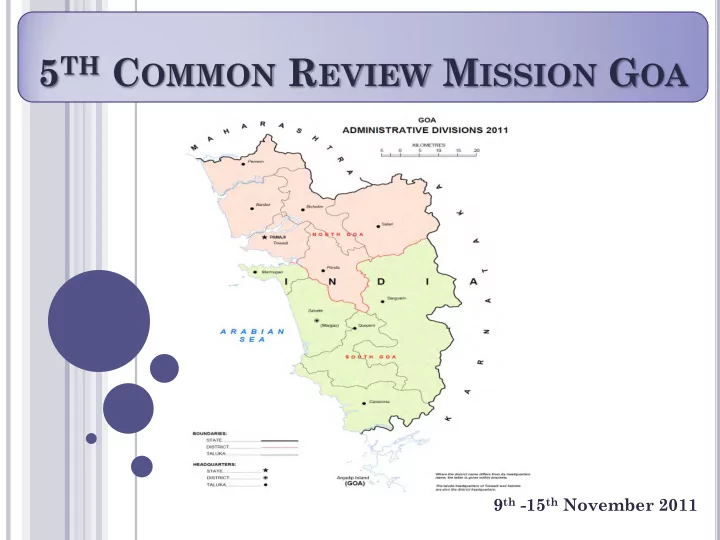
GMC: Handling all complicated cases but also handling a host of unnecessarily referred normal delivery cases DH: Handling maximum cases of normal delivery and also handling fair amount of C. Section cases. An NICU has been recently set up. CHC: Handling only 10-12 normal deliveries/ month and have gynaecologists conducting ANC clinics

PHC: Out of 19, 4 handle more than 10 deliveries per month, 9 conduct less than 3 deliveries per month and 6 do not conduct deliveries At most PHCs ANC clinics are conducted by Gynaecologists once - twice a week Sub Centres: Do not conduct deliveries or outreach ANC camps. ANC services are available at the subcentres once a week when the doctor conducts OPDs at the Sub

  • centre. NO DELIVERIES
slide-4
SLIDE 4

STRENGTHS

  • Fully functional One Tertiary care and two secondary care

Hospitals to cater to 14 lakh population.

  • Good quality Infrastructure development of DH North Goa

recently taken up and DH South Goa underway to address the increasing case loads.

  • Completely FREE Services including diagnostics and drugs to

those who come to the government facilities

  • Out of pocket expenditures are minimal and absence of

evidence of informal payments.

  • Facilities are neat & clean with adequate amenities for patients

and well displayed signages.

  • Availability of assured referral transport to cater to

emergencies.

slide-5
SLIDE 5

STRENGTHS

  • Specialized neonatal ambulances have been introduced since

October 2011.

  • Efficient Vector Borne Disease Control Programme focusing
  • n migrant population.
  • Maternal & Infant Death Review well in place
  • Initiatives towards addressing emerging needs of non-

communicable diseases which include: – Mobile Mammography Vans – Cancer Registry – Hypertension screening – Screening for Infant Metabolic Disorders – Tobacco Control Initiatives – Mental Health – De-addiction – Diabetes Screening and Registry

slide-6
SLIDE 6

8 people trained with the aim of creating Diabetes Educators in:

  • Diabetes management
  • Diabetic Foot care
  • Collection
  • f

anthropometric parameters

  • Diet
  • Exercise
  • House to house survey - 72785

houses surveyed with a population

  • f 309719. 18853 RBS done. 8557

people referred to health centers for further investigation All 1260 AWWs from 11 blocks :

  • Educated

in understanding diabetes

  • Refresher course after 1 year
  • >60% retention

RALLY BY SCHOOL CHILDREN ON OCCASION

OF WORLD DIABETES DAY

slide-7
SLIDE 7

STRENGTHS

  • Good IDSP monitoring team

with a programme officer, epidemiologist and his team.

  • Among top states in terms of

completeness of data entry for the Mother and Child Tracking System

  • Active PRI involvement
  • Good

general awareness among people contributes to better health seeking behavior

  • Significant focus on IEC
slide-8
SLIDE 8

CONVERGENCE FOR

MDA ROUNDS

It was interesting to note that in the absence of AWWs to help out with the MDA rounds, the Chief Secretary

  • f

the State had mobilized other measures to ensure that the rounds are conducted as per

  • schedule. NSS students had been

trained for the MDA rounds and under the supervision of the ANMs, the students distributed the tablets to the households. Interactions with the students showed that they had been trained well and were capable

  • f doing the needful.

GOOD INITIATIVES FOR

INTERSECTORAL CONVERGENCE.

slide-9
SLIDE 9

WEAKNESSES - RCH

  • Irrational

distribution

  • f

specialists. There are 16 gynecologists but only 2 FRUs

  • Drop back facilities for pregnant women not available
  • Suboptimal utilization of PHCs: Out of 19, 4 handle more than

10 deliveries per month, 9 conduct less than 3 deliveries per month and 6 do not conduct deliveries

  • High number of irrational referrals to GMC
  • Issues in Quality of Care at facilities below DH level

– Emergency Tray not well maintained at all facilities eg- it took 10 mins for the nurse at PHC Pernem to get hold of adrenaline. – NSSK protocols are not being followed – Use of Partographs and delivery protocols are not being followed and technical capacity is weak – QACs are only restricted to family planning services

slide-10
SLIDE 10
  • Strengthening RCH services using a two pronged approach

Mapping of facilities catering to migrant population and ensuring availability of normal delivery services at these PHC/ CHC Reduce load at the GMC by Ensuring availability of full complement of Gynae, Paeds and Anesthetist at atleast

  • ne more facility in each district to

provide EmOC services

RECOMMENDATIONS RCH

slide-11
SLIDE 11

RECOMMENDATIONS RCH

  • Immediately start drop back services for operationalizing

JSSK.

  • JSSK entitlements should be displayed at all facilities
  • Expand the mandate of Quality Assurance Committees
  • Define referral protocols and strengthen technical capacity at

CHC/PHC to reduce referrals to higher facilities

  • Performance appraisal of specialists should be conducted.
slide-12
SLIDE 12

WEAKNESSES & RECOMMENDATIONS- TRAINING

  • Training is the weakest component

– Absence of a training institute and an MPW School in the State – Training plans and calendars not in place – NSSK and other essential trainings like IMNCI not yet initiated – Similarly SBA and BEmOC trainings need to be expedited

  • Recommendations

– Training infrastructure and capacity to achieve training load should be developed – Either set up an MPW school/ tie ups with other States for admitting candidates from Goa – Establish mechanisms for post training supervision – Fill up the position of the State training consultant

slide-13
SLIDE 13

WEAKNESSES – SERVICE DELIVERY

  • Many instances of Stock outs (buffer stock not maintained)

– Eg lack of bronchodilators for nebulization at PHC Sakoli and PHC Aldona – Lack of Glucometer Strips at CHC Valpoi

  • EDL is not displayed and it could not be seen at any of the

visited facilities

  • Initiatives such as Mobile Mammography Vans, Neonatal

Ambulances, Tele Medicine units have been established, however their utilization needs to be increased substantially and closely monitored

  • High waiting time at public health facilities acting as a barrier

to access

slide-14
SLIDE 14

RECOMMENDATIONS- STRENGTHENING SERVICE DELIVERY

  • Since basic structure of service delivery is in place, State may

consider Quality Certification of Hospitals

– Introduce the position of hospital managers to strengthen service delivery – Conduct time motion studies to reduce waiting time in hospitals

  • Closely monitor the achievements of innovative interventions

such as MMUs and neonatal ambulances

  • Improve implementation of Biomedical waste management

protocols

  • Update and disseminate essential drug list (EDL) to all health

providers and ensure that the same is displayed at the facilities

slide-15
SLIDE 15

WEAKNESSES & RECOMMENDATIONS - DECENTRALIZATION

  • District and Block Health Plans not made.
  • Utilization of untied funds at Sub-centres poor.

– Only 4 out of 172 sub-centres were able to utilize more than 50 % of their funds in 2010-11

  • Only one meeting of State Health Mission conducted from the

start of the mission

  • Recommendations

– Planning at block level to be immediately initiated. – To ensure functional VHSNCs a reorientation is required. – Systems for monitoring VHSNC meetings, RKS functioning are not in

  • place. These need to be introduced.
slide-16
SLIDE 16

OTHER RECOMMENDATIONS

  • Study the reason for low annual case detection rate of TB &

strengthen RNTCP programme to meet the national targets.

  • To detect glaucoma cases Ophthalmic Assistants should

perform tonometry.

  • Monitoring by the SPMU needs to be strengthened.
  • Financial Management:

– All account registers including the advance register need to be maintained and reconciled periodically by the District Health Societies. – Proper record keeping of the financial transactions at the facility level should be ensured. – State should not divert funds from one programme to another programme.

  • Procurement manual/ guidelines need to be prepared by the

state for all NRHM societies

slide-17
SLIDE 17