5 5 June 1998 JOB HAZARD ANALYSIS & STEPBACK 5 X 5 - - PowerPoint PPT Presentation

5 5
SMART_READER_LITE
LIVE PREVIEW

5 5 June 1998 JOB HAZARD ANALYSIS & STEPBACK 5 X 5 - - PowerPoint PPT Presentation

STEPBACK 5 X 5 MANAGING YOUR HAZARDS MANAGING YOUR HAZARDS IN THE WORKPLACE IN THE WORKPLACE 5 5 June 1998 JOB HAZARD ANALYSIS & STEPBACK 5 X 5 M:\SS62\PRES\JHA5X5.PPT WOODSIDE JOB HAZARD ANALYSIS & 5 x 5 JOB HAZARD ANALYSIS


slide-1
SLIDE 1

June 1998 M:\SS62\PRES\JHA5X5.PPT

WOODSIDE

JOB HAZARD ANALYSIS & STEPBACK 5 X 5
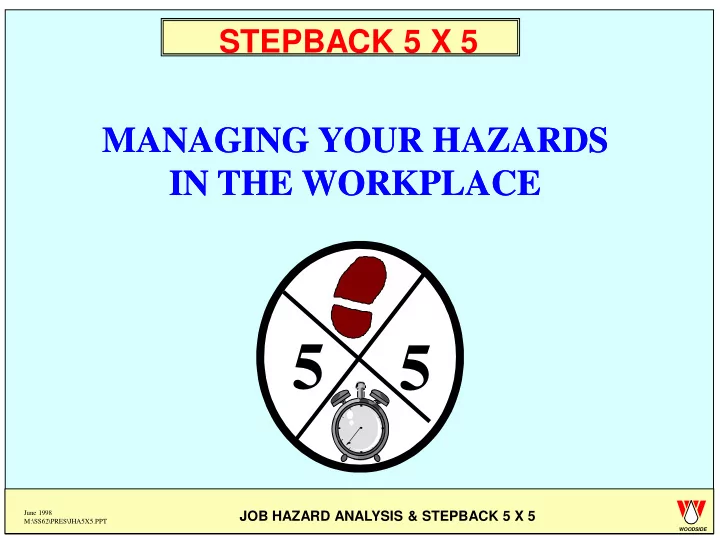
STEPBACK 5 X 5

MANAGING YOUR HAZARDS MANAGING YOUR HAZARDS IN THE WORKPLACE IN THE WORKPLACE

5 5

slide-2
SLIDE 2

June 1998 M:\SS62\PRES\JHA5X5.PPT

WOODSIDE

JOB HAZARD ANALYSIS & STEPBACK 5 X 5

June 1998

WOODSIDE

JOB HAZARD ANALYSIS & 5 x 5 JOB HAZARD ANALYSIS & 5 x 5

5 5 WHAT IS “STEPBACK 5 x 5” ?

STEPBACK 5 x 5 is a process that encourages workers to identify hazards

associated with ALL tasks before starting a job. It helps to promote a hazard management culture through continual self evaluation.

It is based on the principle of ‘ENGAGING THE MIND BEFORE THE HANDS’

by:

Stepping back 5 paces from the job Investing 5 minutes (nominal) to step through the job in your mind and

identify plans to control hazards before starting the job

STEPBACK 5 x 5 is an informal personal planning process. It is essentially a

mental JHA applied before starting ALL jobs.

The process encourages sharing of information and experiences with others.

slide-3
SLIDE 3

June 1998 M:\SS62\PRES\JHA5X5.PPT

WOODSIDE

JOB HAZARD ANALYSIS & STEPBACK 5 X 5

WHERE CAN WE IMPROVE WHERE CAN WE IMPROVE

Woodsides OHS Policy

  • “no work starts without confirmation that essential safety

systems are in place”

  • “all work-related injuries, diseases and property losses are

preventable”.

Analysis of accidents indicates that;

  • A large number are caused by poor control of hazards,

particularly routine work.

  • Personal planning to identify and control hazards could be

improved.

Existing hazard management tools (e.g. QRA, Hazop, JSA) do not address personal planning or planning for routine activities.

slide-4
SLIDE 4

June 1998 M:\SS62\PRES\JHA5X5.PPT

WOODSIDE

JOB HAZARD ANALYSIS & STEPBACK 5 X 5

HOW IS STEPBACK 5 X 5 DONE HOW IS STEPBACK 5 X 5 DONE

  • BEFORE THE JOB

BEFORE THE JOB Stop and think

Observe the work area and surroundings Step through your mind what you are going to do Think about what else is happening in the area

  • r

nearby Identify what else could go wrong Satisfy yourself that the hazards are controlled before starting the work

slide-5
SLIDE 5

June 1998 M:\SS62\PRES\JHA5X5.PPT

WOODSIDE

JOB HAZARD ANALYSIS & STEPBACK 5 X 5

HOW IS STEPBACK 5 X 5 DONE

DURING THE JOB

  • Be aware that when performing a routine task, it is possible to

get into an automatic mode of operation.

If it is a long routine task, take short regular breaks to re-focus

  • n the job, work environment and related hazards

When a job is coming to a conclusion or a natural break

e.g. (Meal Break) re-focus your effort on what is required to complete the task safely.

slide-6
SLIDE 6

June 1998 M:\SS62\PRES\JHA5X5.PPT

WOODSIDE

JOB HAZARD ANALYSIS & STEPBACK 5 X 5

HOW IS STEPBACK 5 X 5 DONE HOW IS STEPBACK 5 X 5 DONE

  • AFTER THE JOB

AFTER THE JOB Observe the work area Take action to control any hazards that may have been created by the work Reflect on how well the job went and the mental planning process you used Did you feel safe doing the job? Were others around you working safely? Can any improvements be made next time?

slide-7
SLIDE 7

June 1998 M:\SS62\PRES\JHA5X5.PPT

WOODSIDE

JOB HAZARD ANALYSIS & STEPBACK 5 X 5

WORK REVIEW/PREVIEW WORK REVIEW/PREVIEW CHECKLIST CHECKLIST

  • Did everyone have a safe day yesterday ?
  • If YES, what made it safe ?
  • If NO, what made it unsafe ?
  • What can/could be done to improve on it ?

SO, lets have a SAFE DAY ! THINK SAFE ! ACT SAFE ! BE SAFE !

slide-8
SLIDE 8

June 1998 M:\SS62\PRES\JHA5X5.PPT

WOODSIDE

JOB HAZARD ANALYSIS & STEPBACK 5 X 5

June 1998

  • START OF SHIFT

START OF SHIFT MEETING MEETING

Raise awareness of

hazards that may be encountered during shift

Encourage investment of

time to think through the job

Promote the

identification and taking action to control hazards

Share information with

  • thers in the workgroup
  • COMPLETION OF MEETING

COMPLETION OF MEETING

Share information on

hazards and other problems encountered during the shift

Discuss any unexpected

events that occurred during the shift

Discuss solutions to problems

encountered

Discuss incomplete activities

so they can be noted in hand-

  • vers

KEEPING THE CULTURE ALIVE KEEPING THE CULTURE ALIVE