5/3/2019 1. Framework 2. User involvement and Partnerships 3. - - PDF document

5 3 2019
SMART_READER_LITE
LIVE PREVIEW

5/3/2019 1. Framework 2. User involvement and Partnerships 3. - - PDF document

5/3/2019 1. Framework 2. User involvement and Partnerships 3. Early Literacy And Play 4. Maker Culture and Co-creation 5. Misinformation and Trust Building The Future(s) Of Libraries 6. Social Challenges and Equity And Library Work 7.


slide-1
SLIDE 1

5/3/2019 1

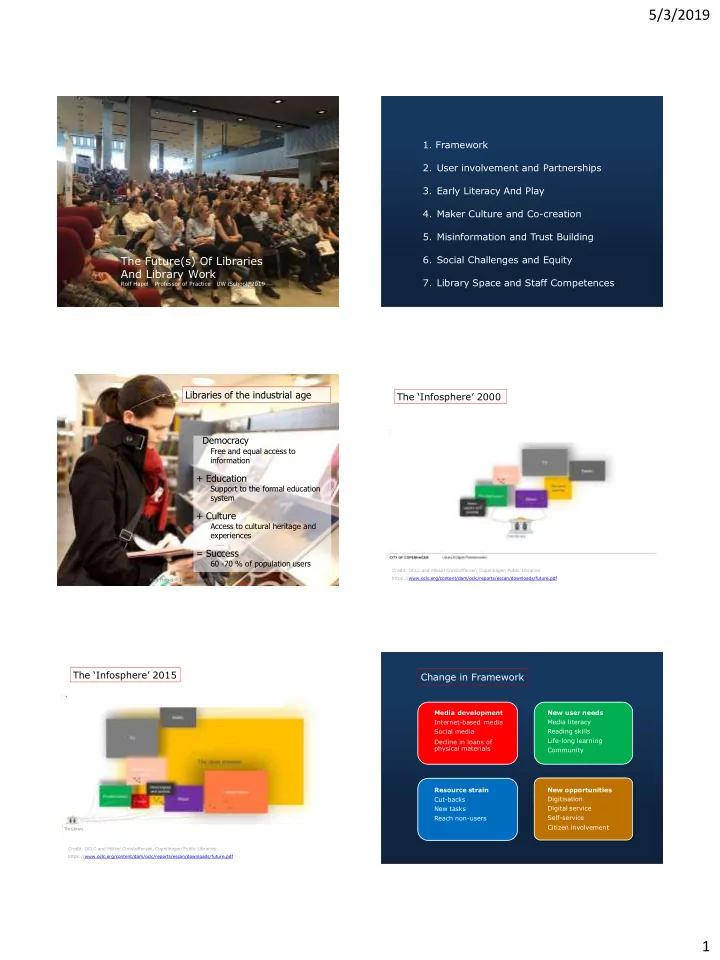
The Future(s) Of Libraries And Library Work

Rolf Hapel Professor of Practice UW iSchool, 2019

  • 1. Framework
  • 2. User involvement and Partnerships
  • 3. Early Literacy And Play
  • 4. Maker Culture and Co-creation
  • 5. Misinformation and Trust Building
  • 6. Social Challenges and Equity
  • 7. Library Space and Staff Competences

Libraries of the industrial age Democracy

Free and equal access to information

+ Education

Support to the formal education system

+ Culture

Access to cultural heritage and experiences

= Success

60 -70 % of population users

Rolf Hapel – Information School UW

The ‘Infosphere’ 2000

Credit: OCLC and Mikkel Christoffersen, Copenhagen Public Libraries https://www.oclc.org/content/dam/oclc/reports/escan/downloads/future.pdf

The ‘Infosphere’ 2015

Credit: OCLC and Mikkel Christoffersen, Copenhagen Public Libraries https://www.oclc.org/content/dam/oclc/reports/escan/downloads/future.pdf The Library

Change in Framework

Resource strain Cut-backs New tasks Reach non-users New user needs Media literacy Reading skills Life-long learning Community New opportunities Digitisation Digital service Self-service Citizen involvement Media development Internet-based media Social media Decline in loans of physical materials

slide-2
SLIDE 2

5/3/2019 2

The libraries

Should the libraries go a lot more digital?

Credit: Mikkel Christoffersen, Copenhagen Public Libraries

The user’s information environment

The library collection

The User’s Infosphere

Credit: Mikkel Christoffersen, Copenhagen Public Libraries

Reinvent the library

new ways of professionalism new products new alliances new ways of funding T N r

  • a

w d i : t i

  • n

e l citizens engagement:

  • Citizens cooperation

Duty-driven and dull

  • U

” M

s

a

e

n

r

d a

d

t

r

  • i

r

v

y

e

c

n

  • n

i

s

n

i d

n

e

  • r

a

v

t i

a

  • n

t i

.

  • .

. ”

n

  • Co-production
  • Hearings and formal
  • C

d

  • e
  • m

c r

  • e

c a r t a i

  • c

y n

Sherry Arnstein, 1969 Rolf Hapel – Information School UW

slide-3
SLIDE 3

5/3/2019 3

Co-creation

Citizens involvement

Rolf Hapel – Information School UW

Photo typing

Rolf Hapel – Information School UW

Users and staff introduces ideas and projects and participants elaborate and develop those ideas

Rolf Hapel – Information School UW

Village Square Lead Users

Hiring young people – Mindspotters - on a short term basis to create events and develop ideas for this user group

Rolf Hapel – Information School UW

Participatory design

Rolf Hapel – Information School UW

Building the future library

Rolf Hapel – Information School UW

Children’s lab: Workshops with children btw 9-14 prototyping a library. The inputs were used as part of the competition programme for UMSA

slide-4
SLIDE 4

5/3/2019 4

Rolf Hapel – Information School UW

Download: www.designthinkingforlibraries.com

Rolf Hapel – Information School UW

DESIGN THINKING

Rolf Hapel – Information School UW

Design thinking is about accelerating innovation to create better solutions to the challenges we meet!

COMMUNITY CENTER

The Mash-up Library

LOCAL ARCHIVE ARKIV MEETING MEDIA CITIZENS SERVICES LEAR

ArN chive ING

PROGRAMS MAKERSPACES HOME- WORK HELP COMMUNITY CENTER CAFÉ STUDY SUPPORT JOB CORNER START-UPS EXHIBITIONS CONSUMER INFO SCIENCE & TECH CULTURAL PROGRAMS TUTORS COUNCELLING LEISURE INFO

Gaming

REA- DING PRO- GRAMS QUIET AREA YOUTH

Partner activities

NEWS

Rolf Hapel – Information School UW

Therefore partnerships..

New resources and skills in the library Knowledge and inspiration from others Increased network Increased diversity and quality in service production Enhanced communication and marketing Legitimization New ambassadors

Rolf Hapel – Information School UW

slide-5
SLIDE 5

5/3/2019 5

https://www.aakb.dk/sites/www.aakb.dk/files/files/file_attachments/2012-10-02_1424/build_partnerships_tools_for_strategical_library_development.pdf

Rolf Hapel – Information School UW

Three levels:

Strategic Programme-based Network-based

Partnership Strategy

Partnerships should be formed as close to the operational agents as possible – personal relationships matter!

Architects Academy Childrens Culture House Chesshouse Aarhus Danish Authors Association Farthers Playground Peoples University Classical Listerners Club Pokemon Club Promenade Orchestra Save the Children Youth Causes that Unite Song Power Write Your Life Story Genealogical Association Students Council Juridical Aid Wild About Words (Literature) The Word School (Dyslectics) NOTA (Dyslectics) The primary schools (Early literacy) Aarhus Movie Workshop etc…

+130 partnerships

Rolf Hapel – Information School UW

One week = 42 activities

  • mostly done

in partnership!

Program | Dokk1 | Nov 16 -22

slide-6
SLIDE 6

5/3/2019 6

‘Invest in early childhood development: Reduce deficits, strengthen the economy’

James J. Heckman, Professor of Economics, University of Chicago. Nobel Prize winner in economics ‘The early catastrophe: The 30-million-word gap’

Betty Hart and Todd R. Risley (2003)

decreasing from 61% in 2010 to 56% in 2017

day - 28% read printed novels Children are inspired to read by their friends, movies and their mother The public library gets the lowest rank as a source of inspiration Children are mostly spending time on screens

Børns Læsevaner 2017: Overblik og Indblik, February 2018”

Report on Reading 2017

Children 9-14 year

..less than 20 percent of U.S. teens report reading a book, magazine or newspaper daily for pleasure, while

Children reading several times per w e

m

e k

  • r

i s

e than 80 percent say they use social media every day

”Trends in U.S. Adolescents’ Media Use, 1976–2016”, Aug.

Children read in school and not at h

  • 2

m

1

e

8 https://www.apa.org/pubs/journals/releases/ppm-

Children find it difficult to read longer

ppt me 0x 0ts 20 3 .pdf

70% of all children read text messages every

Reading together 1

Rolf Hapel – Information School UW

Reading together 2

Rolf Hapel – Information School UW

Reading in solitude

Rolf Hapel – Information School UW

slide-7
SLIDE 7

5/3/2019 7

Childrens theater

Rolf Hapel – Information School UW

Board game

Rolf Hapel – Information School UW

Chess

Rolf Hapel – Information School UW

Card board knights

Rolf Hapel – Information School UW

Creative play

Rolf Hapel – Information School UW

Creation

Rolf Hapel – Information School UW

slide-8
SLIDE 8

5/3/2019 8

Lego

Rolf Hapel – Information School UW Rolf Hapel – Information School UW Rolf Hapel – Information School UW

‘The Globe’

Rolf Hapel – Information School UW

slide-9
SLIDE 9

5/3/2019 9

Hackerspaces Makerspaces Fablabs Share premises, tools, knowledge Create projects, ideas, network Hackathons

Rolf Hapel – Information School UW

Hacker Labs

Rolf Hapel – Information School UW

People’s Lab

Rolf Hapel – Information School UW

Innovating services

Rolf Hapel – Information School UW Rolf Hapel – Information School UW

slide-10
SLIDE 10

5/3/2019 10

Rolf Hapel – Information School UW Rolf Hapel – Information School UW Rolf Hapel – Information School UW

Tweens Lab

Rolf Hapel – Information School UW

Maker fair

Rolf Hapel – Information School UW Rolf Hapel – Information School UW

slide-11
SLIDE 11

5/3/2019 11

Rolf Hapel – Information School UW Rolf Hapel – Information School UW

Drone workshop

Rolf Hapel – Information School UW

Coding Pirates

Rolf Hapel – Information School UW Rolf Hapel – Information School UW

Open Data hackathon 50 young developers A weekend at the library Experts as mentors and evaluators Prizes for the winners

Rolf Hapel – Information School UW

slide-12
SLIDE 12

5/3/2019 12

Rolf Hapel – Information School UW Rolf Hapel – Information School UW

Open Tourism Days

Rolf Hapel – Information School UW 2017

Design Thinking Camp

Rolf Hapel – Information School UW

slide-13
SLIDE 13

5/3/2019 13

+

Rolf Hapel – Information School UW

International Awareness

Rolf Hapel – Information School UW Rolf Hapel – Information School UW

"To be information literate, a person must be able to recognize when information is needed and have the ability to locate, evaluate, and use effectively the needed information”. ALA Presidential Committee on Information Literacy, 1989

Information Literacy Instruction

slide-14
SLIDE 14

5/3/2019 14

Children Debating News

Panel of experts from library partner organisations (media, university)

Library staff Rolf Hapel – Information School UW Rolf Hapel – Information School UW

Expert Public Speaking

Rolf Hapel – Information School UW

Public Debate

Rolf Hapel – Information School UW

Health Care Info

Rolf Hapel – Information School UW

Knowledge Creation

Rolf Hapel – Information School UW

slide-15
SLIDE 15

5/3/2019 15

Truth About Nutrition Information, Communications, and Technology Literacy

Rolf Hapel – Information School UW

The economic shifts Post-industrialism New types of jobs Disappearance of old jobs Precariat Gentrification

Rolf Hapel – Information School UW Photo by Jon Tyson on Unsplash

Challenges

Photo by Brandi Ibrao on Unsplash Rolf Hapel – Information School UW

Negative images Public housing Gangs Drugs Homelessness Vacant buildings Abandoned land

slide-16
SLIDE 16

5/3/2019 16

How to include people

  • who have not

graduated from high school?

  • who struggle with

literacy?

  • who have difficulty

finding employment?

  • who must work two or

more jobs to support their families?

  • people who feel like

strangers in their own communities?

Photo by Brandi Ibrao on Unsplash

Focus on deficiencies, problems Creates “client” mentality Outsiders, not community members Influential institutions retaining “deficiency” model Focus on survival, not serious change or community development Has been predominant, but that’s changing

Needs-based approach

Local community members committed to efforts Community members “contributors” not “clients” Assets = Individuals, Associations, Institutions

Photo by Aarhus Public Libraries

Asset-based approach

Rolf Hapel – Information School UW

Get out of the library Meet people where they are most comfortable Start with small activities Hold back on own ideas, knowledge, experiences

Photo by Aarhus PublicLibraries Rolf Hapel – Information School UW

slide-17
SLIDE 17

5/3/2019 17

Photo by Aarhus PublicLibraries Rolf Hapel – Information School UW

Outreach

Photo by Aarhus Kommunes Biblioteker

Community Event

Photo by Aarhus Kommunes Biblioteker

Home Visit

Photo by Aarhus Kommunes Biblioteker

Library Garden Meal

Photo by Aarhus Kommunes Biblioteker

slide-18
SLIDE 18

5/3/2019 18

From

Information that can be found anywhere

To

What can only be experienced in the library Space for media Space as a media On-line On site Information Meaning and significance Facts Credibility Meeting information Meeting people Knowing Eksperimenting Visitor Resource Neutral Emotional Seriousness Sense of humor Arranged events Things that happen

The library as a space

Ivar Moltke, Create

”..shared spaces shape

  • ur interactions.”

Eric Klinenberg:Palaces for the People:How Social Infrastructure Can Help Fight Inequality, Polarization, and the Decline of Civic Life”.

Election meetings

Rolf Hapel – Information School UW

Seminars for Start-Up Businesses

Rolf Hapel – Information School UW

Childrens literature festival

Rolf Hapel – Information School UW

slide-19
SLIDE 19

5/3/2019 19

Singing

Rolf Hapel – Information School UW Rolf Hapel – Information School UW

The Café

Rolf Hapel – Information School UW

Between the shelves

Rolf Hapel – Information School UW

Design for programmability Social space

Social space

Communal space

Rolf Hapel – Information School UW

The Café

Rolf Hapel – Information School UW

slide-20
SLIDE 20

5/3/2019 20

Pram Parking

Rolf Hapel – Information School UW

Safe Place for All Editing the screens

slide-21
SLIDE 21

5/3/2019 21

Rolf Hapel – Information School UW

Interactive screens

Rolf Hapel – Information School UW

Interactive tables

Rolf Hapel – Information School UW

slide-22
SLIDE 22

5/3/2019 22

Rolf Hapel – Information School UW

Interactive floor

Rolf Hapel – Information School UW

Gaming Gaming ‘Old School” Arkade Game

slide-23
SLIDE 23

5/3/2019 23

Self service return

Rolf Hapel – Information School UW

870.000 items 4.3 mill loan per year 80.000 reservations at any given time 770.000 reservations per year

Rolf Hapel – Information School UW

Main library + 18 branches

Rolf Hapel – Information School UW

Increased diversity in collections at the branches Less unproductive transportation Saves time, costs and resources

Rolf Hapel – Information School UW

Floating collections Online reservation lists on Smart Phones for staff Predetermined collection paths on every branch Work flow

Rolf Hapel – Information School UW

Shelving bot

prototype

Rolf Hapel – Information School UW

slide-24
SLIDE 24

5/3/2019 24

Robot ‘Norma’

Rolf Hapel – Information School UW

Story Telling by Norma

Rolf Hapel – Information School UW

LESSONS LEARNED

Make partnerships Address community needs Co-create and co-produce Integrate user generated knowledge in services Liberate the library from the brand of the books – gradually! Think ’relations’ rather than ’transactions’ Build value chains, formats and ”universes” in service production Make space for transformation – don’t be afraid of un-programmed spaces

Teacher Tutor

Rolf Hapel, Borgerservice og Biblioteker , Aarhus Kommune

Project leader

slide-25
SLIDE 25

5/3/2019 25

Designer Facilitator Professional host

..with a service oriented mindset!

From Space for Media to Space for People

Libraries are low intensive meeting places and creators of social capital and trust..

Ragnar Audunson, Oslo University College, Dept. of Journalism, Library and Information Studies, Oslo, Norway

Urban performance depends not only on the city’s hard infrastructure - physical capital - but also, and increasingly so, on the availability and quality of knowledge, communication, and social infrastructure - human and social capital.

”Smart Cities in Europe”, Caragliu, et al., Amsterdam Free University, 2009

Smart City

Rolf Hapel – Information School UW

slide-26
SLIDE 26

5/3/2019 26

The end

Rolf Hapel – Information School UW