5/24/10 Modern Hardware is Complex Modern systems built on layers - - PDF document

5 24 10
SMART_READER_LITE
LIVE PREVIEW

5/24/10 Modern Hardware is Complex Modern systems built on layers - - PDF document

5/24/10 Modern Hardware is Complex Modern systems built on layers of hardware Tamper Evident Microprocessors Applications OS Hypervisor Motherboard/ Slave Chips Adam Waksman CPU Simha Sethumadhavan Complexity increases risk of


slide-1
SLIDE 1

5/24/10 1

Tamper Evident Microprocessors

Adam Waksman Simha Sethumadhavan

Computer Architecture & Security Technologies Lab (CASTL)

Department of Computer Science Columbia University

1

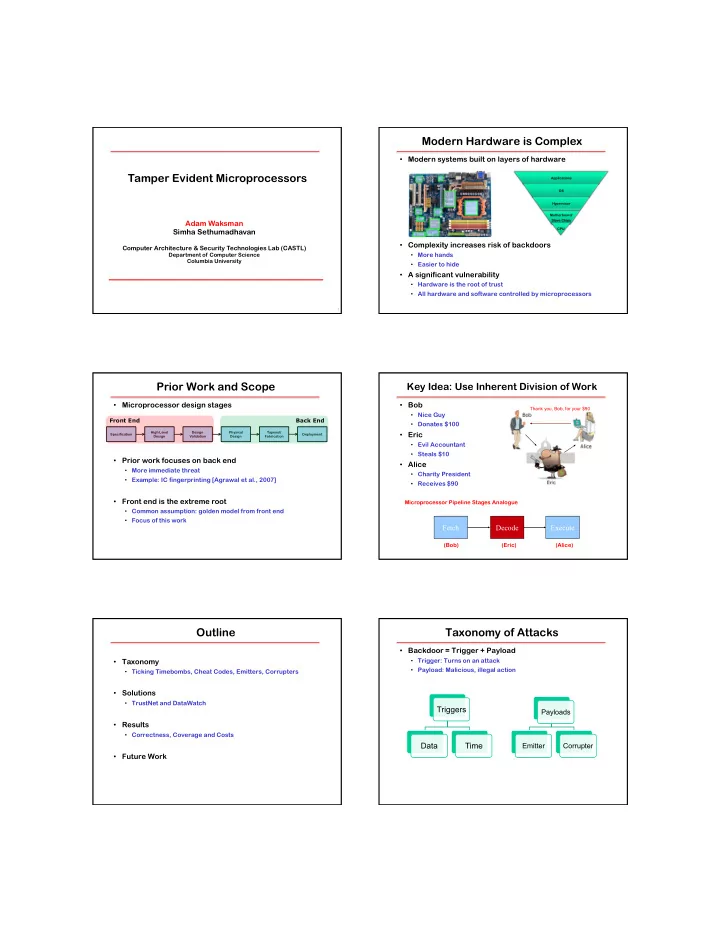
Modern Hardware is Complex

  • Modern systems built on layers of hardware
  • Complexity increases risk of backdoors
  • More hands
  • Easier to hide
  • A significant vulnerability
  • Hardware is the root of trust
  • All hardware and software controlled by microprocessors

Applications OS Hypervisor Motherboard/ Slave Chips CPU

Prior Work and Scope

  • Microprocessor design stages
  • Prior work focuses on back end
  • More immediate threat
  • Example: IC fingerprinting [Agrawal et al., 2007]
  • Front end is the extreme root
  • Common assumption: golden model from front end
  • Focus of this work

High Level Design Specification Design Validation Physical Design Tapeout/ Fabrication Deployment

Back End Front End

Key Idea: Use Inherent Division of Work

  • Bob
  • Nice Guy
  • Donates $100
  • Eric
  • Evil Accountant
  • Steals $10
  • Alice
  • Charity President
  • Receives $90

Thank you, Bob, for your $90

Fetch Decode Execute

Microprocessor Pipeline Stages Analogue (Bob) (Eric) (Alice)

Outline

  • Taxonomy
  • Ticking Timebombs, Cheat Codes, Emitters, Corrupters
  • Solutions
  • TrustNet and DataWatch
  • Results
  • Correctness, Coverage and Costs
  • Future Work

Taxonomy of Attacks

  • Backdoor = Trigger + Payload
  • Trigger: Turns on an attack
  • Payload: Malicious, illegal action

Triggers Data Time

Payloads Emitter Corrupter

slide-2
SLIDE 2

5/24/10 2

Taxonomy of Attacks: Triggers

Triggers Data Time

Taxonomy of Attacks: Payloads

  • Emitter Attacks
  • Extra malicious events
  • Separate from normal events

Payloads Emitter Corrupter

  • Corrupter Attacks
  • No extra malicious events
  • Normal instructions altered

Taxonomy of Attacks: Summary

Emitter Timebomb Corrupter Timebomb Emitter Cheatcode Corrupter Cheatcode

Assumptions

  • Large design team
  • Each designer works on one unit or part of one
  • Security add-ons cannot be done by one member
  • Full knowledge
  • Attacker has complete access to all design specifications
  • Attacker also knows about additional security mechanism
  • Equal distrust
  • Any one designer/unit may be evil
  • Security add-ons may contain backdoors

Outline

  • Taxonomy
  • Ticking Timebombs, Cheat Codes, Emitters, Corrupters
  • Solutions
  • TrustNet and DataWatch
  • Results
  • Correctness, Coverage and Costs
  • Future Work

Sample Emitter Backdoor

  • Consider a malicious instruction decoder
  • Decoder emits instructions not in the original program
  • Execution unit faithfully executes them

Fetch Fetch Fetch Decode Execute

Spurious Output

slide-3
SLIDE 3

5/24/10 3

TrustNet

  • Predictor and Reactor monitor the Target
  • Division of work prevents one bad guy from breaking two units
  • Scaling to larger number increases design complexity

Predictor Reactor Target

add $r1, $r2, $r3

Fetch Decode Execute

Corrupter Backdoors

  • Bob
  • Still nice
  • Donates $100
  • Eric
  • Evil (and smarter)
  • Converts to Canadian $
  • Alice
  • Still president
  • Fooled by Eric’s C$100

Thank you, Bob, for your C$100

DataWatch

  • Scaled up version of TrustNet
  • Multiple bit messages
  • Confirms types of messages (instead of just yes/no)

Predictor Reactor Target

add $r1, $r2, $r3

Fetch Decode Execute

SUB $r1, $r2, $r3 STOP

Outline

  • Taxonomy
  • Ticking Timebombs, Cheat Codes, Emitters, Corrupters
  • Solutions
  • TrustNet and DataWatch
  • Results
  • Correctness, Coverage and Costs
  • Future Work

Experimental Context, Correctness, Costs

  • Context
  • Simplified OpenSPARC T2
  • Correctness
  • Designed attacks
  • No false positives or negatives
  • Costs
  • Low area overhead (2 KB per core)
  • No performance impact
  • How to measure coverage?

18

Units with a core Units with a core Paper has plots for other units at a chip level

Coverage: Vulnerability Space

slide-4
SLIDE 4

5/24/10 4

19

Coverage Visualization

WARNING: This is an approximate vizualization

19

Summary and Future Work

  • Strengthen root of trust: microprocessors
  • Hardware-only solution. No perf impact, low area overhead
  • Security add-on highly resilient to corruption
  • Provided attack taxonomy, method to characterize attack space
  • Applicability of TrustNet & DataWatch
  • Covered: pipelines, caches and content associative memory
  • Not covered: ALU, microcode, power mgmt., side-channels
  • Moving Forward
  • Expand coverage
  • Out-of-order processors
  • Motherboard components
  • Design automation tools
  • Reaction to errors
  • Applying techniques for reliable execution
  • First steps toward a secure trusted hardware w/ untrusted units

Thank You! and Questions?