5/22/2018 Breastfeeding the NICU patient Susan McLaughlin, RN, - - PDF document

5 22 2018
SMART_READER_LITE
LIVE PREVIEW

5/22/2018 Breastfeeding the NICU patient Susan McLaughlin, RN, - - PDF document

5/22/2018 Breastfeeding the NICU patient Susan McLaughlin, RN, MPH, IBCLC Maternal Role Attainment Ramona Mercer Commitment and Preparation of pregnancy- anticipatory stage Acquaintance, practice and physical restoration first 2


slide-1
SLIDE 1

5/22/2018 1

Breastfeeding the NICU patient

Susan McLaughlin, RN, MPH, IBCLC

Maternal Role Attainment

Ramona Mercer

  • Commitment and Preparation of pregnancy- anticipatory

stage

  • Acquaintance, practice and physical restoration – first 2

weeks

  • Approaching normalization 2 weeks to 4 months
  • Integration of maternal identity- 4 months and beyond

2

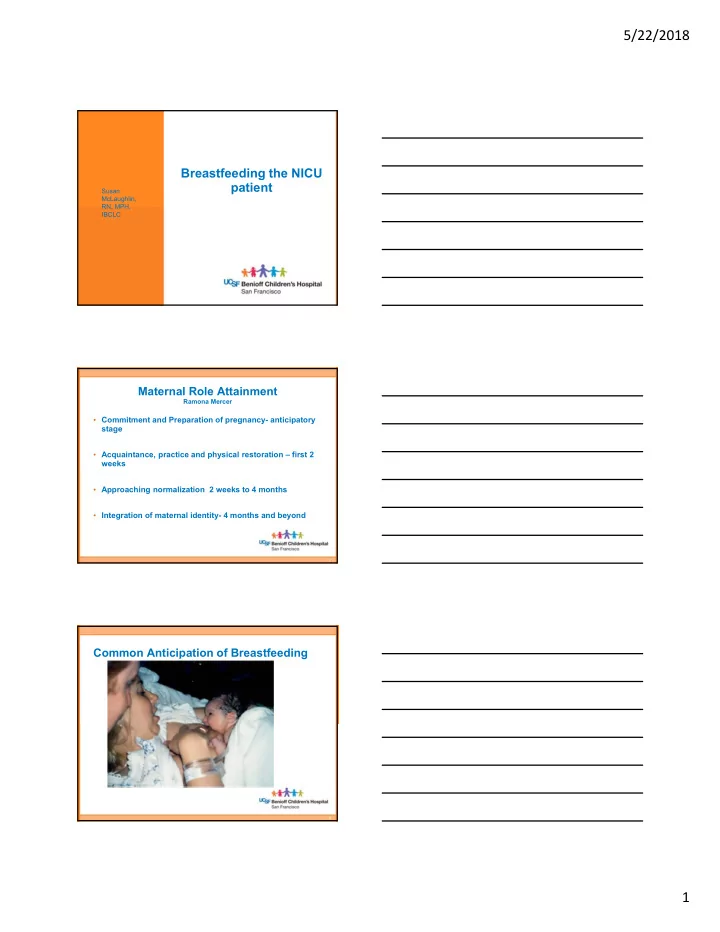
Common Anticipation of Breastfeeding

3

slide-2
SLIDE 2

5/22/2018 2

Breastfeeding in the ICN

4 5

Nursing Care in the ICN is Based on: Ten Steps to Breastfeeding Vulnerable Infants

  • Informed decision

– Educating parents on the risks of not breastfeeding

  • Establishment and maintenance of milk supply

– Pump every 2-3 hours (8-10x day), – Daily assessment of milk supply

  • Breastmilk management

– Storing, handling, not wasting

  • Feeding of breastmilk

– Priority : (1) Colostrum (2) Fresh (3) Frozen (4)Donor – Trophic feeds: bolus vs. continuous to maintain important fats

  • Skin-to-skin care
  • Non-nutritive sucking at the breast
  • Assessment of milk transfer
  • Preparation for discharge
  • Appropriate follow-up

Review of Human Breastmilk for a Vulnerable Human Baby

Digests easier and more fully = Decrease NEC Risk

  • Human milk proteins are more completely broken down and absorbed

– Contains lipase to help digest important fats more efficiently. – Protective immune properties for the gut.

  • Decreases infection risk

– Live anti-infective and anti-inflammatory agents are available in fresh milk, even more in colostrum.

  • Human-specific: types of fatty acids, hormones, enzymes and growth

factors – Facilitates Vision decreased ROP Risk – Enhances CNS maturation

6

slide-3
SLIDE 3

5/22/2018 3

7

ICN Factors Associated With Challenges for Breastfeeding

  • Unable to make enough

breast milk/ worry about milk supply.

  • Maternal-infant separation
  • Maternity leave is used up

while baby in hospital

  • ICN stress
  • Lack of privacy in the ICN
  • Baby may not be able to

breastfeed

– At All – Partially – Well – Exclusively

Hand Expression

8

  • Although for many moms (and nurses), hand expression

feels awkward at first, do teach all moms the technique.

  • Milk is not in the nipple, milk just comes through the
  • nipple. Nipple is not the target of hand expression, milk

is.

  • Encourage hand expression of colostrum, many mothers

will find it more productive than a pump in early days. Both can be used.

How to help a mother do hand expression

  • http://med.stanford.edu/newborns/professional-

education/breastfeeding/hand-expressing-milk.html

9

slide-4
SLIDE 4

5/22/2018 4

Kangaroo Care: Makes More Milk

10

Early Oral Exposure to Breastmilk

11

  • Drops of milk into

baby’s mouth to:

– Awaken baby’s senses: taste, smell, tactile – Provide nutrition – Promote normal flora – Provides GI tract w/sIgA and antibodies – Helps you teach manual expression – Mom-baby response and relationship

Oral Care: Involve parents whenever possible

12

slide-5
SLIDE 5

5/22/2018 5

Premature Infant Olfactory System

13

  • When infants are

provided with mom’s smell before a feeding:

– Longer sucking bursts – More milk consumed

Raimbault C, Saliba E, Porter RH (2007) The effect of the odour of mother’s milk on breastfeeding behaviour of premature neonates. Acta Paediatr 96: 368–371.

Early Oral Feedings

14

  • There are many benefits

to starting oral feedings at the breast before bottles

  • Flow at the breast is

responsive, the bottle flow is not

  • Improved sO2, HR, RR,

and temp compared to bottle feeding

NON NUTRITIVE BREASTFEEDING

  • https://www.youtube.com/watch?v=AwLeSQ7mwdo&t=1s

15

slide-6
SLIDE 6

5/22/2018 6

Non-Nutritive Breastfeeding

16

  • Nurses observe when the

baby is ready

  • MD/NNP order is

required to initiate

  • Feeding starts on a “dry”

breast, after pumping

  • Non-nutritive allows

practice for baby and mom without flow

  • Move to nutritive feeds

requires an order.

17

First Nutritive Breastfeeding

18

  • An order is required
  • Supplement full, half or

none of normal feed volume

  • Frequency as tolerated

(and the mother available)

  • When possible delay

bottles until full feedings at breast & weight gain, if feasible

slide-7
SLIDE 7

5/22/2018 7

Nipples Shields

19

  • Useful for some situations

– Premature infants

  • One study with premature

infants showed double the intake with a shield

  • Temporary use- usually

about a month

– Flat nipples – Inverted nipples

Breastfeeding Assessment

20

  • LATCH Score is based on degree of effectiveness

0= Inability / full assistance needed 1= Somewhat challenging /In need of some assistance 2= Effective/ can perform without assistance

– L- Latch – A- Audible Swallows – T- Type Nipple – C- Comfort for Mom – H- Holding Baby Independently

Breastfeeding Quality Scale

  • Used to gauge amount of supplement needed on a

sliding scale format

  • Quality Ranges from:

– Excellent (no supplement) – Good (0%- 50% supplement) – Fair (50% supplement to 100% supplement) – Attempted (100% supplement) – Poor (100% supplement) – No Feed (100% supplement)

21

slide-8
SLIDE 8

5/22/2018 8

Supplement Decisions

22

  • If baby breastfed, how well did he do?
  • Base decision on:

– Active feeding (with swallows) time – Breast softer? (may not apply for small volume) – Baby’s behavior – Baby’s clinical appearance – Swallowing – NOT on residual in NG-milk gets digested quickly

  • Watch baby, mother is involved in the decision

Use of Breast Compression During a Feeding

23

  • Breast compression will increase milk transfer. This can
  • verwhelm a baby, or can be a helpful when help with

transfer is needed. With care this can show parents what swallowing is supposed to look/ sound/ feel like.

  • It is also an effective way to give baby an oral stimulus

for an oral response.

– Creating a mouth full of milk to initiate the need to swallow, rather than tapping on baby’s face or feet.

Use of Breast Compression

continued

24

  • The use of hand “compression and hold” (as tolerated)

while baby is suckling can help encourage a sleepy, fatigued or distracted baby to continue feeding.

  • Follow baby’s lead: Sucking burst, then compress and
  • hold. When baby pauses to breathe and rest, mom to

relax compression. Suck, compress and hold, relax.

slide-9
SLIDE 9

5/22/2018 9

Alternative Supplementation Methods: Bottles

25

Bottle feeding: there is no one best bottle nipple for breastfeeding…. Get more info from lactation professionals

Alternative Supplementation Methods: Syringe Feeding

  • Use Enteral Syringes

for small volume supplement

26

Supplementing with SNS

27

slide-10
SLIDE 10

5/22/2018 10

Starter Supplemental Nursing System (SNS)

28

  • Drip chamber with

valve

– Valve drains towards baby

  • Clamp for turning

flow off and on

  • Clamp for holding

to clothing(not shown)

Issues Affecting Feeding

29 30

Some Infant Conditions that Impact Feedings at Breast

  • Prematurity
  • Respiratory Distress
  • Cardiac defects
  • Surgical Conditions

– TEF (Tracheal-Esophageal Fistula) – Abdominal Surgery – CDH (Congen Diaphragmatic Hernia) – Gastroschisis – NEC (Necrotizing Enterocolitis)

  • Neurological insult
  • Medications
  • Cleft lip/palate
  • Pierre Robin
  • Small jaw or tongue
  • Tongue-tie
  • Clavicle fracture
  • Torticollis
  • In-utero position
slide-11
SLIDE 11

5/22/2018 11

More Feeding Challenges for a Vulnerable Baby

31

  • Tubes in the way of searching for the nipple. May not have

energy to search. To push a bottle nipple into baby’s mouth doesn’t allow baby’s natural cues for feeding readiness.

  • Grasping and keeping the nipple deeply in the mouth requires

fat cheek pads for stability.

  • Creating and maintaining a seal requires toned lips.
  • Coordination is required between the GI, Respiratory and CNS

that our OT team is awesome at assessing for.

  • Last, but not least, is a good position and latch between baby

and mother.

Positions

32

Upright Football

Positions

33

Cross Cradle Cradle Side-Lying Football

slide-12
SLIDE 12

5/22/2018 12

Positions

34

Laid Back Cradle

Baby’s condition influences positioning

35

Baby with cast on pelvis

Latching Tips

  • Allow baby to participate
  • Align baby for the widest latch
  • Assess after latched
  • Adjust during feeding as needed

36

slide-13
SLIDE 13

5/22/2018 13

Unwrap Babies’ Feeding Instincts

37

  • Babies use their hands, mouths, cheeks, chin,

lips, tongue and body to search for the nipple. Unwrap baby.

  • The process of searching before latch increases

mom’s oxytocin, therefore the potential for release of milk.

  • Allowing babies to search catalyzes the

parasympathetic nervous system =Rest and Digest.

Supporting Baby’s Body

38

Tips:

  • Baby’s ear-shoulder-hip in alignment
  • Baby’s spine and shoulder girdle should be well

supported between mom’s body and her entire arm

  • Cross cradle/cradle: tuck baby under mom’s opposite

breast

  • Football hold: baby’s belly against mom’s lateral rib cage

Assess Once Latched

continued

39

Hear: Swallows may sound like- “G” or “Kah” or “puh” sound Colostrum= 5 to 9 sucks:1 swallow Milk= 1 to 3 sucks:1 swallow Mom should feel a pull rather than a pinch If the nipples are injured, a sting will also be felt.

slide-14
SLIDE 14

5/22/2018 14

40

Multiples may be fed at same time, once each are feeding well. Digital Suck Assessment

41

  • Using your gloved finger, pad side up, tickle nose to top

lip.

  • Wait for root and opened mouth.
  • Drop finger on tongue.
  • Allow baby to suck finger back to as near the hard-soft

palate junction as baby will allow.

Digital Suck Assessment: What you might feel…

42

You may feel:

  • good cupping and suction of your finger
  • tongue thrusting
  • tongue against palate
  • higher than normal hard palate
  • super-sensitive gag reflex
slide-15
SLIDE 15

5/22/2018 15

Transporting Frozen Milk

43

  • Small insulated bag for few

bottles, with blue ice pack

  • Place milk together, using

commercial freezer packs instead of ice

– Water freezes at a warmer temperature than milk, so will thaw milk sooner

  • Pack to eliminate air

– Use blankets, crumpled paper, plastic bags

Breastfeeding Support in the Community

44

  • LC Clinic visit
  • Private LC’s
  • WIC
  • Family
  • Mothers’ groups
  • Baby centers
  • La Leche League
  • OB for breast problems
  • Pediatrician for baby

problems