5/2/16 Insect Mouthparts Insects with Chewing Mouthparts Japanese - - PDF document

5 2 16
SMART_READER_LITE
LIVE PREVIEW

5/2/16 Insect Mouthparts Insects with Chewing Mouthparts Japanese - - PDF document

5/2/16 2016 Plant Insect Update Insect CSI: Identifying the Culprit and Other Common Insects PJ Liesch UW-Madison Insect Diagnostic Lab pliesch@wisc.edu @WiBugGuy labs.russell.wisc.edu/insectlab/ University of WisconsinMadison University


slide-1
SLIDE 1

5/2/16 1

University of Wisconsin–Madison Insect Diagnostic Lab

2016 Plant Insect Update

and Other Common Insects

PJ Liesch UW-Madison Insect Diagnostic Lab pliesch@wisc.edu @WiBugGuy labs.russell.wisc.edu/insectlab/

University of Wisconsin–Madison Insect Diagnostic Lab

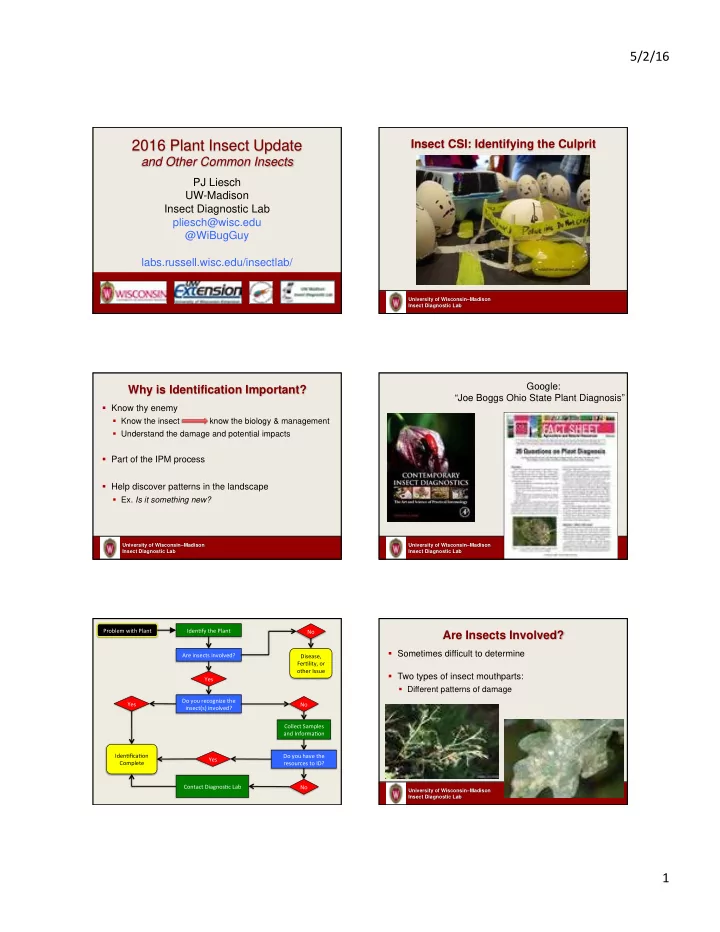
Insect CSI: Identifying the Culprit

University of Wisconsin–Madison Insect Diagnostic Lab

Why is Identification Important?

§ Know thy enemy

§ Know the insect know the biology & management § Understand the damage and potential impacts

§ Part of the IPM process § Help discover patterns in the landscape

§ Ex. Is it something new?

University of Wisconsin–Madison Insect Diagnostic Lab

Google: “Joe Boggs Ohio State Plant Diagnosis”

Problem with Plant Iden6fy the Plant Are insects involved? No Disease, Fer6lity, or

  • ther Issue

Yes Do you recognize the insect(s) involved? Yes No Iden6fica6on Complete Collect Samples and Informa6on Do you have the resources to ID? Yes No Contact Diagnos6c Lab

University of Wisconsin–Madison Insect Diagnostic Lab

Are Insects Involved?

§ Sometimes difficult to determine § Two types of insect mouthparts:

§ Different patterns of damage

slide-2
SLIDE 2

5/2/16 2

University of Wisconsin–Madison Insect Diagnostic Lab

Insect Mouthparts

University of Wisconsin–Madison Insect Diagnostic Lab

Insects with Chewing Mouthparts

Japanese Beetle Imported Willow Leaf Beetle Gypsy Moth Eastern Tent Caterpillar Rose Slug Sawfly University of Wisconsin–Madison Insect Diagnostic Lab

Tatters

University of Wisconsin–Madison Insect Diagnostic Lab

“Hard-to-Find” Cases: Borers

Bronze Birch Borer Two Lined Chestnut Borer Emerald Ash Borer

University of Wisconsin–Madison Insect Diagnostic Lab

Insects with Sucking Mouthparts

Honeylocust Plant Bug Lace Bugs Four Lined Plant Bugs Aphids

University of Wisconsin–Madison Insect Diagnostic Lab

“Hard-to-Understand” Cases: Galls

slide-3
SLIDE 3

5/2/16 3

University of Wisconsin–Madison Insect Diagnostic Lab

Diseases and other Disorders

University of Wisconsin–Madison Insect Diagnostic Lab

Collecting Samples

§ Physical samples

§ Insects § Plant materials

§ Digital Samples

§ Images

§ Other clues

§ Plant species/cultivar, site conditions, site history, etc. § Record in notebook / on data form

University of Wisconsin–Madison Insect Diagnostic Lab

How to Properly Collect Physical Samples

§ Collect multiple specimens (if possible) § Hard-bodied insects

§ Place into small container w/padding

§ Soft-bodied insects

§ Place into container with alcohol § 60-70% ethanol (ideal) § Hand sanitizer, rubbing alcohol (ok)

§ Identify as soon as possible

University of Wisconsin–Madison Insect Diagnostic Lab

Things You Shouldn’t Do:

§ Place several types of live insects per container § Place soft-bodied insects into vials w/o alcohol § Place onto tape § If mailing: place directly into envelope

University of Wisconsin–Madison Insect Diagnostic Lab

Submitting Samples

labs.russell.wisc.edu/insectlab/ Digital Samples: pliesch@wisc.edu Physical Samples: See website

University of Wisconsin–Madison Insect Diagnostic Lab

Unless requested to directly contact the client, I will respond to submitter:

  • UWEX office/agent
  • Hort Help Desk
  • Response is

typically a phone call/email; can create written letter if requested

slide-4
SLIDE 4

5/2/16 4

University of Wisconsin–Madison Insect Diagnostic Lab

Digital Samples

§ Use best photography equipment available § Use as much magnification as possible § Take several photographs

§ Different angles, magnification, upper & lower surfaces § Include a size reference (if possible) § Take one of entire plant & surrounding area

University of Wisconsin–Madison Insect Diagnostic Lab

Other Clues: Get a glimpse of the “bigger picture”

University of Wisconsin–Madison Insect Diagnostic Lab

Clues to Keep an Eye Out For:

§ Size of the insects § Time of the year § Location in/on plant § Fine details of damage (frass)

University of Wisconsin–Madison Insect Diagnostic Lab

What’s in Store for 2016?

University of Wisconsin–Madison Insect Diagnostic Lab

Medically Important Arthropods

University of Wisconsin–Madison Insect Diagnostic Lab

Mosquitoes

§ Populations depend on weather; precipitation

§ 2016???

§ High numbers in 2015 in June/July in some areas § Zika Virus???

slide-5
SLIDE 5

5/2/16 5

University of Wisconsin–Madison Insect Diagnostic Lab

labs.russell.wisc.edu/wisconsin-ticks/

Ticks in Wisconsin

University of Wisconsin–Madison Insect Diagnostic Lab

Tickencounter.org

Great Info on:

  • Tick ID
  • Tick Testing
  • Etc.

University of Wisconsin–Madison Insect Diagnostic Lab University of Wisconsin–Madison Insect Diagnostic Lab

Bird Mites

University of Wisconsin–Madison Insect Diagnostic Lab University of Wisconsin–Madison Insect Diagnostic Lab

Indoor Insects

slide-6
SLIDE 6

5/2/16 6

University of Wisconsin–Madison Insect Diagnostic Lab

Management of Indoor Insects

  • 1. Identify first, act second
  • 2. The vacuum is your friend
  • 3. (Bug) Bombs are not the answer*
  • 4. Discretely-placed glue boards come in handy
  • 5. Keep a plant-free buffer zone around your home
  • 6. Fill in the gaps (caulk + expanding foam)
  • 7. Know thy ant species
  • 8. Detective work pays off
  • 9. One word: Tupperware
  • 10. Use your freezer to kill pests

University of Wisconsin–Madison Insect Diagnostic Lab

Ants

  • Identifying species can be important step
  • Locating nest (if possible)
  • Not all baits are created equal!

University of Wisconsin–Madison Insect Diagnostic Lab

Household Pests

§ Box Elder Bugs (down in ‘14 & ‘15); influenced by rain § Multicolored Asian lady Beetles

University of Wisconsin–Madison Insect Diagnostic Lab

Foreign Grain Beetle

  • Common in August & September
  • Associated with new homes

University of Wisconsin–Madison Insect Diagnostic Lab

Masked hunter Bugs

§ Type of assassin bug § Feed on small insects indoors § Juveniles (nymphs) camouflage themselves with bits of lint, debris

University of Wisconsin–Madison Insect Diagnostic Lab

Bed Bugs vs Bat Bugs

§ ID critical for management!

Bat Bug Bed Bug

slide-7
SLIDE 7

5/2/16 7

University of Wisconsin–Madison Insect Diagnostic Lab

§ Exotic, invasive insect from Asia § Introduced to US in mid 1990’s § Can attack agricultural crops, vegetables, fruit, ornamentals § Can be a structural nuisance

§ Gets into attics and crawl spaces

Brown Marmorated Stink Bug

University of Wisconsin–Madison Insect Diagnostic Lab

Brown Marmorated Stink Bug

University of Wisconsin–Madison Insect Diagnostic Lab

Brown Marmorated Stink Bugs

§ First WI Find: 2010 § 2015: 30+ cases § 2016: 25+ cases

University of Wisconsin–Madison Insect Diagnostic Lab University of Wisconsin–Madison Insect Diagnostic Lab

Outdoor Insects

University of Wisconsin–Madison Insect Diagnostic Lab

Japanese Beetles

  • History:
  • Tend to be problematic in a

given spot for 5-10 years

  • 2014
  • Low numbers
  • Few reports of significant

damage

  • Weather?
  • 2015: lowish numbers
  • 2016: Increased numbers???
slide-8
SLIDE 8

5/2/16 8

University of Wisconsin–Madison Insect Diagnostic Lab

Spotted Wing Drosophila

§ Invasive pest of fruits, from Asia § Found in WI: 2010

University of Wisconsin–Madison Insect Diagnostic Lab

SWD on Home Fruit

§ A number of home fruits can be attacked

University of Wisconsin–Madison Insect Diagnostic Lab

SWD Cases in WI: 2015

= Confirmed (42) = Suspected (7)

University of Wisconsin–Madison Insect Diagnostic Lab

Emerald Ash Borer

§ Exotic, Invasive Species from China

§ 2008: found in WI

§ Larvae kill ash trees by feeding on vascular tissues beneath the bark § Trees die within 1-5+ years depending on population density

Photo Credit: David Cappaert, Michigan State University, Bugwood.org

University of Wisconsin–Madison Insect Diagnostic Lab

Price Clark Dane Polk Vilas Grant Iron Bayfield Rusk Sawyer Oneida Marathon Sauk Forest Taylor Douglas Iowa Dunn Marinette Rock Oconto Wood Dodge Barron Lincoln Burnett Jackson Ashland Monroe Vernon Juneau Portage Chippewa Buffalo Adams Shawano Langlade Door Green Pierce
  • St. Croix
Washburn Brown Columbia Waupaca Lafayette Richland Crawford Jefferson Waushara Walworth Eau Claire Fond du Lac Outagamie Florence Manitowoc Waukesha Winnebago Racine Calumet La Crosse Marquette Sheboygan Pepin Kenosha Menominee Trempealeau Washington Kewaunee Green Lake Ozaukee Milwaukee

Quarantined County

EAB: Quarantine early 2014

Map Credit: WI-DATCP

EAB: Quarantine late 2014

University of Wisconsin–Madison Insect Diagnostic Lab

EAB: Quarantine late 2015

Map Credit: WI-DATCP

EAB: Quarantine early 2016

slide-9
SLIDE 9

5/2/16 9

University of Wisconsin–Madison Insect Diagnostic Lab

Gypsy Moth

  • ‘14 & ‘15: Quiet years
  • Cool, damp conditions favored

diseases

  • Few reports: Dane, Rock,

Walworth counties

  • 2016: Expecting low numbers

University of Wisconsin–Madison Insect Diagnostic Lab

Historical GM Pattern in WI

24,000 65,000 20 22,994 8,659 3,620 347,000 14,500 12,242 85

50,000 100,000 150,000 200,000 250,000 300,000 350,000 400,000 2002 2003 2004 2005 2006 2007 2008 2009 2010 2011 2012 2013 2014 2015

Gypsy Moth Defolia0on in WI 2002 - 2015 Acres Defoliated

University of Wisconsin–Madison Insect Diagnostic Lab

Invasive Leaf Beetles:

Lily Leaf Beetle & Viburnum Leaf Beetle

§ Both of European Origin

§ Arrived in Canada: 1940’s § Arrived in NE US: 1990’s

University of Wisconsin–Madison Insect Diagnostic Lab

Lily Leaf Beetle in WI

University of Wisconsin–Madison Insect Diagnostic Lab

Viburnum Leaf Beetle in WI

University of Wisconsin–Madison Insect Diagnostic Lab

Minute Pirate Bugs

  • Notable Activity in October
  • Indian Summer
slide-10
SLIDE 10

5/2/16 10

University of Wisconsin–Madison Insect Diagnostic Lab

§ Aphids and Scale Insects: § Can secrete honeydew

§ “Raining” phenomenon

Sucking Insects

University of Wisconsin–Madison Insect Diagnostic Lab

Honeydew and. . .

University of Wisconsin–Madison Insect Diagnostic Lab

Wasps and Yellowjackets

University of Wisconsin–Madison Insect Diagnostic Lab

Pollinators

§ Many pollinators facing decline due to a variety of factors

§ Habitat loss & fragmentation § Diseases, parasites, viruses § Agricultural practices § Pesticides

University of Wisconsin–Madison Insect Diagnostic Lab

What Can We Do?

§ Use insecticides only when appropriate

§ Explicitly follow allow label directions

§ Make your yard and landscape pollinator friendly

§ Diversity of flowers = diversity of insects § Seasonal blooming patterns

§ Provide nesting habitat

§ Google “Bee Hotel”

§ Educate yourself

University of Wisconsin–Madison Insect Diagnostic Lab

Resources

hort.uwex.edu