5/11/2011 Two Key Questions Is a patent (claim) valid? Does - - PDF document

5 11 2011
SMART_READER_LITE
LIVE PREVIEW

5/11/2011 Two Key Questions Is a patent (claim) valid? Does - - PDF document

5/11/2011 Two Key Questions Is a patent (claim) valid? Does technology X infringe a particular claim? Substantial overlap between these questions: the test for validity and infringement both start with claim Patent Analysis and


slide-1
SLIDE 1

5/11/2011 1

Patent Analysis and Application

160

Two Key Questions

  • Is a patent (claim) valid?
  • Does technology X infringe a particular claim?

– Substantial overlap between these questions: the test for validity and infringement both start with claim construction

  • Infringement: interpret the claims, apply the claims

to the target

  • Validity: interpret the claims, apply the claims to the

prior art

161

The Tension

  • Patent holders always urge a broad interpretation of

their claims in order to ensnare more infringers

– The Risk: If the patent holder goes too broad, they also risk ensnaring prior art, invalidating the claim

  • Would-be infringers generally urge a narrow

interpretation of claims in order to escape infringement

– The Risk: If the claims are narrowly construed, they are more likely to be valid

162

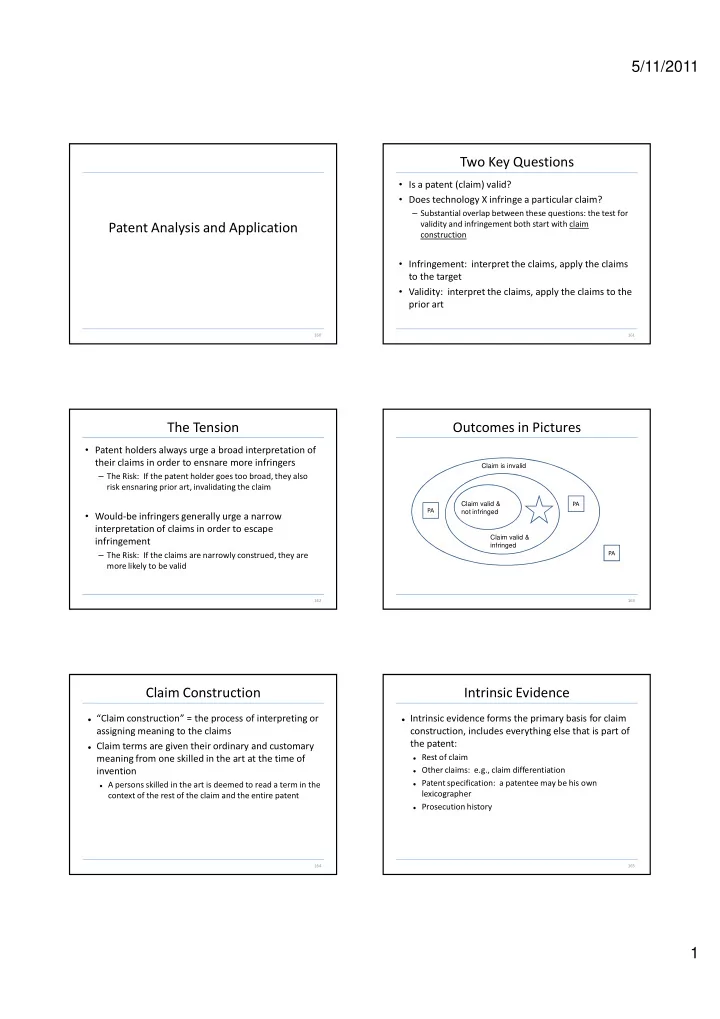
Outcomes in Pictures

163

PA PA PA Claim is invalid Claim valid & infringed Claim valid & not infringed

Claim Construction

“Claim construction” = the process of interpreting or

assigning meaning to the claims

Claim terms are given their ordinary and customary

meaning from one skilled in the art at the time of invention

A persons skilled in the art is deemed to read a term in the

context of the rest of the claim and the entire patent

164

Intrinsic Evidence

Intrinsic evidence forms the primary basis for claim

construction, includes everything else that is part of the patent:

Rest of claim Other claims: e.g., claim differentiation Patent specification: a patentee may be his own

lexicographer

Prosecution history 165

slide-2
SLIDE 2

5/11/2011 2

Claim Differentiation

  • 1. An apparatus comprising: … a memory …
  • 2. The apparatus of claim 1 wherein the memory is a

fixed disk drive.

  • Claim 1 is by definition broader than claim 2, thus

“memory” includes fixed disks and other storage devices.

166

Claim Differentiation

  • 1. A method of packing a lunch, comprising:

selecting a fruit; making a sandwich; and packing the fruit and sandwich in a container.

  • 2. The method of claim 1 wherein selecting the fruit

includes picking a fruit from a tree.

167

Prosecution History

Statements made during prosecution can and will be

used during claim construction

Estoppel: The patentee cannot urge one

interpretation (usually a narrow one) to obtain a patent, and then urge another interpretation (usually a broad one) during enforcement

Example: “the term ‘mobile device’ does not include

laptop computer”

Patentee cannot later claim that “mobile device” includes

laptops…

168

Extrinsic Evidence

Less significant than intrinsic evidence Dictionaries Treatises Expert testimony 169

Infringement Analysis

  • Interpret claims
  • Read claims in light of technology
  • If a parent claim is not infringed, then by definition

its dependent claims cannot be infringed

– If the independent claim is not infringed, then none of its children are

  • Infringement must be shown by a preponderance of

the evidence

170

Different Types of Infringement

  • Literal infringement

– Accused device literally performs/includes each and every aspect of the claim

  • Non-literal infringement (Doctrine of Equivalents) –

may still infringe if there are “insubstantial differences”

– Differences are insubstantial if the accused device performs substantially the same function, in substantially the same way, to achieve substantially the same result

171

slide-3
SLIDE 3

5/11/2011 3

Direct/Indirect

  • Direct infringement

– E.g., Accused performs each step of the a method

  • Indirect infringement

– Contributory infringement: selling an article that does not by itself infringe, but (1) infringes in combination with

  • ther parts, (2) accused knows article to be especially

adapted for infringement, and (3) is not a staple article of commerce having substantial non-infringing uses – Induced infringement: knowingly causing direct infringement by another

  • “Joint infringement”

– Cannot occur without control by one party

172

Basis for invalidity

Bases for invalidity, in decreasing order of value… Anticipation with “killer” 102(b) prior art – a single

reference teaches all of the claim limitations

Anticipation with other prior art Obviousness using 102(b) prior art – multiple combined

references teach all of the claim limitations

Obviousness with other prior art Subject matter – the claims are not directed to patentable

subject matter

Indefiniteness – we cannot ascertain the boundaries of the

claim

173

Prior Art Invalidity Analysis

  • Interpret claims
  • Read claims in light of one or more prior art

references

  • If a parent claim is not valid, its dependent claim may

still be valid (because they are narrower)

  • Invalidity must be shown by clear and convincing

evidence

174

Invalidity: A process

Process: Interpret claims (read patent, file history, etc.) Determine effective filing date of claimed subject matter:

wade through priority chain

Determine the “critical date” = one year before effective

filing date

Search for prior art Read claims on the prior art 175

Invalidity: Claim charts

Claim Aspect Citation

  • 1. A computer-implemented method for

sorting data, comprising: Ref X, p. 1 receiving an indication of an array of values; Ref X, p. 2 partitioning the array; Ref X, p. 2 recursively sorting the array. Ref X, p. 2

  • 2. The method of claim 1, further

comprising: iteratively sorting the array when it is shorter than a specified size. Ref Y. p. 7

176

Legal Opinions

  • When you placed “on notice,” you may be liable for

treble damages due to “willfull infringement”

  • To protect against this, parties frequently obtain legal
  • pinions stating that:

– The patent claims are not infringed, and/or – The patent claims are invalid (and thus cannot be infringed)

  • If the claims are valid and infringed, no choice but to

take a license or design around

177